On 5 August 2026, India marked the seventh anniversary of the abrogation of Article 370 and Article 35A. The constitutional changes effected on 5 August 2019 had ended the special status of the erstwhile state of Jammu and Kashmir and led to its reorganisation into the two Union Territories of Jammu and Kashmir and Ladakh.
Prime Minister Narendra Modi described the day as the beginning of “a decisive new chapter” in the journey of both regions. In a post on X, he said that since the changes, the lives of the people of Jammu and Kashmir and Ladakh had witnessed wide-ranging transformation. Infrastructure had expanded and opportunities in education, healthcare, entrepreneurship and sports had grown. Women and marginalised communities, who had earlier been denied basic constitutional rights, had been empowered through the full application of the Constitution of India.
The Prime Minister also linked the anniversary to the 125th birth anniversary of Dr Syama Prasad Mookerjee, noting that what Mookerjee had envisioned decades earlier found historic fulfilment on 5 August 2019. He reaffirmed the government’s commitment to the progress of the two Union Territories and to ensuring that every citizen could contribute to a developed India.
India’s Response to Pakistan
Pakistan observed 5 August as “Youm-e-Istehsal” (Day of Exploitation) and its leadership criticised India’s 2019 decision. Deputy Prime Minister and Foreign Minister Ishaq Dar described the constitutional changes as a grave challenge to the international framework and expressed solidarity with the people of the region.
India firmly rejected the Pakistani position. Ministry of External Affairs spokesperson Randhir Jaiswal stated that India categorically rejected the “political absurdity and futile attempts by Pakistan to observe the so-called Youm-e-Istehsal to spread malicious propaganda against India.” He underlined that the Union Territories of Jammu and Kashmir and Ladakh “are, have always been, and shall forever remain an integral and inalienable part of India.”
Jaiswal emphasised that the constitutional changes of 5 August 2019 were entirely an internal matter of India. These decisions, he said, had brought unprecedented socio-economic development, good governance and democratic empowerment to the people of the region. Pakistan, he added, had no locus standi to comment on matters strictly internal to India.
The MEA also pointed to the situation in Pakistan-occupied Jammu and Kashmir, accusing the Pakistani establishment of suppressing fundamental rights and of attempting to deflect international attention from its own human rights record and its status as a centre of terrorism. India called on Pakistan to end violence in PoJK, take credible action against terror networks, and vacate Indian territories under its occupation.
Domestic Political Reactions in Jammu and Kashmir
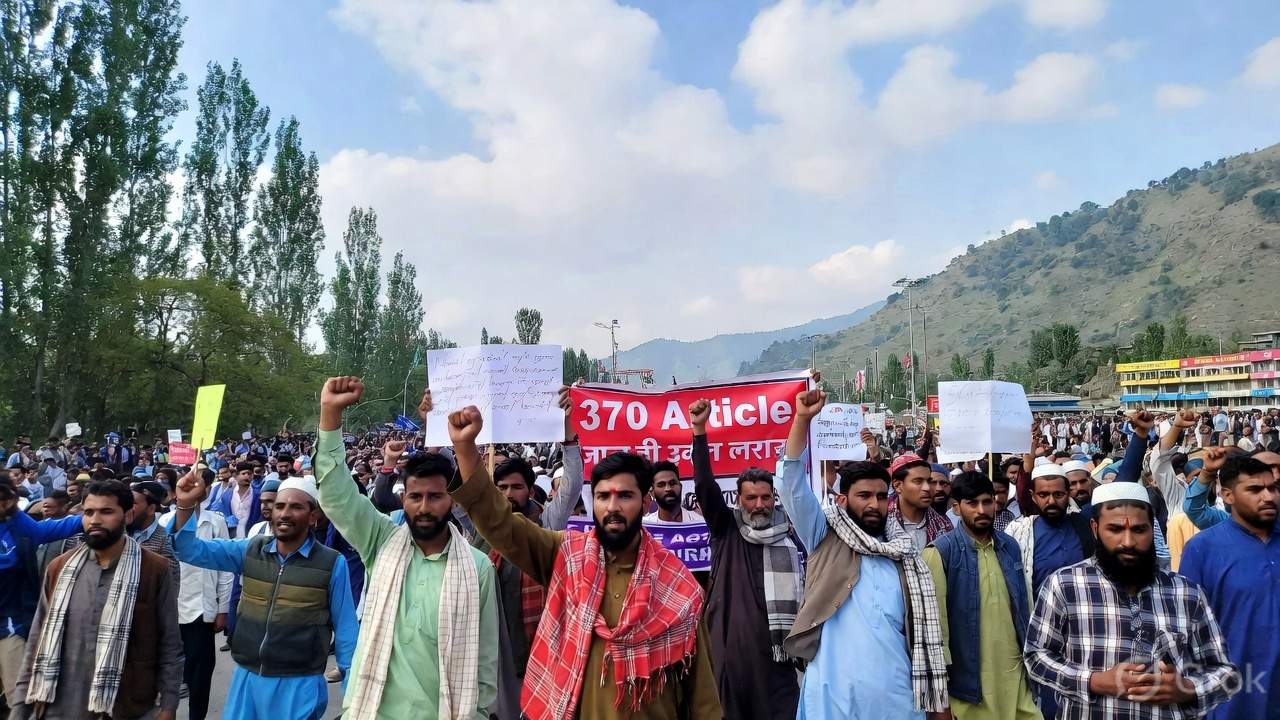
Within Jammu and Kashmir, the anniversary was marked by contrasting political positions. The National Conference and the Peoples Democratic Party organised protests and described 5 August as a “Black Day.” Chief Minister Omar Abdullah stated that seven years later his party had neither forgotten nor accepted the changes. Quoting Robert Frost, he spoke of promises still to be kept and reiterated the commitment to restoring the rights and dignity of the people of the region through lawful and peaceful means.
Other NC leaders echoed the sentiment that the emotions associated with the day remained strong and that the party’s resolve to reverse the dilution of the region’s special status and the reduction of the state into a Union Territory had only grown.
On the other side, Lieutenant Governor Manoj Sinha described 5 August 2019 as a historic turning point. He noted that the extension of a large number of Central laws had strengthened governance, transparency, accountability and equal opportunities across the Union Territory.
Constitutional and Political Background
Article 370 of the Indian Constitution had conferred a special status on Jammu and Kashmir, limiting the application of the Constitution and the powers of Parliament in relation to the state. Article 35A, introduced through a Presidential Order, empowered the state legislature to define permanent residents and grant them special rights and privileges. Both provisions were rendered inoperative on 5 August 2019 through a combination of a Presidential Order and a statutory resolution passed by Parliament, followed by the Jammu and Kashmir Reorganisation Act that created the two Union Territories.
The Supreme Court later upheld the constitutional validity of the changes. The government has maintained that the move integrated the region more fully with the rest of the country, extended fundamental rights and Central laws, and opened the path for greater development and investment.
Seven years later, the anniversary continues to generate political debate inside Jammu and Kashmir over the question of restoration of statehood, while the Central government points to improvements in security, infrastructure and the reach of welfare schemes.
International Dimension
Pakistan’s annual observance of Youm-e-Istehsal forms part of its long-standing diplomatic campaign on the Kashmir issue. India has consistently maintained that the issue is bilateral and that there is no scope for third-party involvement. The strong MEA response on the seventh anniversary reaffirmed this position and sought to shift the focus onto Pakistan’s internal situation in the territories under its control and its record on terrorism.
The exchange of statements on 5 August 2026 followed the familiar pattern seen on previous anniversaries, with India rejecting any external commentary on its internal constitutional arrangements.
Exam Relevance
UPSC GS Paper 2 (Polity and Governance)
- Constitutional history and abrogation of Article 370 and Article 35A
- Jammu and Kashmir Reorganisation Act, 2019
- Distinction between special status and the present Union Territory framework
- Role of Presidential Orders and parliamentary resolutions in constitutional change
GS Paper 2 (International Relations)
- India’s position on Kashmir as an internal matter
- Pakistan’s Youm-e-Istehsal campaign and India’s diplomatic response
- Bilateral nature of the India-Pakistan relationship on the Kashmir issue
GS Paper 1 / Modern Indian History
- Contribution and vision of Dr Syama Prasad Mookerjee in the context of national integration
State PSC / SSC / Banking
- Date and significance of the 5 August 2019 decisions
- Current status of Jammu and Kashmir and Ladakh as Union Territories
- Official Indian response to Pakistan’s annual observance
Aspirants should be clear about the sequence of events in 2019, the subsequent Supreme Court judgment, the contrasting political narratives inside Jammu and Kashmir, and the consistent official Indian position that the constitutional changes are an internal matter. The 2026 anniversary statements by the Prime Minister and the Ministry of External Affairs provide a contemporary illustration of both the domestic and international dimensions of the issue.
Seven years after the abrogation, the anniversary continues to serve as a moment of political assertion by different stakeholders. The Central government presents it as a milestone of integration and development, while regional parties in the Valley continue to press for restoration of the earlier constitutional arrangements and full statehood. Pakistan’s diplomatic campaign remains unchanged in form and is met with a firm Indian rejection each year.
Frequently Asked Questions (FAQ)
Q1. What did PM Modi say on the 7th anniversary of Article 370 abrogation?
He described 5 August 2019 as marking a decisive new chapter for Jammu and Kashmir and Ladakh, highlighting expanded infrastructure, opportunities in education, healthcare, entrepreneurship and sports, and the empowerment of women and marginalised communities.
Q2. How did India respond to Pakistan’s Youm-e-Istehsal?
The Ministry of External Affairs rejected it as political absurdity and malicious propaganda, stating that the 2019 constitutional changes were an internal matter and that Jammu and Kashmir and Ladakh remain integral parts of India.
Q3. What was the reaction of political parties in Jammu and Kashmir?
The National Conference and PDP observed the day as a Black Day and reiterated their commitment to restoring the region’s rights and special status through peaceful means. The Lieutenant Governor described the changes as a historic turning point.
Q4. Why is the anniversary linked to Dr Syama Prasad Mookerjee in 2026?
2026 marks the 125th birth anniversary of Dr Mookerjee. PM Modi noted that his vision of national unity found fulfilment in the 2019 decisions.