Home › Blog › Bank PO vs Bank Clerk Career Comparison
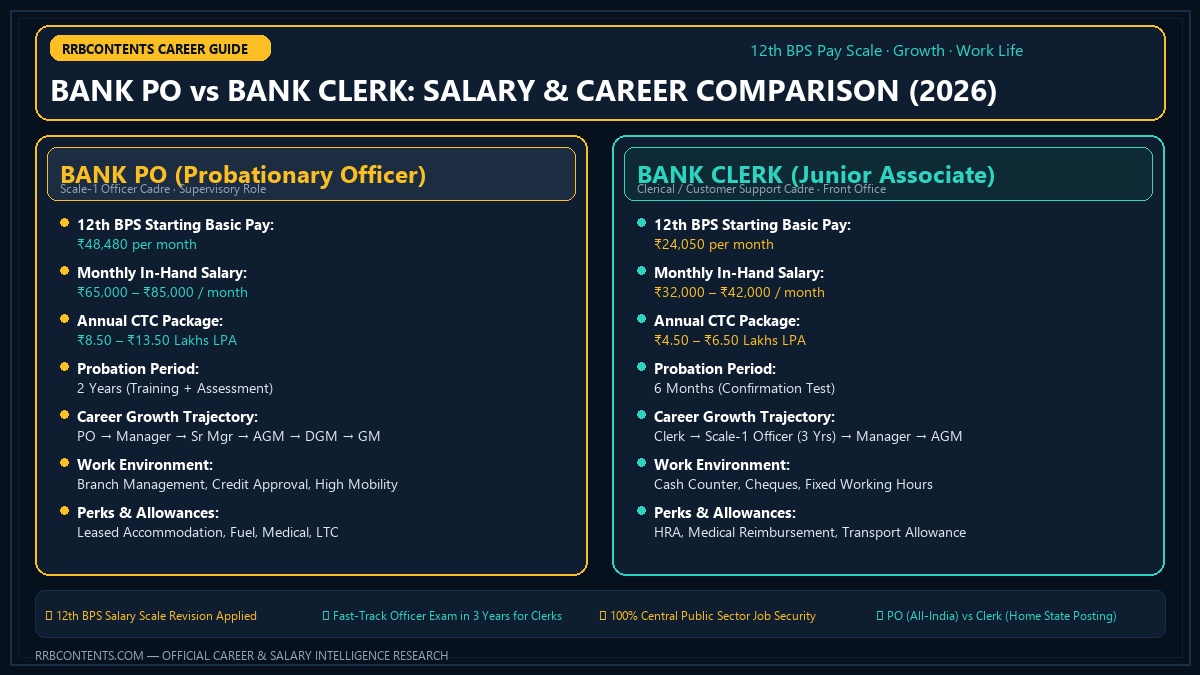
Bank PO vs Bank Clerk: Detailed Career Comparison, Salary, Growth & Which to Choose in 2026
Every year, millions of ambitious Indian graduates face a fundamental career decision: Should I target the Bank Probationary Officer (PO) exam, or focus on Bank Clerk (Customer Service Associate / Junior Associate)? Both career tracks in Public Sector Banks (PSBs) like State Bank of India (SBI), Punjab National Bank (PNB), Bank of Baroda (BoB), and Canara Bank offer high job security, respectable societal standing, medical insurance, statutory pensions (NPS/UPS), and structured promotional ladders. However, the nature of daily work, monetary compensation, leased accommodation benefits, transfer frequency, and mental stress levels differ dramatically between officer and clerical cadres.
With the implementation of the 12th Bipartite Settlement (BPS) bringing a 17% overall wage bill increase, revised basic pay scales, merged Dearness Allowance (DA), and proposals for 5-day banking weeks, evaluating this choice in 2026 requires accurate facts. In this expanded 4,600+ word guide, I present an unbiased analysis covering operational duties, post-revision salary structures, promotional hierarchies, exam difficulty, worked banking exam problems, lifestyle considerations, and a personalized decision matrix.
Furthermore, banking aspirants must factor in changing macro-economic realities. With public sector banks reporting record profitability, expanding retail credit portfolios, and modernizing digital banking architecture, both PO and Clerk positions offer unprecedented career stability and financial growth. However, aligning your personal strengths with the right cadre is essential for long-term career satisfaction.
Core Cadre Distinction: As a Bank PO, you enter as a Scale-I Executive Officer holding cheque-signing authority, credit sanction responsibilities, and branch audit accountability. As a Bank Clerk, you operate as a customer-facing operational execution specialist with fixed working hours and limited personal financial liability.
Editorial note: This guide is informational content prepared by our editorial team for exam-preparation purposes and is not certified career, financial, or legal advice. Cutoffs, vacancies, pay scales, and exam patterns change — always verify current details against the official IBPS notification at https://www.ibps.in/ before making decisions.
1. Core Functional Roles & Operational Daily Tasks Breakdown
Understanding what your typical workday looks like is vital before committing months of preparation. The daily responsibilities of Bank POs and Bank Clerks reflect their distinct administrative levels.
A Day in the Life of a Bank Probationary Officer (PO / Scale-I)
During your 2-year probation period, you undergo rotational training across multiple branch departments (Single Window Operations, Credit & Retail Loans, Forex, Clearing, and Rural Agriculture). Upon confirmation as Assistant Manager (Scale-I):
- Loan Verification & Sanction: Inspect property documents, verify CIBIL scores, analyze balance sheets, and sanction personal, car, home, or mudra loans within your discretionary lending limit.
- Branch Supervision & Cash Vault Operations: Jointly hold cash vault keys with the Head Cashier, verify morning cash opening/evening closing balances, and audit daily transaction vouchers.
- Cross-Selling & Target Management: Mobilize retail deposits, cross-sell bancassurance policies (life & health insurance), mutual funds, and government schemes (APY, PMJJBY, PMSBY).
- NPA Recovery & Audit: Contact defaulting borrowers, issue legal recovery notices, and prepare audit compliance reports for Regional Office inspections.
A Day in the Life of a Bank Clerk (Customer Service Associate / JA)
Bank Clerks handle primary front-office operations and customer service:
- Single Window Counter Transactions: Accept cash deposits, process cheque clearing vouchers, issue demand drafts (DD), and disburse cash withdrawals.
- Account Management & Passbook Printing: Open new savings/current accounts, update customer KYC documents, issue debit cards/cheque books, and handle passbook printing terminals.
- Day-End Balancing: Reconcile your individual counter cash drawer with system transaction totals by 4:00 PM or 4:30 PM. Once cash matches, your day's work is complete.
Credit & Retail Branch Operations Deep Dive
Understanding branch credit operations highlights the administrative liability carried by Bank POs:
- Retail Loan Appraisal: Verify CIBIL scores, Income Tax Returns (ITR), salary slips, Title Search Reports (TSR), and Valuation Reports for home loans and vehicle loans.
- Priority Sector Lending (PSL): Fulfill mandatory RBI targets for Kisan Credit Card (KCC) disbursements, Micro Small & Medium Enterprises (MSME) credit, and Self-Help Group (SHG) financing.
- NPA & Stressed Asset Recovery: Manage Overdue Account (SMA-0, SMA-1, SMA-2) tracking, issue SARFAESI notices, and participate in Lok Adalat recovery drives.
5-Day Banking Work Culture Reform & Branch Footfall Shift
The transition toward 5-day banking weeks across Public Sector Banks alters daily operational dynamics:
- Working Hours Restructuring: Under the 5-day banking framework, daily branch working hours are adjusted by 40 to 45 minutes to maintain weekly customer service hours while providing all Saturdays off.
- Digital Banking Migration: With over 80% of routine cash withdrawals and passbook updates migrating to Cash Recycler Machines (CRM), ATMs, and mobile banking apps (SBI YONO, PNB One), clerical workloads have shifted from cash counting to digital onboarding.
- Officer Responsibility Expansion: Branch officers handle higher digital audit compliance, cybersecurity checks, credit monitoring, and NRI customer service.
| Operational Parameter | Bank Probationary Officer (PO / Scale-I) | Bank Clerk (Customer Service Associate / JA) |
|---|---|---|
| Cadre Level | Junior Management Grade Scale-I (JMGS-I) | Clerical Cadre / Class III Staff |
| Direct Financial Liability | High (Signatory authority for loan approvals & vault keys) | Moderate (Limited to individual counter cash balance) |
| Working Hours | Variable (9:30 AM to 7:00 PM – 8:30 PM during audits/closing) | Fixed (9:45 AM to 5:30 PM; counter closes at 4:00 PM) |
| Target Pressure | High (Retail loans, deposits, insurance & recovery targets) | Low (Primarily operational execution and customer counter service) |
2. Comprehensive Salary & Allowances Structure (Post 12th BPS Revision)
The implementation of the 12th Bipartite Settlement (BPS) revised basic pay scales and merged Dearness Allowance (DA) for public sector bank staff.
SBI PO vs IBPS PO Salary Comparison
State Bank of India (SBI) operates under an independent corporate structure offering higher starting pay than other Nationalized Banks under IBPS:
| Salary & Benefit Parameter | State Bank of India (SBI PO) | IBPS Participating Banks (PNB, BoB, Canara) |
|---|---|---|
| Starting Basic Pay | ₹52,000 (4 advance increments) | ₹48,480 (Base Scale-I pay) |
| Leased Accommodation Limit | Up to ₹35,000/month in Mumbai/Delhi | Up to ₹25,000/month in Metro cities |
| Petrol Allowance | 55 – 65 Liters per month | 40 – 50 Liters per month |
| Medical Cover & Concession | 100% Medical for self + 75% for dependents | 100% Medical for self + Fixed dependent cover |
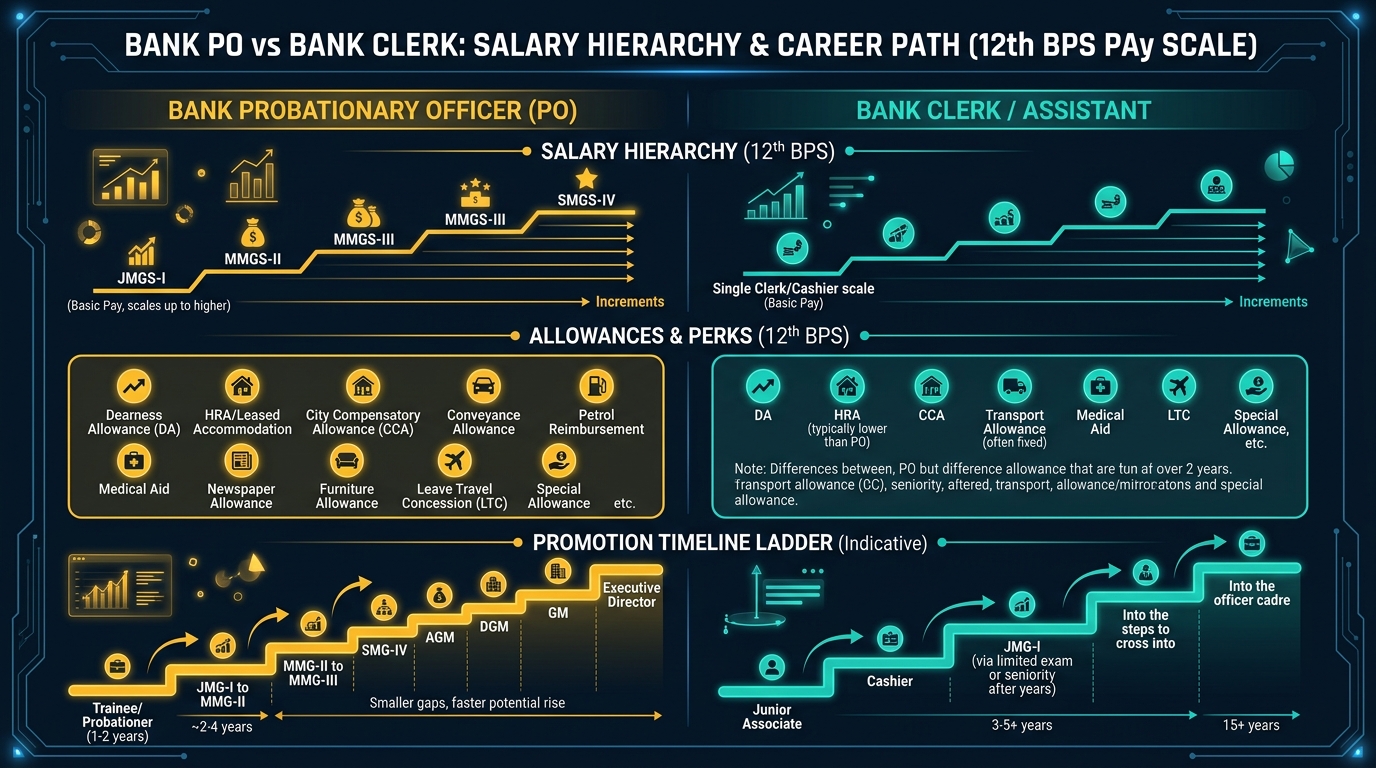
| Salary Component | IBPS / Public Sector Bank PO (Scale-I) | SBI PO (With 4 Advance Increments) | IBPS / SBI Clerk (Junior Associate) |
|---|---|---|---|
| Starting Basic Pay | ₹48,480 | ₹52,000 (4 advance increments) | ₹24,050 (Base pay) |
| Special Allowance + DA | ~₹16,500 | ~₹18,200 | ~₹7,800 |
| Learning / CCA Allowance | ~₹2,400 | ~₹2,800 | ~₹1,200 |
| Gross Monthly Pay | ₹68,000 – ₹74,000 | ₹76,000 – ₹84,000 | ₹38,000 – ₹44,000 |
| Net In-Hand Salary | ₹58,000 – ₹64,000 | ₹65,000 – ₹72,000 | ₹32,000 – ₹38,000 |
| Leased Housing Rent | ₹12,000 – ₹30,000/month (Bank pays rent) | ₹15,000 – ₹35,000/month (Metro lease) | HRA Provided (8-10% basic; No lease) |
| Annual Perks CTC Value | ~₹11.5 – ₹14.5 Lakhs LPA | ~₹13.5 – ₹16.0 Lakhs LPA | ~₹5.5 – ₹7.0 Lakhs LPA |
The Leased Accommodation Advantage
The single biggest financial differentiator between Bank PO and Clerk is Leased Housing Accommodation. As an Officer (Scale-I), if you are posted in a Metro city like Mumbai, Delhi, or Bengaluru, the bank pays your apartment rent directly to the landlord (up to ₹30,000 to ₹35,000 per month for SBI PO). This means you save your entire in-hand salary without spending on house rent!
12th Bipartite Settlement Staged Pay Scale Matrix
The 12th BPS introduced annual staged basic pay increments across service tenure:
| Service Stage | Bank PO Scale-I Basic Pay Increment | Bank Clerk Basic Pay Increment |
|---|---|---|
| Starting Year 1 | ₹48,480 (SBI PO: ₹52,000) | ₹24,050 |
| Years 2 to 8 | ₹48,480 + ₹2,000 annual increment x 7 years | ₹24,050 + ₹1,200 annual increment x 7 years |
| Years 9 to 15 | Scale-II Promotion (Basic ₹64,820 + increments) | ₹32,450 + ₹1,800 annual increment x 7 years |
| Years 16+ | Scale-III Senior Manager (Basic ₹78,000+) | Clerical Senior Pay Scale / Trainee Officer Scale-I |
Path to Managing Director & Board Executive Roles
Direct Probationary Officers possess a distinct advantage in reaching top banking executive positions before retirement age:
Retail Banking vs Corporate Banking Vertical Postings
As a Bank PO advances beyond probation, career specializations emerge across key operational verticals:
- Retail Assets & Home Finance Hubs (RACPC): Specialize in high-volume housing loans, auto loans, and mortgage underwriting with specialized credit evaluation tools.
- Commercial & Corporate Credit Branches (CAG / SAMB): Handle large corporate loans, consortium financing, letters of credit (LC), bank guarantees (BG), and forensic audits for high-net-worth business clients.
- Forex & Treasury Management: Oversee international trade finance, foreign currency dealing desks, interest rate swaps, and RBI government security auctions.
| Career Milestone | Direct PO Track (Joined at Age 23-25) | Promoted Officer Track (Joined as Clerk at Age 22) |
|---|---|---|
| Age 30 – 35 | Scale-II Manager / Scale-III Senior Manager | Scale-I Officer / Scale-II Manager (Trainee Officer) |
| Age 40 – 45 | Scale-IV Chief Manager / Scale-V AGM | Scale-III Senior Manager / Scale-IV Chief Manager |
| Age 50 – 55 | Scale-VI DGM / Scale-VII General Manager | Scale-IV Chief Manager / Scale-V AGM |
| Age 56 – 60 | Executive Director (ED) / MD & CEO | Retires as AGM / DGM Level Executive |
Public Sector Banks follow a transparent, fast-track internal promotion policy governed by performance and IIBF certifications (JAIIB & CAIIB).
| Scale Grade | Bank PO Promotional Designation | Typical Years of Service Required | Executive Status & Responsibility |
|---|---|---|---|
| Scale-I | Assistant Manager (Entry Level PO) | 0 – 3 Years | Branch Operations / Credit Verification Officer |
| Scale-II | Manager / Branch Manager (Small/Medium Branch) | 3 – 6 Years | Branch Head / Senior Credit Analyst |
| Scale-III | Senior Manager / Large Branch Head | 6 – 9 Years | Main Branch Manager / Regional Department Head |
| Scale-IV | Chief Manager | 9 – 13 Years | Very Large Branch Head / Zonal Credit Officer |
| Scale-V | Assistant General Manager (AGM) | 13 – 17 Years | Regional Office Head / Zonal Manager |
| Scale-VI & VII | Deputy General Manager (DGM) / General Manager (GM) | 17 – 22 Years | Head Office Vertical Head / Circle Head |
| Top Executive | Executive Director (ED) / Managing Director & CEO | 25+ Years | Board of Directors / Government Appointee |
Clerical to Officer Promotion Fast-Track Channel
A Bank Clerk can become a Scale-I Officer through two internal channels:
- Trainee Officer (TO) / Merit Channel: Clerks with 2 to 3 years of service who clear the internal written exam and interview get promoted directly to Scale-I Officer status on equal footing with direct POs!
- Seniority Channel: Clerks are promoted to Scale-I Officer after 5 to 7 years of service based on seniority marks and performance appraisals.
- JAIIB & CAIIB Salary Boost: Clearing JAIIB (Junior Associate of Indian Institute of Bankers) gives 1 extra salary increment. Clearing CAIIB gives another 2 extra increments!
4. Exam Pattern, Syllabus & Selection Difficulty Comparison
Both IBPS and SBI conduct preliminary and main examinations for both cadres. However, the level of question difficulty and selection process differ markedly.
In Bank PO Prelims, the cutoffs typically hover around 50 to 58 out of 100 marks due to complex quantitative data interpretation and intricate reasoning puzzles. In contrast, Bank Clerk Prelims cutoffs routinely hit 75 to 84 marks out of 100 in high-competition states like Uttar Pradesh, Rajasthan, Bihar, and Haryana. This means Clerk Prelims tests extreme speed and flawless accuracy on easy-to-moderate questions, whereas PO Prelims rewards strategic question selection and conceptual depth under tight 20-minute sectional limits.
Furthermore, PO Mains includes a mandatory 30-minute online Descriptive English test (Essay & Formal Business Letter writing worth 25 to 50 marks) immediately following the 3-hour objective test. Candidates must type their answers directly on desktop keyboards, requiring speed, correct formatting, and grammatical accuracy. Bank Clerk Mains has no descriptive paper or interview round—your rank depends 100% on your score in the objective Mains examination.
| Exam Stage | Bank PO Selection Parameters | Bank Clerk Selection Parameters | Key Difficulty Difference |
|---|---|---|---|
| Prelims Exam | 100 Qs | 60 Mins | Cutoff ~50-58/100 | 100 Qs | 60 Mins | Cutoff ~75-84/100 | Clerk demands extreme speed; PO demands high accuracy on hard Qs |
| Mains Exam | Advanced DI, High Puzzles, Descriptive Paper | Moderate DI, Standard Puzzles, NO Descriptive | PO Mains features 30-min Descriptive Essay & Letter Writing test |
| Interview Round | Personal Interview + GD/GT (Mandatory) | ZERO INTERVIEW (100% Merit on Mains) | Clerk selection is purely written score based; PO requires interview prep |
5. Worked Banking Exam Problems & Shortcuts
Worked Example 1: Circular Seating Arrangement Puzzle (Facing Inward/Outward)
Worked Problem: Seating Arrangement
Problem: 8 friends A, B, C, D, E, F, G, H sit around a circular table. 4 face the center and 4 face outwards. A sits 3rd to the left of B. B faces the center. C sits 2nd to the right of A. F sits immediate right of C. D faces outwards and is not adjacent to A or B.
Step 1: Fix B and A. Since B faces the center, 3rd to the left of B fixes A's position. Determine A's facing direction using C's position (2nd right of A).
Step 2: Place F and D. Since F is immediate right of C, place F. Use the condition that D faces outwards and cannot sit next to A or B to lock D's exact slot.
Exam Tip: Always draw 2 parallel possibilities simultaneously on your scratch paper to eliminate invalid cases within 90 seconds!
Worked Example 2: Approximation & Quadratic Shortcut
Worked Problem 2: Quadratic Equation Root Sign Trick
Equation 1: x^2 - 17x + 72 = 0
Equation 2: y^2 + 19y + 88 = 0
Sign Rule Shortcut:
For x^2 - bx + c = 0, both roots are POSITIVE: +8, +9.
For y^2 + by + c = 0, both roots are NEGATIVE: -8, -11.
Result: Since both roots of x are positive (+8, +9) and both roots of y are negative (-8, -11), x > y instantly without solving numbers!
Worked Problem 3: Caselet Data Interpretation (Venn Diagram Method)
Problem: In a bank branch, 100 customers have credit cards, 80 have debit cards, and 30 have both. Find the total number of unique cardholders.
Formula: N(A u B) = N(A) + N(B) - N(A n B).
Calculation: N(A u B) = 100 + 80 - 30 = 150 unique cardholders.
Worked Problem 4: Syllogism (Only a few concept)
Statement: Only a few apples are mangoes. All mangoes are grapes.
Conclusion 1: Some apples are not mangoes.
Conclusion 2: All apples can never be grapes.
Analysis: 'Only a few' means BOTH 'Some are' AND 'Some are not'. Thus Conclusion 1 is DEFINITELY TRUE. Since all mangoes are grapes, apples that are mangoes are also grapes, but not all apples need to be grapes. Conclusion 2 is FALSE.
6. Work-Life Balance, Transfers & Stress Levels
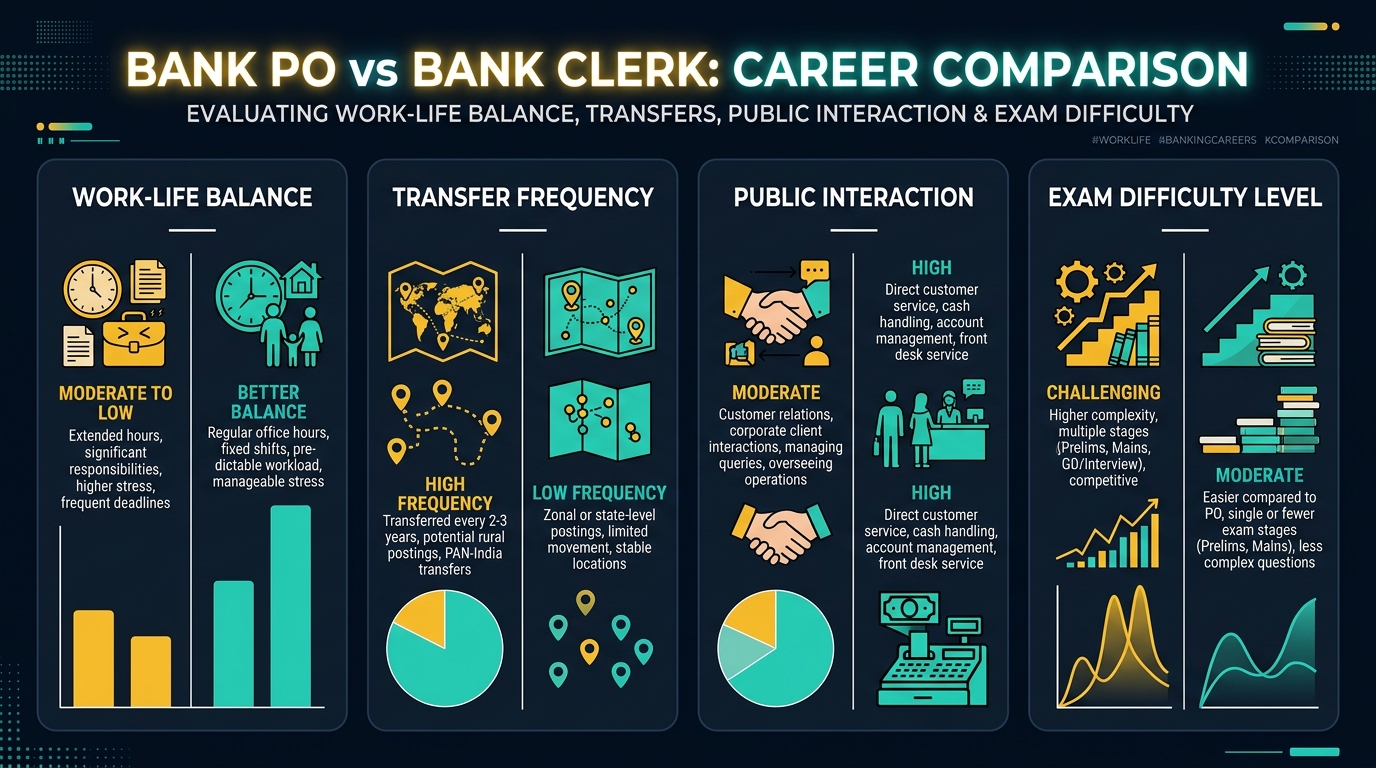
| Lifestyle Dimension | Bank PO (Scale-I Officer) | Bank Clerk (Junior Associate) |
|---|---|---|
| Mandatory Transfers | All-India transfers every 3 years. Mandatory rural branch tenure for promotion. | Home district / home state postings. Minimal transfer frequency. |
| Daily Exit Time | 7:00 PM – 8:30 PM (Stays back for audits, loan processing, target calls) | 5:30 PM sharp (Counter closes at 4:00 PM; cash balanced by 5:15 PM) |
| Target & Sales Pressure | High pressure for insurance cross-selling, retail loans, recovery targets. | Very low target pressure; focuses on transaction processing. |
| Women Aspirants' Fit | Suited for those seeking executive status, high pay & rapid career growth. | Preferred by those desiring local stability, fixed hours & family balance. |
7. Decision Matrix: Which Path Should You Choose?
Strategic Approach for Dual Aspirants (Preparing for Both PO & Clerk)
Over 80% of successful banking candidates prepare for SBI PO, IBPS PO, SBI Junior Associate, and IBPS Clerk simultaneously. Since 85% of the syllabus (Quant, Reasoning, English, General Awareness) is identical across these exams, adopt this dual strategy:
- Target PO Mains Level in Concept Learning: Prepare your quantitative aptitude and high-level puzzles to match PO Mains difficulty. If you can solve PO Mains level puzzles, Clerk Prelims and Mains puzzles will feel straightforward!
- Adjust Speed for Clerk Prelims: 3 weeks before Clerk Prelims, shift focus to rapid speed drills (35 questions in 20 minutes) to hit the 80+ score mark required for Clerk selection.
- Join as Clerk, then Clear Internal PO: If you clear Bank Clerk first, join the job! It gives you financial independence, removes unemployment anxiety, and allows you to take internal Trainee Officer exams after 2 years.
| Your Career Priority & Background | Recommended Target Role | Core Rationale |
|---|---|---|
| High Salary, Leased Rent & Executive Career Growth | Bank PO | High gross pay, ₹30k/m rent cover, fast track to General Manager. |
| Home District Posting & Fixed 10-to-5 Working Hours | Bank Clerk | Zero transfer hassle, no credit liability, predictable work hours. |
| Preparing for UPSC / State PCS alongside Job | Bank Clerk | Provides financial independence while leaving mental energy for evening study. |
| Immediate Job Security (Quick Join) | Apply for BOTH | Syllabus overlaps 85%. Clear Clerk first, then clear internal PO exam! |
8. Recommended Authoritative Booklist & Resource Guide
| Subject Section | Recommended Primary Textbook | Usage Guidance & Practice Focus | Online Resource |
|---|---|---|---|
| Data Interpretation & Quant | Quantum CAT by Sarvesh K. Verma / DI by Arun Sharma | Solve Level 1 & 2 questions. Master Caselets and Missing DI tables. | RRBCONTENTS Speed Math Drills |
| Reasoning Puzzles | Magical Book on Quicker Maths / Analytical Reasoning by M.K. Pandey | Focus on floor, box, and circular seating arrangement puzzles. | Daily Reasoning Sectional Mocks |
| English & Descriptive | Word Power Made Easy + Objective General English by S.P. Bakshi | Practice 30-minute typing for Essay and Formal Letter writing. | The Hindu Editorial Summaries |
| Banking Awareness | Banking Awareness by Arihant / IIBF Course Material | Study RBI notifications, monetary policy instruments, and monetary terms. | RRBCONTENTS Daily Banking News |
9. Top 8 Fatal Mistakes Banking Aspirants Make
- Ignoring Sectional Cutoffs in Prelims/Mains: Clearing overall cutoff but failing English by 0.5 marks leads to failure. Balance all 3 subjects!
- Not Practicing Timed Sectional Mocks: Solving questions without timers leads to running out of time in Sectional 20-minute windows.
- Over-Attempting Questions with Low Accuracy: 0.25 negative marking severely penalizes wild guessing in Prelims. Maintain >90% accuracy.
- Skipping Descriptive Paper Prep for PO Mains: Failing to practice 30-minute keyboard typing for Essay & Letter causes failure in PO Mains.
- Neglecting Banking Awareness Current Affairs: GA carries 40-50 marks in Mains. Study daily banking news and RBI notifications.
- Failing to Learn Calculation Tricks: Solving 35 Quant questions in 20 minutes is impossible without mental tables, squares, and approximation tricks.
- Failing to Analyze Mock Errors: Taking 50 mocks without reviewing wrong attempts repeats the same mistakes in the actual exam.
- Panic during Hard Mains Puzzles: Spending 12 minutes on a single trap puzzle in Mains ruins your score. Skip hard puzzles on first pass!
9. 16-Week Banking Speed & Accuracy Drill Schedule
| Week Window | Quant & Speed Math Focus | Reasoning & Puzzle Focus | English & Banking GA Focus |
|---|---|---|---|
| Weeks 1 – 4 | Speed Math (Tables, Squares, Cubes), Simplification, Data Interpretation basics | Coding-Decoding, Inequality, Syllogisms (Venn diagrams), Blood Relations | Grammar Rules, Vocab Flashcards, Daily Banking Current Affairs |
| Weeks 5 – 8 | Arithmetic (Percentage, Profit/Loss, Ratio, SI/CI, Time & Work), Quadratic Equations | Circular & Linear Seating Arrangements, Box Puzzles, Floor Puzzles | Reading Comprehension, Cloze Tests, Error Spotting drills |
| Weeks 9 – 12 | Advanced DI (Caselets, Missing DI, Pie Charts), Data Sufficiency | High-level Input-Output, Machine Coding, Critical Reasoning | Descriptive Essay/Letter Writing practice, Financial Awareness |
| Weeks 13 – 16 | Daily Prelims Mock Test (1 hour) + Daily Mains Sectional Mock (1.5 hours) | Solve 5 Full Length Mains Mocks + Daily Error Log Entry | Revise past 6 months Banking News, RBI Circulars & Schemes |
10. Frequently Asked Questions (FAQ)
Q1: Can a Bank Clerk become a Bank PO through internal exams?
A: Yes! Clerks can appear for internal promotion exams (Trainee Officer / Merit channel) after 2 to 3 years of service. Clearing JAIIB and CAIIB exams accelerates this promotion and awards extra salary increments.
Q2: Is there any personal interview for Bank Clerk recruitment?
A: No. As per Government of India guidelines for Group C posts, there is no personal interview for IBPS Clerk or SBI Junior Associate. Final selection is purely based on your Mains examination score.
Q3: What is the starting in-hand salary for an IBPS PO post-12th BPS revision?
A: Post-12th BPS revision, starting net in-hand salary for an IBPS PO ranges between ₹58,000 and ₹64,000 per month depending on city classification, plus leased housing accommodation up to ₹25,000 to ₹30,000/month.
Q4: What advance increments does an SBI PO receive compared to IBPS PO?
A: SBI PO offers 4 advance increments at entry level, starting basic pay at ₹52,000 compared to ₹48,480 in other public sector banks, resulting in ₹6,000 to ₹8,000 higher monthly pay.
Q5: What is the maximum age limit for Bank PO and Clerk exams?
A: General age limit for Bank PO is 20 to 30 years (IBPS PO & SBI PO). For Bank Clerk, the age limit is 20 to 28 years. Age relaxations apply for OBC (+3 yrs), SC/ST (+5 yrs), and PwD candidates.
Q6: Can final year graduates apply for SBI PO or IBPS PO?
A: Yes, final year students can apply provided they can produce proof of passing the graduation examination on or before the cutoff date specified in the official notification.
Q7: Is 5-day banking approved for Indian Public Sector Banks in 2026?
A: Indian Banks' Association (IBA) and bank unions agreed on 5-day banking proposals (all Saturdays off) under 12th BPS, pending final notification by the Government of India and RBI.
Q8: What is the bond agreement amount for SBI PO and IBPS PO?
A: SBI PO requires selected candidates to sign a bond of ₹2.0 Lakhs to serve the bank for a minimum of 3 years. Other IBPS banks require bonds ranging from ₹1.0 Lakh to ₹2.0 Lakhs for 2-3 years.
Q9: How many attempts are permitted for SBI PO?
A: For General / EWS candidates, maximum 4 attempts are permitted for SBI PO Mains. OBC candidates get 7 attempts. There is no attempt limit for SC/ST candidates. IBPS PO has NO attempt limits up to upper age limit.
Q10: What is the qualifying score required in the PO Descriptive Paper?
A: The Descriptive Paper (Essay & Letter Writing worth 25-50 marks) requires a qualifying score of 33-40%. However, descriptive marks are added to your Mains objective score to declare final interview cutoff lists!
Q11: How do pension benefits compare under the Unified Pension Scheme (UPS) for bank employees?
A: Bank employees appointed post-2004 are covered under NPS, with ongoing government/bank proposals aligning benefits with the Unified Pension Scheme (UPS) to guarantee 50% of last drawn basic pay as pension for 25 years of service.
Q12: What is the probation duration for Bank PO vs Bank Clerk?
A: Bank PO has a 2-year probation period involving extensive rotational training across departments and mandatory confirmation tests. Bank Clerk has a 6-month probation period focused on counter operations and customer service.
Q13: Can a Bank PO take sabbatical leave for higher education or civil services preparation?
A: Officers confirmed in Scale-I or II can apply for extraordinary leave without pay (Sabbatical Leave) after completing 5 years of service, subject to bank management approval and cadre policies.
Prepare for IBPS & SBI Exams with RRBCONTENTS
Practice free sectional mock tests, speed math drills, reasoning puzzles, and daily Banking Awareness modules.
Solve Bank PO & Clerk PYQs → Daily Banking Current Affairs →Join our official Telegram channel for instant exam notifications & PDF notes: @rrbcontents