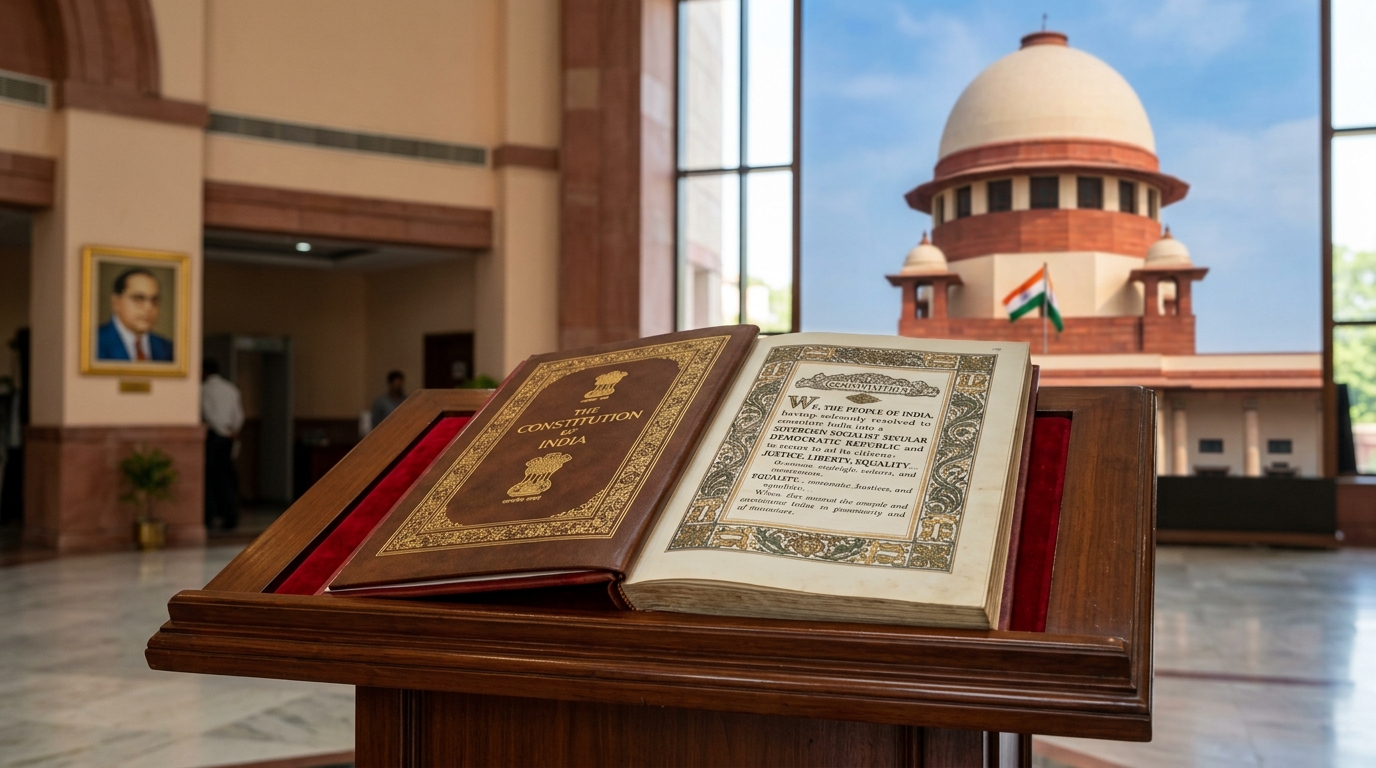
BASIC STRUCTURE DOCTRINE OF THE INDIAN CONSTITUTION: ORIGIN, JUDICIAL EVOLUTION, LANDMARK CASES & IMPORTANCE (COMPLETE GUIDANCE FOR COMPETITIVE EXAMS)
Chapter 1
INTRODUCTION
The Basic Structure Doctrine (mūla ḍhāñcā siddhānta) is arguably the most significant judicial innovation in Indian constitutional jurisprudence. Formulated by a landmark 13-Judge Constitution Bench of the Supreme Court of India in the historic Kesavananda Bharati v. State of Kerala case on 24th April 1973, the doctrine establishes a vital constitutional principle: while Parliament possesses wide power under Article 368 to amend any part of the Constitution, it CANNOT alter, damage, abrogate, or destroy the basic structure or core identity of the Constitution.
The Constitution of India is not a static legal text; it is a living document designed to adapt to changing socio-economic conditions. However, the framers of the Constitution never intended for a temporary Parliamentary majority to dismantle the fundamental democratic, secular, federal, and judicial pillars upon which the Republic rests. The Basic Structure Doctrine acts as an indispensable constitutional check against Parliamentary absolutism, ensuring that the spirit of constitutionalism prevails over majoritarian politics.
For aspirants preparing for competitive examinations such as UPSC Civil Services (GS Paper II & Political Science Optional), State Public Service Commissions (BPSC, UPPSC, MPPSC, RAS), Judicial Services, and SSC CGL, a thorough mastery of the origin, historical tug-of-war between Legislature and Judiciary, landmark case law timeline, and judicially recognized basic features is essential.
This comprehensive master career guide provides an exhaustive breakdown of the Basic Structure Doctrine. We cover every legal detail—from Shankari Prasad (1951) and Golaknath (1967) to Kesavananda Bharati (1973), Minerva Mills (1980), IR Coelho (2007), NJAC Case (2015), comprehensive elements lists, comparative tables, 12 exam-focused FAQs, and essential revision tools.
---
Chapter 2
CONCEPT & PHILOSOPHICAL FOUNDATION OF BASIC STRUCTURE
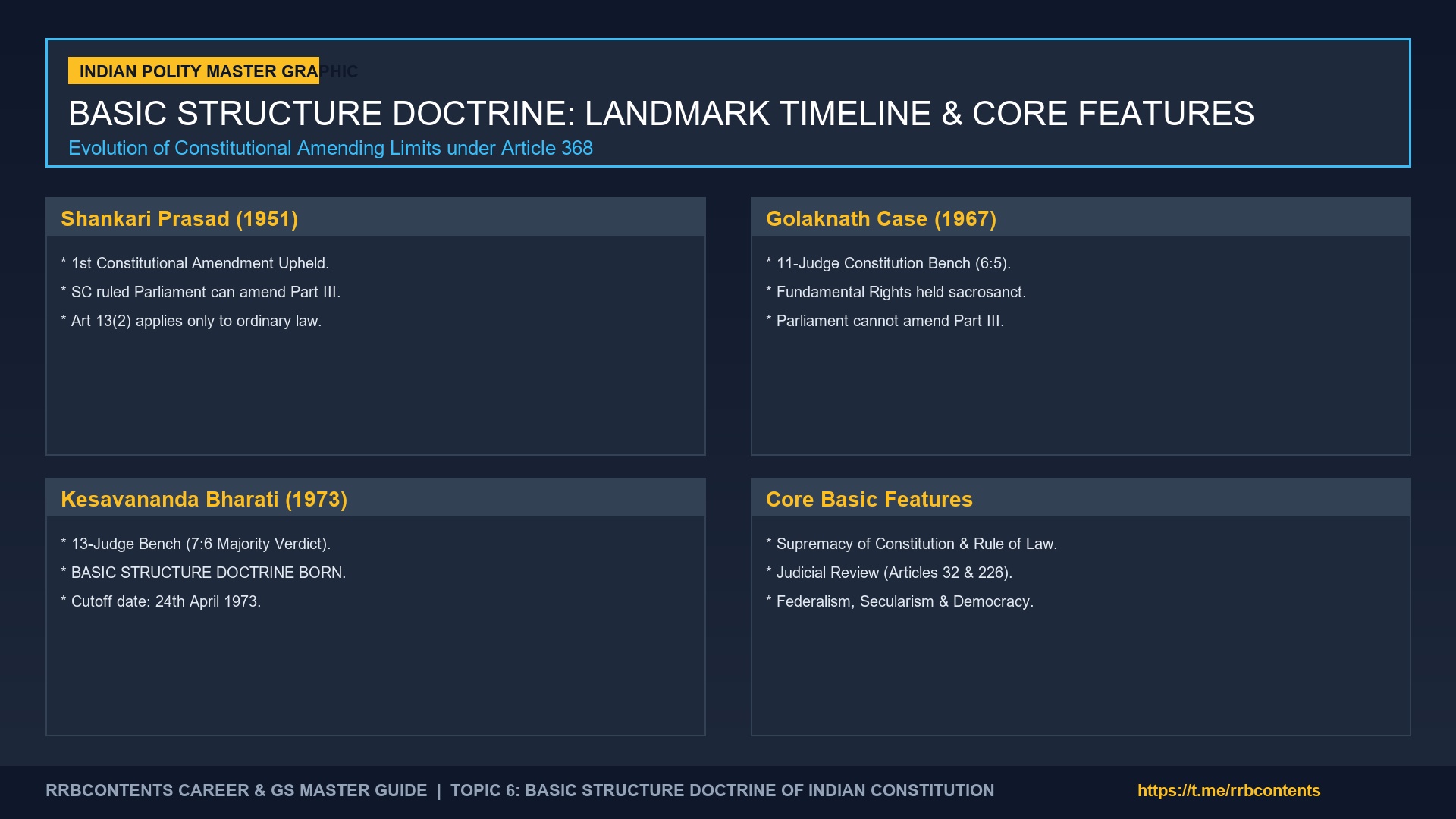
CONCEPT & PHILOSOPHICAL FOUNDATION OF BASIC STRUCTURE - Illustrative Reference
What is the 'Basic Structure' of a Constitution?
Constitutional Amending Power (Article 368)
"The basic structure may be said to consist of the following features: Supremacy of the Constitution, Republican and Democratic form of Government, Secular character of the Constitution, Separation of powers, and Federal character. An amendment that seeks to destroy any of these core pillars is unconstitutional."
Just as removing the load-bearing pillars of a building causes the entire structure to collapse, stripping the Constitution of its fundamental features destroys its identity, turning a democratic constitution into a majoritarian dictatorship.
---
- 1965 Lecture at BHU: In February 1965, Professor Conrad delivered a historic lecture titled "Implied Limitations of the Amending Power" at the Law Faculty of Banaras Hindu University (BHU).
- The Core Thesis: Conrad argued that an amending power under a written constitution cannot be used to abolish the constitution itself. For example, an amendment cannot turn a republic into a monarchy, abolish the legislature, or repeal the fundamental rights en masse.
- Impact on Supreme Court: Advocate M.K. Nambyar introduced Conrad's paper during the Golaknath arguments in 1967. Later, Senior Advocate Nani Palkhivala masterfully synthesized Conrad's implied limitations thesis during his legendary 68-day oral arguments in Kesavananda Bharati (1973), persuading the 7-judge majority.
Chapter 3
HISTORICAL TUG-OF-WAR: LEGISLATURE VS JUDICIARY (1951 TO 1973)
The emergence of the Basic Structure Doctrine was the outcome of a prolonged 22-year legal battle between the Parliament of India and the Supreme Court over the scope of amending power under Article 368 versus Fundamental Rights under Part III.
Phase 1: Judicial Deference (1951 - 1964)
├── Shankari Prasad Case (1951) & Sajjan Singh Case (1965)
       │
       ▼
Phase 2: Judicial Reaction (1967)
├── Golaknath Case (1967) - 11-Judge Bench
       │
       ▼
Phase 3: Executive Retaliation (1971)
├── 24th, 25th & 29th Constitutional Amendment Acts
       │
       ▼
Phase 4: Historic Compromise & Synthesis (24th April 1973)
├── Kesavananda Bharati Case (1973) - 13-Judge Bench (7:6 Verdict)
---
Chapter 4
DETAILED STEP-BY-STEP CHRONOLOGY OF LANDMARK CASES
- Context: Challenged the validity of the 1st Constitutional Amendment Act, 1951, which inserted Article 31A, Article 31B, and the 9th Schedule to protect agrarian land reform laws from judicial challenge under Fundamental Rights.
- Petitioner's Argument: Article 13(2) states that the State shall not make any "law" that takes away or abridges Fundamental Rights. Therefore, a Constitutional Amendment is a "law" under Article 13(2) and cannot violate Part III.
- Supreme Court Verdict (5-Judge Bench): The Supreme Court unanimously rejected the petition. The Court drew a distinction between:
1. Ordinary Law (made in exercise of legislative power under Art 245-248).
2. Constitutional Amendment Law (made in exercise of constituent power under Art 368).
- Held: "Law" in Article 13(2) includes only ordinary statutory laws, NOT Constitutional Amendments. Parliament can amend any part of the Constitution, including Fundamental Rights.
- Context: Challenged the 17th Constitutional Amendment Act, 1964, which placed various state land reform acts in the 9th Schedule.
- Supreme Court Verdict (5-Judge Bench): Upheld Shankari Prasad by a 3:2 majority, ruling that Parliament can amend Fundamental Rights.
- Early Seeds of Basic Structure: In their dissenting opinions, Justice J.R. Mudholkar and Justice M. Hidayatullah raised landmark questions. Justice Mudholkar cited the Pakistani Supreme Court judgment in Fazlul Quader Chowdhry (which used German jurist Professor Dietrich Conrad's concept of 'implied limitations') and asked whether the Constitution had certain "basic features" that could not be changed.
- Context: Challenged the validity of the 1st, 4th, and 17th Constitutional Amendments impacting family landholdings in Punjab.
- Supreme Court Verdict (11-Judge Bench): By a narrow 6:5 majority, the Supreme Court overruled Shankari Prasad and Sajjan Singh!
- Key Rulings:
Chapter 5
1. Fundamental Rights under Part III possess a "transcendental and inviolable position".
Chapter 6
2. Parliament has NO power to amend Part III to take away or abridge any Fundamental Right.
Chapter 7
3. Article 368 merely lays down the procedure for amendment, not the substantive power to amend.
Chapter 8
4. Constitutional Amendments are "law" under Article 13(2) and are subject to Fundamental Rights.
- 24th Amendment Act (1971): Amended Article 13 and Article 368 to explicitly state that nothing in Article 13 shall apply to any amendment made under Article 368. Made it explicit that Parliament has constituent power to amend any provision of the Constitution.
- 25th Amendment Act (1971): Inserted Article 31C, stating that laws enacted to implement Directive Principles under Article 39(b) and 39(c) cannot be challenged for violating Articles 14, 19, or 31.
- 29th Amendment Act (1972): Placed Kerala land reform acts in the 9th Schedule.
---
- Longest Oral Arguments: Heard continuous oral arguments for 68 days between October 1972 and March 1973.
- 11 Separate Judgments: The 13 judges authored 11 separate opinion papers, creating a 700-page complex verdict.
- Emergency Judicial Supersession: Just 24 hours after delivering the judgment on 24th April 1973, PM Indira Gandhi's government bypassed the three senior-most majority judges (Justices J.M. Shelat, K.S. Hegde, and A.N. Grover) to appoint Justice A.N. Ray (who dissented) as Chief Justice of India.
Chapter 9
KESAVANANDA BHARATI V. STATE OF KERALA (1973): THE WATERSEHD MOMENT
Swami Kesavananda Bharati, head of Edneer Mutt in Kerala, challenged the Kerala government's land acquisition under the 29th Amendment. The case was referred to the largest Constitution Bench in Indian judicial history: 13 Judges.
Kesavananda Bharati Case (1973) Summary
├── Bench Strength: 13 Judges (Largest ever in Supreme Court history)
├── Hearing Duration: 68 Days of continuous hearings
├── Verdict Date: 24th April 1973
└── Verdict Majority: 7 : 6 Majority Verdict
By a razor-thin 7:6 majority (Chief Justice S.M. Sikri, Justices K.S. Hegde, A.K. Mukherjea, J.M. Shelat, A.N. Grover, P. Jaganmohan Reddy, and H.R. Khanna in majority; Justices A.N. Ray, D.G. Palekar, K.K. Mathew, M.H. Beg, S.N. Dwivedi, and Y.V. Chandrachud dissenting):
1. Overruled Golaknath: The Court held that Parliament CAN amend any part of the Constitution, including Fundamental Rights under Part III.
2. Upheld 24th Amendment: Reaffirmed that Parliament possesses constituent power under Article 368.
3. Formulated Basic Structure Doctrine: The Court ruled that Article 368 does NOT enable Parliament to alter, abrogate, or destroy the "Basic Structure" or basic framework of the Constitution.
4. Invalidated Part of Article 31C: Struck down the second part of Article 31C which barred judicial review of laws implementing Article 39(b)/(c).
---
In November 1975, during the Emergency, Chief Justice A.N. Ray constituted a 13-Judge Bench to review and overrule the Kesavananda Bharati judgment. However, after two days of fierce arguments by Nani Palkhivala exposing the lack of any formal review petition, CJI Ray dissolved the Bench, securing the permanence of the Basic Structure Doctrine.
Chapter 10
POST-KESAVANANDA EVOLUTION OF THE DOCTRINE
- Context: Raj Narain challenged PM Indira Gandhi's election to Lok Sabha from Rae Bareli. The Allahabad High Court invalidated her election. In response, Parliament passed the 39th Constitutional Amendment Act (1975), inserting Article 329A which placed the election of the PM and Speaker beyond judicial review.
- Supreme Court Verdict: A 5-Judge Constitution Bench applied the Basic Structure Doctrine for the first time to strike down a Constitutional Amendment!
- Held: Article 329A Clause (4) destroyed the Basic Structure. The Court declared Judicial Review, Rule of Law, and Free and Fair Elections as inviolable basic features.
- Context: During the 1975 Emergency, Parliament passed the 42nd Constitutional Amendment Act (1976), adding Clauses (4) and (5) to Article 368. Clause (4) barred courts from questioning any constitutional amendment, and Clause (5) declared that there shall be no limitation on Parliament's constituent power.
- Supreme Court Verdict: The 5-Judge Bench struck down Clauses (4) and (5) of Article 368 as unconstitutional.
- Famous Quote by Chief Justice Y.V. Chandrachud:
"Since the Constitution has conferred a limited amending power on the Parliament, the Parliament cannot in the exercise of that very power convert the limited power into an unlimited one... A limited amending power is itself a basic feature of the Constitution."
- Held: Reaffirmed that Harmony and Balance between Fundamental Rights and Directive Principles is part of the Basic Structure.
- Context: Clarified the application of the Basic Structure Doctrine to laws placed in the 9th Schedule.
- Held: The Basic Structure Doctrine applies prospectively. All constitutional amendments and laws placed in the 9th Schedule prior to 24th April 1973 remain valid and immune. However, all amendments and laws added to the 9th Schedule after 24th April 1973 are open to judicial challenge if they violate the Basic Structure.
- Context: Challenged the arbitrary dismissal of state governments under Article 356 (President's Rule).
- Supreme Court Verdict (9-Judge Bench): Declared Secularism, Federalism, and Democracy as integral components of the Basic Structure.
- Original Intent (1951): Inserted via Article 31B by the 1st Amendment to protect progressive zamindari abolition and agrarian land reform laws from court challenges under Article 31 (Right to Property).
- Political Abuse: Over decades, successive governments placed over 284 state and central laws in the 9th Schedule—ranging from industrial regulations and reservation quotas (e.g., Tamil Nadu 69% Reservation Act) to electoral laws—seeking complete immunity from judicial review.
- Judicial Check (I.R. Coelho 2007): A 9-Judge Constitution Bench closed this loophole, declaring that the 9th Schedule cannot be used as a "super-constitution" or "blanket vault". Any law added post-24th April 1973 that damages the Basic Structure will be unhesitatingly struck down.
- Context: 9-Judge Constitution Bench examined whether laws placed in the 9th Schedule are immune from judicial review.
- Supreme Court Verdict: Unanimously held that the 9th Schedule cannot be used as a "blanket vault" to bypass the Constitution. If a law placed in the 9th Schedule post-24th April 1973 violates Fundamental Rights forming part of the Basic Structure (Articles 14, 19, 21), it will be struck down!
- Context: Challenged the 99th Constitutional Amendment Act, 2014, which created the National Judicial Appointments Commission (NJAC) to replace the Collegium system.
- Supreme Court Verdict (5-Judge Bench): By a 4:1 majority, the Supreme Court struck down the 99th Amendment as unconstitutional.
- Held: Independence of the Judiciary is an indispensable part of the Basic Structure, and executive involvement in judicial appointments compromises judicial independence.
---
Chapter 11
COMPREHENSIVE LIST OF JUDICIALLY RECOGNIZED ELEMENTS OF BASIC STRUCTURE
The Supreme Court has deliberately avoided defining 'Basic Structure' exhaustively, adopting an ongoing case-by-case approach. Below is the comprehensive list of elements recognized across judgments:
Core Judicially Declared Elements of Basic Structure
├── 1. Supremacy of the Constitution
├── 2. Sovereign, Democratic & Republican Nature of Indian Polity
├── 3. Secular Character of the Constitution
├── 4. Separation of Powers (Legislature, Executive & Judiciary)
├── 5. Federal Character of the Constitution
├── 6. Unity and Integrity of the Nation
├── 7. Judicial Review (Articles 32, 136, 226, 227)
├── 8. Rule of Law & Equality before Law (Article 14)
├── 9. Freedom & Dignity of the Individual (Part III / Article 21)
├── 10. Independence of the Judiciary
├── 11. Harmony & Balance between Fundamental Rights and DPSPs
├── 12. Free and Fair Elections
├── 13. Limited Amending Power of Parliament (Article 368)
├── 14. Effective Access to Justice & Complete Justice (Article 142)
├── 15. Welfare State Mandate (Socio-Economic Justice)
└── 16. Principle of Reasonableness (Article 14)
---
Chapter 12
COMPARATIVE ANALYSIS OF LANDMARK CASES ON AMENDING POWER
| Landmark Case | Year | Bench Strength | Key Constitutional Question | Supreme Court Holding / Ruling |
|---|---|---|---|---|
| Shankari Prasad | 1951 | 5 Judges | Can Parliament amend Fundamental Rights under Art 368? | YES. Art 13(2) does not apply to Art 368 amendments. |
| Sajjan Singh | 1965 | 5 Judges | Re-examination of Shankari Prasad ruling. | YES. Upheld Shankari Prasad. (Mudholkar J. hinted basic features). |
| Golaknath | 1967 | 11 Judges | Are Fundamental Rights amendable by Parliament? | NO. FRs are sacrosanct. Parliament cannot amend Part III. |
| Kesavananda Bharati | 1973 | 13 Judges | Validity of 24th Amendment & scope of Art 368. | BASIC STRUCTURE DOCTRINE BORN. Parliament can amend FRs, BUT cannot alter Basic Structure. |
| Indira Gandhi | 1975 | 5 Judges | Validity of 39th Amendment (Art 329A election immunity). | 39th Amendment Struck Down. Applied Basic Structure to strike down amendment. |
| Minerva Mills | 1980 | 5 Judges | Validity of 42nd Amendment Clauses (4) & (5) of Art 368. | Struck Down. Limited amending power & Judicial Review are Basic Features. |
| Waman Rao | 1981 | 5 Judges | Prospective application of Basic Structure to 9th Schedule. | Doctrine applies prospectively to amendments post-24th April 1973. |
| S.R. Bommai | 1994 | 9 Judges | Federalism & Secularism under Art 356. | Declared Federalism & Secularism as Basic Features. |
| I.R. Coelho | 2007 | 9 Judges | Can 9th Schedule bypass Judicial Review? | NO. Post-1973 9th Schedule laws subject to Basic Structure test. |
| NJAC Case | 2015 | 5 Judges | Validity of 99th Amendment (NJAC Judicial Appointments). | 99th Amendment Struck Down. Independence of Judiciary is Basic Structure. |
---
- Insertion of Article 368(4): Declared that no amendment of the Constitution made before or after the 42nd Amendment shall be called in question in any court on any ground.
- Insertion of Article 368(5): Declared that there shall be no limitation whatever on the constituent power of Parliament to amend by way of addition, variation or repeal the provisions of the Constitution.
- Judicial Annihilation Struck Down: In Minerva Mills (1980), Justice P.N. Bhagwati and Chief Justice Y.V. Chandrachud unanimously invalidated Clauses (4) and (5), ruling that Parliament cannot usurp constituent supremacy to destroy judicial review.
Chapter 13
SIGNIFICANCE & CRITICISM OF THE BASIC STRUCTURE DOCTRINE
1. Prevents Constitutional Authoritarianism: Stops a ruling political party with a 2/3rd majority from transforming India into a one-party state or monarchy.
2. Protects Minority Rights & Secularism: Guarantees that fundamental freedoms, secularism, and minority rights cannot be erased through majoritarian votes.
3. Preserves Judicial Independence: Ensures that the judiciary remains an independent umpire capable of holding the executive accountable.
4. Ensures Constitutional Continuity: Maintains the core identity and democratic soul of the 1950 Constitution.
1. No Express Constitutional Text: Critics argue that 'Basic Structure' is not mentioned anywhere in the Constitution, making it an invention of judicial activism.
2. Judicial Overreach / "Judiciocracy": Opponents contend that unelected judges override the legislative mandate of democratically elected representatives of the people.
3. Vagueness and Uncertainty: Because the Supreme Court has not defined Basic Structure exhaustively, it creates legal ambiguity for Parliament when drafting amendments.
4. Veto on Constitutional Growth: Potential risk of blocking necessary constitutional reforms required for national progress.
---
- South Asian Adoption: The Supreme Courts of Bangladesh (8th Amendment Case 1989), Pakistan (Mahmood Khan Achakzai 1997), Nepal (2007), and Uganda have explicitly cited and adopted the Indian Basic Structure Doctrine to strike down authoritarian constitutional amendments.
- Comparative Law Studies: Leading law universities worldwide (Harvard, Oxford, Yale, Heidelberg) study Kesavananda Bharati as a masterclass in constitutional self-defense against democratic backsliding.
Chapter 14
IMPORTANCE FOR COMPETITIVE EXAMS & QUICK REVISION
1. Date to Remember: 24th April 1973 (Kesavananda Bharati verdict date - cutoff date for Basic Structure applicability to 9th Schedule).
2. Bench Strengths: Shankari Prasad (5), Golaknath (11), Kesavananda (13 - Largest ever, 7:6 verdict), SR Bommai (9), IR Coelho (9).
3. Key Amendments Struck Down: 39th Amendment (Art 329A in Indira Gandhi 1975), 42nd Amendment Art 368(4)&(5) (Minerva Mills 1980), 99th Amendment (NJAC 2015).
4. Core Doctrines: Doctrine of Implied Limitations, Doctrine of Prospective Overruling (Golaknath), Basic Structure Doctrine (Kesavananda).
---
Chapter 15
FREQUENTLY ASKED QUESTIONS (FAQS)
Chapter 16
# Q1: What is the Basic Structure Doctrine of the Indian Constitution?
Answer: The Basic Structure Doctrine is a judicial principle established by the Supreme Court in the Kesavananda Bharati case (1973), holding that Parliament can amend any part of the Constitution under Article 368, but cannot alter, damage, or destroy its basic framework or core features.
Chapter 17
# Q2: In which landmark case was the Basic Structure Doctrine formulated?
Answer: Formulated in Kesavananda Bharati v. State of Kerala on 24th April 1973 by a 13-Judge Constitution Bench (7:6 majority verdict).
Chapter 18
# Q3: Is the phrase 'Basic Structure' mentioned in the Indian Constitution?
Answer: No. The phrase 'Basic Structure' is not mentioned anywhere in the text of the Constitution of India; it is a judicially evolved concept.
Chapter 19
# Q4: What was the significance of the Shankari Prasad case (1951)?
Answer: In Shankari Prasad (1951), the Supreme Court ruled that Parliament's constituent power under Article 368 includes the power to amend Fundamental Rights, holding that Constitutional Amendments are not "laws" under Article 13(2).
Chapter 20
# Q5: What did the Supreme Court rule in Golaknath v. State of Punjab (1967)?
Answer: An 11-Judge Bench held that Fundamental Rights are sacrosanct and transcendental, ruling that Parliament has no power to amend Part III to abridge Fundamental Rights.
Chapter 21
# Q6: What was the first case in which a Constitutional Amendment was struck down using Basic Structure?
Answer: Indira Nehru Gandhi v. Raj Narain (1975), where the Supreme Court struck down the 39th Constitutional Amendment Act (Article 329A) for violating free and fair elections and judicial review.
Chapter 22
# Q7: What did the Supreme Court strike down in Minerva Mills v. Union of India (1980)?
Answer: The Court struck down Clauses (4) and (5) of Article 368 (inserted by 42nd Amendment), holding that Judicial Review and a limited amending power are part of the Basic Structure.
Chapter 23
# Q8: What was the ruling in I.R. Coelho v. State of Tamil Nadu (2007)?
Answer: A 9-Judge Bench ruled that laws placed in the 9th Schedule post-24th April 1973 are open to judicial review if they violate Fundamental Rights forming part of the Basic Structure.
Chapter 24
# Q9: What is the significance of 24th April 1973 in Indian Constitutional law?
Answer: 24th April 1973 is the date of the Kesavananda Bharati judgment. It serves as the constitutional cutoff date for applying the Basic Structure test to laws placed in the 9th Schedule (Waman Rao & IR Coelho cases).
Chapter 25
# Q10: Is Judicial Review part of the Basic Structure of the Constitution?
Answer: Yes. Judicial Review under Articles 32, 136, 226, and 227 has been declared an inviolable component of the Basic Structure in Minerva Mills (1980) and L. Chandra Kumar (1997).
Chapter 26
# Q11: Why was the 99th Constitutional Amendment (NJAC) struck down in 2015?
Answer: Struck down because the 5-Judge Bench held that executive presence in the NJAC compromised the Independence of the Judiciary, which is a Basic Feature of the Constitution.
Answer: The harmony and balance between Fundamental Rights and Directive Principles (Part III and Part IV) was declared a Basic Feature in the Minerva Mills case (1980).
---
Chapter 27
# Q13: Who was Nani Palkhivala and what was his role in Kesavananda Bharati case?
Answer: Nani Palkhivala was the legendary Constitutional jurist and Senior Advocate who led the petitioners' legal team in Kesavananda Bharati (1973), delivering 68 days of brilliant oral arguments that convinced the Supreme Court to establish the Basic Structure Doctrine.
Chapter 28
# Q14: Who was the German jurist who influenced the Basic Structure Doctrine?
Answer: Professor Dietrich Conrad, whose 1965 lecture on "Implied Limitations of the Amending Power" provided the conceptual foundation for the Basic Structure thesis.
Chapter 29
# Q15: Can a Constitutional Amendment adding a new Fundamental Right be challenged under Basic Structure?
Answer: No. A Constitutional Amendment that expands fundamental freedoms or socio-economic rights strengthens the Constitution. Basic Structure challenge applies ONLY to amendments that abridge, alter, or destroy basic features.
Chapter 30
EVOLUTION OF NINTH SCHEDULE SCUTINY (I.R. COELHO CASE 2007)
The 9-judge Constitution Bench in I.R. Coelho v. State of Tamil Nadu (2007) unanimously held:
- Laws placed in the Ninth Schedule after 24th April 1973 (date of Kesavananda Bharati judgment) do not enjoy absolute immunity from judicial review.
- If a law placed in the Ninth Schedule violates Fundamental Rights under Articles 14, 19, or 21, and such violation damages the Basic Structure of the Constitution, that law will be struck down.
- The Ninth Schedule cannot be used as a "safe harbor" to bypass judicial review or destroy constitutional governance.
---
Chapter 31
# Article 368 vs Article 13 Harmony:
- Under Article 13(2), the State shall not make any law which takes away or abridges Fundamental Rights.
- The 24th Constitutional Amendment Act (1971) added Clause (4) to Article 13 and Clause (3) to Article 368, stating that nothing in Article 13 shall apply to any constitutional amendment made under Article 368.
- In Kesavananda Bharati (1973), the Supreme Court upheld the validity of the 24th Amendment but ruled that Parliament's constituent power under Article 368 does not enable it to alter or destroy the Basic Structure of the Constitution.
---
Chapter 32
CONCLUSION
The Basic Structure Doctrine stands as the ultimate constitutional sentinel protecting Indian democracy from executive encroachment and majoritarian overreach. By establishing that the core identity of the Constitution—its secularism, federalism, judicial review, rule of law, and fundamental freedoms—is immune to legislative destruction, the Supreme Court has preserved the democratic vision of the Founding Fathers.
For competitive exam aspirants, mastering the chronological evolution from Shankari Prasad (1951) to Kesavananda Bharati (1973), Minerva Mills (1980), IR Coelho (2007), and the NJAC Case (2015) provides an unbeatable foundation for achieving top scores in Indian Polity and Governance.
👉 Official Career Portal: [https://rrbcontents.com](https://rrbcontents.com)
👉 Official Telegram Channel: [Join RRBCONTENTS Telegram (@rrbcontents)](https://t.me/rrbcontents)
---
Chapter 33
Evolution of Judicial Review on Constitutional Amendments — Complete Case Timeline
The trajectory of Parliament's power to amend the Constitution — specifically Fundamental Rights — represents one of the most dramatic judicial evolutions in Indian constitutional history. Understanding this sequence of landmark cases is essential for UPSC, State PSC, and all competitive exams dealing with Indian Polity.
The core question that ran through decades of litigation was: Can Parliament amend Fundamental Rights? And if yes, are there any limits on that power?
| Case | Year | Bench | Key Ruling |
|---|---|---|---|
| Shankari Prasad v. Union of India | 1951 | Supreme Court | Parliament CAN amend Fundamental Rights. The word 'law' in Article 13 does not include constitutional amendments — only ordinary legislation. First Amendments to Constitution (land reform) upheld. |
| Sajjan Singh v. State of Rajasthan | 1965 | Supreme Court | Reaffirmed Shankari Prasad; upheld 17th Amendment. Parliament's constituent power under Article 368 is unlimited with respect to FRs. |
| Golak Nath v. State of Punjab | 1967 | Supreme Court (11-judge bench, 6-5 majority) | Historic reversal — Parliament CANNOT amend Fundamental Rights. FRs are transcendental, immutable, inalienable. Future amendments curtailing FRs declared void. Led to 24th Amendment 1971. |
| Kesavananda Bharati v. State of Kerala | 1973 | Supreme Court (13-judge bench, 7-6 majority) | Parliament CAN amend any part of the Constitution including FRs, BUT cannot destroy the Basic Structure of the Constitution. Overruled Golak Nath. Most significant constitutional case in Indian history. |
| Indira Gandhi v. Raj Narain | 1975 | Supreme Court | Democracy, free and fair elections, and rule of law are part of the Basic Structure. Struck down Clause 4 of 39th Amendment that placed election disputes of PM beyond judicial review. |
| Minerva Mills Ltd. v. Union of India | 1980 | Supreme Court | Judicial Review and the balance between Fundamental Rights and Directive Principles are part of the Basic Structure. Clauses 4 and 5 of 42nd Amendment struck down. |
| Waman Rao v. Union of India | 1981 | Supreme Court | Clarified that laws placed in Ninth Schedule before Kesavananda (April 24, 1973) are protected; those added after must pass Basic Structure test. |
| SR Bommai v. Union of India | 1994 | Supreme Court (9-judge bench) | Federalism, Secularism, Democracy are Basic Structure. Presidential Rule under Article 356 is justiciable. President must give state government opportunity to respond before proclamation. |
| I.R. Coelho v. State of Tamil Nadu | 2007 | Supreme Court (9-judge bench) | All laws placed in Ninth Schedule — even if added before April 24, 1973 — are subject to Basic Structure test if they violate or abrogate the rights guaranteed under Articles 14, 19, 20, 21. Ninth Schedule is NOT an absolute safe harbour. |
Mnemonic for case sequence: Shankari → Sajjan → Golak → Kesavananda → Indira → Minerva → Waman → Bommai → IR Coelho — SS GK IM WBI
Critical fact for exams: The Kesavananda Bharati judgment was delivered on April 24, 1973 (called the Kesavananda date) — laws added to Ninth Schedule before this date were initially considered safe, but the I.R. Coelho case (2007) ended that protection for laws violating core Fundamental Rights.
---
Chapter 34
IMAGE GENERATION PROMPTS
`A high-resolution, realistic digital photograph of the Constitution of India manuscript resting on a polished wooden podium with the Preamble visible, surrounded by the Supreme Court of India dome in the background. Professional lighting, 8k resolution, photorealistic quality.`
`A detailed realistic photo illustration of a 13-judge Constitution Bench in the Supreme Court of India delivering a landmark verdict under warm courtroom lighting. High detail, photorealistic quality.`
Prepare with RRBCONTENTS
Free mock tests, previous year papers, and daily current affairs for UPSC, SSC & Railway exams.
Start Free Mock Tests →Continue Reading
Explore More Articles
Knowledge Hub
More Blog Articles
In-depth articles on Polity, Economy, Environment and Current Affairs.
Study Material
Exam Study Notes
Subject-wise notes and digests for Railway, SSC, Banking and State PSC exams.
Current Affairs
Daily Current Affairs & GK
Daily updates and static GK bank with active-recall quizzes.