Between the twelfth and seventeenth centuries, two powerful currents of devotion—Bhakti and Sufism—quietly rearranged the moral vocabulary of the subcontinent more deeply than most royal decrees.
Table of Contents
Century Era
Peak period of devotional renaissance across India
Sufi Silsilas
Chishti, Suhrawardi, Qadiri, and Naqshbandi orders
Literature
Hindi, Marathi, Punjabi, Bengali, Awadhi poetry
Devotion
Rejection of caste barriers, ritualism, and middleman priests
Medieval Indian society was never a closed system of rigid hierarchies. Between the twelfth and seventeenth centuries two powerful currents of devotion—Bhakti in its many regional forms and Sufism in its organised silsilas—moved through towns, villages and courts, quietly rearranging the way ordinary people thought about God, caste, gender and community. These movements did not overthrow political structures, yet they altered the moral vocabulary of the subcontinent more deeply than most royal decrees. For competitive examination aspirants the topic is less about memorising lists of saints and more about understanding how ideas of personal devotion, social equality and religious experience challenged and sometimes reinforced existing orders.
The following discussion treats Bhakti and Sufism as parallel yet frequently intersecting streams. It examines their historical setting, the distinctive teachings of major figures, the social consequences of their message, and the points at which the two traditions spoke to each other.
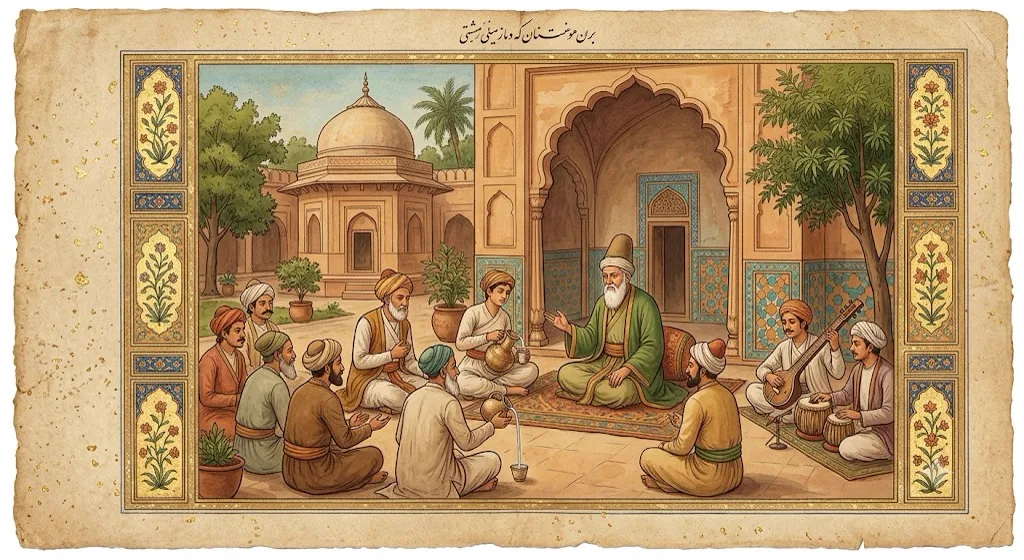
Miniature painting depicting a Sufi gathering (mehfil) in a khanqah courtyard.
Chapter 1
The Historical Ground from which the Movements Grew
By the time the Delhi Sultanate was consolidating power, several older religious and intellectual traditions had already begun to show strain. Brahmanical orthodoxy faced criticism from within through earlier heterodox voices. At the same time, the arrival of Islam introduced new theological languages and new forms of organised mysticism. Ordinary cultivators, artisans and women occupied a social world in which temple and mosque rituals often felt distant, expensive or exclusionary. Into this space stepped teachers who insisted that the divine could be approached directly, without elaborate mediation, and that sincere love mattered more than birth or formal learning.
Sufism entered the subcontinent mainly through the Chishti, Suhrawardi, Qadiri and Naqshbandi orders. Bhakti, though rooted in earlier Tamil and Sanskrit traditions, acquired new intensity and social edge in the Hindi, Marathi, Bengali and other vernacular regions during the same centuries. Both movements privileged experience over ritual formalism. Both produced literature that ordinary people could understand and sing. Both, in different degrees, questioned the equation of spiritual worth with social rank.
Chapter 2
Sufi Orders and Their Leading Voices
The Chishti order became the most influential in North India. Khwaja Moinuddin Chishti established his centre at Ajmer in the late twelfth century. His emphasis on love, tolerance and service to the poor set a tone that later Chishti saints continued. Nizamuddin Auliya of Delhi, living through the turbulent Khalji and early Tughlaq periods, developed a circle that attracted both Muslim and Hindu devotees. His conversations, preserved in the Fawa’id al-Fu’ad, repeatedly stress that the path to God lies through compassion and that rigid orthodoxy can become a veil. The practice of sama, or listening to music as a means of spiritual ecstasy, became a distinctive Chishti feature and occasionally invited criticism from more legalistic scholars.
Other orders followed different accents. The Suhrawardis maintained closer relations with political authority and emphasised a more sober discipline. The Qadiris and later Naqshbandis brought their own methods of remembrance and ethical training. Across these differences ran a common insistence on the purification of the heart, the importance of a living guide (pir), and the possibility that divine reality could be tasted in this life.
Sufi hospices (khanqahs) functioned as social institutions. They offered food, shelter and a measure of dignity to the poor. In doing so they created spaces where caste and sometimes even religious boundaries softened. The shrine of a major saint often became a shared sacred site long after the saint’s death, drawing pilgrims across community lines.
Chapter 3
Bhakti Saints and the Vernacular Revolution
Bhakti expressed itself through remarkably diverse voices. In the north, Kabir stands out for the sheer force of his critique. A weaver by caste, he rejected both Hindu and Muslim externalities with equal sharpness. His dohas mock the pandit and the mulla who claim exclusive knowledge while remaining strangers to the divine presence within. For Kabir the true Guru is internal; the true pilgrimage is into one’s own consciousness. His language is rough, direct and unforgettable.
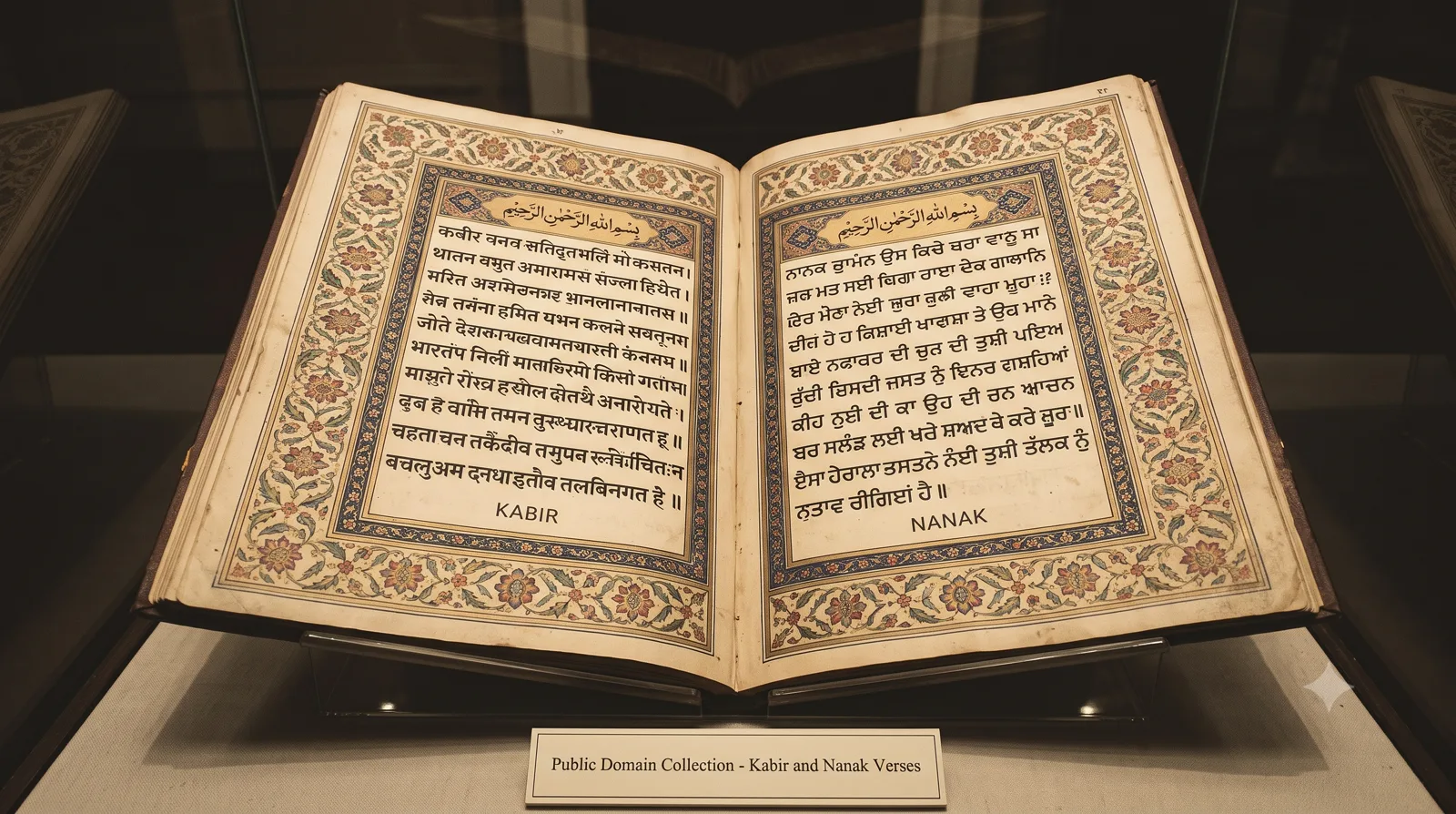
An illuminated manuscript displaying verses of Kabir and Guru Nanak.
Guru Nanak, roughly contemporary, carried a similar emphasis on the formless One and the futility of empty ritual into the Punjab. His teachings, later collected in the Guru Granth Sahib, stress honest labour, sharing, and equality before the divine Name. The community kitchen (langar) became a practical expression of that equality.
In Rajasthan and Gujarat, Mirabai’s bhajans gave voice to an intense, almost transgressive personal love for Krishna that refused the constraints of her royal and marital status. In Bengal, Chaitanya Mahaprabhu transformed devotion into collective, ecstatic singing and dancing that drew people across caste lines into the streets. In Maharashtra, the Varkari tradition associated with Namdev, Eknath and Tukaram created a continuous current of pilgrimage and abhang poetry that criticised social arrogance while remaining rooted in Vaishnava devotion. Tulsidas, writing in Awadhi, produced the Ramcharitmanas, which made the story of Rama accessible to vast numbers who could not read Sanskrit and simultaneously reinforced certain social ideals.
What united these very different figures was the decision to speak in the language of ordinary people and to locate spiritual authority in sincerity rather than in birth or scholarly pedigree.
Chapter 4
Points of Convergence and Difference
It is tempting to treat Bhakti and Sufism as mirror images. Both valued love, both criticised empty formalism, both produced poetry that still lives in popular memory. Yet important differences remained. Most Sufi orders operated within an Islamic theological frame even when they stretched its boundaries. Most Bhakti saints worked within, or at the edges of, Hindu mythological and philosophical vocabularies, even when they rejected caste orthodoxy. Kabir and Nanak occupy a more liminal space that later traditions have claimed in different ways.
At the social level the two movements often occupied overlapping physical and emotional spaces. Hindus visited Sufi shrines; Muslims listened to bhajans. Shared metaphors of the lover and the beloved, of the drop and the ocean, of the veil and the face, travelled freely between the traditions. This traffic did not produce a single syncretic religion, but it did create a climate in which rigid communal boundaries were harder to maintain in everyday religious life.
Chapter 6
Political Relations and Limits of the Movements
Neither Bhakti nor Sufism was inherently anti-state. Many Sufi saints accepted land grants or maintained cautious relations with sultans. Some Bhakti poets received patronage. Others, like Kabir, kept a pointed distance from both political and religious establishments. The movements could be co-opted, tolerated or occasionally harassed depending on the temperament of the ruler and the local balance of power. Their enduring influence came less from political confrontation than from the quiet transformation of religious sensibility among large sections of the population.
Chapter 7
Why the Topic Matters for Competitive Examinations
Questions on Bhakti and Sufism appear with regularity in UPSC, State PSC and SSC papers. They test several competencies at once: the ability to move beyond names and dates to ideas, the capacity to compare two traditions without forcing false equivalence, and the skill of linking religious history with social change. Aspirants are often asked to evaluate the role of these movements in promoting social harmony, to discuss the contribution of a particular saint, or to explain why vernacular literature flourished in this period. Answers that remain at the level of pious summary score poorly. Answers that demonstrate understanding of both the radical and the conservative elements within the movements score well.
The topic also connects usefully with later developments—Sikh history, the nineteenth-century reform movements, and contemporary debates about shared sacred spaces. A solid grasp of the medieval foundations therefore pays dividends across the syllabus.
Closing Perspective
"The Bhakti and Sufi movements did not create a utopian society. They did, however, keep alive a set of questions that no orthodoxy could permanently silence."
The Bhakti and Sufi movements did not create a utopian society. They did, however, keep alive a set of questions that no orthodoxy could permanently silence: Who has the right to speak of God? Does birth determine spiritual capacity? Can love dissolve the barriers that law and custom erect? In answering those questions through poetry, song, personal example and open hospitality, the saints of both traditions left an imprint on Indian social and religious life that remains visible centuries later. For the student of history the movements offer a reminder that profound change sometimes arrives not through conquest or legislation but through the stubborn insistence that the divine is closer than any institution admits.
Chapter 9
Frequently Asked Questions
What was the central teaching common to most Bhakti and Sufi saints?
How did Kabir’s approach differ from more conventional Bhakti poets?
In what ways did Sufi khanqahs influence medieval Indian society?
Why are Bhakti and Sufi movements important for competitive examinations?
Don't Just Reread It
Don't just reread the narrative — solve the matching previous-year questions and compare your answers with the structured notes.
Continue on RRBCONTENTS
Explore More
Knowledge Hub
More Blog Articles
In-depth, exam-focused articles on Indian history, geography, culture and static GK.
Study Material
Exam Study Notes
Subject-wise notes and digests for Railway, SSC, Banking and State PSC exams.
Current Affairs
Daily Current Affairs & GK
Daily updates and static GK bank with active-recall quizzes for GS preparation.
Chapter 5
Social Impact: Caste, Gender and Community
The most consequential social claim made by both movements was that spiritual worth is not determined by birth. Kabir’s contempt for caste pride, Nanak’s langar, Chaitanya’s disregard for conventional barriers, and the Chishti openness to all seekers chipped away at the idea that purity and pollution should dictate access to the sacred. The effect was never revolutionary in a political sense. Caste did not disappear. Yet a moral alternative had been publicly articulated and embodied by figures of high prestige. That alternative remained available for later social reformers to draw upon.
Women found, in certain Bhakti voices, a language of direct devotion that bypassed male ritual specialists. Mirabai is the most celebrated example, but she was not alone. The presence of women in some Sufi circles, though more restricted, also complicated simple patriarchal assumptions. At the same time, many Bhakti and Sufi texts continued to use hierarchical or gendered imagery, so the record is mixed rather than uniformly emancipatory.
The movements also strengthened vernacular literary cultures. By choosing Hindi, Marathi, Punjabi, Bengali and other languages, the saints helped create public spheres of devotion and discussion outside the control of Sanskrit or Persian elites. The long-term cultural consequences of that linguistic choice are difficult to overstate.