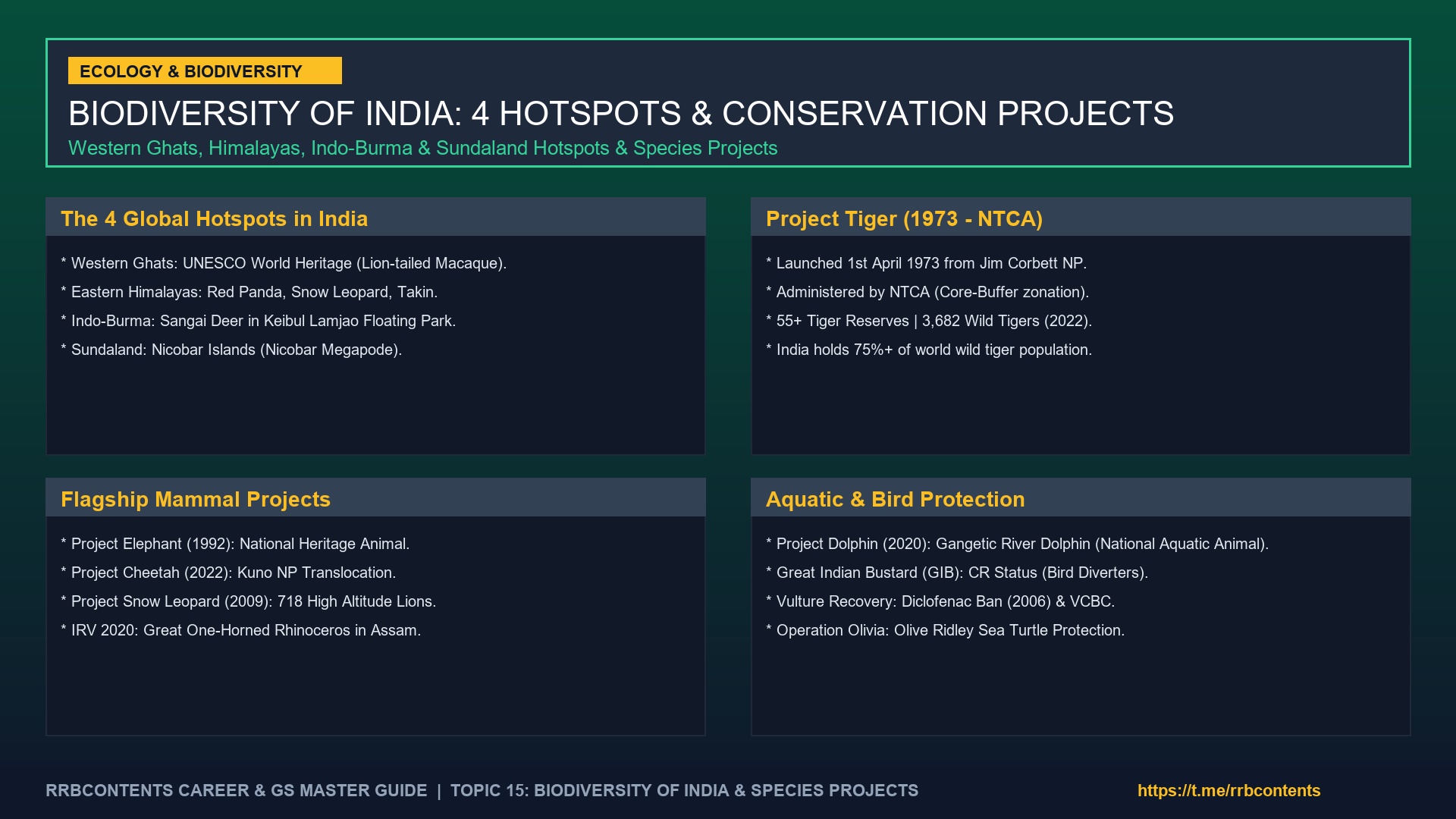
BIODIVERSITY OF INDIA: 10 BIOGEOGRAPHIC ZONES, 4 GLOBAL HOTSPOTS, IUCN RED LIST SPECIES & SPECIES CONSERVATION PROJECTS (COMPLETE GUIDANCE FOR COMPETITIVE EXAMS)
- National Gene Bank (NGB): Located at ICAR-National Bureau of Plant Genetic Resources (NBPGR), New Delhi, housing over 4.5 lakh crop seed germplasm accessions.
- Svalbard Global Seed Vault: Global seed backup facility in Norway holding duplicate backup seeds of Indian crop varieties.
Chapter 1
INTRODUCTION
India is universally celebrated as one of the world's 17 "Megadiverse Nations". Occupying just 2.4% of the Earth's total land area, India harbors an extraordinary 7% to 8% of all recorded global species of flora and fauna. This exceptional biodiversity is driven by India's vast geographic diversity—spanning snow-capped Himalayan peaks and arid Rajasthan deserts to lush Western Ghats rainforests, mangrove estuaries, and tropical coral island archipelagos.
Biodiversity provides essential ecosystem services that sustain human life—including climate regulation, watershed protection, agricultural crop pollination, soil fertility maintenance, and medicinal resources. However, habitat fragmentation, deforestation, illegal wildlife poaching, invasive alien species, and climate change pose severe threats to India's natural heritage.
To protect these priceless ecological assets, India has designated Four Global Biodiversity Hotspots (Western Ghats, Eastern Himalayas, Indo-Burma, and Sundaland) and established an extensive network of Protected Areas (PAs) comprising over 100 National Parks, 560+ Wildlife Sanctuaries, 55+ Tiger Reserves, and 18 Biosphere Reserves (12 recognized under the UNESCO MAB Program).
Furthermore, India has spearheaded landmark species-specific recovery initiatives—such as Project Tiger (1973), Project Elephant (1992), Project Snow Leopard (2009), Project Dolphin (2020), and the Vulture Conservation Breeding Programme to rescue critically endangered species from the brink of extinction.
For aspirants preparing for competitive examinations such as UPSC Civil Services (GS Paper III Environment & Ecology), State Public Service Commissions (BPSC, UPPSC, MPPSC, RAS), SSC CGL, and Forestry services, a thorough mastery of biogeographic zones, 4 hotspot criteria, IUCN Red List categories (CR, EN, VU), and species conservation projects is essential.
This comprehensive master career guide provides an exhaustive breakdown of Biodiversity of India. We cover every ecological detail—from 10 biogeographic zones and 4 hotspot profiles to IUCN critically endangered species, Project Tiger NTCA rules, 12 exam-focused FAQs, and essential revision tools.
---
- Lantana camara: Exotic shrub suppressing native forest undergrowth in Western Ghats and tiger reserves.
- Water Hyacinth (Eichhornia crassipes): 'Terror of Bengal' suffocating freshwater lakes and wetlands.
- Prosoppis juliflora (Vilayati Kikar): Invasive tree depleting groundwater in arid ecosystems.
- Prosopis juliflora & Parthenium hysterophorus (Carrot Grass).
Chapter 2
INDIA'S 10 BIOGEOGRAPHIC ZONES
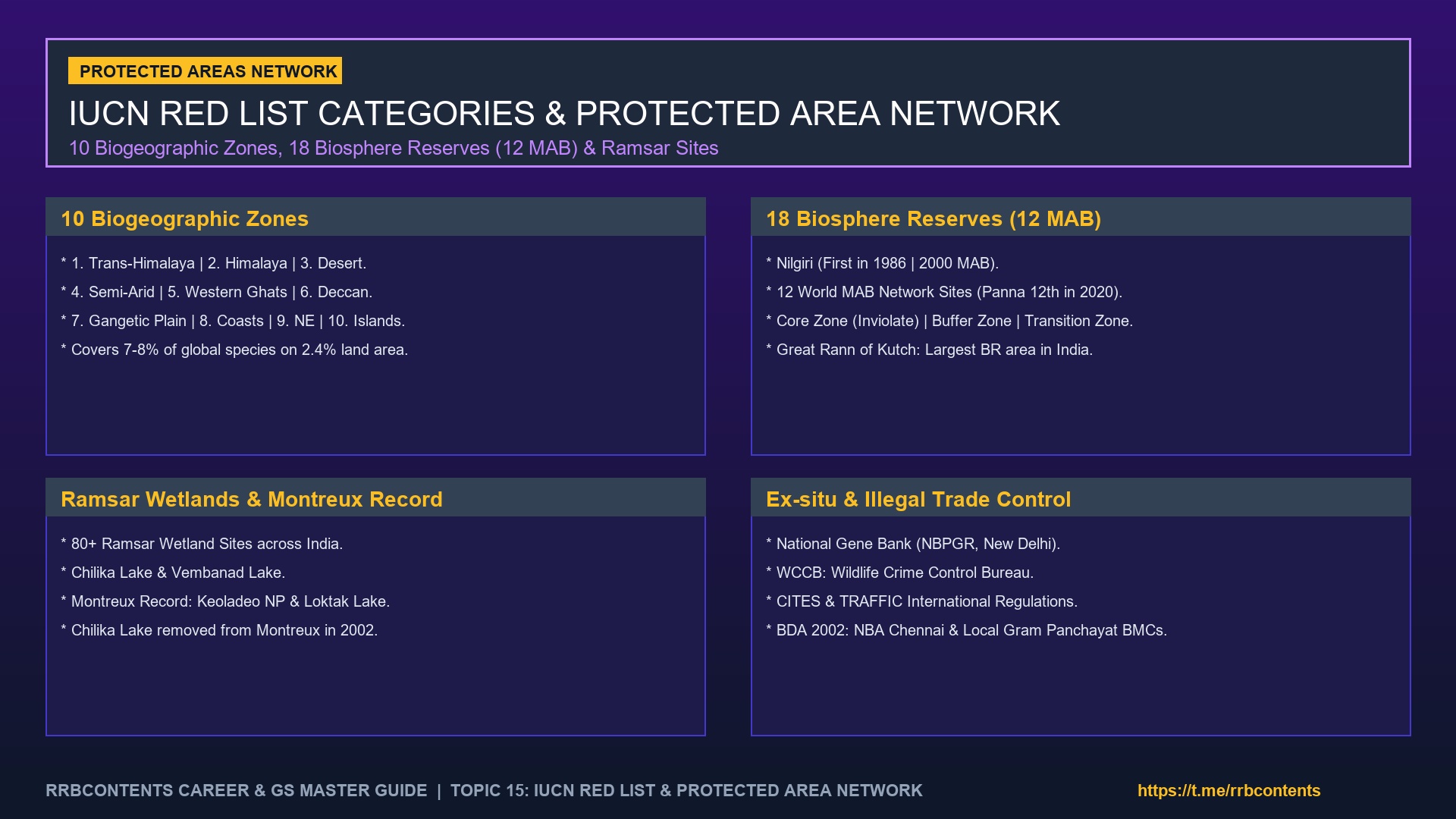
INDIA'S 10 BIOGEOGRAPHIC ZONES - Illustrative Reference
India's 10 Biogeographic Zones
├── 1. Trans-Himalaya (Ladakh, Lahaul-Spiti, High altitude cold desert)
├── 2. Himalaya (North-West, West, Central & East Himalayan ranges)
├── 3. Desert (Thar Desert & Rann of Kutch)
├── 4. Semi-Arid (Transition zone: Gujarat, Rajasthan, Punjab, Haryana)
├── 5. Western Ghats (Western coastal mountain chain - High Endemism)
├── 6. Deccan Peninsula (Largest zone covering central & southern plateau)
├── 7. Gangetic Plain (Fertile alluvial plains of North India)
├── 8. Coasts (7,516 km coastline: Mangroves, Estuaries, Beaches)
├── 9. North-East India (Transition zone between Indian & Malayan fauna)
└── 10. Islands (Andaman & Nicobar Islands & Lakshadweep)
---
Biosphere Reserve Zonation Architecture
├── 1. Core Zone (Strictly protected inviolate area for natural ecosystem processes)
├── 2. Buffer Zone (Surrounds core; used for research, education & regulated ecotourism)
└── 3. Transition Zone (Outermost zone; sustainable human settlements & agriculture)
- Total Biosphere Reserves in India: 18 Biosphere Reserves.
- UNESCO MAB World Network: 12 Biosphere Reserves recognized under UNESCO's MAB Program (Nilgiri - first in 2000, Gulf of Mannar, Sunderbans, Nanda Devi, Nokrek, Pachmarhi, Similipal, Achanakmar-Amarkantak, Great Nicobar, Agasthyamala, Khangchendzonga, Panna).
- Ramsar Convention (1971): International treaty for conservation of wetlands signed in Ramsar, Iran. India became a contracting party in 1982.
- Network in India: India has 80+ Ramsar Sites (largest in South Asia), covering major wetlands like Chilika Lake (Odisha), Loktak Lake (Manipur), Keoladeo National Park (Rajasthan), Vembanad Lake (Kerala), and Sundarbans (West Bengal).
- The Montreux Record: A register of Ramsar sites where changes in ecological character have occurred, are occurring, or are likely to occur due to technological developments or pollution. Two Indian sites are currently listed in the Montreux Record: Keoladeo National Park (Rajasthan) and Loktak Lake (Manipur). (Chilika Lake was removed in 2002 after successful ecological restoration).
Chapter 3
THE 4 GLOBAL BIODIVERSITY HOTSPOTS IN INDIA
1. High Endemism: It must contain at least 1,500 species of endemic vascular plants (>0.5% of the world's total).
2. High Degree of Threat: It must have lost at least 70% of its original primary native vegetation.
The 4 Biodiversity Hotspots in India
├── 1. Western Ghats (and Sri Lanka): UNESCO World Heritage Site | Lion-tailed Macaque, Nilgiri Tahr
├── 2. Eastern Himalayas: Spans Sikkim, Arunachal Pradesh | Red Panda, Snow Leopard
├── 3. Indo-Burma: Covers Northeast India south of Brahmaputra & Andaman Islands | Sangai Deer
└── 4. Sundaland: Includes Nicobar Islands chain | Nicobar Megapode, Saltwater Crocodile
---
| Hotspot Name | Geographic Extent in India | Flagship Endemic Species | Key Ecological Threat |
|---|---|---|---|
| 1. Western Ghats | Mountain chain along West Coast (Gujarat to Kerala) | Lion-tailed Macaque, Nilgiri Tahr, Purple Frog, Malabar Civet | Monoculture plantations, mining & urban fragmentation |
| 2. Eastern Himalayas | Sikkim, West Bengal hills, Arunachal Pradesh | Red Panda, Snow Leopard, Himalayan Serow, Mishmi Takin | Deforestation, road expansion & climate warming |
| 3. Indo-Burma | NE States (Assam, Manipur, Mizoram, Nagaland, Tripura) | Sangai (Manipuri Brow-antlered Deer), Hoolock Gibbon | Shifting cultivation (Jhumming) & poaching |
| 4. Sundaland | Nicobar Group of Islands | Nicobar Megapode, Saltwater Crocodile, Tree Shrew | Tsunami vulnerability & coastal development |
---
Chapter 4
IUCN RED LIST CATEGORIES & CRITICALLY ENDANGERED SPECIES IN INDIA
IUCN Red List Categories Spectrum
├── 1. Extinct (EX) & Extinct in the Wild (EW)
│      ├── Critically Endangered (CR) - Extremely high risk of extinction in immediate future
│      ├── Endangered (EN) - Very high risk of extinction in wild
│      └── Vulnerable (VU) - High risk of endangerment in wild
└── 3. Lower Risk Categories: Near Threatened (NT) & Least Concern (LC)
1. Great Indian Bustard (GIB) (Ardeotis nigriceps):
- Status: Critically Endangered (CR). State Bird of Rajasthan.
- Habitat: Arid grasslands (Desert National Park, Jaisalmer).
- Threat: Power line collisions (Mitigated by installing Bird Diverters on overhead transmission lines).
2. Pygmy Hog (Porcula salvania):
- Status: Critically Endangered (CR). World's smallest and rarest wild pig.
- Habitat: Tall wet alluvial grasslands of Manas National Park, Assam.
3. Hangul / Kashmir Stag (Cervus hanglu hanglu):
- Status: Critically Endangered (CR). Subspecies of Red Deer.
- Habitat: Dachigam National Park, Jammu & Kashmir.
4. Gharial (Gavialis gangeticus):
- Status: Critically Endangered (CR). Distinctive long, narrow snout with a bulbous 'ghara'.
- Habitat: Clean riverine systems (National Chambal Sanctuary).
5. Namdapha Flying Squirrel (Biswamoyopterus biswasi):
- Status: Critically Endangered (CR). Endemic to Namdapha National Park, Arunachal Pradesh.
---
Chapter 5
MAJOR SPECIES CONSERVATION PROJECTS IN INDIA
Flagship Species Conservation Projects
├── 1. Project Tiger (1973 - Administered by NTCA | 55+ Tiger Reserves | ~3,682 Tigers)
├── 2. Project Elephant (1992 - Declared Elephant as National Heritage Animal)
├── 3. Project Snow Leopard (2009 - High altitude Himalayan conservation)
├── 4. Project Dolphin (2020 - Gangetic River Dolphin - National Aquatic Animal)
├── 5. Vulture Conservation Project (Diclofenac ban & breeding centers)
└── 6. Indian Rhino Vision 2020 (IRV2020 - Kaziranga & Manas One-Horned Rhinos)
---
Chapter 6
# Deep Dive: Project Cheetah — World's First Intercontinental Wild Carnivore Translocation:
- Background: The Asiatic Cheetah (Acinonyx jubatus venaticus) was officially declared extinct in India in 1952 due to overhunting and habitat destruction.
- Translocation Initiative: Under Action Plan for Reintroduction of Cheetah in India, wild African Cheetahs (Acinonyx jubatus jubatus) were translocated from Namibia (8 cheetahs) and South Africa (12 cheetahs) to Kuno National Park in Madhya Pradesh.
- Objectives: Establish a self-sustaining wild cheetah population, restore India's open forest and grassland ecosystems, and enhance ecotourism livelihoods.
- Launched From: Jim Corbett National Park, Uttarakhand.
- Statutory Oversight: National Tiger Conservation Authority (NTCA) created under 2006 Amendment to Wildlife Protection Act 1972.
- Core-Buffer Strategy:
- Critical Tiger Habitat (Core Area): Kept inviolate for wildlife conservation.
- Buffer Area: Peripheral area supporting sustainable local community land use.
- 2022 Census Result: India's wild tiger population reached 3,682 tigers (holding over 75% of global wild tiger population).
- 55th Tiger Reserve: Dholpur-Karauli / Veerangana Durgavati Tiger Reserves.
---
- Launched: 1992 as a Centrally Sponsored Scheme.
- National Heritage Animal: Asian Elephant declared India's National Heritage Animal in 2010.
- Elephant Corridors & MIKE Program: Protects 100+ migratory elephant corridors. Operates under the CITES MIKE (Monitoring the Illegal Killing of Elephants) program.
---
- National Aquatic Animal: The Gangetic River Dolphin (Platanista gangetica) was declared India's National Aquatic Animal in 2009.
- Key Feature: Blind freshwater mammal navigating via Echolocation (Ultrasonic Click Sounds). Locally called "Susu".
- First Dolphin Sanctuary: Vikramshila Gangetic Dolphin Sanctuary in Bhagalpur district, Bihar.
---
Chapter 7
# 4. VULTURE CONSERVATION PROGRAMME & THE DICLOFENAC CRISIS
- The Crisis: During the 1990s, India lost over 99% of its Gyps vulture population (White-rumped, Long-billed, and Slender-billed vultures).
- Root Cause: Ingestion of livestock carcasses treated with Diclofenac—a non-steroidal anti-inflammatory drug (NSAID) that causes rapid visceral gout and kidney failure in vultures.
- Government Action: Banned veterinary use of Diclofenac in 2006. Established Vulture Conservation Breeding Centres (VCBC) at Pinjore (Haryana), Rani (Assam), and Bhopal.
---
1. CITES (Convention on International Trade in Endangered Species): International agreement between governments ensuring international trade in wild animals and plants does not threaten their survival. Operates 3 Appendices (Appendix I: Highest commercial trade ban).
2. TRAFFIC (Trade Records Analysis of Fauna and Flora in Commerce): Leading global wildlife trade monitoring network operating as a joint conservation program of WWF and IUCN.
Pavitra Vana or Orans (Rajasthan), Kavu (Kerala), Devarakadu (Karnataka), and Sacred Groves of Meghalaya (Khasi Hills) protected traditionally by indigenous local communities under sacred cultural taboos.
Chapter 8
IMPORTANCE FOR COMPETITIVE EXAMS & QUICK REVISION
1. 4 Hotspots in India: Western Ghats, Eastern Himalayas, Indo-Burma, Sundaland (Nicobar).
2. Project Tiger (1973): Administered by NTCA; Core-Buffer model; 3,682 wild tigers (75% world total).
3. Project Elephant (1992): Elephant is National Heritage Animal (2010); MIKE Sites.
4. Gangetic Dolphin: National Aquatic Animal (2009); Blind, echolocation navigation (Susu); Vikramshila Sanctuary (Bihar).
---
Chapter 9
FREQUENTLY ASKED QUESTIONS (FAQS)
Answer: There are Four Biodiversity Hotspots in India: Western Ghats, Eastern Himalayas, Indo-Burma, and Sundaland (Nicobar Islands).
Answer: British ecologist Norman Myers in 1988.
Chapter 10
# Q3: What is the statutory body overseeing Project Tiger in India?
Answer: The National Tiger Conservation Authority (NTCA), established under the Wildlife (Protection) Act, 1972 (amended in 2006).
Answer: The Asian Elephant, officially declared as India's National Heritage Animal in 2010.
Answer: The Gangetic River Dolphin (Platanista gangetica), declared in 2009.
Chapter 11
# Q6: Which veterinary drug caused the catastrophic decline of vultures in India?
Answer: Diclofenac, a non-steroidal anti-inflammatory drug (NSAID) given to cattle, which caused kidney failure and visceral gout in feeding vultures.
Answer: The Vikramshila Gangetic Dolphin Sanctuary in Bhagalpur district, Bihar.
Chapter 12
# Q8: What is the IUCN status of the Great Indian Bustard (GIB)?
Answer: Critically Endangered (CR).
Chapter 13
# Q9: What is the IUCN status of the Sangai (Manipuri Brow-antlered Deer)?
Answer: Endangered (EN), found exclusively in Keibul Lamjao National Park (Loktak Lake, Manipur).
Answer: At Jim Corbett National Park in Uttarakhand on 1st April 1973.
Answer: MIKE (Monitoring the Illegal Killing of Elephants), an international program established under CITES to track wild elephant poaching.
Chapter 14
# Q12: Which national park in Assam is famous as the primary habitat of the One-Horned Rhinoceros?
Answer: Kaziranga National Park, hosting over two-thirds of the world's Great One-Horned Rhinoceros population.
---
Chapter 15
# Q13: Where were the African Cheetahs translocated under Project Cheetah in 2022?
Answer: African Cheetahs were translocated to Kuno National Park in Madhya Pradesh from Namibia and South Africa.
Chapter 16
# Q14: How many Biosphere Reserves in India are included in the UNESCO MAB World Network?
Answer: 12 out of India's 18 Biosphere Reserves are recognized under the UNESCO Man and the Biosphere (MAB) Program (Panna was the 12th in 2020).
Chapter 17
# Q15: What is the only floating national park in the world?
Answer: Keibul Lamjao National Park on Loktak Lake in Manipur, home to the endangered Sangai Deer.
Answer: A register of wetland sites of international importance where ecological character changes have occurred due to pollution or human interference (Keoladeo NP and Loktak Lake are in India's Montreux Record).
Chapter 18
# Q17: Which Indian site was successfully removed from the Montreux Record in 2002?
Answer: Chilika Lake in Odisha was removed from the Montreux Record after successful ecological restoration of its lagoon mouth.
- 4 Major Coral Reef Regions: Andaman & Nicobar Islands (fringing reefs), Lakshadweep Islands (atolls), Gulf of Mannar (barrier-like fringing reefs), and Gulf of Kutch (patch reefs).
- Ecological Threats: Coral bleaching caused by sea surface temperature warming, sedimentation, and illegal coral mining.
Chapter 19
IN-SITU VS EX-SITU CONSERVATION METHODS
| Conservation Strategy | Definition | Examples |
|---|---|---|
| In-Situ Conservation | Protection of species within their natural habitat and natural ecosystem. | National Parks, Wildlife Sanctuaries, Biosphere Reserves, Tiger Reserves, Sacred Groves. |
| Ex-Situ Conservation | Protection of threatened species outside their natural habitat in artificially controlled environments. | Zoological Parks (Zoos), Botanical Gardens, Seed Banks, Gene Banks, Cryopreservation Facilities. |
---
Chapter 20
# Sacred Groves of India:
- Forest patches protected by local communities through traditional religious beliefs and cultural taboos.
- Act as crucial refuges for endemic, rare, and threatened flora and fauna.
- Known locally as: Kavu (Kerala), Devarakadu (Karnataka), Oran (Rajasthan), Law Kyntang (Meghalaya), Jahera (Jharkhand).
---
Chapter 21
# Critical Wildlife Habitats (CWH):
- Defined under the Forest Rights Act, 2006 (FRA).
- Areas within National Parks and Sanctuaries required to be kept inviolate for wildlife conservation.
- Can be notified only with the informed consent of affected Gram Sabhas and after tribal settlement process is complete.
---
Chapter 22
CONCLUSION
India's rich biodiversity is a priceless national heritage requiring rigorous, sustained conservation efforts. By protecting the four global biodiversity hotspots, expanding tiger and elephant reserves under the NTCA and Project Elephant, enforcing strict bans on toxic veterinary drugs like Diclofenac, and empowering local communities through Biodiversity Management Committees (BMCs), India models successful ecological stewardship.
For competitive exam aspirants, mastering 4 hotspot locations, IUCN Red List species categories, Project Tiger core-buffer rules, and species recovery initiatives guarantees complete preparation for scoring top marks in Environment and Ecology.
👉 Official Career Portal: [https://rrbcontents.com](https://rrbcontents.com)
👉 Official Telegram Channel: [Join RRBCONTENTS Telegram (@rrbcontents)](https://t.me/rrbcontents)
---
Chapter 23
ADDITIONAL EXAM INSIGHTS & CASE STUDIES
---
Chapter 24
# INDIA'S 4 GLOBAL BIODIVERSITY HOTSPOTS — DETAILED SPECIES PROFILE
The concept of Biodiversity Hotspots was introduced by British ecologist Norman Myers in 1988. A region qualifies as a Biodiversity Hotspot only if it meets two strict criteria:
Chapter 25
1. Contains at least 1,500 species of endemic vascular plants (more than 0.5% of the world's total)
Chapter 26
2. Has lost at least 70% of its original primary native vegetation
| Hotspot | States / Territory in India | Total Vascular Plant Endemics | Key Endemic Fauna | Primary Threats |
|---|---|---|---|---|
| Western Ghats (and Sri Lanka) | Karnataka, Kerala, Tamil Nadu, Goa, Maharashtra, Gujarat (partial) | 3,049 endemic plant species; 325 endemic vertebrates | Lion-tailed Macaque, Nilgiri Tahr, Purple Frog (Nasikabatrachus sahyadrensis), Malabar Giant Squirrel, Malabar Civet | Monoculture plantations (tea, eucalyptus), illegal mining, road expansion, urbanization |
| Eastern Himalayas (Himalaya Hotspot) | Sikkim, West Bengal (Darjeeling), Arunachal Pradesh, eastern Meghalaya | 3,500+ endemic plant species; 75 endemic mammals | Red Panda, Snow Leopard, Mishmi Takin, Himalayan Serow, Clouded Leopard | Deforestation, hydropower construction, road expansion, climate warming |
| Indo-Burma | Assam (south of Brahmaputra), Manipur, Mizoram, Nagaland, Tripura, Meghalaya | 1,300+ endemic plant species; multiple endemic vertebrates | Sangai (Manipuri Brow-antlered Deer), Hoolock Gibbon, Capped Langur, Burmese Star Tortoise | Jhum (shifting) cultivation, poaching, dam construction, land conversion |
| Sundaland (Nicobar Islands portion) | Nicobar Islands (southern group) | 860+ endemic plant species in Indian Nicobar portion | Nicobar Megapode, Saltwater Crocodile, Nicobar Tree Shrew, Leatherback Sea Turtle | Tsunami vulnerability, coastal development, invasive species |
Exam Tip: Western Ghats is also a UNESCO World Heritage Site (inscribed 2012). It is sometimes called the "cradle of speciation" for amphibians — hosting over 120 endemic frog species.
---
Chapter 27
# INDIA'S 10 BIOGEOGRAPHIC ZONES — COMPLETE TABLE
| Zone No. | Zone Name | States / Territory | Representative Species |
|---|---|---|---|
| 1 | Trans-Himalaya | Ladakh, Lahaul-Spiti (HP), North Sikkim | Snow Leopard, Tibetan Antelope (Chiru), Tibetan Wild Ass (Kiang) |
| 2 | Himalaya | J&K, Himachal Pradesh, Uttarakhand, North-East Himalayan ranges | Brown Bear, Monal Pheasant, Western Tragopan |
| 3 | Desert | Western Rajasthan (Thar), Rann of Kutch (Gujarat) | Great Indian Bustard, Blackbuck, Indian Wild Ass |
| 4 | Semi-Arid | Eastern Rajasthan, Gujarat, Punjab, Haryana, parts of Deccan | Wolf, Chinkara, Indian Fox |
| 5 | Western Ghats | Coastal chain from Gujarat-Maharashtra border to Kerala tip | Lion-tailed Macaque, Nilgiri Tahr, King Cobra |
| 6 | Deccan Peninsula | Madhya Pradesh, Maharashtra, Andhra Pradesh, Karnataka, Telangana | Sloth Bear, Gaur (Indian Bison), Indian Leopard |
| 7 | Gangetic Plain | Uttar Pradesh, Bihar, parts of Haryana, West Bengal | Gangetic Dolphin, Bengal Tiger, One-Horned Rhino (eastern end) |
| 8 | Coasts | 7,516 km coastline including Sundarbans mangroves | Olive Ridley Turtle, Saltwater Crocodile, Dugong |
| 9 | North-East India | Assam, Meghalaya, Nagaland, Manipur, Tripura, Mizoram, Arunachal | One-Horned Rhino, Hoolock Gibbon, Sangai Deer |
| 10 | Islands | Andaman and Nicobar Islands, Lakshadweep | Andaman Wild Pig, Nicobar Megapode, Sea Turtle species |
---
Chapter 28
# WILDLIFE PROTECTION ACT 1972 — 6 SCHEDULES (ORIGINAL) AND 2022 AMENDMENT
Original WPA 1972 — 6 Schedules:
| Schedule | Category | Examples | Protection Level |
|---|---|---|---|
| I | Highest protection — endangered species | Bengal Tiger, Indian Elephant, Snow Leopard, GIB, Blackbuck, Nilgiri Tahr, Lion, Gangetic Dolphin, Dugong, One-Horned Rhino | Maximum penalties; no hunting, possession, or trade |
| II | Hunting prohibited but penalties lower | Himalayan Black Bear, Hyena, Jackal, Mongoose | High protection |
| III | Hunting regulated; licenses may be issued | Nilgai, Barking Deer, Flying Fox | Moderate protection |
| IV | Can be hunted with licenses | Certain birds, smaller mammals, insects | Limited protection |
| V | Vermin — can be killed | Common Crow, Fruit Bats, Rats, Mice | Minimal protection |
| VI | Specified Plants — trade and cultivation regulated | Red Vanda (Orchid), Blue Vanda, Pitcher Plant | Plant protection |
WPA Amendment Act 2022 — Restructured to 4 Schedules:
| New Schedule | Equivalent Old Schedule | Category |
|---|---|---|
| Schedule I | Old Schedule I + II | Highest protected animals |
| Schedule II | Old Schedule IV | Lower-protection animals |
| Schedule III | Old Schedule V | Vermin species |
| Schedule IV | Old Schedule VI | Protected plants (including CITES Appendix specimens) |
Key Change: Old Schedules III and IV merged; Schedule V (vermin) renumbered; CITES specimens now part of Schedule IV. The 2022 amendment also recognized "invasive alien species" and granted NTCA enhanced enforcement powers.
---
Chapter 29
# PROJECT TIGER 1973 — COMPREHENSIVE FACTS
- Launch Date: 1st April 1973 at Jim Corbett National Park, Uttarakhand
- Trigger: In 1972, India's tiger population had crashed to an estimated 1,827 individuals from over 40,000 at the start of the 20th century — due to hunting, habitat loss, and prey base depletion.
- Legal Framework: NTCA (National Tiger Conservation Authority) created under the Wildlife (Protection) Amendment Act 2006; now a statutory body with suo motu powers.
- Core-Buffer Model:
- Critical Tiger Habitat (CTH/Core): Inviolate zone where no human activity is permitted; 800+ villages have been voluntarily relocated from Tiger Reserve cores.
- Buffer/Fringe Area: Peripheral area where local community activities are managed through co-existence programs.
- Tiger Census Results:
| Year | Tiger Count | Method |
|---|---|---|
| 1973 | 1,827 | Manual pugmark method |
| 2006 | 1,411 | Camera trap + GIS (wake-up call) |
| 2010 | 1,706 | Camera trap (Project Monitoring System) |
| 2014 | 2,226 | Camera trap + occupancy modeling |
| 2018 | 2,967 | Camera trap (phase IV census) |
| 2022 | 3,682 | Camera trap + AI-assisted identification |
- 2022 Tiger Census: India holds 75% of the world's wild tiger population — a conservation triumph endorsed globally.
- Number of Tiger Reserves: India currently has 55 Tiger Reserves spanning 18 states.
- Largest Tiger Reserve: Nagarjunasagar-Srisailam Tiger Reserve (Telangana/Andhra Pradesh) — over 3,728 sq km.
- Newest Tiger Reserve: Veerangana Durgavati Tiger Reserve, Madhya Pradesh (notified 2023).
---
Chapter 30
# PROJECT ELEPHANT 1992 — ELEPHANT AS NATIONAL HERITAGE ANIMAL
- Launched: 1992 as a Centrally Sponsored Scheme under MoEFCC
- Elephant Reserves: India currently has 33 Elephant Reserves across 14 states — Assam, Arunachal Pradesh, West Bengal, Jharkhand, Odisha, Chhattisgarh, Uttarakhand, Himachal Pradesh, Uttar Pradesh, Karnataka, Kerala, Tamil Nadu, Andhra Pradesh, and Maharashtra.
- National Heritage Animal: Asian Elephant declared India's National Heritage Animal in 2010 (replacing the Bull, which was only the logo animal of the Dept. of Revenue).
- Elephant Corridors: Project Elephant has identified and works to protect 101 elephant corridors — narrow strips of forest/land enabling elephants to move between habitats. Many corridors are threatened by roads, railways, and agriculture.
- MIKE Program: India participates in the CITES MIKE (Monitoring Illegal Killing of Elephants) program which tracks elephant poaching deaths across 65 sites in Africa and Asia.
- Human-Elephant Conflict: India records approximately 400-500 human deaths per year due to human-elephant conflict — one of the highest globally. Conflict hotspots include Assam, West Bengal, Odisha, and Kerala.
- Elephant Census 2017: India's elephant population estimated at 29,964 — approximately 60% of Asia's total wild elephant population.
---
Chapter 31
# PROJECT CHEETAH 2022 — WORLD'S FIRST INTERCONTINENTAL CARNIVORE TRANSLOCATION
- Background: The Asiatic Cheetah (Acinonyx jubatus venaticus) was declared extinct in India in 1952 — the last three cheetahs were shot by Maharaja Ramanuj Pratap Singh Deo of Surguja in what is now Chhattisgarh.
- Scientific Decision: Since Asiatic Cheetahs survive only in Iran (fewer than 40 individuals), with no prospect of sourcing them for reintroduction, the Wildlife Institute of India (WII) decided to use the closely related African Cheetah (Acinonyx jubatus jubatus).
- Phase 1 — Namibia (September 2022): PM Narendra Modi personally received 8 cheetahs (5 female, 3 male) from Namibia at Kuno National Park.
- Phase 2 — South Africa (February 2023): 12 more African cheetahs (7 male, 5 female) translocated from South Africa.
- Kuno National Park: Located in Sheopur district, Madhya Pradesh; chosen after a comprehensive habitat suitability assessment by the Supreme Court-appointed Committee and WII experts.
- Objective: Establish a self-sustaining population of 40-50 cheetahs over 15 years; restore open grassland and dry deciduous forest ecosystems; revive predator-prey balance.
---
The Great Indian Bustard (Ardeotis nigriceps) is at the absolute brink of extinction — with fewer than 150 individuals surviving in the wild (2023 estimate):
- IUCN Status: Critically Endangered (CR)
- State Bird of: Rajasthan
- Last strongholds: Desert National Park (DNP), Jaisalmer district, Rajasthan; Naliya grasslands, Gujarat
- Primary Threat: Collision with overhead power transmission lines during flight. As a heavy bird (up to 15 kg — heaviest flying bird in India), GIB cannot rapidly change flight direction to avoid cables.
- Supreme Court Intervention: In a landmark 2021 judgment (M.K. Ranjitsinh v. Union of India), the SC ordered that overhead power lines in GIB habitat in Rajasthan and Gujarat be converted to underground cables — but later modified this order in 2024 acknowledging technical feasibility constraints, allowing diverters instead.
- Vikram Solar Park Controversy: Large solar parks being built in Jaisalmer (Pokaran, Fatehgarh) overlap with GIB core habitat areas — creating a tension between renewable energy expansion (Panchamrit targets) and GIB conservation.
- Conservation Actions: An "Emergency Response" breeding program has been set up at Sam, Jaisalmer with eggs harvested from wild nests for captive incubation at Jaisalmer Breeding Centre.
---
Chapter 32
# PROJECT DOLPHIN 2020 — GANGETIC RIVER DOLPHIN
- National Aquatic Animal: Gangetic River Dolphin (Platanista gangetica) was declared India's National Aquatic Animal in 2009.
- Project Dolphin: Announced by PM Modi on Independence Day 2020; aims to protect both the Gangetic River Dolphin (river) and the Irrawaddy Dolphin (coastal/estuarine).
- Habitat: Gangetic-Brahmaputra-Meghna and Karnaphuli-Sangu river systems in India, Bangladesh, Nepal.
- Special Feature: Functionally blind — navigates entirely through echolocation (biosonar) by emitting ultrasonic clicks. Locally called "Susu" for the sound it makes breathing.
- First Dolphin Sanctuary: Vikramshila Gangetic Dolphin Sanctuary, Bhagalpur district, Bihar (60.5 km stretch of Ganga between Sultanganj and Kahalgaon).
- Population: Estimated at approximately 3,000-4,000 individuals across Indian rivers; classified as Endangered (EN) on IUCN Red List.
- Threats: Accidental entanglement in fishing nets, sand mining disturbing riverbed habitat, water extraction reducing river flows, and oil spills.
---
Chapter 33
# RAMSAR WETLAND SITES IN INDIA — 80+ SITES
- Current Count: India has 80+ Ramsar sites (as of 2024), covering over 1.3 million hectares of wetland area.
- First Two Ramsar Sites (1981): Chilika Lake (Odisha) and Keoladeo National Park (Rajasthan) — designated in 1981 when India first ratified the Ramsar Convention.
- Largest Ramsar Site: Sundarbans Wetland, West Bengal — covering 4,23,000 hectares; also a UNESCO World Heritage Site.
- Most Ramsar Sites per State: Uttar Pradesh (10+ sites including Nawabganj, Sandi, Samaspur, Sur Sarovar, Bakhira, Parvati Agra, Sarsai Nawar, Upper Ganga).
Montreux Record — Indian Entries:
| Site | State | Reason for Listing | Current Status |
|---|---|---|---|
| Keoladeo National Park | Rajasthan | Reduction of water inflow; tourist pressure affecting bird breeding | Still listed in Montreux Record |
| Loktak Lake | Manipur | Phumdis (floating biomass) degradation; Ithai Barrage impacts | Still listed in Montreux Record |
| Chilika Lake | Odisha | Reduced salinity; siltation; fishing pressure | REMOVED from Montreux Record in 2002 after successful restoration |
---
Prepare with RRBCONTENTS
Free mock tests, previous year papers, and daily current affairs for UPSC, SSC & Railway exams.
Start Free Mock Tests →Continue Reading
Explore More Articles
Knowledge Hub
More Blog Articles
In-depth articles on Polity, Economy, Environment and Current Affairs.
Study Material
Exam Study Notes
Subject-wise notes and digests for Railway, SSC, Banking and State PSC exams.
Current Affairs
Daily Current Affairs & GK
Daily updates and static GK bank with active-recall quizzes.