Home › Blog › BPSC School Teacher (Primary, Middle, TGT, PGT)
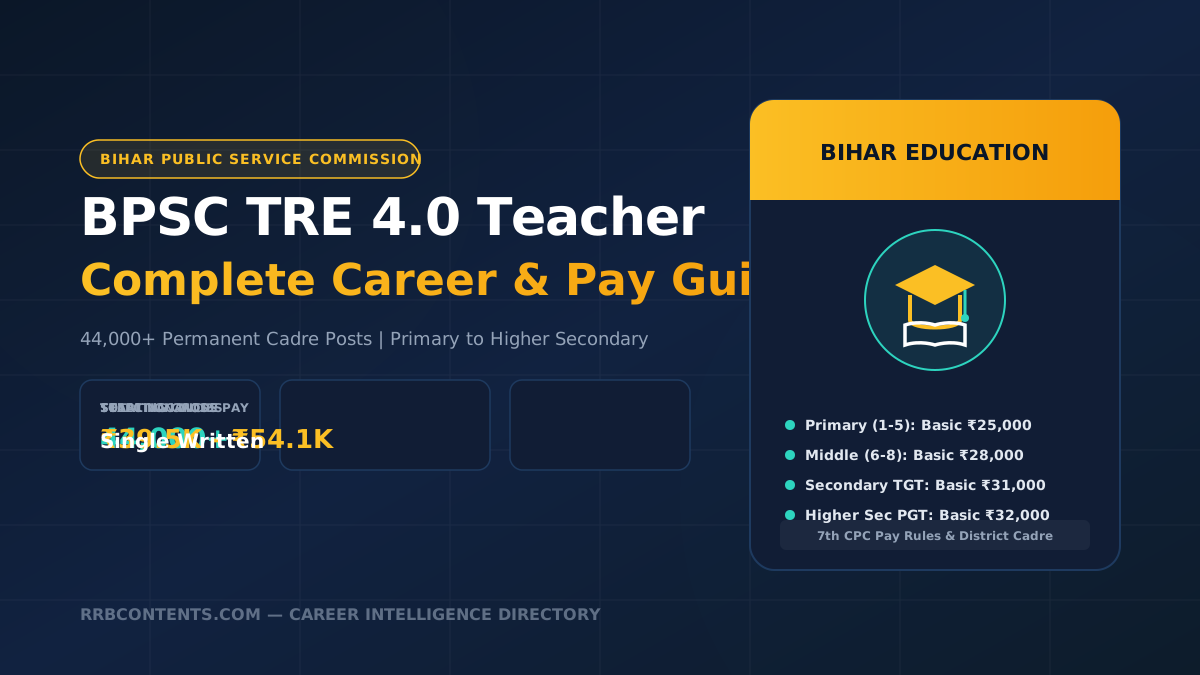
BPSC TRE 4.0 Teacher Salary, In-Hand Pay & Career Guide 2026
SECTION 1: OPENING HOOK
The Bihar Public Service Commission (BPSC) TRE 4.0 recruitment drive represents one of the largest public sector employment initiatives in modern Indian education, opening approximately 44,000 permanent cadre teaching posts across Bihar’s primary, middle, secondary, and higher secondary schools. A primary school teacher entering service under this notification starts at a basic pay of ₹25,000—yielding an initial gross monthly package of ₹39,500 to ₹42,500 depending on rural or urban posting allowances—while a higher secondary teacher commands a basic pay of ₹32,000, bringing gross monthly earnings to between ₹50,280 and ₹54,120. Unlike contractual or ad-hoc appointments of previous decades, candidates selected in BPSC TRE 4.0 join the permanent Bihar State School Teacher Cadre governed by the Bihar State School Teacher (Appointment, Transfer, Disciplinary Action and Service Conditions) Rules. This grants them full civil service protection under Article 311 of the Constitution of India, standard 7th Pay Commission-aligned salary progression, annual 3% step increments, and eligibility for BPSC fast-track departmental examinations for Headmaster (Pradhanhyapak) and Head Teacher (Pradhan Shikshak) roles after 8 years of continuous service.
What makes BPSC TRE 4.0 uniquely attractive is its combination of massive vacancy volume, a single-stage merit selection process without an interview, and structured promotional mobility into educational administration. For any candidate deciding where to invest months of competitive exam preparation, evaluating this 44,000-post opportunity requires more than scanning a notification summary; it demands an in-depth understanding of daily classroom realities, localized allowance calculations across district zones, 15-year career trajectory maps, and strategic syllabus preparation tailored to SCERT and NCERT frameworks. This guide delivers an exhaustive, factual blueprint of what serving as a BPSC TRE 4.0 teacher actually involves—from first-month pay slips to senior administrative promotions across Bihar's public education infrastructure.
SECTION 2: WHAT THE JOB ACTUALLY INVOLVES DAY-TO-DAY
Serving as a BPSC TRE teacher entails a dynamic combination of classroom instruction, student evaluation, school administrative management, and community outreach across Bihar's 38 districts. A standard working week runs Monday through Saturday, following official school schedules (typically 9:00 AM to 4:00 PM, adjusted seasonally by the Bihar Education Department). The specific work environment and daily tasks vary significantly across the four primary recruitment cadres: Primary (Classes 1-5), Middle (Classes 6-8), Secondary (Classes 9-10 / TGT), and Higher Secondary (Classes 11-12 / PGT).
Daily Operational Realities by Cadre:
- Primary School Teacher (Classes 1-5):
Primary teachers operate in village panchayat or block-level basic schools (Prathmik Vidyalaya). Daily work revolves around Foundational Literacy and Numeracy (FLN) under the NIPUN Bihar Mission, delivering lessons in basic mathematics, Hindi, English, and Environmental Studies (EVS). Primary teachers handle high student-teacher ratios (often 40 to 70 students per classroom). A key morning task involves supervising the Pradhan Mantri Poshan (Mid-Day Meal) scheme—verifying food preparation hygiene, recording daily beneficiary registers, monitoring student health, and updating attendance metrics digitally on the state e-Shikshakosh portal.
2. Middle School Teacher (Classes 6-8):
Middle school teachers transition toward subject-specific instruction in Mathematics, Science, Social Science, Hindi, English, Sanskrit, or Urdu. They maintain Continuous and Comprehensive Evaluation (CCE) registers, track student academic growth, conduct remedial classes for academically weak students, and manage laboratory kits distributed under state science initiatives.
3. Secondary (Classes 9-10 / TGT) & Higher Secondary (Classes 11-12 / PGT):
Secondary and higher secondary teachers operate in sub-divisional or district headquarters high schools (Uchcha Vidyalaya) and upgraded senior secondary schools (Uchchatar Madhyamik Vidyalaya). These desk-bound, academic roles focus on specialized subject delivery, conducting laboratory practicals in Physics, Chemistry, Biology, and Computer Science, setting internal terminal examinations, and preparing students for the Bihar School Examination Board (BSEB) Class 10 Matriculation and Class 12 Intermediate board examinations. Higher secondary teachers also supervise school libraries, coordinate co-curricular sports and cultural events, and advise students on higher education avenues.
Year-1 Reality vs. Year-5+ Reality:
During their first year, fresh recruits undergo probation under direct supervision. New teachers spend early months mastering the Bihar SCERT curriculum, adapting to local classroom dynamics, maintaining student attendance via the e-Shikshakosh digital portal, and completing mandatory orientation modules organized by the State Council of Educational Research and Training (SCERT) Bihar. They work under the guidance of the school Headmaster, handling proxy classes, assisting in internal exam evaluation, and learning administrative routine.
By Year 5 and beyond, an established teacher assumes independent academic and administrative leadership. Senior teachers act as Class Teachers, Subject Department Heads, Examination In-Charges, and Coordinators for state educational schemes such as Cycle Yojana and Poshan Yojana. They participate actively in School Management and Development Committees (SMDC), mentor junior faculty members, and serve as external examiners or evaluation superintendents for BSEB board examinations.
Field Duties and Administrative Expectations:
State government teachers in Bihar fulfill compulsory periodic non-teaching public duties mandated under state executive orders. Teachers are routinely appointed as Polling Officers (PO1, PO2, PO3) or Presiding Officers during Lok Sabha, Bihar Vidhan Sabha, and Panchayat elections. Additional duties include national population census enumeration, socio-economic surveys, electoral roll verification drives (BLO duty), and disaster relief support during annual monsoon flood cycles in North Bihar. While standard school hours are fixed, election training sessions, disaster management duties, and board valuation camps require occasional weekend work and local travel within the assigned district. Transfers operate primarily within the assigned district cadre, governed strictly by state education department regulations.
SECTION 3: COMPLETE PAY SCALE & IN-HAND SALARY BREAKDOWN
Salaries for BPSC TRE 4.0 appointees are codified under the Bihar State School Teacher Rules, which adapt 7th Pay Commission principles into state pay bands. Initial basic pay figures are fixed according to cadre level, complemented by state-approved allowances.
Core Salary Components:
- Basic Pay: Fixed initial entry basic pay by cadre (₹25,000 for Primary; ₹28,000 for Middle; ₹31,000 for Secondary; ₹32,000 for Higher Secondary).
- Dearness Allowance (DA): Calculated as a percentage of Basic Pay (currently benchmarked at 50% of Basic Pay, revised semi-annually by the Bihar Finance Department).
- House Rent Allowance (HRA): Categorized by posting location—4% for Rural/Panchayat areas; 6% for Block Headquarters/Municipalities; 8% for District Headquarters/Cities; 16% for Patna Urban Agglomeration.
- Medical Allowance: Fixed at ₹1,000 per month across all cadres.
- Gross Monthly Salary: Basic Pay + DA + HRA + Medical Allowance.
- Mandatory Deductions: NPS employee contribution (10% of Basic Pay + DA), Professional Tax (approx. ₹150–₹200/month), and Group Insurance (GIS) (approx. ₹30–₹100/month).
- Net In-Hand Salary: Gross Monthly Salary minus total mandatory deductions.
In-Hand Salary Progression Table across Posting Zones (Estimates Based on 50% DA):
| Cadre / Post | Basic Pay | Posting Zone (HRA %) | DA (50%) | HRA Amount | Medical | Est. Gross Salary | NPS (10%) | Est. Net In-Hand Salary |
|---|---|---|---|---|---|---|---|---|
| Primary Teacher (Class 1-5) | ₹25,000 | Rural / Panchayat (4%) | ₹12,500 | ₹1,000 | ₹1,000 | ₹39,500 | ₹3,750 | ₹35,550 - ₹35,700 |
| Primary Teacher (Class 1-5) | ₹25,000 | District HQ / City (8%) | ₹12,500 | ₹2,000 | ₹1,000 | ₹40,500 | ₹3,750 | ₹36,550 - ₹36,700 |
| Primary Teacher (Class 1-5) | ₹25,000 | Patna Urban (16%) | ₹12,500 | ₹4,000 | ₹1,000 | ₹42,500 | ₹3,750 | ₹38,550 - ₹38,700 |
| Middle Teacher (Class 6-8) | ₹28,000 | Rural / Panchayat (4%) | ₹14,000 | ₹1,120 | ₹1,000 | ₹44,120 | ₹4,200 | ₹39,720 - ₹39,900 |
|---|---|---|---|---|---|---|---|---|
| Middle Teacher (Class 6-8) | ₹28,000 | District HQ / City (8%) | ₹14,000 | ₹2,240 | ₹1,000 | ₹45,240 | ₹4,200 | ₹40,840 - ₹41,000 |
| Middle Teacher (Class 6-8) | ₹28,000 | Patna Urban (16%) | ₹14,000 | ₹4,480 | ₹1,000 | ₹47,480 | ₹4,200 | ₹43,080 - ₹43,200 |
| Secondary TGT (Class 9-10) | ₹31,000 | Rural / Panchayat (4%) | ₹15,500 | ₹1,240 | ₹1,000 | ₹48,740 | ₹4,650 | ₹43,890 - ₹44,100 |
|---|---|---|---|---|---|---|---|---|
| Secondary TGT (Class 9-10) | ₹31,000 | District HQ / City (8%) | ₹15,500 | ₹2,480 | ₹1,000 | ₹49,980 | ₹4,650 | ₹45,130 - ₹45,300 |
| Secondary TGT (Class 9-10) | ₹31,000 | Patna Urban (16%) | ₹15,500 | ₹4,960 | ₹1,000 | ₹52,460 | ₹4,650 | ₹47,610 - ₹47,800 |
| Higher Secondary PGT (11-12) | ₹32,000 | Rural / Panchayat (4%) | ₹16,000 | ₹1,280 | ₹1,000 | ₹50,280 | ₹4,800 | ₹45,280 - ₹45,450 |
|---|---|---|---|---|---|---|---|---|
| Higher Secondary PGT (11-12) | ₹32,000 | District HQ / City (8%) | ₹16,000 | ₹2,560 | ₹1,000 | ₹51,560 | ₹4,800 | ₹46,560 - ₹46,750 |
| Higher Secondary PGT (11-12) | ₹32,000 | Patna Urban (16%) | ₹16,000 | ₹5,120 | ₹1,000 | ₹54,120 | ₹4,800 | ₹49,120 - ₹49,300 |
Annual Increments and Pension Contributions:
Teachers receive a 3% annual basic pay increment every year, effective on 1st January or 1st July. Allowance totals grow alongside basic pay increases over time. Additionally, the state government contributes 14% of (Basic Pay + DA) toward each teacher's NPS retirement account, building long-term financial security. All listed in-hand payouts are operational estimates; actual amounts vary based on exact local tax rules, municipal classification boundaries, and future DA revisions announced by the state government.
SECTION 4: CAREER GROWTH & PROMOTIONAL PATH
Advancement for BPSC TRE appointees follows two distinct routes: time-bound financial upgrades and merit-based fast-track departmental examinations conducted by BPSC. Because appointments belong to district-level cadres, promotional velocity depends on district vacancy rosters, subject seniority, and continuous service length.
Career Trajectory Stages:
- Primary Teacher Cadre:
- Entry: Primary School Teacher (Basic Pay ₹25,000)
- Stage 1 Promotion: Senior Primary Teacher / Head Teacher (Pradhan Shikshak - Basic Pay ₹30,500). Eligibility: 8 years of continuous service plus clearing the BPSC Head Teacher Departmental Examination or seniority list selection.
- Stage 2 Promotion: Middle School Headmaster / Block Academic Coordinator. Eligibility: 12-15 years of service.
- Stage 3 Promotion: Block Education Officer (BEO). Eligibility: Seniority-cum-merit promotion into administrative service cadre.
2. Secondary Teacher Cadre (TGT):
- Entry: Secondary School Teacher (Basic Pay ₹31,000)
- Stage 1 Promotion: Headmaster in High School (Pradhanhyapak - Basic Pay ₹35,000). Eligibility: 8 years of regular service as Secondary Teacher and passing the BPSC High School Headmaster Examination.
- Stage 2 Promotion: Principal of Upgraded Higher Secondary School. Eligibility: 12-15 years of combined service.
- Stage 3 Promotion: District Programme Officer (DPO) / Assistant Director. Eligibility: Seniority progression into state education administrative cadres.
3. Higher Secondary Teacher Cadre (PGT):
- Entry: Higher Secondary School Teacher (Basic Pay ₹32,000)
- Stage 1 Promotion: Headmaster / Principal of Higher Secondary School (Basic Pay ₹35,000 - ₹47,600 band). Eligibility: 8 years of service as PGT with BPSC exam success or 10-12 years via seniority.
- Stage 2 Promotion: District Programme Officer (DPO - Establishment / Quality Education). Eligibility: 15-18 years of service.
- Stage 3 Promotion: District Education Officer (DEO). Eligibility: Executive administrative selection prior to superannuation.
15-Year Career Trajectory Table:
| Stage / Designation | Est. Years of Service | Pay Level / Basic Pay | Primary Selection Mode | Cadre Level |
|---|---|---|---|---|
| Entry Teacher (Primary / Secondary) | 0 Years | ₹25,000 - ₹32,000 | BPSC TRE Direct Recruitment | District Cadre |
| Senior Teacher / Department Lead | 5 - 8 Years | ₹31,000 - ₹38,000 | Time-Bound Financial Upgrade / Seniority | District Cadre |
| Head Teacher / High School Headmaster | 8 - 12 Years | ₹30,500 - ₹47,600 | BPSC Departmental Exam / Seniority List | District / Zone Cadre |
| Block Education Officer / DPO | 15 - 20 Years | ₹53,100 - ₹67,700 | Departmental Promotion / Exam | State Cadre |
| District Education Officer (DEO) | 22+ Years | ₹67,700 - ₹78,800 | Bihar Education Service Selection | State Directorate |
Promotional Speed Determinants:
Teachers seeking accelerated advancement can bypass long seniority queues by appearing for BPSC fast-track departmental examinations for Head Teachers (Pradhan Shikshak) and Headmasters (Pradhanhyapak). Teachers with 8 years of continuous regular service qualify for these competitive tests, jumping directly into supervisory roles and Level 7/8 pay scales early in their careers. Additional factors influencing promotional speed include maintaining clean Annual Performance Assessment Reports (APAR) and maintaining subject-wise seniority in the district cadre roster.
SECTION 5: SELECTION PROCESS EXPLAINED FOR THIS SPECIFIC POST
Selection in BPSC TRE 4.0 is conducted through a single-stage objective Written Examination (MCQ) administered directly by BPSC. There is no interview stage for any teaching post, ensuring final selection depends entirely on written marks and document verification.
| Examination Scheme (150 Questions | 150 Marks | Duration: 2.5 Hours): |
|---|
The single exam paper contains three sections in a unified test booklet:
- Part 1: Language Proficiency (Qualifying Only):
- 30 Questions (30 Marks): Mandatory English (8 Questions) + Choice of Hindi, Urdu, or Bengali (22 Questions).
- Minimum qualifying score: 30% (9 marks out of 30). Marks are qualifying only and are not added to final merit ranking.
2. Part 2: General Studies (Evaluative):
- 40 Questions (40 Marks): Covers Elementary Mathematics, Reasoning, General Awareness, General Science, Social Science, Geography, Environment, and the Indian National Movement (focusing on Bihar's historical role).
- Fully evaluative toward final merit ranking (40 of 120 evaluative marks).
3. Part 3: Main Subject & Pedagogy (Evaluative):
- 80 Questions (80 Marks): Customized by post cadre.
- Primary (1-5): General Pedagogy, Mathematics, EVS, and Elementary Science.
- Middle (6-8): Chosen subject stream (Mathematics & Science, Social Science, or Languages).
- Secondary (9-10 / TGT): Specific subject chosen (e.g., Mathematics, Science, Social Science, English, Hindi, Computer Science).
- Higher Secondary (11-12 / PGT): Advanced post-graduate level subject discipline.
- Fully evaluative toward final merit ranking (80 of 120 evaluative marks).
Scoring Rules and Cut-off Mechanics:
- Total Evaluative Base: 120 Marks (Part 2 + Part 3).
- Marking Scheme: Each correct answer awards 1 mark. Negative marking is either not applied or set to 0.25 marks per wrong answer per official cycle guidelines.
- Minimum Qualifying Percentages (out of 120 Marks): General (Unreserved): 40%; BC: 36.5%; EBC: 34%; SC/ST, Women, and PwD: 32%.
- Tie-Breaker Protocol: Equal total marks are resolved first by higher Part 3 (Main Subject) marks, followed by candidate age seniority, and finally alphabetical name order in Devanagari script.
Document Verification (DV):
Shortlisted candidates attend DV at district headquarters, producing valid CTET/STET certificates, D.El.Ed/B.Ed degrees, Bihar domicile certificates, and category reservation documents (NCL/EWS). District postings are allocated according to merit rank preferences and vacancy availability.
SECTION 6: SKILLS & PREPARATION FOCUS THAT ACTUALLY MATTERS
Succeeding in BPSC TRE 4.0 requires a prep strategy tailored directly to BPSC exam patterns rather than generic coaching modules. Analysis of prior TRE cycles indicates that performance depends on four critical focus areas.
- SCERT and NCERT Textbook Mastery:
Questions in Part 2 and Part 3 trace directly to Bihar SCERT and NCERT textbooks.
- Primary (1-5) & Middle (6-8): Thoroughly study SCERT Bihar Class 3 to 10 textbooks in Environmental Studies, Mathematics, Science, and Social Science. Pay close attention to chapter summaries and regional Bihar context examples.
- Secondary (9-10): Conduct line-by-line reading of Class 9 and 10 NCERT/SCERT texts in science, mathematics, and social studies, focusing on core concepts, diagrams, formula derivations, and historical timelines.
- Higher Secondary (11-12): Analyze Class 11 and 12 NCERT textbooks in detail, as questions test graduate-level applications of core topics introduced in senior secondary syllabi.
2. Priority Focus on the Indian National Movement & Bihar's History:
The Indian National Movement section carries heavy weight in Part 2 General Studies. Candidates must prioritize:
- The 1857 Revolt in Bihar, focusing on Babu Veer Kunwar Singh's role in Jagdishpur and local resistance centers.
- The 1917 Champaran Satyagraha and key Bihar associates (Rajendra Prasad, Anugrah Narayan Sinha, J.B. Kripalani).
- Major national phases (Non-Cooperation, Civil Disobedience, 1942 Quit India Movement) and Bihar Congress Socialist Party activities.
- Peasant movements led by Swami Sahajanand Saraswati and the Bihar Provincial Kisan Sabha.
3. Numerical Competency and Mental Ability Speed:
Elementary Mathematics in Part 2 is a key rank separator. Practice percentage calculations, profit and loss, interest, ratio and proportion, time and work, and mensuration to complete the 40-question GS section within 35 minutes, maximizing time for subject questions.
4. Language Safety Margin & Mock Test Execution:
- Language Qualifying Margin: Allocate 15-20 minutes to clear the 30% qualifying mark (9 marks) in Part 1 to prevent unexpected disqualification.
- Timed Mock Tests: Solve full-length 150-minute past BPSC TRE papers under timed conditions, targeting a raw score of 85+ out of 120 evaluative marks in practice tests to clear competitive district cut-offs safely.
SECTION 7: COMPARISON: HOW THIS STACKS UP AGAINST SIMILAR GOVERNMENT CAREERS
Candidates considering BPSC TRE 4.0 often compare it against Kendriya Vidyalaya Sangathan (KVS) TGT/PGT posts and Uttar Pradesh Primary Teacher (UP PRT / TGT) roles.
Comparative Feature Matrix:
| Career Axis | BPSC TRE 4.0 (Bihar Teacher) | KVS TGT / PGT (Central Govt) | UP PRT / TGT (Uttar Pradesh) |
|---|---|---|---|
| Starting In-Hand Salary | ₹35,500 - ₹49,200 | ₹48,000 - ₹62,000 (Central Scales) | ₹42,000 - ₹52,000 |
| Posting Stability | District Cadre (Within Bihar) | All-India Transferable (Pan-India) | District Cadre (Within UP) |
| Selection Mode | Single-Stage Written (No Interview) | Written Exam + Demo + Interview | Super TET / Written + Merit |
| Fast-Track Promotion | BPSC Headmaster Exam (8 Yrs) | Limited LDCE Exams | Seniority-Based |
| Competition Dynamics | Bihar Domicile Reservation Focus | Open All-India Competition | UP Domicile Weightage |
Key Trade-Off Comparisons:
- BPSC TRE vs. KVS:
- Pay: KVS offers higher starting packages due to direct Central Pay Levels (Level 6/7/8).
- Location Stability: BPSC TRE wins for candidates desiring stability in Bihar, as postings remain inside an assigned district. KVS requires mandatory pan-India relocations every 3-5 years.
- Selection Simplicity: BPSC TRE relies strictly on a single written test without an interview, whereas KVS requires a multi-stage written, interview, and teaching demonstration process.
2. BPSC TRE vs. UP PRT / TGT:
- Recruitment Regularity: BPSC TRE offers greater vacancy predictability, having conducted multiple large-scale cycles (TRE 1.0 to 4.0) rapidly, whereas UP recruitments have faced multi-year delays between notifications.
- Career Growth: BPSC TRE features legally codified departmental competitive exams for Headmaster roles after 8 years, providing faster administrative growth than traditional UP seniority channels.
SECTION 8: REAL TALK: DOWNSIDES & WHAT TO EXPECT
While BPSC TRE 4.0 provides job security and respectable compensation, candidates should weigh specific operational trade-offs before applying.
- Rural Postings and Facilities:
Many vacancies are located in rural panchayat schools where housing options, daily commute transport, and local amenities are limited. Facility standards vary; older rural schools may experience power outages, basic sanitation setups, and limited lab equipment.
2. Mandatory Non-Teaching Duties:
Bihar state teachers fulfill several civic responsibilities, including election polling duties during Lok Sabha, Vidhan Sabha, and Panchayat elections. Teachers also manage Mid-Day Meal records, student scholarship portal updates, and periodic census or flood relief operations.
3. Inter-District Transfer Restrictions:
Initial appointments lock teachers into their assigned District Cadre. Inter-district transfers require fulfilling strict state guidelines, mutual matching candidates, or approved medical/administrative grounds.
4. Large Student-Teacher Ratios:
In high-density rural blocks, primary classroom sizes can reach 50 to 70 students per section, demanding patience, classroom management skill, and adaptability.
SECTION 9: FREQUENTLY ASKED QUESTIONS (FAQ)
Q: What is the starting in-hand salary for a BPSC TRE 4.0 Primary Teacher versus a Higher Secondary Teacher?
A: A Primary Teacher (Class 1-5) starts with a basic pay of ₹25,000, yielding an estimated net in-hand monthly salary of ₹35,550 to ₹38,700 depending on rural (4% HRA) or urban (Patna 16% HRA) posting. A Higher Secondary Teacher (Class 11-12) starts with a basic pay of ₹32,000, resulting in an estimated net in-hand salary of ₹45,280 to ₹49,300 per month.
Q: Is clearing CTET or Bihar STET mandatory for BPSC TRE 4.0?
A: Yes. Primary posts (Classes 1-5) require CTET Paper 1 or BTET Paper 1; Middle posts (Classes 6-8) require CTET Paper 2 or BTET Paper 2; Secondary posts (Classes 9-10) require Bihar STET Paper 1; and Higher Secondary posts (Classes 11-12) require Bihar STET Paper 2. Professional training degrees (D.El.Ed or B.Ed) are also compulsory.
Q: Is there an interview stage in BPSC TRE 4.0?
A: No, there is no interview or personality test. Selection is based entirely on merit marks obtained in the single-stage written examination (120 evaluative marks in Part 2 and Part 3), provided candidates clear the 30% qualifying score in Part 1 Language and pass document verification.
Q: How quickly can a BPSC TRE teacher be promoted to a Headmaster?
A: Teachers completing 8 years of continuous regular service can appear for the BPSC Headmaster / Head Teacher Competitive Examination. Passing this exam allows direct promotion to a Headmaster position (Level 7/8 pay scale). Seniority-based administrative promotions to Block Education Officer (BEO) typically occur after 12 to 15 years of service.
Q: Can candidates from states outside Bihar apply for BPSC TRE 4.0?
A: Yes, non-Bihar residents can apply under the General (Unreserved) category if they meet educational and eligibility (CTET/STET) criteria. Category reservation benefits are reserved exclusively for permanent Bihar domicile residents.
Q: How does a BPSC TRE position compare to KVS regarding work-life balance and transfers?
A: BPSC TRE provides geographic stability within a single Bihar district cadre, avoiding the mandatory pan-India relocations required in KVS. However, KVS offers higher starting central pay scales and fewer non-teaching administrative duties compared to Bihar state teaching roles.
Q: What non-teaching duties are expected of a Bihar government teacher?
A: Teachers are legally required to serve as election polling officers during state and national elections, maintain Mid-Day Meal registers, update student records on e-Shikshakosh, and assist in population census enumeration or local disaster management drives when ordered.
SECTION 10: CLOSING CTA
Ready to apply for a permanent teaching career in Bihar? Access the complete BPSC TRE 4.0 Recruitment 2026 notification—including official application dates, vacancy distributions, fee details, and eligibility guidelines—on RRBCONTENTS. Stay ahead in your preparation by joining our official Telegram community at https://t.me/rrbcontents for daily study resources, updates, and mock tests.
VERIFICATION NOTE & CONFIDENCE CHECK:
- Pay Scale & Salary Math: Basic Pay figures (Primary ₹25,000; Middle ₹28,000; Secondary ₹31,000; Higher Secondary ₹32,000) reflect official Bihar State School Teacher Rules. Allowances (DA 50%, Medical ₹1,000, HRA 4%/6%/8%/16%, NPS 10%) match current Bihar Finance Department norms. All net figures are explicitly identified as estimates.
- Selection Scheme: 150 total questions (Part 1 Language 30 qualifying; Part 2 GS 40; Part 3 Subject 80) evaluated out of 120 marks without interview matches official BPSC TRE exam pattern.
- Departmental Exam Eligibility: The 8-year service requirement for BPSC Headmaster / Head Teacher departmental competitive exams reflects state education department regulations.
Explore Verified Government & PSU Career Guides on RRBCONTENTS
Get official notifications, full syllabus blueprints, and daily exam current affairs.
Apply for BPSC TRE 4.0 2026 → Latest Recruitment Notifications → Exam Preparation Resources →Join our official Telegram channel for instant career alerts: @rrbcontents