The British did not invent land revenue in India... What they changed was the legal character of that claim, the identity of the payer, and the rigidity with which the demand was enforced.
Table of Contents
% Land Area
Permanent Settlement in Bengal, Bihar & Orissa
% Land Area
Ryotwari System in Madras, Bombay & Assam
% Land Area
Mahalwari System in NW Provinces & Punjab
Colonial Systems
Reshaped Indian agrarian structure & rural economy
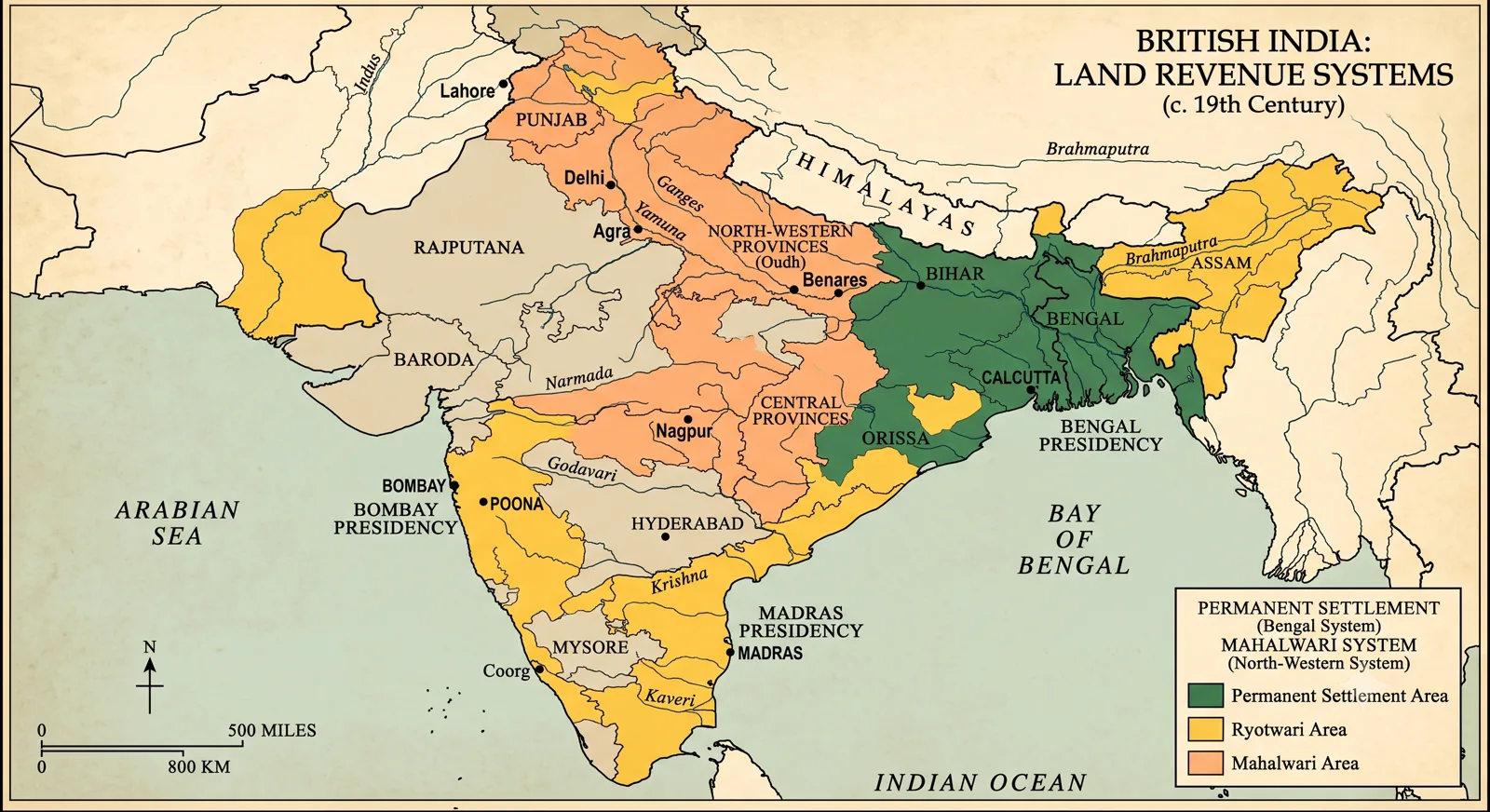
Historical map of British India showing color-coded Land Revenue Systems (c. 19th Century)
The British did not invent land revenue in India. They inherited a long tradition of the state claiming a share of agricultural produce. What they changed was the legal character of that claim, the identity of the payer, and the rigidity with which the demand was enforced. Between the 1790s and the mid-nineteenth century three major systems took shape: the Permanent Settlement in eastern India, the Ryotwari system in the south and west, and the Mahalwari system in the north. Each system reflected a different diagnosis of Indian society and a different calculation of imperial interest. Together they restructured rural property relations, altered the balance between cultivator and intermediary, and left consequences that independent India is still sorting out.
This article examines the three systems in turn, then sets them against one another, and finally assesses their deeper economic and social effects. The aim is not to repeat textbook summaries but to clarify the logic that produced each arrangement and the human realities that followed from it.
Chapter 1
The Colonial Context and the Search for a Stable Revenue
After the East India Company acquired the diwani of Bengal in 1765 it struggled for three decades to find a workable method of collection. Early experiments—yearly settlements, five-year settlements, the use of temporary farmers of revenue—produced uncertainty for both the Company and the rural population. Officials debated whether Indian society was composed of great landlords who should be confirmed in their rights or of peasant proprietors who should deal directly with the state. The answer given in each region depended on the intellectual preferences of the administrators on the spot, the existing pattern of land control, and the Company’s urgent need for predictable income to finance its wars and administration.
The Permanent Settlement of 1793 was the first comprehensive solution. Ryotwari and Mahalwari emerged later as deliberate alternatives once the drawbacks of the Bengal model became visible.
For more high-quality GS resources and daily exam updates, join our community!
Get instant updates, notes and quiz questions directly on Telegram.
Chapter 2
Permanent Settlement: Fixing the Demand and Creating a Class
Lord Cornwallis and his advisers believed that a hereditary class of landlords with a permanent, fixed revenue obligation would invest in agriculture, improve their estates, and become a stable political ally of the Company. The settlement was introduced in Bengal, Bihar and Orissa (and later extended to parts of the Madras Presidency). Zamindars were recognised as full proprietors of the land for which they paid revenue. The state’s demand was fixed in perpetuity; any future increase in produce or price would benefit the zamindar, not the government.
In theory the cultivators were to be protected by the zamindar and by new regulations. In practice the settlement strengthened the zamindar’s hand. Many old families failed to meet the high initial demand and lost their estates to auction purchasers—often urban moneylenders or Company employees. The new owners frequently became absentees. Rent collection was left to intermediate agents, and the actual cultivators faced rising rents, illegal cesses and the constant threat of eviction. Because the state’s share was frozen, the Company itself was unable to benefit from later agricultural expansion or price rises. By the 1820s official opinion had turned against the Permanent Settlement, yet the property rights it had created proved difficult to undo.
The system produced a distinctive social structure in eastern India: a layer of rent-receiving landlords, a large body of tenants with varying degrees of security, and a growing class of landless labourers. It also shaped the character of later agrarian politics in the region.
Chapter 3
Ryotwari: The State as Direct Landlord
In the Madras and Bombay Presidencies a different diagnosis prevailed. Officials such as Thomas Munro argued that the real owners of the soil were the cultivators themselves and that intermediaries only complicated collection and oppressed the peasantry. Under the Ryotwari system the government settled the revenue directly with the individual ryot. Each field was surveyed, classified according to soil quality, and assessed. The demand was not permanent; it was subject to periodic revision, usually every thirty years.
The system required an enormous administrative apparatus of surveyors, assessors and village accountants. In principle it eliminated the zamindar and gave the cultivator a clear title. In practice the revenue rates were often set too high, especially in the early decades. Cultivators fell into arrears, lost their land through forced sales, or became dependent on moneylenders who paid the revenue on their behalf. Because the assessment was individual, the village community lost some of its earlier collective functions. At the same time the system gave the state a more flexible instrument: when prices rose or new land came under cultivation, the demand could be increased at the next settlement.
Ryotwari areas developed a different rural profile—larger numbers of peasant proprietors, greater fragmentation of holdings over time, and a more direct relationship (for better or worse) between the cultivator and the colonial state.
Chapter 4
Mahalwari: The Village as the Unit of Account
In the North-Western Provinces, the Punjab and parts of Central India the British encountered strong village institutions and a variety of joint or coparcenary tenures. The Mahalwari system, refined under Holt Mackenzie and later administrators, treated the village or the mahal (a group of estates) as the unit of assessment. The revenue demand was fixed for the village as a whole, and the villagers remained jointly responsible for its payment. Individual shares were recorded, yet the collective liability gave the community an interest in keeping every member solvent.
In practice the system varied widely. In some areas it operated close to a landlord form; in others it resembled a modified Ryotwari arrangement. The joint responsibility could protect weaker cultivators, but it could also allow stronger elements inside the village to shift the burden onto the vulnerable. Periodic revisions of the demand created the same problems of over-assessment seen elsewhere. Nevertheless, Mahalwari preserved a greater role for village-level leadership than either of the other two systems and left a deeper imprint on the later revenue administration of northern India.
Chapter 5
Comparative Features at a Glance
Although each system responded to local conditions, certain structural differences stand out clearly.
The Permanent Settlement created a class of private proprietors whose revenue obligation was frozen. Ryotwari made the individual cultivator the proprietor and kept the state’s demand revisable. Mahalwari sat between them, recognising both individual shares and collective responsibility while allowing periodic revision.
Security of tenure for the actual tiller was weakest under the Permanent Settlement and theoretically strongest under Ryotwari, though high demand often undermined that security in practice. The administrative cost was lowest under the Permanent Settlement (once the initial settlement was complete) and highest under Ryotwari, which required continuous survey and record-keeping. Political consequences also diverged: the Permanent Settlement produced a landlord class that later played a prominent role in provincial politics; Ryotwari areas generated a more assertive peasantry that became important in twentieth-century nationalist and agrarian movements.
Chapter 6
Economic and Social Impact
All three systems were designed to maximise and stabilise the colonial state’s income. In that narrow sense they succeeded. Land revenue remained the single largest source of government receipts for most of the nineteenth century. The deeper effects were more ambiguous.
Agricultural investment suffered under the Permanent Settlement because many zamindars preferred to live on rent rather than improve their estates. In Ryotwari and Mahalwari areas the cultivator’s incentive to invest was blunted by the fear that any improvement would lead to a higher assessment at the next revision. The continuous pressure of the revenue demand, combined with the new legal machinery of courts and coercive collection, increased the cultivator’s dependence on credit. Moneylenders and grain merchants gained ground across all three regions, though the precise mechanisms differed.
Social differentiation sharpened. In eastern India the gap between rent-receiver and cultivator widened. In the south and west the differentiation occurred more among the peasantry itself—between those who could hold on to their title and those who slipped into tenancy or labour. The legal recognition of private property in land also made land alienable on a scale previously unknown, accelerating the transfer of holdings from cultivating families to non-cultivating creditors.
Famine policy and relief were shaped by these revenue arrangements. Officials often insisted that the revenue must be collected even in distress years so that the “fiscal foundation” of the state would not be weakened. The result was that revenue demand sometimes intensified the crisis rather than cushioning it.
Chapter 7
Long-term Legacy & Exam Relevance
At independence India inherited a patchwork of property rights and revenue practices. The zamindari system was abolished through a series of state laws in the 1950s, yet the intermediate tenures and the records created under the Permanent Settlement continued to complicate land reform. Ryotwari areas entered the new republic with a clearer tradition of peasant proprietorship, which influenced the design of later agricultural policy. The Mahalwari emphasis on village records and joint responsibility left its mark on the revenue administration of Uttar Pradesh, Punjab and neighbouring states.
The colonial systems also left an intellectual legacy. Debates about the relative efficiency of landlord and peasant agriculture, about the proper degree of state intervention in the land market, and about the political reliability of different rural classes all took shape inside the experience of these three settlements. Those debates did not end with the British departure.
Questions on land revenue systems test several skills at once: the ability to distinguish institutional features, to link administrative choices with social consequences, and to see regional variation inside a single colonial framework. Aspirants are frequently asked to compare the systems, to explain why the Permanent Settlement was not extended to the whole of India, or to assess the impact on the peasantry. Answers that merely list features score modestly. Answers that show how each system altered the distribution of power and risk in the countryside score higher.
The topic also connects with later themes—peasant movements, the economic drain, the nature of colonial modernity, and the difficulties of post-independence land reform. A secure grasp of the original systems therefore repays effort across the modern Indian history and economy portions of the syllabus.
The Permanent Settlement, Ryotwari and Mahalwari systems were not technical adjustments. They were attempts to rewrite the relationship between the cultivator, the intermediary and the state according to colonial priorities. One froze the state’s claim and elevated a landlord class. Another made the state the direct landlord of millions of individual cultivators. The third tried to harness the village community as a collective fiscal agent. Each produced its own pattern of prosperity, indebtedness and resistance. Together they formed one of the most consequential institutional interventions of the entire colonial period. For anyone seeking to understand the agrarian structure of modern India, these three experiments remain indispensable points of departure.
Chapter 8
Frequently Asked Questions
What was the main difference between Permanent Settlement and Ryotwari system?
Why did the British not extend the Permanent Settlement to the whole of India?
What was the unit of assessment under the Mahalwari system?
How did the three land revenue systems affect the peasantry differently?
Close the Loop
Close the loop on this topic with a short PYQ set, then use the history notes to patch whatever you missed.
Continue on RRBCONTENTS
Explore More
Knowledge Hub
More Blog Articles
In-depth, exam-focused articles on Modern History, Economic History, Indian Geography, and Static GK.
Study Material
Exam Study Notes
Subject-wise notes and digests for Railway, SSC, Banking and State PSC exams.
Current Affairs
Daily Current Affairs & GK
Daily updates and a 70-day static GK bank with active-recall quizzes.
"One froze the state’s claim and elevated a landlord class. Another made the state the direct landlord of millions of individual cultivators. The third tried to harness the village community as a collective fiscal agent."
Together they formed one of the most consequential institutional interventions of the entire colonial period in India.