Home › Blog › Chemistry Notes › Acids, Bases & Salts
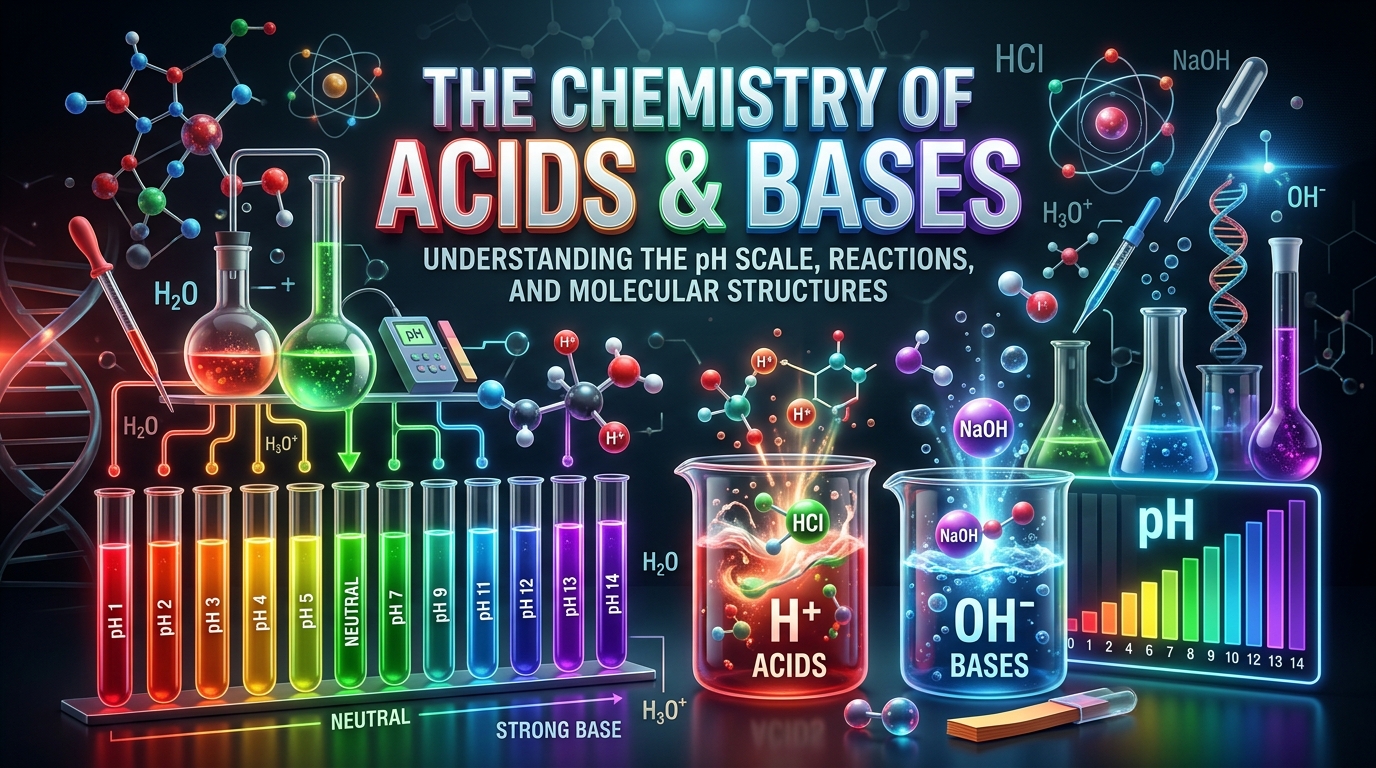
Acids, Bases, and Salts: Complete Chemistry Notes & Formula Guide
Part 1: Theories of Acids and Bases
Acid-base chemistry forms the bedrock of chemical reactions in both aqueous solutions and industrial manufacturing. To understand how acids and bases interact, scientists developed three major historical and conceptual theories: Arrhenius Theory, Brønsted-Lowry Theory, and Lewis Theory.
1. Arrhenius Theory of Acids and Bases (1887)
Svante Arrhenius defined acids and bases based on their dissociation behavior in aqueous solutions (water medium):
- Arrhenius Acid: A chemical substance that dissociates in water to yield hydrogen ions, \( \text{H}^+(aq) \). Because a free proton \( \text{H}^+ \) cannot exist independently in water due to its high charge density, it immediately attaches to a water molecule to form the hydronium ion, \( \text{H}_3\text{O}^+(aq) \).
Example: \( \text{HCl}(g) + \text{H}_2\text{O}(l) \rightarrow \text{H}_3\text{O}^+(aq) + \text{Cl}^-(aq) \) - Arrhenius Base: A substance that dissociates in water to release hydroxide ions, \( \text{OH}^-(aq) \).
Example: \( \text{NaOH}(s) \xrightarrow{\text{H}_2\text{O}} \text{Na}^+(aq) + \text{OH}^-(aq) \)
2. Brønsted-Lowry Theory (1923)
Johannes Brønsted and Thomas Lowry expanded the definition to include non-aqueous environments by focusing on proton (\( \text{H}^+ \)) transfer:
- Brønsted-Lowry Acid: Any species (molecule or ion) capable of donating a proton (Proton Donor).
- Brønsted-Lowry Base: Any species capable of accepting a proton (Proton Acceptor).
This theory introduced the fundamental concept of Conjugate Acid-Base Pairs:
\[ \text{NH}_3(aq) + \text{H}_2\text{O}(l) \rightleftharpoons \text{NH}_4^+(aq) + \text{OH}^-(aq) \]
In this reversible reaction, Ammonia \( \text{NH}_3 \) accepts a proton to become its conjugate acid \( \text{NH}_4^+ \), while Water \( \text{H}_2\text{O} \) acts as a Brønsted acid by donating a proton to form its conjugate base \( \text{OH}^- \).
3. Lewis Theory of Acids and Bases (1923)
Gilbert N. Lewis established the most comprehensive definition, which operates independently of hydrogen atoms by evaluating electron-pair donation and acceptance:
- Lewis Acid: An electron-pair acceptor (Electrophile). These species typically have electron-deficient central atoms or vacant orbitals.
Examples: \( \text{BF}_3 \), \( \text{AlCl}_3 \), \( \text{CO}_2 \), \( \text{Fe}^{3+} \), \( \text{H}^+ \). - Lewis Base: An electron-pair donor (Nucleophile). These species possess at least one lone pair of non-bonding electrons.
Examples: \( \text{NH}_3 \), \( \text{H}_2\text{O} \), \( \text{OH}^- \), \( \text{F}^- \), \( \text{CN}^- \).
| Theory | Acid Definition | Base Definition | Scope / Limitation |
|---|---|---|---|
| Arrhenius | Yields \( \text{H}^+ \) / \( \text{H}_3\text{O}^+ \) in water | Yields \( \text{OH}^- \) in water | Aqueous solutions only |
| Brønsted-Lowry | Proton Donor (\( \text{H}^+ \)) | Proton Acceptor (\( \text{H}^+ \)) | Proton-transfer reactions |
| Lewis | Electron-pair Acceptor | Electron-pair Donor | Universal (includes gas phase & complexation) |
Part 2: The pH Scale & Logarithmic Calculations
Proposed by Søren Sørensen in 1909, pH stands for "Potenz" (power) of Hydrogen. It measures the effective concentration of hydronium ions in an aqueous solution on a logarithmic scale ranging from 0 to 14 at \( 25^\circ\text{C} \) (298 K).
Mathematical Definition of pH and pOH
\[ \text{pH} = -\log_{10}[\text{H}^+] = -\log_{10}[\text{H}_3\text{O}^+] \]
\[ \text{pOH} = -\log_{10}[\text{OH}^-] \]
Water undergoes auto-ionization (self-protolysis):
\[ \text{H}_2\text{O}(l) + \text{H}_2\text{O}(l) \rightleftharpoons \text{H}_3\text{O}^+(aq) + \text{OH}^-(aq) \]
The Ionic Product of Water at \( 25^\circ\text{C} \) is constant:
\[ K_w = [\text{H}^+][\text{OH}^-] = 1.0 \times 10^{-14} \text{ M}^2 \]
Taking the negative logarithm on both sides yields the fundamental relation:
\[ \text{pH} + \text{pOH} = 14 \]
Step-by-Step Numerical Examples for Competitive Exams:
Example 1: Calculate the pH of a \( 0.01 \text{ M} \) Hydrochloric Acid (\( \text{HCl} \)) solution.
Solution: Since \( \text{HCl} \) is a strong monoprotic acid, it dissociates completely: \( [\text{H}^+] = 0.01 \text{ M} = 10^{-2} \text{ M} \).
\( \text{pH} = -\log_{10}(10^{-2}) = -(-2) = 2.0 \).
Example 2: Calculate the pH of a \( 0.005 \text{ M} \) Sulphuric Acid (\( \text{H}_2\text{SO}_4 \)) solution, assuming complete dissociation.
Solution: \( \text{H}_2\text{SO}_4 \) is diprotic: \( \text{H}_2\text{SO}_4 \rightarrow 2\text{H}^+ + \text{SO}_4^{2-} \).
\( [\text{H}^+] = 2 \times 0.005 = 0.01 \text{ M} = 10^{-2} \text{ M} \).
\( \text{pH} = -\log_{10}(10^{-2}) = 2.0 \).
Example 3: Calculate the pH of a \( 0.01 \text{ M} \) Sodium Hydroxide (\( \text{NaOH} \)) solution.
Solution: \( \text{NaOH} \rightarrow \text{Na}^+ + \text{OH}^- \implies [\text{OH}^-] = 0.01 \text{ M} = 10^{-2} \text{ M} \).
\( \text{pOH} = -\log_{10}(10^{-2}) = 2.0 \).
\( \text{pH} = 14 - \text{pOH} = 14 - 2 = 12.0 \).
Part 3: Chemical Indicators & Everyday Applications
Indicators are weak organic acids or bases that exhibit distinct color changes depending on the pH of the medium.
| Indicator Type | Indicator Name | Color in Acidic Medium | Color in Neutral Medium | Color in Basic Medium |
|---|---|---|---|---|
| Natural | Litmus (Lichen) | Red | Purple | Blue |
| Natural | Turmeric (Curcumin) | Yellow (No change) | Yellow | Reddish-Brown |
| Natural | Red Cabbage Extract | Red / Pink | Purple | Green / Yellow |
| Synthetic | Phenolphthalein | Colorless | Colorless | Deep Pink |
| Synthetic | Methyl Orange | Red / Pink | Orange | Yellow |
| Olfactory | Onion / Vanilla / Clove | Retains Characteristic Smell | Retains Smell | Smell Completely Destroyed |
Everyday Biological and Environmental Importance of pH
- Stomach Digestion: Gastric juice contains Hydrochloric Acid (\( \text{HCl} \)) maintaining a pH of 1.2 to 2.0 to activate pepsin. Excess acid causes indigestion, treated with antacids like Milk of Magnesia (\( \text{Mg(OH)}_2 \)) or Sodium Hydrogen Carbonate (\( \text{NaHCO}_3 \)).
- Tooth Decay Threshold: Tooth enamel is made of Calcium Hydroxyapatite \( \text{Ca}_5(\text{PO}_4)_3\text{OH} \), the hardest substance in the human body. It begins to corrode when mouth pH drops below 5.5 due to bacterial acid production from sugars.
- Acid Rain: When rainwater pH drops below 5.6 due to dissolved atmospheric pollutants (\( \text{SO}_2 \), \( \text{NO}_2 \) forming \( \text{H}_2\text{SO}_4 \) and \( \text{HNO}_3 \)), it damages aquatic ecosystems and historical marble structures (Marble Cancer: \( \text{CaCO}_3 + \text{H}_2\text{SO}_4 \rightarrow \text{CaSO}_4 + \text{H}_2\text{O} + \text{CO}_2 \)).
- Self-Defense in Plants & Insects: Honeybee stings and ant bites inject Methanoic Acid (Formic acid, \( \text{HCOOH} \)), causing severe burning pain. Neutralized by applying mild bases like baking soda paste. Wasp stings are alkaline and neutralized with mild acids like vinegar.
Part 4: Neutralization & Classification of Salts
Neutralization is the quantitative chemical reaction between an acid and a base to yield a salt and water:
\[ \text{Acid} + \text{Base} \rightarrow \text{Salt} + \text{Water} + \text{Heat} \]
Net ionic equation for any strong acid - strong base neutralization:
\[ \text{H}^+(aq) + \text{OH}^-(aq) \rightarrow \text{H}_2\text{O}(l) \quad (\Delta H = -57.1 \text{ kJ/mol}) \]
Classification of Salts based on Hydrolysis
- Neutral Salts: Formed by Strong Acid + Strong Base. No hydrolysis occurs in water; pH = 7.
Examples: \( \text{NaCl} \), \( \text{KNO}_3 \), \( \text{Na}_2\text{SO}_4 \). - Acidic Salts: Formed by Strong Acid + Weak Base. Cation undergoes hydrolysis releasing \( \text{H}^+ \); pH < 7.
Examples: \( \text{NH}_4\text{Cl} \), \( \text{CuSO}_4 \), \( \text{FeSO}_4 \).
Reaction: \( \text{NH}_4^+ + \text{H}_2\text{O} \rightleftharpoons \text{NH}_4\text{OH} + \text{H}^+ \) - Basic Salts: Formed by Weak Acid + Strong Base. Anion undergoes hydrolysis releasing \( \text{OH}^- \); pH > 7.
Examples: \( \text{CH}_3\text{COONa} \), \( \text{Na}_2\text{CO}_3 \), \( \text{NaHCO}_3 \).
Reaction: \( \text{CH}_3\text{COO}^- + \text{H}_2\text{O} \rightleftharpoons \text{CH}_3\text{COOH} + \text{OH}^- \)
Part 5: Important Industrial Salts & Chemical Processes
1. Sodium Hydroxide (Caustic Soda, \( \text{NaOH} \)) — Chlor-Alkali Process
Produced by the electrolysis of concentrated aqueous Sodium Chloride solution (Brine):
\[ 2\text{NaCl}(aq) + 2\text{H}_2\text{O}(l) \xrightarrow{\text{Electrolysis}} 2\text{NaOH}(aq) + \text{Cl}_2(g) + \text{H}_2(g) \]
- At Anode (+): Chlorine gas (\( \text{Cl}_2 \)) is liberated (used in water treatment, PVC, bleaching).
- At Cathode (-): Hydrogen gas (\( \text{H}_2 \)) is liberated (used in ammonia synthesis, fuel cells).
- Near Cathode: Sodium Hydroxide (\( \text{NaOH} \)) solution forms (used in soap, paper, textile manufacturing).
2. Bleaching Powder (Calcium Oxychloride, \( \text{CaOCl}_2 \))
Prepared by passing dry chlorine gas over dry slaked lime at 313 K:
\[ \text{Ca(OH)}_2(s) + \text{Cl}_2(g) \rightarrow \text{CaOCl}_2(s) + \text{H}_2\text{O}(l) \]
Uses: Disinfecting drinking water, bleaching cotton and linen in textile mills, oxidizing agent in chemical synthesis.
3. Baking Soda (Sodium Hydrogen Carbonate, \( \text{NaHCO}_3 \))
Prepared industrially using the Solvay Process:
\[ \text{NaCl} + \text{H}_2\text{O} + \text{CO}_2 + \text{NH}_3 \rightarrow \text{NH}_4\text{Cl} + \text{NaHCO}_3 \]
When heated during cooking, it decomposes to produce carbon dioxide gas bubbles:
\[ 2\text{NaHCO}_3(s) \xrightarrow{\Delta} \text{Na}_2\text{CO}_3(s) + \text{H}_2\text{O}(g) + \text{CO}_2(g) \]
4. Washing Soda (Sodium Carbonate Decahydrate, \( \text{Na}_2\text{CO}_3 \cdot 10\text{H}_2\text{O} \))
Obtained by recrystallizing anhydrous sodium carbonate (soda ash) in water:
\[ \text{Na}_2\text{CO}_3 + 10\text{H}_2\text{O} \rightarrow \text{Na}_2\text{CO}_3 \cdot 10\text{H}_2\text{O} \]
Uses: Removing permanent hardness of water (precipitates \( \text{Ca}^{2+} \) and \( \text{Mg}^{2+} \) as insoluble carbonates), glass, soap, and paper manufacturing, laboratory reagent.
5. Plaster of Paris (POP) & Gypsum
Plaster of Paris is Calcium Sulphate Hemihydrate (\( \text{CaSO}_4 \cdot \frac{1}{2}\text{H}_2\text{O} \)). Prepared by controlled heating of Gypsum (\( \text{CaSO}_4 \cdot 2\text{H}_2\text{O} \)) at 373 K (100°C):
\[ \text{CaSO}_4 \cdot 2\text{H}_2\text{O} \xrightarrow{373 \text{ K}} \text{CaSO}_4 \cdot \frac{1}{2}\text{H}_2\text{O} + 1.5\text{H}_2\text{O} \]
If heated above 393 K, it loses all water to form anhydrous \( \text{CaSO}_4 \) known as "Dead Burnt Plaster".
When POP is mixed with water, it rehydrates back into a hard solid mass of Gypsum within 10–15 minutes:
\[ \text{CaSO}_4 \cdot \frac{1}{2}\text{H}_2\text{O} + 1.5\text{H}_2\text{O} \rightarrow \text{CaSO}_4 \cdot 2\text{H}_2\text{O} \]
Frequently Asked Questions (FAQ) & High-Yield Exam Tips
Q: What is the difference between an Acid, a Base, and an Alkali?
A: An acid releases H+ ions in water. A base neutralizes an acid to form salt and water (metal oxides/hydroxides). An alkali is specifically a water-soluble base such as NaOH or KOH. All alkalis are bases, but not all bases are alkalis.
Q: What is the exact formula of Plaster of Paris and why is it written as 1/2 H2O?
A: Plaster of Paris is CaSO4·0.5H2O (Calcium Sulphate Hemihydrate). It is written with half a water molecule because two formula units of CaSO4 share one molecule of water of crystallization: (CaSO4)2·H2O.
Q: What happens during the Chlor-Alkali process?
A: Electrolysis of brine (aqueous NaCl) produces Sodium Hydroxide (NaOH) near the cathode, Chlorine gas (Cl2) at the anode, and Hydrogen gas (H2) at the cathode.
Q: Why is Tartaric Acid added to Baking Soda to make Baking Powder?
A: Heating baking soda alone produces Sodium Carbonate (Na2CO3), which tastes bitter. Tartaric acid reacts with Na2CO3 to neutralize its alkalinity, producing pleasant-tasting sodium tartrate while releasing extra CO2 gas for rising.
Q: How does tooth enamel corrode during tooth decay?
A: Tooth enamel consists of Calcium Hydroxyapatite [Ca5(PO4)3OH]. Bacteria in the mouth feed on residual food sugars, producing organic acids. When mouth pH drops below 5.5, the acid dissolves the hydroxyapatite matrix.
Master Chemistry & General Science on RRBCONTENTS
Access full study notes, interactive formula cheat sheets, and daily competitive exam updates.
Full Science Study Notes → Practice Chemistry PYQs →Join our official Telegram channel for instant study resources: @rrbcontents