Home › Blog › Chemistry Notes › Atomic Structure
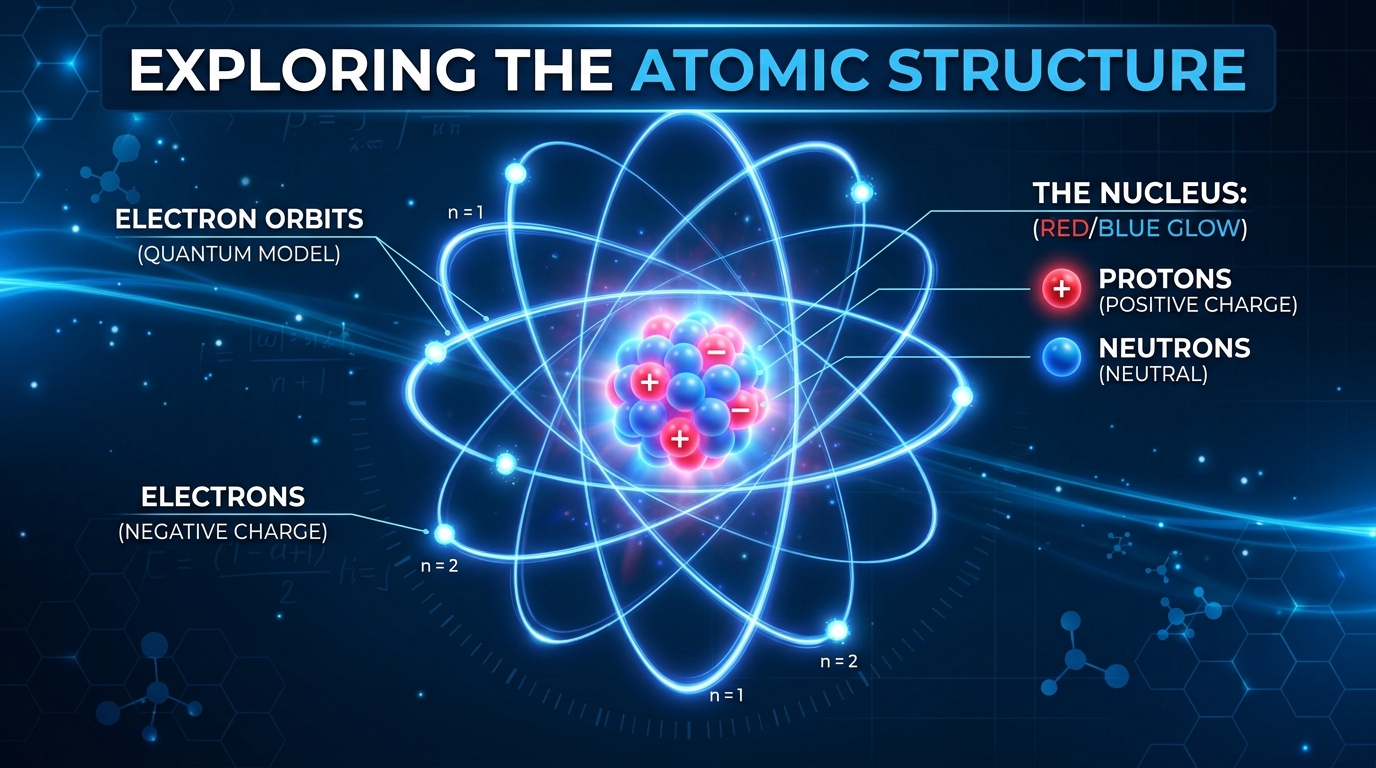
Atomic Structure & Quantum Mechanics: Master Chemistry Notes
Part 1: Discovery of Subatomic Particles
The concept of the atom evolved from John Dalton’s indivisible sphere hypothesis (1808) to modern quantum mechanics. The discovery of subatomic particles demonstrated that atoms possess complex internal architectures.
| Particle | Discoverer & Year | Mass (kg) | Mass (amu) | Charge (Coulombs) | Relative Charge |
|---|---|---|---|---|---|
| Electron (e⁻) | J.J. Thomson (1897) | \( 9.10938 \times 10^{-31} \) | 0.0005485 | \( -1.6022 \times 10^{-19} \) | -1 |
| Proton (p⁺) | E. Goldstein / E. Rutherford (1919) | \( 1.67262 \times 10^{-27} \) | 1.007276 | \( +1.6022 \times 10^{-19} \) | +1 |
| Neutron (n⁰) | James Chadwick (1932) | \( 1.67493 \times 10^{-27} \) | 1.008665 | 0 | 0 |
Key Historical Discovery Experiments
- Cathode Ray Tube (J.J. Thomson): Demonstrated that cathode rays consist of negatively charged particles. Thomson measured the charge-to-mass ratio: \[ \frac{e}{m_e} = 1.75882 \times 10^{11} \text{ C/kg} \]
- Millikan's Oil Drop Experiment (1909): Determined the absolute charge of an electron: \( e = 1.602 \times 10^{-19} \text{ C} \). Combined with Thomson's \( e/m_e \), this yielded the electron mass: \( m_e = 9.109 \times 10^{-31} \text{ kg} \).
- Rutherford's Gold Foil \( \alpha \)-Particle Scattering (1911): Bombarded thin gold foil (100 nm thick) with high-velocity \( \alpha \)-particles (\( \text{He}^{2+} \)).
Observations: Most \( \alpha \)-particles passed undeflected; 1 in 8,000 deflected by large angles; 1 in 20,000 rebounded by 180°.
Conclusions: Most atomic volume is empty space; positive charge and mass are concentrated in a tiny dense core called the Nucleus (radius \( \approx 10^{-15} \text{ m} \) compared to atomic radius \( \approx 10^{-10} \text{ m} \)).
Part 2: Bohr's Quantum Model of the Atom (1913)
Niels Bohr resolved the stability crisis of Rutherford's classical model by applying Max Planck's Quantum Theory.
Bohr's Postulates
- Electrons revolve around the positive nucleus in specific non-radiating circular orbits called Stationary States or energy levels (K, L, M, N... or \( n = 1, 2, 3... \)).
- The orbital angular momentum (\( L \)) of an electron is quantized in integral multiples of \( \frac{h}{2\pi} \): \[ L = m_e v r = \frac{n h}{2\pi} \quad (n = 1, 2, 3...) \]
- Energy is emitted or absorbed only when an electron jumps between energy levels: \[ \Delta E = E_2 - E_1 = h \nu = \frac{h c}{\lambda} \]
Mathematical Derivations & Formulas for Hydrogen-like Species
For an atom/ion with atomic number \( Z \) and a single electron (e.g., \( \text{H}, \text{He}^+, \text{Li}^{2+} \)):
- Radius of \( n \)-th Orbit: \[ r_n = \frac{n^2 h^2 \epsilon_0}{\pi m_e Z e^2} = 0.529 \times \frac{n^2}{Z} \text{ \AA} \quad (1 \text{ \AA} = 10^{-10} \text{ m}) \]
- Velocity of Electron in \( n \)-th Orbit: \[ v_n = \frac{Z e^2}{2 n h \epsilon_0} = 2.18 \times 10^6 \times \frac{Z}{n} \text{ m/s} \]
- Energy of Electron in \( n \)-th Orbit: \[ E_n = -\frac{m_e Z^2 e^4}{8 \epsilon_0^2 n^2 h^2} = -13.6 \times \frac{Z^2}{n^2} \text{ eV/atom} = -2.18 \times 10^{-18} \times \frac{Z^2}{n^2} \text{ J/atom} \]
Part 3: Quantum Numbers & Electronic Configuration Rules
Every electron in an atom is uniquely identified by four Quantum Numbers:
| Quantum Number | Symbol | Allowed Values | Physical Significance |
|---|---|---|---|
| Principal | \( n \) | \( 1, 2, 3, 4... \) | Main energy level (shell), orbital size & average distance from nucleus |
| Azimuthal (Subsidiary) | \( l \) | \( 0 \text{ to } (n-1) \) | Subshell shape (\( l=0 \rightarrow s \) spherical, \( l=1 \rightarrow p \) dumbbell, \( l=2 \rightarrow d \) double-dumbbell, \( l=3 \rightarrow f \) complex) |
| Magnetic | \( m_l \) | \( -l \text{ to } +l \) | Spatial orientation of orbital in magnetic field (Total orbitals in subshell = \( 2l+1 \)) |
| Spin | \( m_s \) | \( +1/2, -1/2 \) | Spin orientation of electron around its own axis (clockwise / counter-clockwise) |
Fundamental Rules for Filling Atomic Orbitals
- Aufbau Principle: Orbitals are filled in order of increasing energy, governed by the \( (n+l) \) rule. Orbitals with lower \( (n+l) \) value fill first. If two orbitals have identical \( (n+l) \), the one with lower \( n \) fills first.
Energy Order: \( 1s < 2s < 2p < 3s < 3p < 4s < 3d < 4p < 5s < 4d \) - Pauli Exclusion Principle: No two electrons in an atom can have the exact same set of all four quantum numbers. Consequently, an orbital can hold a maximum of 2 electrons, and they must have opposite spins.
- Hund's Rule of Maximum Multiplicity: Electron pairing in degenerate orbitals (orbitals of equal energy, e.g., \( p_x, p_y, p_z \)) does not occur until each orbital is singly occupied by an electron with parallel spin.
\( \text{Cr } (Z=24): [\text{Ar}] 3d^5 4s^1 \) (instead of \( [\text{Ar}] 3d^4 4s^2 \))
\( \text{Cu } (Z=29): [\text{Ar}] 3d^{10} 4s^1 \) (instead of \( [\text{Ar}] 3d^9 4s^2 \))
Part 4: Isotopes, Isobars, Isotones & Isoelectronic Species
- Isotopes: Atoms of the same element having the same Atomic Number (\( Z \)) but different Mass Number (\( A \)). They have identical chemical properties but different physical properties.
Examples: Hydrogen isotopes — Protium (\( ^1_1\text{H} \)), Deuterium (\( ^2_1\text{H} \) or \( \text{D} \)), Tritium (\( ^3_1\text{H} \) or \( \text{T} \), radioactive). Carbon — \( ^{12}_6\text{C}, ^{13}_6\text{C}, ^{14}_6\text{C} \). - Isobars: Atoms of different elements having different Atomic Numbers (\( Z \)) but the same Mass Number (\( A \)).
Examples: \( ^{40}_{18}\text{Ar}, ^{40}_{19}\text{K}, ^{40}_{20}\text{Ca} \). - Isotones: Atoms of different elements containing the same number of neutrons (\( N = A - Z \)).
Examples: \( ^{14}_6\text{C} \) (14-6 = 8 neutrons) and \( ^{16}_8\text{O} \) (16-8 = 8 neutrons). - Isoelectronic Species: Atoms, molecules, or ions that possess the exact same total number of electrons.
Examples: \( \text{N}^{3-}, \text{O}^{2-}, \text{F}^-, \text{Ne}, \text{Na}^+, \text{Mg}^{2+}, \text{Al}^{3+} \) (all possess 10 electrons).
Part 5: Advanced Spectroscopy & Quantum Physics Numerical Masterclass
Spectroscopy provides direct empirical evidence for the quantized energy levels within atoms. When excited gaseous atoms return to lower electronic states, they emit discrete wavelengths of light forming a characteristic line spectrum.
1. Photoelectric Effect & Einstein's Photon Theory (1905)
When electromagnetic radiation of frequency \( \nu \) strikes a clean metal surface (e.g., Potassium, Cesium, Rubidium), electrons are ejected instantly. Albert Einstein explained this using Planck's quantum concept:
\[ E_{\text{photon}} = h \nu = W_0 + K.E._{\text{max}} \]
Where \( W_0 = h \nu_0 \) is the Work Function (minimum energy required to eject an electron from the metal surface), and \( \nu_0 \) is the Threshold Frequency.
\[ K.E._{\text{max}} = \frac{1}{2} m_e v_{\text{max}}^2 = h (\nu - \nu_0) = e V_0 \]
Where \( V_0 \) is the Stopping Potential required to reduce photoelectric current to zero.
Solved Exam Numerical Problems:
Problem 1: Calculate the energy in eV of a photon having a wavelength of \( 4000 \text{ \AA} \).
Solution: \( E = \frac{h c}{\lambda} = \frac{(6.626 \times 10^{-34} \text{ J}\cdot\text{s}) (3 \times 10^8 \text{ m/s})}{4000 \times 10^{-10} \text{ m}} = 4.97 \times 10^{-19} \text{ J} \).
Converting to eV: \( E = \frac{4.97 \times 10^{-19}}{1.602 \times 10^{-19}} = 3.10 \text{ eV} \).
Problem 2: Calculate the de Broglie wavelength of an electron moving with a velocity of \( 2.0 \times 10^6 \text{ m/s} \).
Solution: \( \lambda = \frac{h}{m_e v} = \frac{6.626 \times 10^{-34} \text{ kg}\cdot\text{m}^2/\text{s}}{(9.109 \times 10^{-31} \text{ kg}) (2.0 \times 10^6 \text{ m/s})} = 3.637 \times 10^{-10} \text{ m} = 3.64 \text{ \AA} \).
Problem 3: Find the longest wavelength transition in the Balmer series of Hydrogen spectrum (\( Z=1 \)).
Solution: Longest wavelength corresponds to minimum energy transition: \( n_1 = 2 \) to \( n_2 = 3 \).
\( \frac{1}{\lambda} = R_H \left( \frac{1}{2^2} - \frac{1}{3^2} \right) = 1.09677 \times 10^7 \left( \frac{1}{4} - \frac{1}{9} \right) = 1.09677 \times 10^7 \left( \frac{5}{36} \right) = 1.523 \times 10^6 \text{ m}^{-1} \).
\( \lambda = \frac{1}{1.523 \times 10^6} = 6.563 \times 10^{-7} \text{ m} = 656.3 \text{ nm} \) (Red H-\(\alpha\) line).
Part 6: Nuclear Chemistry, Radioactivity & Mass Defect
The stability of an atomic nucleus depends on the neutron-to-proton ratio (\( N/Z \)). For light stable elements (\( Z \le 20 \)), \( N/Z \approx 1.0 \). For heavy nuclei (e.g., Lead, Uranium), \( N/Z \) increases to \( \approx 1.5 \).
1. Types of Radioactive Emissions
- Alpha Decay (\( \alpha \)): Emission of a Helium nucleus \( ^{4}_{2}\text{He}^{2+} \). Mass number drops by 4, atomic number drops by 2: \[ ^{238}_{92}\text{U} \rightarrow ^{234}_{90}\text{Th} + ^{4}_{2}\text{He} \]
- Beta Decay (\( \beta^- \)): Transformation of a neutron into a proton, releasing an electron \( ^{0}_{-1}\text{e} \) and an antineutrino \( \bar{\nu} \). Atomic number increases by 1: \[ ^{14}_{6}\text{C} \rightarrow ^{14}_{7}\text{N} + ^{0}_{-1}\text{e} + \bar{\nu} \]
- Gamma Radiation (\( \gamma \)): High-energy photon emission during nuclear relaxation. No change in mass or atomic number.
2. Nuclear Binding Energy & Mass Defect Formula
The total rest mass of a stable nucleus is always less than the sum of individual masses of its constituent protons and neutrons. This mass difference is called the Mass Defect (\( \Delta m \)):
\[ \Delta m = [Z m_p + (A - Z) m_n] - m_{\text{nucleus}} \]
By Einstein's mass-energy equivalence equation (\( E = \Delta m \cdot c^2 \)), this mass defect releases the Nuclear Binding Energy (typically \( \approx 8.8 \text{ MeV per nucleon} \) for Iron \( ^{56}\text{Fe} \)).
Part 7: Competitive Exam Practice Question Bank (RRB, SSC, NEET, JEE & UPSC)
Test your conceptual understanding with these high-yield previous year questions accompanied by detailed explanatory solutions:
Question 1 (RRB JE 2019): Which of the following subatomic particles has the highest mass-to-charge ratio?
Options: (A) Electron (B) Proton (C) Alpha particle (D) Neutron
Answer: (D) Neutron.
Detailed Explanation: Since a neutron has zero charge (q = 0), its mass-to-charge ratio (m/q) is infinite (1.675 × 10^-27 / 0 = ∞), which is the highest among all subatomic particles.
Question 2 (SSC CGL 2021): What is the maximum number of orbitals possible in a subshell with Azimuthal Quantum Number l = 3?
Options: (A) 3 (B) 5 (C) 7 (D) 14
Answer: (C) 7.
Detailed Explanation: The total number of spatial orientations (orbitals) in any subshell is given by (2l + 1). For l = 3 (f-subshell), Number of orbitals = 2(3) + 1 = 7 orbitals (holding max 14 electrons).
Question 3 (NEET 2020): Which orbital transition in a Hydrogen atom emits a photon of the shortest wavelength?
Options: (A) n = 2 to n = 1 (B) n = 4 to n = 2 (C) n = 3 to n = 1 (D) n = 5 to n = 3
Answer: (C) n = 3 to n = 1.
Detailed Explanation: Shortest wavelength (λ_min) corresponds to maximum energy emission (ΔE = hc/λ). Transitions ending at n1 = 1 belong to the Lyman series (UV region, highest energy). Between n=2->1 and n=3->1, the n=3->1 jump releases greater energy difference (12.09 eV vs 10.2 eV).
Question 4 (UPSC GS 2022): Consider Isoelectronic species N³⁻, O²⁻, F⁻, Na⁺, Mg²⁺, Al³⁺. What is the correct order of decreasing ionic radii?
Options: (A) Al³⁺ > Mg²⁺ > Na⁺ > F⁻ > O²⁻ > N³⁻ (B) N³⁻ > O²⁻ > F⁻ > Na⁺ > Mg²⁺ > Al³⁺ (C) Na⁺ > Mg²⁺ > Al³⁺ > N³⁻ > O²⁻ > F⁻ (D) F⁻ > O²⁻ > N³⁻ > Al³⁺ > Mg²⁺ > Na⁺
Answer: (B) N³⁻ > O²⁻ > F⁻ > Na⁺ > Mg²⁺ > Al³⁺.
Detailed Explanation: For isoelectronic species (all having 10 electrons), ionic radius decreases with increasing nuclear charge (Z). Al³⁺ has Z = 13 pulling 10 e⁻ tightly (smallest radius), while N³⁻ has Z = 7 holding 10 e⁻ loosely (largest radius).
Question 5 (JEE Main 2021): Calculate the total number of nodes (angular + radial) present in a 4d orbital.
Options: (A) 1 (B) 2 (C) 3 (D) 4
Answer: (C) 3.
Detailed Explanation: For any atomic orbital, Radial Nodes = n - l - 1; Angular Nodes = l; Total Nodes = (n - l - 1) + l = n - 1. For 4d orbital (n = 4, l = 2): Radial nodes = 4 - 2 - 1 = 1; Angular nodes = 2; Total nodes = 4 - 1 = 3.
Frequently Asked Questions (FAQ) & High-Yield Exam Tips
Q: What are the allowed values for Azimuthal Quantum Number (l) when n = 3?
A: When n = 3, l can take integral values from 0 to (n-1), which are l = 0 (3s), l = 1 (3p), and l = 2 (3d).
Q: Why do Chromium (Cr) and Copper (Cu) show anomalous electronic configurations?
A: Half-filled (d5) and fully-filled (d10) subshells possess extra stability due to symmetrical distribution of electrons and maximum exchange energy. Thus, an electron from 4s shifts to 3d.
Q: What is the difference between Isotopes and Isobars?
A: Isotopes have the same atomic number (Z) but different mass numbers (A) [same element]. Isobars have different atomic numbers (Z) but the same mass number (A) [different elements].
Q: What is the radius of the first orbit of Hydrogen atom according to Bohr Model?
A: The radius of the first orbit (n=1) of Hydrogen (Z=1) is a0 = 0.529 Å (0.0529 nm or 52.9 pm).
Q: What is the maximum number of electrons that can be accommodated in a shell with principal quantum number n?
A: The maximum electron capacity of a shell is given by the formula 2n². For n=1 (K shell) = 2, n=2 (L shell) = 8, n=3 (M shell) = 18, n=4 (N shell) = 32.
Master Chemistry & General Science on RRBCONTENTS
Access full study notes, interactive formula cheat sheets, and daily competitive exam updates.
Full Science Study Notes → Practice Chemistry PYQs →Join our official Telegram channel for instant study resources: @rrbcontents