Home › Blog › Chemistry Notes › Behaviour of Gases
Behaviour of Gases & Gas Laws: Complete Physical Chemistry Notes
Part 1: Fundamental Gas Laws
The physical state of a gas is described by four state variables: Pressure (\( P \)), Volume (\( V \)), Temperature (\( T \) in Kelvin), and Amount of substance (\( n \) in moles). The classical Gas Laws relate these variables under controlled conditions.
1. Boyle's Law (Pressure-Volume Relationship)
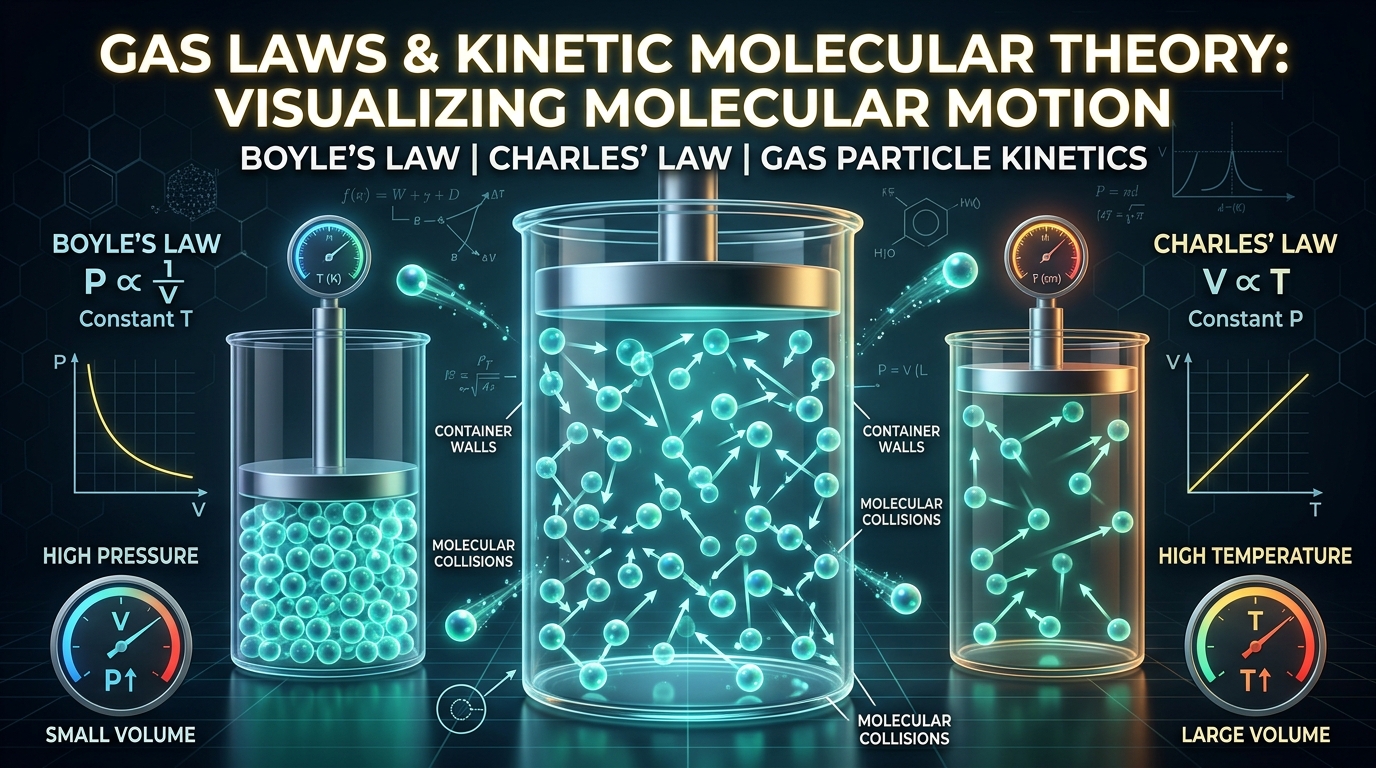
Formulated by Robert Boyle (1662): At constant temperature, the volume of a fixed mass of gas is inversely proportional to its pressure.
\[ V \propto \frac{1}{P} \quad (\text{at constant } T, n) \implies P_1 V_1 = P_2 V_2 \]
Graphically, a plot of \( P \) versus \( V \) yields a rectangular hyperbola called an Isotherm.
2. Charles's Law (Temperature-Volume Relationship)
Formulated by Jacques Charles (1787): At constant pressure, the volume of a given mass of gas is directly proportional to its absolute temperature (Kelvin scale).
\[ V \propto T \quad (\text{at constant } P, n) \implies \frac{V_1}{T_1} = \frac{V_2}{T_2} \]
Absolute Zero (\( 0 \text{ K} = -273.15^\circ\text{C} \)) is the theoretical temperature at which the volume of an ideal gas shrinks to zero. Plots of \( V \) versus \( T \) at constant pressure are called Isobars.
3. Gay-Lussac's Law (Pressure-Temperature Relationship)
At constant volume, the pressure of a given mass of gas is directly proportional to its absolute temperature in Kelvin.
\[ P \propto T \quad (\text{at constant } V, n) \implies \frac{P_1}{T_1} = \frac{P_2}{T_2} \]
Plots of \( P \) versus \( T \) at constant volume are called Isochores.
4. Avogadro's Law (Volume-Amount Relationship)
Formulated by Amedeo Avogadro (1811): Equal volumes of all gases under the same conditions of temperature and pressure contain equal number of molecules.
\[ V \propto n \quad (\text{at constant } P, T) \]
At Standard Temperature and Pressure (STP: \( 0^\circ\text{C} = 273.15 \text{ K} \), \( 1 \text{ atm} = 1.013 \text{ bar} \)), 1 mole of any ideal gas occupies a molar volume of 22.414 Litres (22.4 L).
Part 2: The Ideal Gas Equation & Gas Constant (R)
Combining Boyle's Law, Charles's Law, and Avogadro's Law gives the single unified Ideal Gas Equation:
\[ P V = n R T \]
Where \( R \) is the Universal Gas Constant. Its numerical value depends on the units of pressure and volume:
| Units of Pressure & Volume | Numerical Value of Gas Constant (R) |
|---|---|
| SI Units (\( \text{N/m}^2 \) or Pa, \( \text{m}^3 \)) | \( R = 8.31446 \text{ J mol}^{-1} \text{K}^{-1} \) |
| Atmospheres & Litres (atm, L) | \( R = 0.082057 \text{ L atm mol}^{-1} \text{K}^{-1} \) |
| Bar & Litres (bar, L) | \( R = 0.08314 \text{ L bar mol}^{-1} \text{K}^{-1} \) |
| Calories (cal) | \( R \approx 1.987 \text{ cal mol}^{-1} \text{K}^{-1} \) |
Part 3: Dalton's Law of Partial Pressures & Graham's Law of Diffusion
Dalton's Law of Partial Pressures
John Dalton (1801): The total pressure exerted by a mixture of non-reacting gases in a enclosed vessel is equal to the sum of partial pressures exerted by individual component gases:
\[ P_{\text{total}} = P_1 + P_2 + P_3 + \dots = \sum_{i} P_i \]
The partial pressure of any component gas \( i \) is related to its mole fraction (\( x_i \)):
\[ P_i = x_i \cdot P_{\text{total}} \]
Graham's Law of Effusion / Diffusion (1848)
Under constant temperature and pressure, the rate of diffusion (\( r \)) of a gas is inversely proportional to the square root of its density (\( d \)) or molar mass (\( M \)):
\[ r \propto \frac{1}{\sqrt{d}} \propto \frac{1}{\sqrt{M}} \implies \frac{r_1}{r_2} = \sqrt{\frac{d_2}{d_1}} = \sqrt{\frac{M_2}{M_1}} \]
Part 4: Kinetic Molecular Theory & Molecular Speeds
Postulates of Kinetic Molecular Theory
- Gases consist of extremely tiny, identical particles (molecules) separated by large distances. The actual volume of molecules is negligible compared to the total container volume.
- Gas molecules are in continuous, rapid, random motion in straight lines, colliding with container walls to exert pressure.
- Collisions between gas molecules and container walls are perfectly elastic (no net loss of kinetic energy).
- There are no intermolecular forces of attraction or repulsion between ideal gas molecules.
- The average kinetic energy of gas molecules is directly proportional to absolute temperature: \( E_k = \frac{3}{2} R T \) per mole.
Molecular Velocities Formulas
- Root Mean Square Velocity (\( v_{\text{rms}} \)): \[ v_{\text{rms}} = \sqrt{\frac{3 R T}{M}} = \sqrt{\frac{3 P}{\rho}} \]
- Average Velocity (\( v_{\text{avg}} \)): \[ v_{\text{avg}} = \sqrt{\frac{8 R T}{\pi M}} \approx 0.921 \times v_{\text{rms}} \]
- Most Probable Velocity (\( v_{\text{mp}} \)): \[ v_{\text{mp}} = \sqrt{\frac{2 R T}{M}} \approx 0.816 \times v_{\text{rms}} \]
Ratio: \( v_{\text{mp}} : v_{\text{avg}} : v_{\text{rms}} = 1 : 1.128 : 1.225 \) or \( \sqrt{2} : \sqrt{\frac{8}{\pi}} : \sqrt{3} \)
Part 5: Real Gases & van der Waals Equation
Real gases deviate from ideal behavior at high pressures and low temperatures because intermolecular forces become significant and molecular volume is no longer negligible. The Compressibility Factor \( Z \) measures this deviation:
\[ Z = \frac{P V_m}{R T} \]
- For an Ideal Gas, \( Z = 1 \) under all conditions.
- If \( Z < 1 \), negative deviation (attractive forces dominate, gas is more compressible).
- If \( Z > 1 \), positive deviation (repulsive forces dominate, gas is less compressible).
van der Waals Equation of State (1873)
Johannes van der Waals modified the ideal gas law by introducing pressure and volume corrections:
\[ \left( P + \frac{a n^2}{V^2} \right) (V - n b) = n R T \]
- Pressure Correction Factor (\( a \)): Accounts for intermolecular attractive forces. Higher value of \( a \) means the gas can be liquified more easily (e.g., \( \text{NH}_3, \text{SO}_2 \)).
- Volume Correction Factor (\( b \)): Co-volume or excluded volume occupied by gas molecules themselves (\( b = 4 \times \text{actual molecular volume} \)).
Part 6: Mathematical Derivations & Industrial Thermodynamics
Understanding gas behavior under extreme conditions is vital in cryogenic engineering, space propellant storage, and petrochemical processing.
1. Kinetic Theory Derivation of Gas Pressure
Consider \( N \) gas molecules, each of mass \( m \), enclosed in a cubic vessel of side \( L \) (volume \( V = L^3 \)). Resolving the root mean square velocity into components \( v_x^2 + v_y^2 + v_z^2 = v^2 \), isotropic motion dictates \( v_x^2 = v_y^2 = v_z^2 = \frac{1}{3} v^2 \).
Change in momentum of one molecule per collision with a vertical wall: \( \Delta p_x = m v_x - (-m v_x) = 2 m v_x \). Time between consecutive collisions: \( \Delta t = \frac{2 L}{v_x} \). Force exerted on the wall:
\[ F_x = \frac{\Delta p_x}{\Delta t} = \frac{2 m v_x}{2 L / v_x} = \frac{m v_x^2}{L} \]
Summing across all \( N \) molecules and dividing by total surface area \( A = L^2 \) yields the fundamental kinetic equation of gas pressure:
\[ P = \frac{F_{\text{total}}}{L^2} = \frac{m}{L^3} \sum v_{x,i}^2 = \frac{N m v_{\text{rms}}^2}{3 V} \implies P V = \frac{1}{3} N m v_{\text{rms}}^2 \]
2. Liquefaction of Gases & The Joule-Thomson Effect
When a real gas under high pressure is allowed to expand adiabatically through a porous plug or narrow orifice into a region of low pressure, its temperature drops. This is the Joule-Thomson Effect.
- Inversion Temperature (\( T_i \)): The characteristic temperature below which gas expansion produces cooling, and above which it produces heating: \[ T_i = \frac{2a}{R b} = 2 T_b \quad (T_b = \text{Boyle Temperature}) \]
- Linde's Process: Uses repeated Joule-Thomson expansion to liquify air into liquid nitrogen (b.p. 77 K) and liquid oxygen (b.p. 90 K).
- Claude's Process: Combines Joule-Thomson expansion with mechanical work performed by expanding gas against a piston, achieving higher liquefaction efficiency.
Step-by-Step Gas Law Numerical Solved Examples:
Problem 1: A steel cylinder contains Oxygen gas at 20°C and 5.0 atm pressure. If the cylinder is heated to 100°C, find the new pressure.
Solution: Volume is constant \( \implies \frac{P_1}{T_1} = \frac{P_2}{T_2} \). Convert T to Kelvin: \( T_1 = 293.15 \text{ K}, T_2 = 373.15 \text{ K} \).
\( P_2 = P_1 \times \frac{T_2}{T_1} = 5.0 \times \frac{373.15}{293.15} = 6.36 \text{ atm} \).
Problem 2: Calculate the RMS velocity of Nitrogen molecules (\( \text{N}_2 \), Molar Mass = 28 g/mol = 0.028 kg/mol) at 300 K.
Solution: \( v_{\text{rms}} = \sqrt{\frac{3 R T}{M}} = \sqrt{\frac{3 \times 8.314 \times 300}{0.028}} = \sqrt{\frac{7482.6}{0.028}} = \sqrt{267235.7} = 516.9 \text{ m/s} \).
Problem 3: Calculate the density of Methane (\( \text{CH}_4 \), M = 16 g/mol) at 27°C and 2.0 atm pressure.
Solution: \( P M = d R T \implies d = \frac{P M}{R T} = \frac{(2.0 \text{ atm}) (16 \text{ g/mol})}{(0.0821 \text{ L atm mol}^{-1}\text{K}^{-1}) (300 \text{ K})} = \frac{32}{24.63} = 1.30 \text{ g/L} \).
Part 7: High-Yield Exam Question Bank & Numerical Problem Set
Master these selected numerical problems and conceptual MCQs frequently tested in competitive examinations:
Question 1 (RRB NTPC 2021): At what temperature will the RMS velocity of Hydrogen gas molecules be equal to that of Oxygen molecules at 47°C?
Options: (A) 20 K (B) 40 K (C) 80 K (D) 320 K
Answer: (A) 20 K.
Detailed Explanation: v_rms = √(3RT/M). Setting v_rms(H2) = v_rms(O2):
√(3 R T_H2 / 2) = √(3 R T_O2 / 32) ⇒ T_H2 / 2 = T_O2 / 32 ⇒ T_H2 = (2 / 32) × T_O2.
Convert T_O2 = 47 + 273.15 = 320 K. Thus, T_H2 = (2 / 32) × 320 = 20 K.
Question 2 (SSC CGL 2020): According to Graham's Law, if 50 mL of Oxygen gas diffuses through a porous membrane in 20 seconds, how long will 50 mL of Hydrogen gas take under identical conditions?
Options: (A) 5 seconds (B) 10 seconds (C) 40 seconds (D) 80 seconds
Answer: (A) 5 seconds.
Detailed Explanation: Rate r = Volume / time = V / t. By Graham's Law: (V/t_H2) / (V/t_O2) = √(M_O2 / M_H2).
t_O2 / t_H2 = √(32 / 2) = √16 = 4 ⇒ 20 / t_H2 = 4 ⇒ t_H2 = 5 seconds.
Question 3 (UPSC GS 2021): Which of the following gas liquefaction conditions is correctly matched with van der Waals constant 'a'?
Options: (A) Higher 'a' means harder to liquify (B) Higher 'a' means stronger intermolecular forces and easier liquefaction (C) 'a' is independent of temperature (D) 'a' measures molecular volume
Answer: (B) Higher 'a' means stronger intermolecular forces and easier liquefaction.
Detailed Explanation: The van der Waals constant 'a' reflects attractive intermolecular forces. Gases like Ammonia (NH3) and Sulfur Dioxide (SO2) have large 'a' values and liquify easily, whereas Helium (He) and Hydrogen (H2) have tiny 'a' values and are hard to liquify.
Question 4 (NEET 2019): A mixture of 4 g Hydrogen and 2 g Helium is enclosed in a 10 L vessel at 0°C. Calculate total pressure.
Options: (A) 2.24 atm (B) 4.48 atm (C) 5.60 atm (D) 11.2 atm
Answer: (C) 5.60 atm.
Detailed Explanation: Moles of H2 = 4g / 2g/mol = 2.0 mol. Moles of He = 2g / 4g/mol = 0.5 mol. Total moles n = 2.5 mol.
Using P = nRT / V = (2.5 mol × 0.0821 L·atm/mol·K × 273.15 K) / 10 L = 5.60 atm.
Part 8: Comprehensive Gas Law Formula Cheat Sheet & Advanced Case Studies
For quick revision before competitive exams, utilize this comprehensive formula summary and conceptual case study analysis:
| Gas Law Name | Governing Equation | Constant Variables | Physical Property Graph |
|---|---|---|---|
| Boyle's Law | \( P_1 V_1 = P_2 V_2 \) | Temperature (T), Mass (n) | P vs V Isotherm (Rectangular Hyperbola) |
| Charles's Law | \( \frac{V_1}{T_1} = \frac{V_2}{T_2} \) | Pressure (P), Mass (n) | V vs T Isobar (Straight line passing through 0 K) |
| Gay-Lussac's Law | \( \frac{P_1}{T_1} = \frac{P_2}{T_2} \) | Volume (V), Mass (n) | P vs T Isochore (Straight line passing through 0 K) |
| Avogadro's Law | \( V \propto n \) | Pressure (P), Temp (T) | Molar Volume at STP = 22.414 Litres |
| Ideal Gas Law | \( P V = n R T \) | Gas Constant R | R = 8.314 J/mol·K = 0.0821 L·atm/mol·K |
| Graham's Law | \( \frac{r_1}{r_2} = \sqrt{\frac{M_2}{M_1}} \) | Pressure (P), Temp (T) | Diffusion speed is inversely proportional to √M |
Industrial Applications & High-Yield Case Studies
- Scuba Diving & Deep-Sea Bends: At deep sea levels, high ambient water pressure increases the solubility of Nitrogen gas in human blood (Henry's Law). When a diver ascends rapidly to the surface, ambient pressure drops suddenly, causing dissolved Nitrogen to form painful gas bubbles in blood vessels (decompression sickness or 'bends'). To prevent this, scuba tanks use Heliox — a breathing mixture of 11.7% Helium, 56.2% Nitrogen, and 32.1% Oxygen.
- Weather Balloons & Atmospheric Altitude: Weather balloons filled with Helium or Hydrogen are only partially inflated at ground level. As the balloon ascends into higher atmospheric layers where barometric pressure drops significantly, the gas inside expands according to Boyle's Law (P1V1 = P2V2), preventing the balloon envelope from bursting.
- Automobile Airbag Safety Chemistry: Modern vehicle airbags deploy in collisions via the rapid thermal decomposition of Sodium Azide (NaN3) triggered by an electrical sensor: \[ 2\text{NaN}_3(s) \xrightarrow{\text{Ignition}} 2\text{Na}(s) + 3\text{N}_2(g) \] The generated Nitrogen gas inflates the nylon airbag in less than 40 milliseconds, cushioning occupants.
Frequently Asked Questions (FAQ) & High-Yield Exam Tips
Q: What is the Ideal Gas Equation and what are the units of R?
A: The ideal gas equation is PV = nRT. In SI units, R = 8.314 J/(mol·K). In atmosphere-litre units, R = 0.0821 L·atm/(mol·K).
Q: What is the ratio of Most Probable, Average, and Root Mean Square velocities?
A: The ratio of v_mp : v_avg : v_rms is √2 : √(8/π) : √3, which numerically equals 1 : 1.128 : 1.225.
Q: Why do real gases deviate from ideal behavior?
A: Real gases deviate at high pressure and low temperature because: (1) Intermolecular attractive forces exist, and (2) Gas molecules occupy a non-zero finite volume.
Q: What do van der Waals constants 'a' and 'b' represent?
A: Constant 'a' measures the magnitude of intermolecular attractive forces (ease of liquefaction). Constant 'b' measures the effective co-volume or excluded volume of gas molecules.
Q: What is Graham's Law of Diffusion?
A: Graham's Law states that at constant T and P, the rate of gas diffusion is inversely proportional to the square root of its molar mass or density: r1/r2 = √(M2/M1).
Master Chemistry & General Science on RRBCONTENTS
Access full study notes, interactive formula cheat sheets, and daily competitive exam updates.
Full Science Study Notes → Practice Chemistry PYQs →Join our official Telegram channel for instant study resources: @rrbcontents