Home › Blog › Chemistry Notes › Carbon & Its Compounds
Carbon and Its Compounds: Complete Organic Chemistry Notes
Part 1: Unique Nature of Carbon
Carbon (symbol \( \text{C} \), atomic number \( Z=6 \), electronic configuration \( 1s^2 2s^2 2p^2 \)) forms the backbone of organic chemistry. Its ability to form millions of organic compounds stems from two fundamental properties:
- Tetravalency: Carbon has 4 valence electrons in its outermost shell. To achieve a stable octet, it forms four covalent bonds by sharing electrons with other carbon atoms or monovalent/multivalent heteroatoms (\( \text{H}, \text{O}, \text{N}, \text{S}, \text{X} \)).
- Catenation: Carbon possesses the unique ability to form strong covalent bonds with other carbon atoms, creating long straight chains, branched chains, and cyclic rings. The high C-C bond dissociation energy (\( 348 \text{ kJ/mol} \)) makes carbon catenation far superior to silicon or sulfur.
Part 2: Allotropes of Carbon
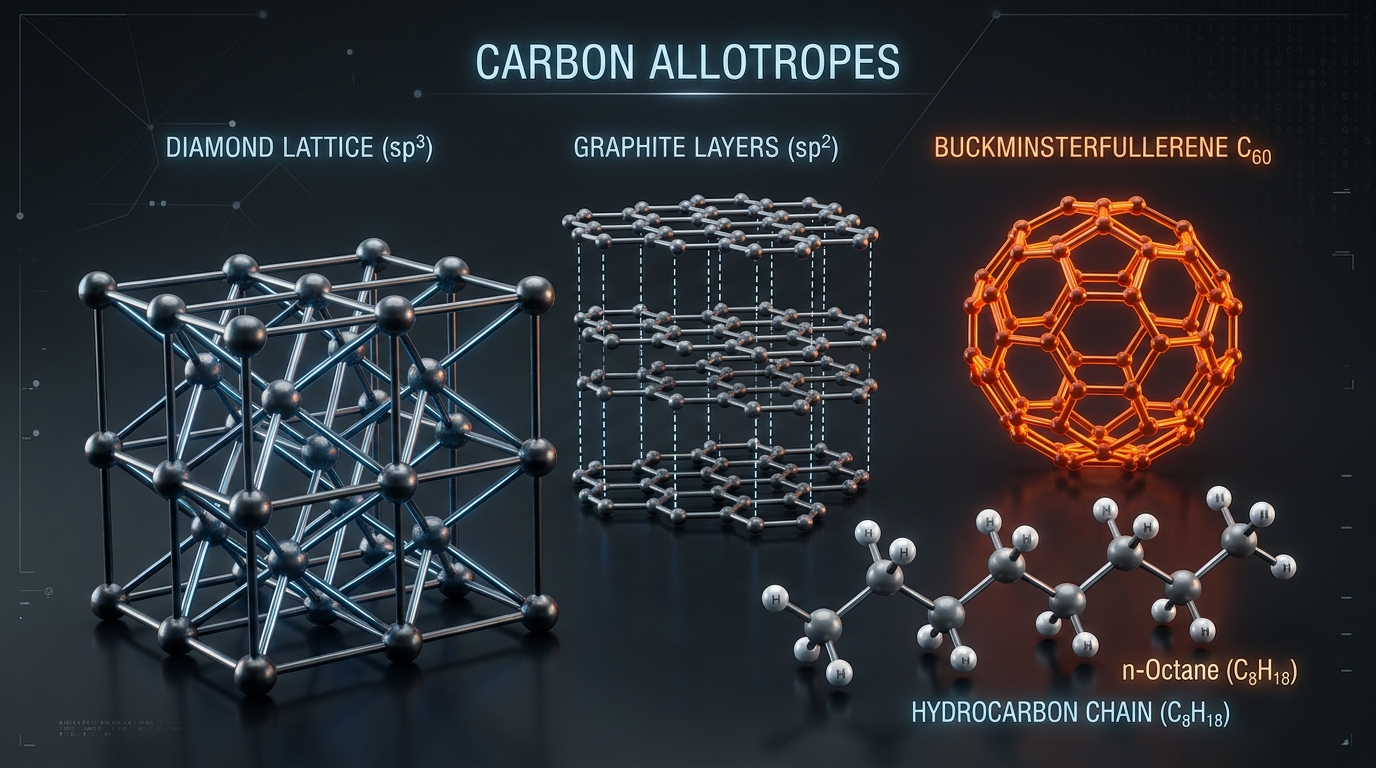
Allotropes are different physical forms of the same element in the same state, possessing identical chemical properties but distinct physical structures.
| Allotrope | Hybridization | Structural Geometry | Electrical Conductivity | Key Physical Properties & Applications |
|---|---|---|---|---|
| Diamond | \( sp^3 \) | Rigid 3D tetrahedral network | Insulator (No free electrons) | Hardest known natural substance (Mohs 10), high refractive index (2.42), used in glass cutting & rock drilling bits. |
| Graphite | \( sp^2 \) | 2D hexagonal planar layers bonded by weak van der Waals forces | Good Conductor (Delocalized \( \pi \)-electrons) | Soft, slippery, black solid, high melting point, used as solid lubricant, pencil lead, and arc lamp electrodes. |
| Fullerenes (\( \text{C}_{60} \)) | \( sp^2 \) | Soccer-ball cage (20 hexagons + 12 pentagons) | Semiconductor / Superconductor when doped | Buckminsterfullerene (named after Buckminster Fuller), targeted drug delivery vehicles, nanotechnology materials. |
| Graphene | \( sp^2 \) | Single 2D honeycomb atomic sheet | Ultra-high electrical & thermal conductor | Thinnest and strongest material known (200x steel), flexible touchscreens, next-gen battery anodes. |
Part 3: Hydrocarbons & IUPAC Nomenclature
Hydrocarbons are organic compounds composed exclusively of carbon and hydrogen atoms.
Classification of Hydrocarbons
- Saturated Hydrocarbons (Alkanes): Contain only single carbon-carbon bonds (\( \text{C}-\text{C} \)).
General Formula: \( \text{C}_n\text{H}_{2n+2} \)
Examples: Methane (\( \text{CH}_4 \)), Ethane (\( \text{C}_2\text{H}_6 \)), Propane (\( \text{C}_3\text{H}_8 \)). - Unsaturated Hydrocarbons:
- Alkenes: Contain at least one carbon-carbon double bond (\( \text{C}=\text{C} \)).
General Formula: \( \text{C}_n\text{H}_{2n} \)
Examples: Ethene (\( \text{C}_2\text{H}_4 \)), Propene (\( \text{C}_3\text{H}_6 \)). - Alkynes: Contain at least one carbon-carbon triple bond (\( \text{C}\equiv\text{C} \)).
General Formula: \( \text{C}_n\text{H}_{2n-2} \)
Examples: Ethyne / Acetylene (\( \text{C}_2\text{H}_2 \)), Propyne (\( \text{C}_3\text{H}_4 \)).
- Alkenes: Contain at least one carbon-carbon double bond (\( \text{C}=\text{C} \)).
- Aromatic Hydrocarbons: Cyclic planar molecules following Huckel's Rule (\( 4n+2 \) \( \pi \)-electrons).
Example: Benzene (\( \text{C}_6\text{H}_6 \)).
Part 4: Important Functional Groups & Chemical Reactions
| Functional Group | Formula | Prefix / Suffix | Example Compound | IUPAC Name |
|---|---|---|---|---|
| Alcohol | \( -\text{OH} \) | -ol | \( \text{C}_2\text{H}_5\text{OH} \) | Ethanol |
| Aldehyde | \( -\text{CHO} \) | -al | \( \text{CH}_3\text{CHO} \) | Ethanal (Acetaldehyde) |
| Ketone | \( >\text{C}=\text{O} \) | -one | \( \text{CH}_3\text{COCH}_3 \) | Propanone (Acetone) |
| Carboxylic Acid | \( -\text{COOH} \) | -oic acid | \( \text{CH}_3\text{COOH} \) | Ethanoic Acid (Acetic Acid) |
| Ester | \( -\text{COOR} \) | -oate | \( \text{CH}_3\text{COOC}_2\text{H}_5 \) | Ethyl Ethanoate |
Key Organic Reactions
- Combustion: \( \text{CH}_4(g) + 2\text{O}_2(g) \rightarrow \text{CO}_2(g) + 2\text{H}_2\text{O}(g) + \text{Heat} + \text{Light} \)
- Esterification: \( \text{CH}_3\text{COOH} + \text{C}_2\text{H}_5\text{OH} \xrightarrow{\text{conc. H}_2\text{SO}_4} \text{CH}_3\text{COOC}_2\text{H}_5 + \text{H}_2\text{O} \) (Fruity aroma ester formed).
- Saponification: Hydrolysis of esters or fats with strong base to yield soap: \[ \text{Fat / Oil} + 3\text{NaOH} \rightarrow \text{Glycerol} + 3\text{RCOONa} \quad (\text{Soap}) \]
- Soaps vs Detergents: Soaps are sodium/potassium salts of long-chain fatty acids. They precipitate as insoluble scum in hard water containing \( \text{Ca}^{2+} \) and \( \text{Mg}^{2+} \) ions. Synthetic Detergents are sodium salts of alkylbenzene sulphonates and do not form scum in hard water.
Part 5: Comprehensive IUPAC Nomenclature Rules & Organic Reaction Mechanisms
The International Union of Pure and Applied Chemistry (IUPAC) established a systematic methodology for naming organic molecules based on root words, primary suffixes, secondary suffixes, and prefixes.
IUPAC Systematic Naming Architecture
\[ \text{Name} = \text{Prefix (Substituents)} + \text{Root Word (Chain Length)} + \text{Primary Suffix (Unsaturation)} + \text{Secondary Suffix (Functional Group)} \]
| Chain Length (Carbon Count) | IUPAC Root Word | Primary Suffix (Bond Type) | Functional Group Secondary Suffix |
|---|---|---|---|
| 1 Carbon (C1) | Meth- | -ane (Single C-C) | Alcohol: -ol (\( -\text{OH} \)) |
| 2 Carbons (C2) | Eth- | -ene (Double C=C) | Aldehyde: -al (\( -\text{CHO} \)) |
| 3 Carbons (C3) | Prop- | -yne (Triple C≡C) | Ketone: -one (\( >\text{C}=\text{O} \)) |
| 4 Carbons (C4) | But- | -ane | Carboxylic Acid: -oic acid (\( -\text{COOH} \)) |
| 5 Carbons (C5) | Pent- | -ane | Ester: -oate (\( -\text{COOR} \)) |
| 6 Carbons (C6) | Hex- | -ane | Amide: -amide (\( -\text{CONH}_2 \)) |
Part 6: Types of Isomerism in Carbon Compounds
Isomers are compounds possessing the identical molecular formula but exhibiting different structural arrangements or spatial orientations.
- Chain Isomerism: Difference in the arrangement of carbon skeleton chain. Example: Butane (\( \text{C}_4\text{H}_{10} \)) exists as n-butane (straight chain) and isobutane / 2-methylpropane (branched).
- Position Isomerism: Difference in the position of functional group or multiple bond on the same carbon skeleton. Example: Propan-1-ol (\( \text{CH}_3\text{CH}_2\text{CH}_2\text{OH} \)) and Propan-2-ol (\( \text{CH}_3\text{CH(OH)CH}_3 \)).
- Functional Group Isomerism: Different functional groups yielding completely different chemical families. Example: Ethanol (\( \text{C}_2\text{H}_5\text{OH} \), alcohol) and Dimethyl ether (\( \text{CH}_3-\text{O}-\text{CH}_3 \), ether).
- Metamerism: Unequal distribution of alkyl chains around a polyvalent heteroatom (\( -\text{O}-, -\text{S}-, -\text{NH}- \)). Example: Diethyl ether (\( \text{C}_2\text{H}_5-\text{O}-\text{C}_2\text{H}_5 \)) and Methyl propyl ether (\( \text{CH}_3-\text{O}-\text{C}_3\text{H}_7 \)).
Part 7: Micelle Mechanics & Cleansing Action of Soap
Soap molecules (e.g., Sodium Stearate \( \text{C}_{17}\text{H}_{35}\text{COONa} \)) possess a dual structural nature (Amphiphilic nature):
- Long Hydrocarbon Tail (\( \text{C}_{17}\text{H}_{35}- \)): Non-polar, Hydrophobic (water-repelling), Lipophilic (grease-attracting).
- Ionic Carboxylate Head (\( -\text{COO}^-\text{Na}^+ \)): Polar, Hydrophilic (water-attracting).
In water, soap molecules self-assemble into spherical aggregates called Micelles above the Critical Micelle Concentration (CMC). The hydrophobic tails point inward trapping grease and oil droplets, while the hydrophilic polar heads project outward interacting with surrounding water molecules. Mechanical agitation suspends the emulsified oil droplets in water, allowing them to be rinsed away easily.
Part 8: High-Yield Organic Chemistry Practice Question Set
Question 1 (RRB JE 2019): What is the product formed when Ethanol is heated at 443 K (170°C) with excess Concentrated Sulphuric Acid?
Options: (A) Ethane (B) Ethene (C) Ethyne (D) Diethyl ether
Answer: (B) Ethene.
Detailed Explanation: Concentrated H2SO4 acts as a powerful dehydrating agent. At 443 K, it eliminates a water molecule from ethanol: CH3-CH2-OH → CH2=CH2 (Ethene) + H2O.
Question 2 (SSC CGL 2022): Which functional group is present in Propanone (Acetone)?
Options: (A) Alcohol (B) Aldehyde (C) Ketone (D) Carboxylic acid
Answer: (C) Ketone.
Detailed Explanation: Propanone (CH3-CO-CH3) contains the carbonyl group (>C=O) bonded to two alkyl groups, which defines the Ketone family (IUPAC suffix -one).
Question 3 (NEET 2021): Which of the following compounds will exhibit Optical Isomerism (Chirality)?
Options: (A) Propan-2-ol (B) Butan-2-ol (C) Ethanol (D) Propanoic acid
Answer: (B) Butan-2-ol.
Detailed Explanation: Optical isomerism requires an asymmetric (chiral) carbon atom bonded to four different groups. In Butan-2-ol [CH3-CH(OH)-CH2-CH3], C2 is attached to -H, -OH, -CH3, and -C2H5.
Question 4 (UPSC GS 2020): What is the main component of Compressed Natural Gas (CNG) and Liquefied Petroleum Gas (LPG)?
Options: (A) CNG: Methane; LPG: Propane & Butane (B) CNG: Ethane; LPG: Methane (C) CNG: Butane; LPG: Methane (D) CNG & LPG both consist exclusively of Methane
Answer: (A) CNG: Methane; LPG: Propane & Butane.
Detailed Explanation: CNG is clean-burning methane (CH4 > 85%). LPG consists of easily liquefiable hydrocarbons: Propane (C3H8) and Iso-butane / n-Butane (C4H10), with Ethyl Mercaptan added for leak detection.
Part 9: Advanced Organic Chemistry Reaction Mechanisms & Polymers
Organic chemistry reactions proceed through bond cleavage mechanisms yielding reactive intermediates (Carbocations, Carbanions, Free Radicals).
1. Electrophilic & Nucleophilic Substitution Mechanisms
- Free Radical Substitution of Alkanes (Chlorination of Methane): Occurs in diffuse sunlight (UV light):
Initiation: \( \text{Cl}_2 \xrightarrow{h\nu} 2\text{Cl}^\bullet \) (Homolytic Cleavage)
Propagation: \( \text{CH}_4 + \text{Cl}^\bullet \rightarrow \text{CH}_3^\bullet + \text{HCl} \); \( \text{CH}_3^\bullet + \text{Cl}_2 \rightarrow \text{CH}_3\text{Cl} + \text{Cl}^\bullet \)
Termination: Combination of free radicals (\( \text{CH}_3^\bullet + \text{CH}_3^\bullet \rightarrow \text{C}_2\text{H}_6 \)). - Addition Reactions of Alkenes: Hydrogenation of vegetable oils (liquid unsaturated fats containing C=C double bonds) in the presence of Nickel or Palladium catalyst at 473 K yields solid saturated ghee/vanaspati fat: \[ \text{Vegetable Oil} + \text{H}_2 \xrightarrow{\text{Ni / 473 K}} \text{Vegetable Ghee (Saturated Fat)} \]
2. Synthetic Polymers & Plastics
| Polymer Name | Monomer Unit | Polymer Structure | Key Industrial Applications |
|---|---|---|---|
| Polyethylene (PE) | Ethene (\( \text{CH}_2=\text{CH}_2 \)) | \( -[\text{CH}_2-\text{CH}_2]_n- \) | Carry bags, squeeze bottles, insulation cables |
| Polyvinyl Chloride (PVC) | Vinyl Chloride (\( \text{CH}_2=\text{CH-Cl} \)) | \( -[\text{CH}_2-\text{CH(Cl)}]_n- \) | Water pipes, raincoats, electrical conduit tubing |
| Teflon (PTFE) | Tetrafluoroethene (\( \text{CF}_2=\text{CF}_2 \)) | \( -[\text{CF}_2-\text{CF}_2]_n- \) | Non-stick cookware coating, chemical gaskets |
| Bakelite | Phenol + Formaldehyde | Thermosetting 3D Network | Electrical switches, saucepan handles, radio cases |
Part 10: Organic Synthesis & Competitive Exam Formula Summary
Below is a quick reference table summarizing essential functional group reactions and tests for competitive exams:
| Compound Class | Characteristic Reagent Test | Observed Positive Result | Key Exam Application |
|---|---|---|---|
| Unsaturated Hydrocarbons | Bromine Water (\( \text{Br}_2/\text{CCl}_4 \)) Test | Reddish-brown color of Bromine is discharged (decolorized) | Distinguishes Alkenes/Alkynes from Alkanes |
| Alcohols (\( -\text{OH} \)) | Sodium Metal Test | Brisk effervescence of Hydrogen gas (\( \text{H}_2 \)) | Identifies acidic hydrogen in alcohols |
| Aldehydes (\( -\text{CHO} \)) | Tollen's Reagent (Ammoniacal \( \text{AgNO}_3 \)) | Silver Mirror formed on test tube wall | Distinguishes Aldehydes from Ketones |
| Carboxylic Acids (\( -\text{COOH} \)) | Sodium Bicarbonate (\( \text{NaHCO}_3 \)) Test | Brisk effervescence of Carbon Dioxide gas (\( \text{CO}_2 \)) | Distinguishes carboxylic acids from alcohols & phenols |
High-Yield Practice Questions & Concept Review
Question 1: What is the product formed when Ethanoic Acid reacts with Sodium Carbonate?
Answer: Ethanoic acid reacts with Sodium Carbonate to produce Sodium Ethanoate (Sodium Acetate), Water, and Carbon Dioxide gas with brisk effervescence:
2CH3COOH + Na2CO3 → 2CH3COONa + H2O + CO2↑.
Question 2: What is the hybridization and C-C-C bond angle in Cyclohexane vs Benzene?
Answer: In Cyclohexane (C6H12), all carbon atoms are sp³ hybridized with tetrahedral bond angles (~109.5° in chair conformation). In Benzene (C6H6), all carbon atoms are sp² hybridized with planar 120° bond angles and a delocalized 6 π-electron aromatic ring.
Frequently Asked Questions (FAQ) & High-Yield Exam Tips
Q: Why is Graphite a good conductor of electricity while Diamond is an insulator?
A: In Graphite, each carbon atom is sp² hybridized, leaving one unbonded delocalized π-electron per carbon to move freely and conduct electricity. In Diamond, all 4 valence electrons are sp³ hybridized in strong single covalent bonds with zero free electrons.
Q: What is the difference between Soaps and Synthetic Detergents?
A: Soaps are sodium salts of long-chain fatty acids that form insoluble scum in hard water (Ca2+/Mg2+). Detergents are sodium salts of long-chain alkylbenzene sulphonates that foam easily in both soft and hard water.
Q: What is Esterification?
A: Esterification is the acid-catalyzed reaction between a carboxylic acid (e.g., Ethanoic acid) and an alcohol (e.g., Ethanol) in the presence of concentrated H2SO4 to form a sweet-smelling ester (Ethyl Ethanoate) and water.
Q: What is Catenation?
A: Catenation is the unique ability of carbon atoms to form strong, stable covalent bonds with other carbon atoms, resulting in long straight, branched, or cyclic carbon chains.
Q: What is the general formula for Alkanes, Alkenes, and Alkynes?
A: Alkanes = C_n H_{2n+2}, Alkenes = C_n H_{2n}, Alkynes = C_n H_{2n-2}.
Master Chemistry & General Science on RRBCONTENTS
Access full study notes, interactive formula cheat sheets, and daily competitive exam updates.
Full Science Study Notes → Practice Chemistry PYQs →Join our official Telegram channel for instant study resources: @rrbcontents