Home › Blog › Chemistry Notes › Chemical Bonding
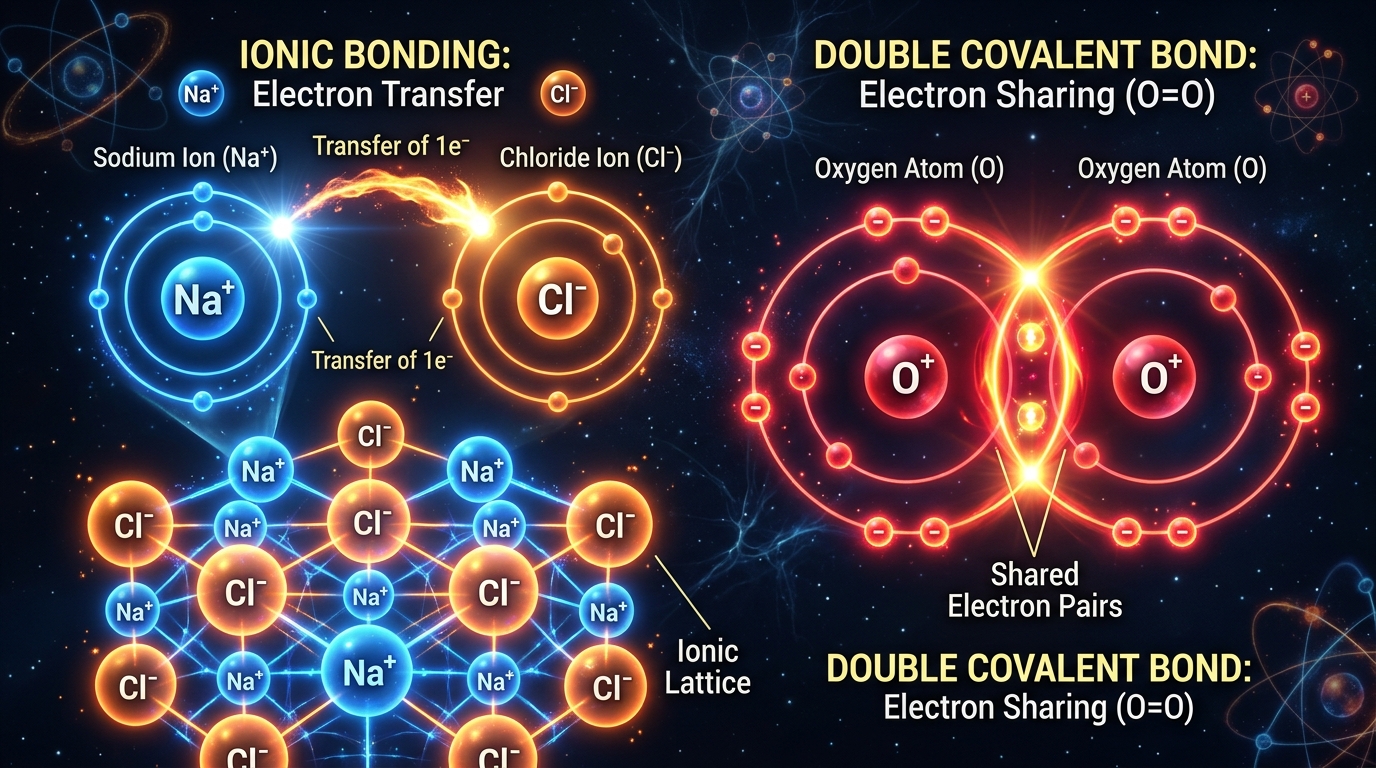
Chemical Bonding & Molecular Geometry: Complete Master Notes
Part 1: Why Atoms Form Chemical Bonds
Atoms bond to lower their potential energy and attain a stable octet (8 valence electrons) or duplet (2 valence electrons for H and He) electronic configuration, mimicking noble gases.
Part 2: Primary Types of Chemical Bonds
1. Ionic (Electrovalent) Bonding
Formed by complete transfer of one or more valence electrons from an electropositive metal atom to an electronegative non-metal atom, resulting in strong electrostatic attraction between cations and anions.
\[ \text{Na} (2,8,1) + \text{Cl} (2,8,7) \rightarrow \text{Na}^+ (2,8) + \text{Cl}^- (2,8,8) \implies \text{NaCl} \]
- Properties of Ionic Compounds: High melting and boiling points, high lattice energy, soluble in polar solvents (water), non-conductors in solid state but excellent conductors in molten or aqueous state.
2. Covalent Bonding
Formed by mutual sharing of electron pairs between non-metal atoms of comparable electronegativity.
- Single Bond (1 shared pair): \( \text{H}-\text{H} \), \( \text{Cl}-\text{Cl} \), \( \text{CH}_4 \)
- Double Bond (2 shared pairs): \( \text{O}=\text{O} \), \( \text{CO}_2 \)
- Triple Bond (3 shared pairs): \( \text{N}\equiv\text{N} \), \( \text{HC}\equiv\text{CH} \)
3. Coordinate (Dative) Covalent Bonding
A special type of covalent bond where the shared electron pair is donated entirely by one atom (Donor / Lewis Base) to an electron-deficient atom (Acceptor / Lewis Acid).
\[ \text{NH}_3 + \text{H}^+ \rightarrow \text{NH}_4^+ \quad | \quad \text{H}_2\text{O} + \text{H}^+ \rightarrow \text{H}_3\text{O}^+ \]
4. Metallic Bonding
Described by the Electron Sea Model (Lorentz & Drude): Positive metal ions (kernels) are immersed in a sea of mobile, delocalized valence electrons. Explains high thermal & electrical conductivity, metallic lustre, malleability, and ductility.
5. Hydrogen Bonding
An electrostatic attractive force between a hydrogen atom covalently bonded to a highly electronegative atom (\( \text{F}, \text{O}, \text{N} \)) and another electronegative atom with a lone pair.
- Intermolecular H-Bonding: Occurs between separate molecules (e.g., \( \text{H}_2\text{O} \), \( \text{HF} \), \( \text{NH}_3 \)). Causes elevated boiling points and anomalous expansion of water (maximum density at \( 4^\circ\text{C} \)).
- Intramolecular H-Bonding: Occurs within the same molecule (e.g., o-nitrophenol). Lowers boiling point compared to p-nitrophenol.
Part 3: VSEPR Theory & Molecular Geometries
Valence Shell Electron Pair Repulsion (VSEPR) Theory (Gillespie & Nyholm) predicts 3D molecular shapes based on minimizing electron pair repulsions:
Repulsion Order: \( \text{Lone Pair - Lone Pair (lp-lp)} > \text{Lone Pair - Bond Pair (lp-bp)} > \text{Bond Pair - Bond Pair (bp-bp)} \)
| Molecule | Steric No. (bp + lp) | Hybridization | Bond Pairs / Lone Pairs | Molecular Geometry | Bond Angle |
|---|---|---|---|---|---|
| \( \text{BeCl}_2 \) | 2 | \( sp \) | 2 bp, 0 lp | Linear | 180° |
| \( \text{BF}_3 \) | 3 | \( sp^2 \) | 3 bp, 0 lp | Trigonal Planar | 120° |
| \( \text{CH}_4 \) | 4 | \( sp^3 \) | 4 bp, 0 lp | Tetrahedral | 109.5° |
| \( \text{NH}_3 \) | 4 | \( sp^3 \) | 3 bp, 1 lp | Trigonal Pyramidal | 107° |
| \( \text{H}_2\text{O} \) | 4 | \( sp^3 \) | 2 bp, 2 lp | Bent / V-shaped | 104.5° |
| \( \text{PCl}_5 \) | 5 | \( sp^3d \) | 5 bp, 0 lp | Trigonal Bipyramidal | 90° & 120° |
| \( \text{SF}_6 \) | 6 | \( sp^3d^2 \) | 6 bp, 0 lp | Octahedral | 90° |
Part 4: Molecular Orbital Theory (MOT) & Magnetism
Formulated by Robert Mulliken and Friedrich Hund (1932), Molecular Orbital Theory treats electrons as delocalized over the entire molecule in Molecular Orbitals formed by Linear Combination of Atomic Orbitals (LCAO).
1. Bonding vs Anti-Bonding Molecular Orbitals
- Bonding MO (\( \sigma, \pi \)): Formed by constructive in-phase overlap of atomic orbital wavefunctions (\( \psi_A + \psi_B \)). Lower energy, higher electron density between nuclei, stabilizes the molecule.
- Anti-Bonding MO (\( \sigma^*, \pi^* \)): Formed by destructive out-of-phase overlap (\( \psi_A - \psi_B \)). Higher energy, nodal plane between nuclei, destabilizes the molecule.
2. Bond Order & Magnetic Character Formulas
\[ \text{Bond Order (B.O.)} = \frac{N_b - N_a}{2} \]
Where \( N_b \) is the number of electrons in bonding orbitals, and \( N_a \) is the number of electrons in anti-bonding orbitals.
- If \( \text{B.O.} > 0 \), the molecule is stable; if \( \text{B.O.} = 0 \), the molecule cannot exist (e.g., \( \text{He}_2 \)).
- Higher Bond Order indicates shorter bond length and higher Bond Dissociation Energy.
- Paramagnetic: Contains unpaired electrons in MOs (attracted by magnetic fields, e.g., \( \text{O}_2, \text{B}_2, \text{NO} \)).
- Diamagnetic: All electrons are paired in MOs (repelled by magnetic fields, e.g., \( \text{N}_2, \text{F}_2, \text{C}_2 \)).
\( \sigma 1s^2 \, \sigma^* 1s^2 \, \sigma 2s^2 \, \sigma^* 2s^2 \, \sigma 2p_z^2 \, (\pi 2p_x^2 = \pi 2p_y^2) \, (\pi^* 2p_x^1 = \pi^* 2p_y^1) \)
The presence of 2 unpaired electrons in degenerate anti-bonding \( \pi^* 2p_x \) and \( \pi^* 2p_y \) orbitals makes \( \text{O}_2 \) paramagnetic! Bond Order = \( \frac{10 - 6}{2} = 2.0 \).
Part 5: Fajan's Rules for Covalent Character in Ionic Bonds
No chemical bond is 100% ionic or 100% covalent. Kasimir Fajans established rules predicting covalent character in ionic compounds based on polarization:
- Small Cation Size: Smaller cations have higher charge density and greater polarizing power (e.g., \( \text{LiCl} \) is more covalent than \( \text{NaCl} \)).
- Large Anion Size: Larger anions are more easily distorted (higher polarizability) by cations (e.g., \( \text{AgI} \) is more covalent than \( \text{AgF} \)).
- High Ionic Charge: Higher positive charge on cation or negative charge on anion increases polarization (e.g., \( \text{AlCl}_3 \) is more covalent than \( \text{MgCl}_2 \) and \( \text{NaCl} \)).
- Pseudo-Noble Gas Configuration: Cations with \( 18 \)-electron outer shell (\( d^{10} \) configuration, e.g., \( \text{Cu}^+, \text{Ag}^+ \)) have greater polarizing power than cations with 8-electron noble gas configuration (e.g., \( \text{Na}^+, \text{K}^+ \)).
Part 6: High-Yield Bonding & Molecular Geometry Question Bank
Question 1 (RRB JE 2019): What is the shape and bond angle of Ammonia (NH3) molecule according to VSEPR theory?
Options: (A) Tetrahedral, 109.5° (B) Trigonal Pyramidal, 107° (C) Bent, 104.5° (D) Trigonal Planar, 120°
Answer: (B) Trigonal Pyramidal, 107°.
Detailed Explanation: In NH3, Nitrogen has 4 electron pairs (3 bond pairs + 1 lone pair) undergoing sp³ hybridization. The lp-bp repulsion compresses the tetrahedral angle from 109.5° down to 107°, creating a Trigonal Pyramidal shape.
Question 2 (NEET 2020): According to Molecular Orbital Theory, which of the following diatomic species is Diamagnetic and has a Bond Order of 3?
Options: (A) O2 (B) N2 (C) B2 (D) NO
Answer: (B) N2.
Detailed Explanation: Nitrogen (N2, 14 electrons) has MO configuration with zero unpaired electrons (Diamagnetic). Its Bond Order = (10 - 4) / 2 = 3.0 (strong triple bond).
Question 3 (SSC CGL 2021): According to Fajan's Rules, which of the following halides has the maximum covalent character?
Options: (A) LiF (B) LiCl (C) LiBr (D) LiI
Answer: (D) LiI.
Detailed Explanation: Polarizing power of cation (Li⁺) is constant. According to Fajan's rules, covalent character increases with increasing anion size. Since Iodide (I⁻) has the largest ionic radius, LiI is the most polarizable and covalent.
Part 7: Dipole Moments, Resonance & Formal Charge Masterclass
1. Molecular Dipole Moment (\( \vec{\mu} \))
Dipole moment measures the overall electrical polarity of a molecule as a vector quantity pointing from electropositive to electronegative atom:
\[ \vec{\mu} = q \times d \quad (\text{SI Unit: C}\cdot\text{m}, \text{ Common Unit: Debye } 1 \text{ D} = 3.33564 \times 10^{-30} \text{ C}\cdot\text{m}) \]
- Non-Polar Symmetrical Molecules (\( \mu = 0 \)): Carbon Dioxide (\( \text{CO}_2 \), linear, opposing dipoles cancel), Boron Trifluoride (\( \text{BF}_3 \), trigonal planar), Carbon Tetrachloride (\( \text{CCl}_4 \), tetrahedral).
- Polar Asymmetrical Molecules (\( \mu > 0 \)): Water (\( \text{H}_2\text{O}, \mu = 1.85 \text{ D} \)), Ammonia (\( \text{NH}_3, \mu = 1.47 \text{ D} \)), Chloroform (\( \text{CHCl}_3, \mu = 1.04 \text{ D} \)).
2. Resonance & Formal Charge Calculation
When a single Lewis structure cannot explain all experimental properties of a molecule (e.g., equal C-O bond lengths in Carbonate ion \( \text{CO}_3^{2-} \)), the actual molecule is represented as a Resonance Hybrid of multiple canonical structures.
Formula for Formal Charge (F.C.) on an atom in a Lewis structure:
\[ \text{F.C.} = V - L - \frac{1}{2} B \]
Where \( V \) is the number of valence electrons in free atom, \( L \) is the number of non-bonding lone pair electrons, and \( B \) is the number of bonding shared electrons.
Part 8: Comprehensive Chemical Bonding Master Comparison & Exam Review
| Bond Type | Bond Formation Mechanism | Typical Bond Energy Range | Representative Examples |
|---|---|---|---|
| Ionic (Electrovalent) | Complete electron transfer forming electrostatic ion pair | 400 – 4000 kJ/mol | NaCl, MgO, CaF2, K2O |
| Covalent (Shared) | Mutual sharing of electron pairs between non-metals | 150 – 1100 kJ/mol | H2, O2, N2, CH4, Diamond |
| Coordinate (Dative) | One atom donates lone pair to vacant orbital | 100 – 800 kJ/mol | NH4+, H3O+, BF3·NH3, CO |
| Metallic | Electrostatic attraction between metal cations and delocalized electron sea | 100 – 800 kJ/mol | Na, Cu, Fe, Ag, Au, Al |
| Hydrogen Bonding | Dipole-dipole attraction between H-atom and F, O, N lone pair | 10 – 40 kJ/mol | H2O, HF, NH3, DNA base pairs |
| van der Waals Forces | Transient induced dipole & dispersion forces | 1 – 10 kJ/mol | Noble gases, N2, O2, Graphite layers |
High-Yield Practice Questions & Concept Review
Question 1: Why does Phosphorus Pentachloride (PCl5) exist, but Nitrogen Pentachloride (NCl5) does not?
Answer: Nitrogen (Z=7, 1s² 2s² 2p³) belongs to the 2nd period and lacks vacant d-orbitals in its valence shell (n=2). Thus, Nitrogen cannot expand its octet beyond 4 electron pairs. Phosphorus (Z=15) belongs to the 3rd period and possesses vacant 3d-orbitals, allowing it to form sp³d hybridized PCl5 with 5 covalent bonds.
Question 2: What is the shape of SF4 and XeF2 according to VSEPR theory?
Answer: SF4 has 4 bond pairs and 1 lone pair (Steric No. = 5, sp³d hybridization) giving a See-Saw shape. XeF2 has 2 bond pairs and 3 lone pairs (Steric No. = 5, sp³d hybridization) giving a Linear shape as the 3 lone pairs occupy equatorial positions.
Part 9: Advanced VSEPR Geometry Masterclass & Hybridization Calculation
Method for Determining Hybridization State & Geometry
To determine the hybridization of any central atom in a molecule or polyatomic ion, calculate the Steric Number (\( Z \)):
\[ Z = \frac{1}{2} [ V + M - C + A ] \]
- \( V \) = Number of valence electrons on central atom
- \( M \) = Number of monovalent atoms bonded to central atom (H, F, Cl, Br, I)
- \( C \) = Positive charge on cation
- \( A \) = Negative charge on anion
| Steric Number (Z) | Hybridization State | Ideal Geometry | Example Molecules & Ions |
|---|---|---|---|
| 2 | \( sp \) | Linear (180°) | BeCl2, CO2, HCN, C2H2, NO2+ |
| 3 | \( sp^2 \) | Trigonal Planar (120°) | BF3, AlCl3, CO3²⁻, NO3⁻, SO3, C2H4 |
| 4 | \( sp^3 \) | Tetrahedral (109.5°) | CH4, NH4+, SO4²⁻, PO4³⁻, ClO4⁻, SiF4 |
| 5 | \( sp^3d \) | Trigonal Bipyramidal (90° & 120°) | PCl5, SF4 (See-saw), ClF3 (T-shape), XeF2 (Linear) |
| 6 | \( sp^3d^2 \) | Octahedral (90°) | SF6, [AlF6]³⁻, IF5 (Square Pyramidal), XeF4 (Square Planar) |
| 7 | \( sp^3d^3 \) | Pentagonal Bipyramidal (72° & 90°) | IF7, XeF6 (Distorted Octahedral) |
Frequently Asked Questions (FAQ) & High-Yield Exam Tips
Q: Why is H2O liquid at room temperature while H2S is a gas?
A: Oxygen has high electronegativity and small atomic radius, forming strong intermolecular Hydrogen bonds that keep H2O liquid. Sulfur has lower electronegativity, so H2S has weak van der Waals forces and exists as a gas.
Q: Why does Water reach its maximum density at 4°C?
A: Below 4°C, hydrogen bonding forces water molecules into an open cage-like crystalline ice structure with high volume. At 4°C, the cage structure collapses, maximizing density.
Q: What is the difference between Sigma (σ) and Pi (π) bonds?
A: A Sigma (σ) bond is formed by end-to-end (head-on) axial overlap of atomic orbitals (stronger, allows free rotation). A Pi (π) bond is formed by lateral (sideways) overlap (weaker, restricts rotation).
Q: Why do ionic compounds conduct electricity in molten state but not in solid state?
A: In solid state, ions are locked in rigid lattice positions by electrostatic forces. In molten or aqueous state, the lattice breaks down, freeing ions to move and carry electric current.
Q: What is the order of electron pair repulsion according to VSEPR theory?
A: Lone Pair - Lone Pair (lp-lp) > Lone Pair - Bond Pair (lp-bp) > Bond Pair - Bond Pair (bp-bp).
Master Chemistry & General Science on RRBCONTENTS
Access full study notes, interactive formula cheat sheets, and daily competitive exam updates.
Full Science Study Notes → Practice Chemistry PYQs →Join our official Telegram channel for instant study resources: @rrbcontents