Home › Blog › Chemistry Notes › Matter & Its States
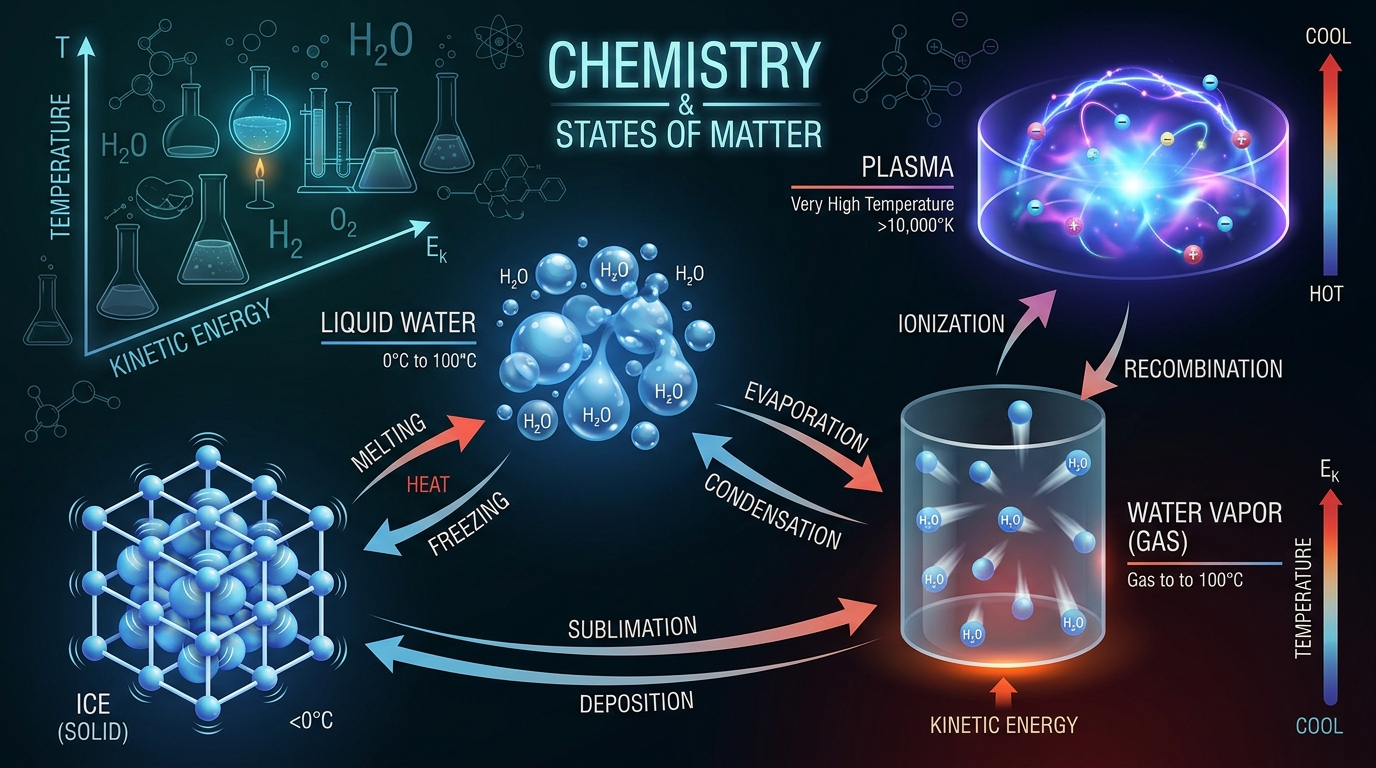
Matter & Its 5 States: Complete General Science Notes
Part 1: Classification of Matter
Matter is anything that possesses mass, occupies volume, and can be perceived by senses. Matter is classified physically into 5 states and chemically into Pure Substances and Mixtures.
| Property | Solid | Liquid | Gas | Plasma | Bose-Einstein Condensate (BEC) |
|---|---|---|---|---|---|
| Shape & Volume | Fixed shape & fixed volume | Indefinite shape, fixed volume | Indefinite shape & volume | Indefinite shape & volume | Macroscopic quantum state |
| Intermolecular Force | Extremely Strong | Moderate | Negligible | Ionized particles | Coherent wavepacket |
| Kinetic Energy | Lowest | Moderate | High | Ultra-High (High Temp) | Ultra-Low (Near 0 K) |
| Compressibility | Incompressible | Nearly Incompressible | Highly Compressible | Compressible | Quantum Fluid |
Part 2: Interconversion of States & Latent Heat
Phase changes occur by altering Temperature or Pressure:
- Fusion (Melting): Solid \( \rightarrow \) Liquid
- Vaporization (Boiling): Liquid \( \rightarrow \) Gas
- Sublimation: Solid directly to Gas without liquid phase (Examples: Camphor, Naphthalene, Ammonium Chloride \( \text{NH}_4\text{Cl} \), Dry Ice solid \( \text{CO}_2 \), Iodine \( \text{I}_2 \)).
- Deposition: Gas directly to Solid.
Latent Heat Formulas
Latent heat is the thermal energy absorbed or released during a phase change at constant temperature:
\[ Q = m \cdot L \]
- Latent Heat of Fusion (\( L_f \)): Heat required to convert 1 kg of solid to liquid at its melting point. For ice at 0°C, \( L_f = 3.34 \times 10^5 \text{ J/kg} \) (80 cal/g).
- Latent Heat of Vaporization (\( L_v \)): Heat required to convert 1 kg of liquid to gas at its boiling point. For water at 100°C, \( L_v = 2.26 \times 10^6 \text{ J/kg} \) (540 cal/g). (Explains why steam burns are more severe than boiling water burns at 100°C).
Part 3: Separation Techniques for Mixtures
| Technique | Principle | Real-World Application |
|---|---|---|
| Fractional Distillation | Difference in boiling points < 25 K | Petroleum refining into petrol, diesel, kerosene; separation of liquid air components. |
| Crystallization | Difference in solubility upon cooling | Purification of copper sulphate, salt extraction from seawater. |
| Chromatography | Difference in adsorption / migration speed | Separating dyes in black ink, drug detection in blood, plant pigments. |
| Centrifugation | Density difference under high-speed rotation | Separating cream from milk in dairies, diagnostic blood cell separation. |
Part 4: Thermodynamic Phase Diagrams & Critical Phenomena
A Phase Diagram maps the physical states of a substance as a function of Temperature and Pressure, delineating phase boundary lines where two or more states exist in dynamic equilibrium.
1. Phase Diagram of Water (\( \text{H}_2\text{O} \))
- Triple Point of Water: The exact temperature and pressure at which ice, liquid water, and water vapor coexist in stable thermodynamic equilibrium: \[ T_{\text{triple}} = 273.16 \text{ K} \ (0.01^\circ\text{C}), \quad P_{\text{triple}} = 611.65 \text{ Pa} \ (0.00603 \text{ atm}) \]
- Critical Point of Water: The termination point of the liquid-gas equilibrium curve beyond which distinct liquid and gas phases cease to exist, forming a Supercritical Fluid: \[ T_c = 647.096 \text{ K} \ (373.94^\circ\text{C}), \quad P_c = 22.064 \text{ MPa} \ (217.75 \text{ atm}) \]
- Anomalous Negative Slope of Fusion Curve: Unlike most substances, the solid-liquid melting line of water has a negative slope (\( dP/dT < 0 \)). Increasing pressure lowers the melting point of ice because liquid water is denser than solid ice.
Part 5: Laws of Chemical Combination
Quantitative chemical reactions follow five fundamental stoichiometry laws:
- Law of Conservation of Mass (Antoine Lavoisier, 1789): Mass can neither be created nor destroyed in a chemical reaction. Total mass of reactants equals total mass of products.
- Law of Definite Proportions (Joseph Proust, 1799): A given chemical compound always contains its component elements in fixed ratio by mass, regardless of its source or method of preparation (e.g., pure water always contains Hydrogen and Oxygen in 1:8 mass ratio).
- Law of Multiple Proportions (John Dalton, 1803): When two elements combine to form more than one compound, the masses of one element that combine with a fixed mass of the other are in small whole number ratios (e.g., \( \text{CO} \) vs \( \text{CO}_2 \) gives Oxygen mass ratio 16:32 = 1:2).
- Gay-Lussac's Law of Gaseous Volumes (1808): When gases react together, they do so in volumes which bear a simple whole number ratio to one another and to the gaseous products at constant T and P.
- Avogadro's Law (1811): Equal volumes of gases under identical T and P contain equal number of molecules.
Part 6: High-Yield Matter & Separation Question Set
Question 1 (RRB NTPC 2021): Which separation technique is used to separate cream from milk?
Options: (A) Evaporation (B) Centrifugation (C) Chromatography (D) Sublimation
Answer: (B) Centrifugation.
Detailed Explanation: Centrifugation spins milk at high speeds. Denser skimmed milk is forced outward while lighter butterfat cream collects at the center for separation.
Question 2 (SSC CGL 2020): What happens to the boiling point of water at high altitudes (e.g. Mount Everest)?
Options: (A) Increases above 100°C (B) Decreases below 100°C (C) Remains unchanged (D) Water freezes instantly
Answer: (B) Decreases below 100°C.
Detailed Explanation: A liquid boils when its vapor pressure equals atmospheric pressure. At high altitudes, atmospheric pressure is low, so water boils at a lower temperature (~70°C on Everest), requiring pressure cookers for cooking food.
Part 7: Advanced Separation Techniques & Phase Transformations
| Separation Process | Operating Principle | Specific Industry Use Cases |
|---|---|---|
| Steam Distillation | Distillation of water-immiscible organic compounds at temperatures below their normal boiling point | Extraction of essential oils (e.g. rose oil, eucalyptus oil, turpentine) from plant tissue. |
| Zone Refining | Fractional crystallization based on higher solubility of impurities in molten metal than in solid state | Ultra-pure Semiconductor production (Germanium Ge, Silicon Si, Gallium Ga) for microchips. |
| Electrophoresis | Differential movement of charged colloidal particles under an electric potential gradient | DNA fingerprinting, protein separation in medical research laboratories. |
Part 8: Comprehensive Master Review & Physical Chemistry Question Bank
| State of Matter | Structural Arrangement | Density & Fluidity | Thermal Expansion & Entropy |
|---|---|---|---|
| Solid | Rigid 3D lattice, fixed particle positions | Maximum density, zero fluidity | Lowest thermal expansion, lowest entropy |
| Liquid | Short-range order, particles slide past each other | High density, high fluidity | Moderate expansion, moderate entropy |
| Gas | Random rapid linear motion, negligible forces | Low density, maximum fluidity | High expansion, high entropy |
| Plasma | Fully ionized high-temperature gas of ions and e⁻ | Variable density, conducts electricity | Extremely high temperature (> 10,000 K) |
| BEC | Macroscopic quantum wavepacket near 0 K | Superfluid state, zero viscosity | Ultra-low temperature (< 1 microkelvin) |
High-Yield Practice Questions & Concept Review
Question 1: Why does a liquid cool when it evaporates?
Answer: During evaporation, high-energy molecules escape from the liquid surface into the gas phase. The remaining molecules in the liquid possess lower average kinetic energy, resulting in a temperature drop (cooling effect).
Question 2: What is the principle of Steam Distillation?
Answer: Steam distillation separates water-immiscible organic compounds. The total vapor pressure of the mixture equals the sum of individual vapor pressures: P_total = P_water + P_organic. Since P_total reaches atmospheric pressure at a temperature lower than the normal boiling point of either component, sensitive organic compounds distill without thermal decomposition.
Part 9: Thermal Properties, Specific Heat Capacity & Calorimetry
Calorimetry is the quantitative measurement of heat transfer during physical state transformations or chemical reactions.
Heat Transfer Formulas
- Sensible Heat Transfer (Temperature Change without Phase Change):
\[ Q = m \cdot c \cdot \Delta T \]
Where \( m \) is mass in kg, \( c \) is specific heat capacity (\( \text{J kg}^{-1}\text{K}^{-1} \)), and \( \Delta T \) is temperature change in Kelvin or Celsius.
Specific Heat Capacity of Water: \( c_{\text{water}} = 4184 \text{ J kg}^{-1}\text{K}^{-1} = 1.0 \text{ cal g}^{-1}\text{C}^{-1} \).
Specific Heat Capacity of Ice: \( c_{\text{ice}} = 2090 \text{ J kg}^{-1}\text{K}^{-1} = 0.5 \text{ cal g}^{-1}\text{C}^{-1} \). - Latent Heat Transfer (Phase Change at Constant Temperature):
\[ Q = m \cdot L \]
Latent Heat of Fusion of Ice: \( L_f = 3.34 \times 10^5 \text{ J/kg} = 80 \text{ cal/g} \).
Latent Heat of Vaporization of Water: \( L_v = 2.26 \times 10^6 \text{ J/kg} = 540 \text{ cal/g} \).
Calorimetry Numerical Problem:
Problem: Calculate total heat required to convert 10 g of ice at -10°C into steam at 100°C.
Solution: Step 1 (Ice -10°C to 0°C): Q1 = m · c_ice · ΔT = 10g × 0.5 cal/g°C × 10°C = 50 cal.
Step 2 (Melting ice at 0°C to water at 0°C): Q2 = m · L_f = 10g × 80 cal/g = 800 cal.
Step 3 (Heating water from 0°C to 100°C): Q3 = m · c_water · ΔT = 10g × 1.0 cal/g°C × 100°C = 1000 cal.
Step 4 (Vaporizing water at 100°C to steam at 100°C): Q4 = m · L_v = 10g × 540 cal/g = 5400 cal.
Total Heat Q = Q1 + Q2 + Q3 + Q4 = 50 + 800 + 1000 + 5400 = 7250 calories (30.33 kJ).
Part 10: Laws of Ideal Gases & Real Gas Deviations Review
Below is a summary table contrasting Ideal Gases vs Real Gases for physical chemistry revision:
| Property / Feature | Ideal Gas Model | Real Gas (van der Waals Model) |
|---|---|---|
| Intermolecular Forces | Strictly zero attraction or repulsion between molecules | Attractive forces present at medium distance; repulsive forces at close distance |
| Molecular Volume | Molecules treated as dimensionless point masses (volume = 0) | Molecules occupy finite excluded co-volume (b = 4 V_actual) |
| Equation of State | PV = nRT | (P + a n²/V²) (V - n b) = n RT |
| Compressibility Factor Z | Z = 1 at all T and P | Z < 1 at low P (attractive); Z > 1 at high P (repulsive) |
| Conditions for Ideal Behavior | High Temperature & Low Pressure | Deviates significantly at Low Temperature & High Pressure |
Part 11: Comprehensive State of Matter Practice Question Set
Question 1: What is Latent Heat of Fusion and Latent Heat of Vaporization of Water?
Answer: Latent Heat of Fusion of ice (L_f) is 3.34 × 10⁵ J/kg (80 cal/g), which is the heat absorbed to melt 1 kg of ice at 0°C into liquid water at 0°C. Latent Heat of Vaporization of water (L_v) is 2.26 × 10⁶ J/kg (540 cal/g), absorbed to convert 1 kg of boiling water at 100°C into steam at 100°C.
Question 2: What is the Law of Definite Proportions and who discovered it?
Answer: Discovered by Joseph Proust (1799). It states that a given chemical compound always contains its component elements in a fixed ratio by mass, regardless of its source or method of synthesis. For example, pure water from any source always contains Hydrogen and Oxygen in a 1:8 mass ratio.
Question 3: What is Chromotography and where is it used?
Answer: Chromatography is a separation technique based on differences in the rates at which components of a mixture migrate through a stationary phase under the influence of a mobile phase. Used to separate plant pigments (chlorophyll, xanthophyll), dyes in ink, and detect drugs in forensic blood samples.
Frequently Asked Questions (FAQ) & High-Yield Exam Tips
Q: What are the 5 States of Matter?
A: Solid, Liquid, Gas, Plasma (high-temperature ionized gas), and Bose-Einstein Condensate (BEC, ultra-cold quantum state near 0 K).
Q: Why does steam cause more severe burns than boiling water at 100°C?
A: Steam contains 2.26×10^6 J/kg of extra latent heat of vaporization (540 cal/g) compared to liquid boiling water at the same temperature of 100°C.
Q: What is Sublimation and what are common sublimable substances?
A: Sublimation is the direct transition of a solid into gas without passing through the liquid state. Examples: Dry Ice (solid CO2), Camphor, Naphthalene, Ammonium Chloride (NH4Cl), and Iodine.
Q: When is Fractional Distillation used instead of Simple Distillation?
A: Fractional distillation is used when the boiling point difference between miscible liquids is less than 25 K (25°C), such as separating crude oil fractions.
Q: What is the Bose-Einstein Condensate (BEC)?
A: BEC is formed by cooling a gas of extremely low density to super-cold temperatures near Absolute Zero (0 K). Predicted by Satyendra Nath Bose & Albert Einstein.
Master Chemistry & General Science on RRBCONTENTS
Access full study notes, interactive formula cheat sheets, and daily competitive exam updates.
Full Science Study Notes → Practice Chemistry PYQs →Join our official Telegram channel for instant study resources: @rrbcontents