Home › Blog › Chemistry Notes › Metals & Metallurgy
Metals, Non-Metals & Metallurgy: Complete Chemistry Notes
Part 1: Physical & Chemical Properties of Metals & Non-Metals
| Property | Metals | Non-Metals |
|---|---|---|
| State at Room Temp | Solids (Except Mercury \( \text{Hg} \) liquid, Gallium \( \text{Ga} \) melts at 29.76°C) | Solids, Gases (Except Bromine \( \text{Br}_2 \) liquid) |
| Lustre & Hardness | Lustrous & Hard (Except Sodium \( \text{Na} \), Potassium \( \text{K} \) soft enough to cut with knife) | Non-lustrous (Except Iodine \( \text{I}_2 \) & Diamond), Soft (Except Diamond) |
| Conductivity | Best: Silver (\( \text{Ag} \)), Copper (\( \text{Cu} \)). Poorest: Lead (\( \text{Pb} \)), Mercury (\( \text{Hg} \)) | Insulators (Except Graphite conducts electricity) |
| Nature of Oxides | Basic Oxides (\( \text{Na}_2\text{O}, \text{CaO} \)). Amphoteric: \( \text{Al}_2\text{O}_3, \text{ZnO} \) | Acidic Oxides (\( \text{CO}_2, \text{SO}_2 \)) or Neutral Oxides (\( \text{CO}, \text{N}_2\text{O}, \text{H}_2\text{O} \)) |
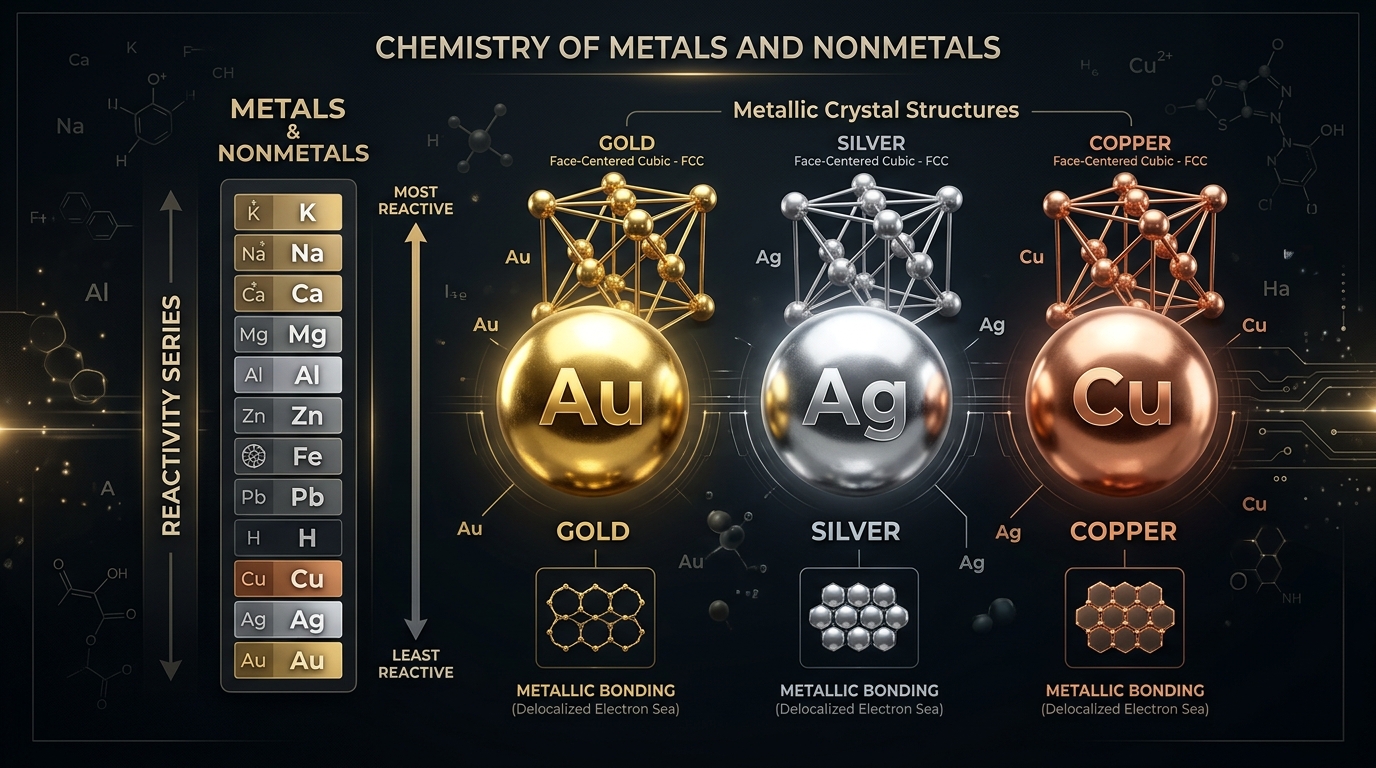
Reactivity Series of Metals
Decreasing Reactivity Order: \( \text{K} > \text{Na} > \text{Ca} > \text{Mg} > \text{Al} > \text{Zn} > \text{Fe} > \text{Pb} > [\text{H}] > \text{Cu} > \text{Hg} > \text{Ag} > \text{Au} \)
Part 2: Metallurgy & Extraction of Metals
- Concentration of Ore:
- Froth Flotation: For Sulphide Ores (e.g., Zinc Blende \( \text{ZnS} \), Galena \( \text{PbS} \), Copper Pyrites \( \text{CuFeS}_2 \)) using pine oil collector.
- Calcination vs Roasting:
Calcination: Heating carbonate ore strongly in absence of air below melting point: \( \text{ZnCO}_3 \xrightarrow{\Delta} \text{ZnO} + \text{CO}_2 \).
Roasting: Heating sulphide ore strongly in excess of air below melting point: \( 2\text{ZnS} + 3\text{O}_2 \xrightarrow{\Delta} 2\text{ZnO} + 2\text{SO}_2 \).
- Thermite Process: Reduction of metal oxides using Aluminum powder as reducing agent: \[ \text{Fe}_2\text{O}_3(s) + 2\text{Al}(s) \rightarrow 2\text{Fe}(l) + \text{Al}_2\text{O}_3(s) + \text{Heat} \] Used for on-site welding of railway tracks and broken machine parts.
Part 3: Alloys & Corrosion
| Alloy Name | Composition | Key Applications |
|---|---|---|
| Brass | Copper (\( \text{Cu} \) 70%) + Zinc (\( \text{Zn} \) 30%) | Utensils, musical instruments, hardware valves |
| Bronze | Copper (\( \text{Cu} \) 90%) + Tin (\( \text{Sn} \) 10%) | Statues, medals, coins, heavy bearings |
| Solder | Lead (\( \text{Pb} \) 50%) + Tin (\( \text{Sn} \) 50%) | Electrical wire joining (low melting point) |
| Stainless Steel | Iron (\( \text{Fe} \)) + Chromium (\( \text{Cr} \) 18%) + Nickel (\( \text{Ni} \) 8%) + Carbon (0.1%) | Surgical instruments, cutlery, food vessels |
| Amalgam | Mercury (\( \text{Hg} \)) + Other Metal (e.g. \( \text{Na-Hg}, \text{Ag-Hg} \)) | Dental fillings, laboratory reducing agents |
Part 4: Industrial Extraction Metallurgy of Iron, Copper & Aluminum
1. Metallurgy of Iron (Extraction in Blast Furnace)
Iron is extracted from its principal carbonate/oxide ores: Hematite (\( \text{Fe}_2\text{O}_3 \)), Magnetite (\( \text{Fe}_3\text{O}_4 \)), and Siderite (\( \text{FeCO}_3 \)).
Charge fed into Blast Furnace top: Calcined Hematite Ore + Coke (fuel & reductant) + Limestone (\( \text{CaCO}_3 \), flux) in 8:4:1 ratio.
| Blast Furnace Zone | Temperature Range | Chemical Reactions Involved |
|---|---|---|
| Zone of Combustion (Bottom) | 1800 K – 2200 K | \( \text{C} + \text{O}_2 \rightarrow \text{CO}_2 + \text{Heat} \quad (\Delta H = -393.5 \text{ kJ}) \) |
| Zone of Reduction (Top) | 500 K – 900 K | \( 3\text{Fe}_2\text{O}_3 + \text{CO} \rightarrow 2\text{Fe}_3\text{O}_4 + \text{CO}_2 \) \( \text{Fe}_3\text{O}_4 + \text{CO} \rightarrow 3\text{FeO} + \text{CO}_2 \) \( \text{FeO} + \text{CO} \rightarrow \text{Fe}(s) + \text{CO}_2 \) |
| Zone of Slag Formation (Middle) | 1000 K – 1200 K | Limestone decomposition: \( \text{CaCO}_3 \rightarrow \text{CaO} + \text{CO}_2 \) Slag reaction: \( \text{CaO} \text{ (Flux)} + \text{SiO}_2 \text{ (Gangue)} \rightarrow \text{CaSiO}_3 \text{ (Slag)} \) |
Molten iron collected at bottom is Pig Iron (4% Carbon, high brittleness). Remelted with scrap iron to produce Cast Iron (3% Carbon). Purified further in puddling furnace to produce Wrought Iron (0.1–0.25% Carbon, purest commercial iron).
2. Extraction of Aluminum (Hall-Héroult Process)
Purified alumina (\( \text{Al}_2\text{O}_3 \)) extracted from Bauxite via Baeyer's Process is dissolved in molten Cryolite (\( \text{Na}_3\text{AlF}_6 \)) and Fluorspar (\( \text{CaF}_2 \)) at 1220 K to lower melting point and improve conductivity.
- Cathode (Carbon lining): \( \text{Al}^{3+}(l) + 3e^- \rightarrow \text{Al}(l) \) (Liquid aluminum sinks to bottom).
- Anode (Graphite rods): \( 2\text{O}^{2-} \rightarrow \text{O}_2(g) + 4e^- \); Oxygen reacts with graphite anodes: \( \text{C} + \text{O}_2 \rightarrow \text{CO}_2(g) \) (anodes must be replaced periodically).
Part 5: High-Yield Metallurgy & Alloy Question Set
Question 1 (RRB JE 2019): What is the primary ore of Aluminum and which process is used for its electrolytic reduction?
Options: (A) Hematite, Blast Furnace (B) Bauxite, Hall-Héroult Process (C) Galena, Froth Flotation (D) Calamine, Calcination
Answer: (B) Bauxite, Hall-Héroult Process.
Detailed Explanation: Bauxite (Al2O3·2H2O) is the main aluminum ore. Purified alumina is dissolved in molten cryolite (Na3AlF6) and electrolyzed in the Hall-Héroult cell to produce pure aluminum.
Question 2 (SSC CGL 2021): Solder is an alloy of which two metals?
Options: (A) Copper & Zinc (B) Lead & Tin (C) Copper & Tin (D) Iron & Nickel
Answer: (B) Lead & Tin.
Detailed Explanation: Solder consists of Lead (Pb ~50%) and Tin (Sn ~50%). Its low melting point makes it ideal for joining electrical wires.
Part 6: Industrial Refining Methods & Metallurgy Summary
Refining of Crude Metals
- Electrolytic Refining: Used for Copper, Zinc, Silver, Gold.
Anode: Impure crude metal block.
Cathode: Strip of pure metal.
Electrolyte: Aqueous metal salt solution (e.g., \( \text{CuSO}_4 + \text{H}_2\text{SO}_4 \) for copper refining). Impurities drop beneath anode as Anode Mud containing precious metals (Ag, Au, Pt). - Zone Refining: For ultra-pure semiconductors (Silicon, Germanium).
- Mond's Process: For refining Nickel via volatile carbonyl formation: \[ \text{Ni} + 4\text{CO} \xrightarrow{330 \text{ K}} \text{Ni(CO)}_4 \xrightarrow{450 \text{ K}} \text{Ni (Pure)} + 4\text{CO} \]
- Van Arkel Method: For refining Zirconium (Zr) and Titanium (Ti) using Iodine vapor.
Part 7: Comprehensive Master Metallurgy & Alloy Summary Table
| Metal | Principal Ore Name & Chemical Formula | Main Concentration & Extraction Method | Primary Industrial Applications |
|---|---|---|---|
| Iron (Fe) | Hematite (\( \text{Fe}_2\text{O}_3 \)), Magnetite (\( \text{Fe}_3\text{O}_4 \)) | Gravity separation, Blast Furnace reduction with CO | Steel construction, rails, machinery, tools |
| Aluminum (Al) | Bauxite (\( \text{Al}_2\text{O}_3 \cdot 2\text{H}_2\text{O} \)) | Baeyer's process, Hall-Héroult molten salt electrolysis | Aircraft frames, power transmission lines, foil |
| Copper (Cu) | Copper Pyrites (\( \text{CuFeS}_2 \)), Malachite | Froth Flotation, Bessemerization & Electrolytic refining | Electrical wiring, motors, heat exchangers, alloys |
| Zinc (Zn) | Zinc Blende (\( \text{ZnS} \)), Calamine (\( \text{ZnCO}_3 \)) | Froth flotation, Roasting/Calcination & Smelting with Carbon | Galvanizing iron, brass alloy, dry cell batteries |
High-Yield Practice Questions & Concept Review
Question 1: Why is Sodium stored under Kerosene oil?
Answer: Sodium (Na) is an extremely reactive alkali metal. When exposed to moist air, it reacts violently with water vapor releasing flammable Hydrogen gas and sufficient heat to cause an immediate explosion: 2Na + 2H2O → 2NaOH + H2↑ + Heat. Storing it under kerosene prevents contact with air and moisture.
Question 2: What is Galvanization and how does it prevent rusting?
Answer: Galvanization is the process of applying a thin protective coating of Zinc over iron or steel. Even if the zinc coating is scratched, Zinc corrodes preferentially (sacrificial protection) because Zinc is more electropositive than Iron in the reactivity series.
Part 8: Comprehensive Extraction Metallurgy Reactions & Slag Chemistry
Comprehensive Ores & Chemical Formulas Reference Table
| Element Name | Ore Name | Chemical Formula | Classification |
|---|---|---|---|
| Iron (Fe) | Hematite | \( \text{Fe}_2\text{O}_3 \) | Oxide Ore |
| Iron (Fe) | Magnetite | \( \text{Fe}_3\text{O}_4 \) | Oxide Ore |
| Aluminum (Al) | Bauxite | \( \text{Al}_2\text{O}_3 \cdot 2\text{H}_2\text{O} \) | Hydrated Oxide Ore |
| Copper (Cu) | Copper Pyrites (Chalcopyrite) | \( \text{CuFeS}_2 \) | Sulphide Ore |
| Zinc (Zn) | Zinc Blende (Sphalerite) | \( \text{ZnS} \) | Sulphide Ore |
| Zinc (Zn) | Calamine | \( \text{ZnCO}_3 \) | Carbonate Ore |
| Lead (Pb) | Galena | \( \text{PbS} \) | Sulphide Ore |
| Mercury (Hg) | Cinnabar | \( \text{HgS} \) | Sulphide Ore |
| Magnesium (Mg) | Magnesite / Dolomite | \( \text{MgCO}_3 / \text{CaCO}_3\cdot\text{MgCO}_3 \) | Carbonate Ore |
Part 9: Refining Methods & Metallurgy Summary Table
| Metallurgical Step | Key Industrial Method | Chemical Principles & Examples |
|---|---|---|
| Crushing & Grinding | Stamp Mill & Ball Mill | Pulverizing giant rocks into fine powder to increase surface area |
| Concentration (Beneficiation) | Froth Flotation / Gravity / Magnetic | Wetting difference for sulfides (Pine oil); Magnetic separation for Chromite |
| Calcination | Reverberatory Furnace | Heating carbonate/hydrated ore in absence of air: ZnCO3 → ZnO + CO2 |
| Roasting | Reverberatory / Blast Furnace | Heating sulfide ore in excess air: 2ZnS + 3O2 → 2ZnO + 2SO2 |
| Reduction | Smelting with Carbon / Thermite / Electrolysis | Fe2O3 + 3CO → 2Fe + 3CO2; Al2O3 + 3C → 2Al + 3CO |
| Refining (Purification) | Electrolytic / Mond's / Liquation / Poling | Electrolytic copper refining; Mond process for Nickel Ni(CO)4 |
Part 10: High-Yield Reactivity & Metallurgy Practice Question Set
Question 1: Why does Aluminum react slowly with dilute acids despite being high in the reactivity series?
Answer: When exposed to atmospheric oxygen, Aluminum rapidly forms a tough, non-porous, protective oxide layer of Aluminum Oxide (Al2O3) on its surface. This passive film prevents underlying metal from reacting further with acids or water unless stripped by strong alkalis.
Question 2: What is Calcination vs Roasting?
Answer: Calcination is heating carbonate or hydrated ore in the absence of air below its melting point to expel CO2 or moisture (ZnCO3 → ZnO + CO2). Roasting is heating sulfide ore strongly in the presence of excess oxygen to convert it into metal oxide and release SO2 gas (2ZnS + 3O2 → 2ZnO + 2SO2).
Question 3: What is Brass, Bronze, and Solder composed of?
Answer: Brass = Copper (70%) + Zinc (30%). Bronze = Copper (90%) + Tin (10%). Solder = Lead (50%) + Tin (50%). Amalgam = Any metal dissolved in Mercury (Hg).
Part 11: Summary of Common Alloys & Everyday Chemistry Applications
Below is a handy reference table of industrial alloys, composition percentages, and specific applications for competitive exams:
| Alloy Name | Primary Composition | Special Mechanical Properties | Industrial & Domestic Applications |
|---|---|---|---|
| Brass | Cu (70%), Zn (30%) | Malleable, acoustic resonance, corrosion resistant | Musical trumpets, plumbing fittings, decorative hardware |
| Bronze | Cu (90%), Sn (10%) | Tough, low friction against metals, sea-water resistant | Statues, ship propellers, bearings, medals |
| Solder | Pb (50%), Sn (50%) | Low melting point (~183°C), good electrical bond | Joining electronic components, printed circuit boards |
| Duralumin | Al (95%), Cu (4%), Mg (0.5%), Mn (0.5%) | High strength-to-weight ratio, ductile | Aircraft bodies, pressure cookers, automobile parts |
| German Silver | Cu (60%), Zn (20%), Ni (20%) [Contains 0% Silver!] | Silvery white lustre, highly durable | Utensils, jewelry, artificial ornaments |
Frequently Asked Questions (FAQ) & High-Yield Exam Tips
Q: Which metal is liquid at room temperature and which non-metal is liquid?
A: Mercury (Hg) is the only liquid metal at room temperature. Bromine (Br2) is the only liquid non-metal.
Q: What is the Thermite Process and its chemical reaction?
A: The Thermite process is an exothermic reduction reaction where Aluminum powder reduces Iron(III) oxide to molten iron: Fe2O3 + 2Al -> 2Fe(l) + Al2O3 + Heat. Used for welding railway tracks.
Q: What is the difference between Calcination and Roasting?
A: Calcination is heating carbonate ore in the absence of air to expel CO2. Roasting is heating sulphide ore in the presence of excess air to convert it into oxide and release SO2.
Q: What are Amphoteric Oxides?
A: Amphoteric oxides are metal oxides that react with both acids and bases to form salt and water. Examples: Aluminum Oxide (Al2O3) and Zinc Oxide (ZnO).
Q: What is Aqua Regia?
A: Aqua Regia is a 3:1 mixture of concentrated HCl and concentrated HNO3. It dissolves noble metals like Gold (Au) and Platinum (Pt).
Master Chemistry & General Science on RRBCONTENTS
Access full study notes, interactive formula cheat sheets, and daily competitive exam updates.
Full Science Study Notes → Practice Chemistry PYQs →Join our official Telegram channel for instant study resources: @rrbcontents