Home › Blog › Chemistry Notes › Oxidation & Reduction
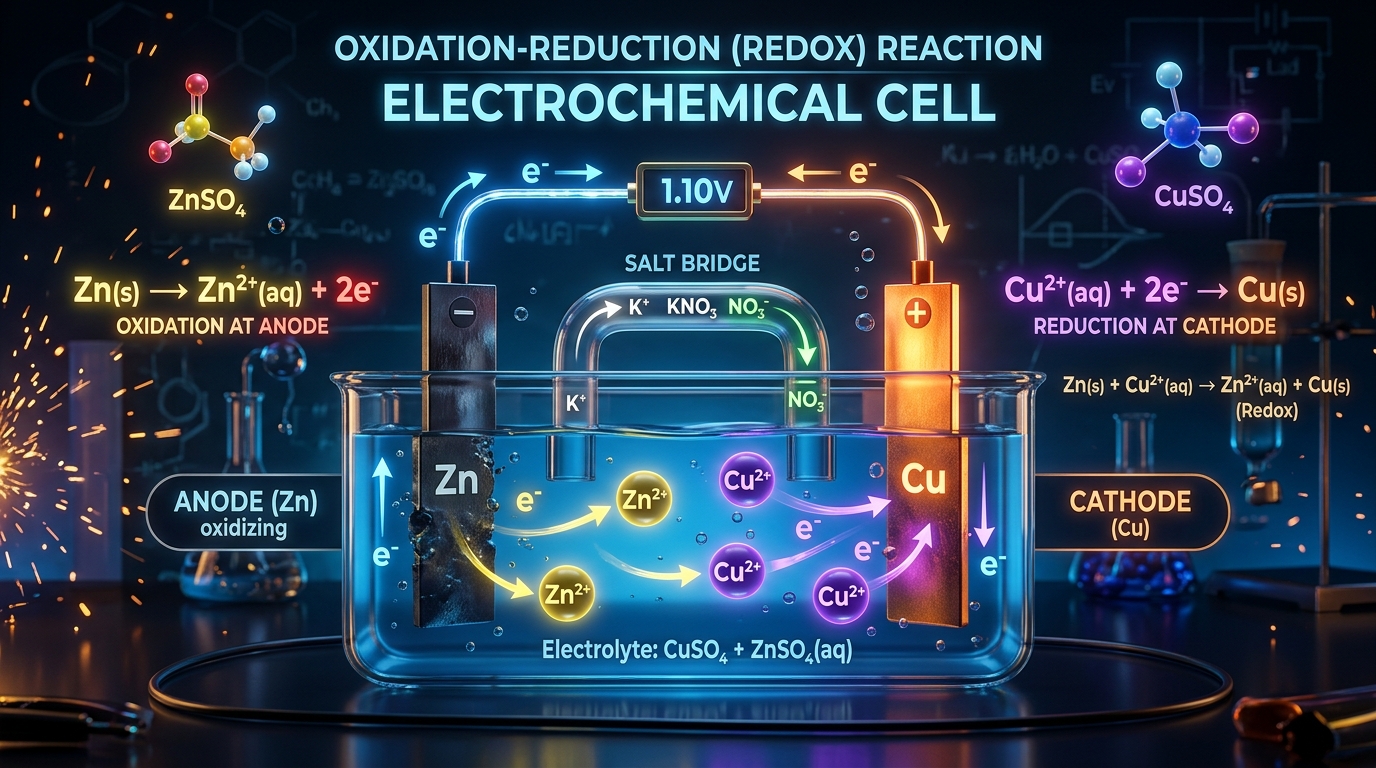
Oxidation & Reduction (Redox): Complete Chemistry Notes
Part 1: Definitions of Oxidation and Reduction
| Concept / Viewpoint | Oxidation | Reduction |
|---|---|---|
| Classical (Oxygen / Hydrogen) | Addition of Oxygen or removal of Hydrogen | Addition of Hydrogen or removal of Oxygen |
| Electronic Theory (OIL RIG) | Loss of Electrons (Oxidation Is Loss) | Gain of Electrons (Reduction Is Gain) |
| Oxidation Number (State) | Increase in Oxidation Number | Decrease in Oxidation Number |
Part 2: Rules for Assigning Oxidation Numbers
- The oxidation number of an element in its free/uncombined state is always 0 (e.g., \( \text{O}_2, \text{H}_2, \text{P}_4, \text{S}_8, \text{Na}, \text{Fe} \)).
- For a monatomic ion, the oxidation state equals its charge (e.g., \( \text{Na}^+ = +1 \), \( \text{Mg}^{2+} = +2 \), \( \text{Al}^{3+} = +3 \), \( \text{Cl}^- = -1 \), \( \text{O}^{2-} = -2 \)).
- Fluorine (\( \text{F} \)) always has an oxidation state of -1 in all compounds.
- Oxygen usually has an oxidation state of -2.
Exceptions: Peroxides (\( \text{H}_2\text{O}_2, \text{Na}_2\text{O}_2 \)) where O is -1; Superoxides (\( \text{KO}_2 \)) where O is -1/2; Oxygen Difluoride (\( \text{OF}_2 \)) where O is +2. - Hydrogen is usually +1 when bonded to non-metals, but -1 in binary metal hydrides (e.g., \( \text{NaH}, \text{CaH}_2 \)).
- The sum of oxidation numbers of all atoms in a neutral molecule is 0; in a polyatomic ion, it equals the overall ion charge.
Step-by-Step Solved Examples:
Example 1: Find oxidation number of Manganese in Potassium Permanganate (\( \text{KMnO}_4 \)).
\( (+1) + x + 4(-2) = 0 \implies 1 + x - 8 = 0 \implies x = +7 \).
Example 2: Find oxidation number of Chromium in Potassium Dichromate (\( \text{K}_2\text{Cr}_2\text{O}_7 \)).
\( 2(+1) + 2x + 7(-2) = 0 \implies 2 + 2x - 14 = 0 \implies 2x = 12 \implies x = +6 \).
Part 3: Electrochemical Cells & Galvanic vs Electrolytic Cells
| Feature | Galvanic (Voltaic) Cell | Electrolytic Cell |
|---|---|---|
| Energy Conversion | Chemical Energy \( \rightarrow \) Electrical Energy | Electrical Energy \( \rightarrow \) Chemical Energy |
| Spontaneity | Spontaneous Reaction (\( \Delta G < 0 \)) | Non-spontaneous Reaction (\( \Delta G > 0 \)) |
| Anode Polarity | Negative (-) [Oxidation occurs] | Positive (+) [Oxidation occurs] |
| Cathode Polarity | Positive (+) [Reduction occurs] | Negative (-) [Reduction occurs] |
Part 4: Advanced Electrochemistry & Commercial Batteries
Batteries store chemical energy in high-density redox active compounds, converting it into electrical energy upon demand.
1. Primary Cells (Non-Rechargeable)
- Dry Cell (Leclanché Cell): Anode is Zinc container; Cathode is Carbon rod surrounded by powdered \( \text{MnO}_2 \) and carbon. Electrolyte: Paste of \( \text{NH}_4\text{Cl} \) and \( \text{ZnCl}_2 \). Voltage: 1.5 V.
Anode: \( \text{Zn}(s) \rightarrow \text{Zn}^{2+} + 2e^- \)
Cathode: \( 2\text{MnO}_2 + 2\text{NH}_4^+ + 2e^- \rightarrow \text{Mn}_2\text{O}_3 + 2\text{NH}_3 + \text{H}_2\text{O} \) - Mercury Button Cell: Used in hearing aids and watches. Constant voltage of 1.35 V over lifetime because no ion concentration changes occur. Anode: Zinc-Mercury Amalgam; Cathode: Paste of \( \text{HgO} \) and carbon.
2. Secondary Cells (Rechargeable)
- Lead-Acid Storage Battery: Used in automobiles and home inverters.
Anode: Lead grid packed with spongy Lead (\( \text{Pb} \)).
Cathode: Lead grid packed with Lead Dioxide (\( \text{PbO}_2 \)).
Electrolyte: 38% aqueous Sulphuric Acid (\( \text{H}_2\text{SO}_4 \), specific gravity 1.28).
Discharge Net Reaction: \[ \text{Pb}(s) + \text{PbO}_2(s) + 2\text{H}_2\text{SO}_4(aq) \xrightarrow{\text{Discharge}} 2\text{PbSO}_4(s) + 2\text{H}_2\text{O}(l) \] During recharging, the reaction reverses completely, consuming electrical energy to regenerate \( \text{Pb} \) and \( \text{PbO}_2 \).
3. Fuel Cells (\( \text{H}_2-\text{O}_2 \) Fuel Cell)
Converts combustion energy of fuels directly into electrical energy with zero harmful emissions (byproduct is pure water vapor):
\[ 2\text{H}_2(g) + \text{O}_2(g) \rightarrow 2\text{H}_2\text{O}(l) \quad (E^0 = 1.23 \text{ V}) \]
Used in Apollo space missions to supply drinking water and electrical power to astronauts.
Part 5: High-Yield Electrochemistry Question Set
Question 1 (RRB JE 2019): What acid is used as the electrolyte in a Lead-Acid Automobile Storage Battery?
Options: (A) Hydrochloric Acid (B) Nitric Acid (C) Sulphuric Acid (D) Acetic Acid
Answer: (C) Sulphuric Acid.
Detailed Explanation: 38% aqueous Sulphuric Acid (H2SO4, specific gravity 1.28) is used as the electrolyte in lead-acid batteries.
Question 2 (SSC CGL 2022): In a Galvanic Cell, at which electrode does oxidation occur and what is its electrical polarity?
Options: (A) Anode, Negative (-) (B) Anode, Positive (+) (C) Cathode, Negative (-) (D) Cathode, Positive (+)
Answer: (A) Anode, Negative (-).
Detailed Explanation: Oxidation ALWAYS occurs at the Anode in all electrochemical cells. In a Galvanic cell, the Anode is negative because it releases electrons into the external circuit.
Part 6: Balancing Redox Reactions & Ion-Electron Method
Complex redox equations in acidic or basic solutions are balanced systematically using the Ion-Electron (Half-Reaction) Method:
Step-by-Step Half-Reaction Balancing Procedure
- Divide the skeletal reaction into two half-reactions: Oxidation half-reaction and Reduction half-reaction.
- Balance all atoms other than Hydrogen and Oxygen in each half-reaction.
- Balance Oxygen atoms by adding water molecules (\( \text{H}_2\text{O} \)) to the oxygen-deficient side.
- Balance Hydrogen atoms by adding hydrogen ions (\( \text{H}^+ \)) to the hydrogen-deficient side. (In basic medium, add equal \( \text{OH}^- \) ions to both sides).
- Balance electrical charge by adding electrons (\( e^- \)) to the more positive side.
- Multiply half-reactions by suitable integers to equalize electrons, then add both half-reactions to obtain the net balanced equation.
Part 7: Comprehensive Master Redox & Electrochemical Summary
| Oxidizing Agent (Oxidant) | Reduction Half-Reaction | Color Change / Indicator Signal | Key Industrial / Analytical Use |
|---|---|---|---|
| Potassium Permanganate (\( \text{KMnO}_4 \)) | \( \text{MnO}_4^- + 8\text{H}^+ + 5e^- \rightarrow \text{Mn}^{2+} + 4\text{H}_2\text{O} \) | Deep Purple to Colorless (Self-indicator) | Redox titrations, water treatment disinfectant |
| Potassium Dichromate (\( \text{K}_2\text{Cr}_2\text{O}_7 \)) | \( \text{Cr}_2\text{O}_7^{2-} + 14\text{H}^+ + 6e^- \rightarrow 2\text{Cr}^{3+} + 7\text{H}_2\text{O} \) | Orange to Green (\( \text{Cr}^{3+} \)) | Breathalyzer alcohol testing, primary standard |
| Concentrated Nitric Acid (\( \text{HNO}_3 \)) | \( \text{NO}_3^- + 4\text{H}^+ + 3e^- \rightarrow \text{NO} + 2\text{H}_2\text{O} \) | Pungent brown \( \text{NO}_2 \) fumes | Oxidizing non-metals & sulfide ores |
| Hydrogen Peroxide (\( \text{H}_2\text{O}_2 \)) | \( \text{H}_2\text{O}_2 + 2\text{H}^+ + 2e^- \rightarrow 2\text{H}_2\text{O} \) | Yields clean water byproduct | Eco-friendly bleaching agent & antiseptic |
High-Yield Practice Questions & Concept Review
Question 1: What is the oxidation state of Sulfur in H2SO5 (Caro's Acid) and H2S2O8 (Marshall's Acid)?
Answer: In Caro's acid (H2SO5), Sulfur has an oxidation state of +6 (contains 1 peroxide linkage -O-O-). In Marshall's acid (H2S2O8), both Sulfur atoms have an oxidation state of +6 (contains 1 peroxide linkage). Simple algebraic calculation yields +8, which is impossible since Sulfur has only 6 valence electrons!
Question 2: What is the Nernst Equation and what does it calculate?
Answer: The Nernst Equation calculates electrode potential (E) under non-standard ion concentrations and temperatures:
E = E° - (2.303 RT / nF) log Q. At 298 K, E = E° - (0.0591 / n) log Q.
Part 8: Advanced Balancing of Complex Redox Equations
Oxidation Number Method Step-by-Step
To balance a redox equation using the Oxidation Number Method:
- Write the skeleton ionic equation and assign oxidation numbers to all atoms.
- Identify atoms undergoing change in oxidation number.
- Calculate the increase and decrease in oxidation number per atom and multiply by the number of atoms involved.
- Equalize total increase and total decrease by multiplying with suitable coefficients.
- Balance charge by adding \( \text{H}^+ \) (in acidic medium) or \( \text{OH}^- \) (in basic medium).
- Balance Hydrogen and Oxygen atoms by adding \( \text{H}_2\text{O} \) molecules.
\[ \text{MnO}_4^-(aq) + 5\text{Fe}^{2+}(aq) + 8\text{H}^+(aq) \rightarrow \text{Mn}^{2+}(aq) + 5\text{Fe}^{3+}(aq) + 4\text{H}_2\text{O}(l) \]
Manganese is reduced from +7 to +2 (gains 5 e⁻); Iron is oxidized from +2 to +3 (loses 1 e⁻, multiplied by 5).
Part 9: Summary Table of Common Oxidizing and Reducing Agents
| Reagent Name | Chemical Formula | Role (Oxidant / Reductant) | Equivalent Mass Formula |
|---|---|---|---|
| Potassium Permanganate (Acidic) | KMnO4 | Powerful Oxidizing Agent | Eq Wt = Molar Mass / 5 (Mn⁷⁺ → Mn²⁺) |
| Potassium Dichromate | K2Cr2O7 | Powerful Oxidizing Agent | Eq Wt = Molar Mass / 6 (2Cr⁶⁺ → 2Cr³⁺) |
| Sodium Thiosulphate (Hypo) | Na2S2O3·5H2O | Reducing Agent (Iodometry) | Eq Wt = Molar Mass / 1 (2S2O3²⁻ → S4O6²⁻) |
| Oxalic Acid | H2C2O4·2H2O | Primary Standard Reducing Agent | Eq Wt = Molar Mass / 2 (C2O4²⁻ → 2CO2) |
| Lithium Aluminum Hydride | LiAlH4 | Powerful Organic Reductant | Reduces esters, carboxylic acids to alcohols |
Part 10: High-Yield Redox Balance & Cell Potential Practice Set
Question 1: What is a Disproportionation Reaction? Give two classic examples.
Answer: A disproportionation reaction is a special type of redox reaction where a single element in a intermediate oxidation state undergoes simultaneous oxidation and reduction.
Example 1: Thermal decomposition of Hydrogen Peroxide:
2H2O2 → 2H2O + O2 (Oxygen in H2O2 has OS -1; reduced to -2 in H2O and oxidized to 0 in O2).
Example 2: Disproportionation of Chlorine in warm alkali:
3Cl2 + 6NaOH → 5NaCl + NaClO3 + 3H2O (Chlorine goes from 0 to -1 in NaCl and +5 in NaClO3).
Question 2: What is the relationship between Standard Cell Potential (E°_cell) and Gibbs Free Energy (ΔG°)?
Answer: ΔG° = -n F E°_cell, where n is moles of transferred electrons and F is Faraday's constant (96,485 C/mol). For a spontaneous galvanic cell reaction, ΔG° must be negative, which requires E°_cell to be positive (E°_cell > 0).
Part 11: Summary of Electrode Potentials & Electrochemical Series
The Electrochemical Series lists standard reduction potentials (E° at 298 K, 1 atm, 1 M) relative to the Standard Hydrogen Electrode (SHE, E° = 0.00 V):
| Half-Reaction (Reduction) | Standard Reduction Potential E° (Volts) | Chemical Behavior |
|---|---|---|
| \( \text{Li}^+ + e^- \rightarrow \text{Li}(s) \) | -3.05 V | Strongest Reducing Agent (Highest electropositivity) |
| \( \text{K}^+ + e^- \rightarrow \text{K}(s) \) | -2.93 V | Powerful Reducing Agent |
| \( \text{Na}^+ + e^- \rightarrow \text{Na}(s) \) | -2.71 V | Strong Reducing Agent |
| \( 2\text{H}^+ + 2e^- \rightarrow \text{H}_2(g) \) | 0.00 V | Standard Reference Electrode (SHE) |
| \( \text{Cu}^{2+} + 2e^- \rightarrow \text{Cu}(s) \) | +0.34 V | Mild Oxidizing Agent |
| \( \text{F}_2(g) + 2e^- \rightarrow 2\text{F}^- \) | +2.87 V | Strongest Oxidizing Agent (Highest electronegativity) |
Question 3: What is the oxidation state of Oxygen in Hydrogen Peroxide (H2O2) vs Oxygen Difluoride (OF2)?
Answer: In H2O2 (peroxide linkage -O-O-), Oxygen has an oxidation state of -1. In OF2, because Fluorine is the most electronegative element (EN = 4.0), Fluorine takes -1 each, giving Oxygen an oxidation state of +2!
Frequently Asked Questions (FAQ) & High-Yield Exam Tips
Q: What does OIL RIG stand for in Redox chemistry?
A: OIL RIG stands for: Oxidation Is Loss of electrons, Reduction Is Gain of electrons.
Q: What is the oxidation state of Manganese in KMnO4 and Chromium in K2Cr2O7?
A: Manganese in KMnO4 has an oxidation state of +7. Chromium in K2Cr2O7 has an oxidation state of +6.
Q: What is a Disproportionation Reaction?
A: A disproportionation reaction is a special redox reaction where the same element undergoes simultaneous oxidation and reduction. Example: 2H2O2 -> 2H2O + O2 (O goes from -1 to -2 and 0).
Q: What is the difference between Anode and Cathode polarity in Galvanic vs Electrolytic cells?
A: In a Galvanic cell, Anode is (-) and Cathode is (+). In an Electrolytic cell, Anode is (+) and Cathode is (-). Oxidation ALWAYS occurs at the Anode in both cells.
Q: What is an Oxidizing Agent and a Reducing Agent?
A: An Oxidizing Agent gains electrons and gets reduced (e.g., KMnO4, K2Cr2O7). A Reducing Agent loses electrons and gets oxidized (e.g., Na, H2, C).
Master Chemistry & General Science on RRBCONTENTS
Access full study notes, interactive formula cheat sheets, and daily competitive exam updates.
Full Science Study Notes → Practice Chemistry PYQs →Join our official Telegram channel for instant study resources: @rrbcontents