Home › Blog › Chemistry Notes › Periodic Classification
Periodic Classification of Elements: Complete Chemistry Notes
Part 1: Historical Development of Periodic Classification
- Dobereiner's Triads (1817): Johann Wolfgang Döbereiner grouped elements into sets of three with similar properties. The atomic mass of the middle element was approximately the arithmetic mean of the first and third elements.
Examples: \( \text{Li (6.9)}, \text{Na (23.0)}, \text{K (39.1)} \); \( \text{Ca (40.1)}, \text{Sr (87.6)}, \text{Ba (137.3)} \); \( \text{Cl (35.5)}, \text{Br (79.9)}, \text{I (126.9)} \). - Newlands' Law of Octaves (1866): John Newlands arranged elements in increasing atomic mass. Every eighth element shared properties similar to the first (like musical octaves). Failed beyond Calcium.
- Mendeleev's Periodic Table (1869): Dmitri Mendeleev stated: "Properties of elements are a periodic function of their atomic masses."
Triumphs: Left gaps for undiscovered elements and predicted their properties accurately:
Eka-Boron \( \rightarrow \) Scandium (\( \text{Sc} \)), Eka-Aluminium \( \rightarrow \) Gallium (\( \text{Ga} \)), Eka-Silicon \( \rightarrow \) Germanium (\( \text{Ge} \)).
Part 2: Modern Periodic Table (Moseley, 1913)
Henry Moseley proved via X-ray spectra that Atomic Number (Z) is the fundamental property of an element, not atomic mass.
Modern Periodic Law: "Physical and chemical properties of elements are periodic functions of their atomic numbers."
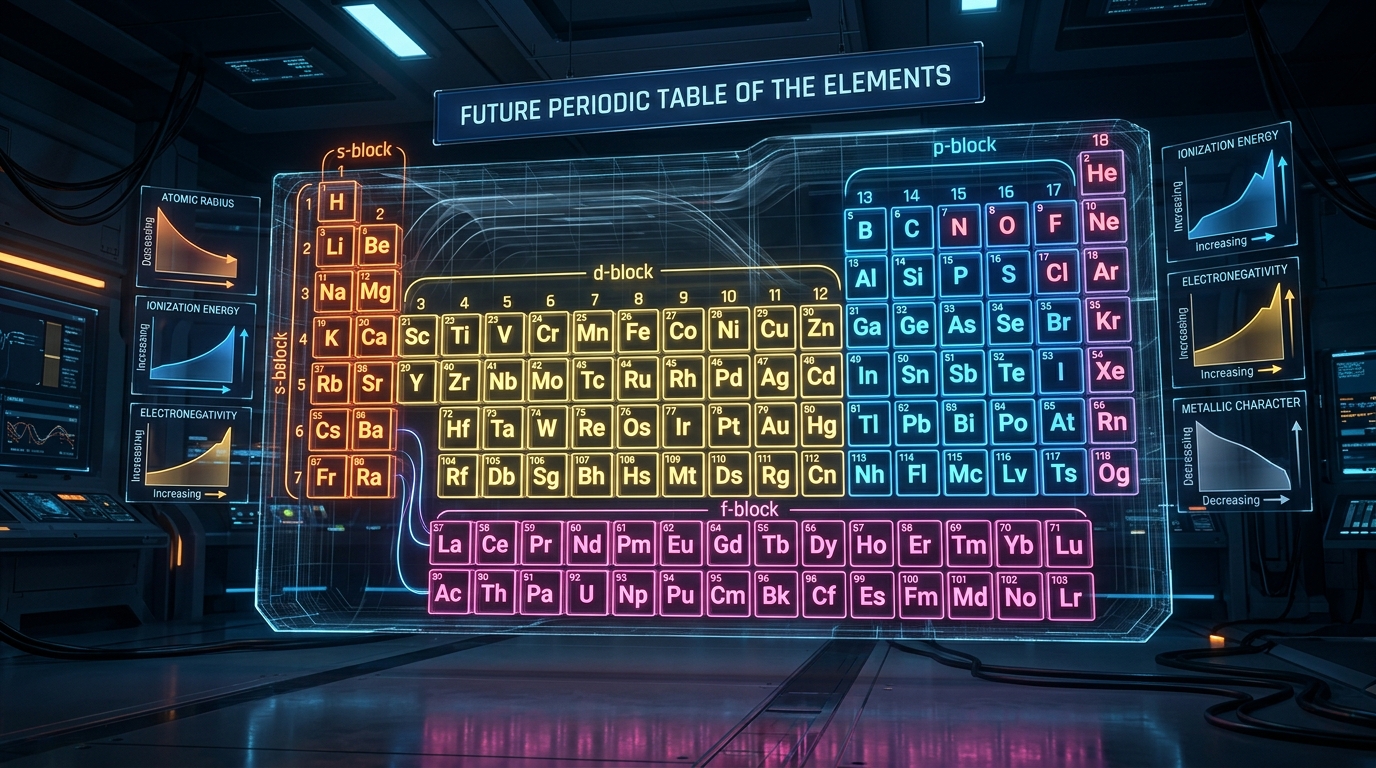
Structure of the Modern Periodic Table
Contains 18 Vertical Columns (Groups) and 7 Horizontal Rows (Periods):
- s-Block (Groups 1 & 2): Group 1 (Alkali Metals: \( \text{Li, Na, K, Rb, Cs, Fr} \)), Group 2 (Alkaline Earth Metals: \( \text{Be, Mg, Ca, Sr, Ba, Ra} \)).
- p-Block (Groups 13 to 18): Includes Metals, Metalloids & Non-Metals. Group 16 (Chalcogens), Group 17 (Halogens: \( \text{F, Cl, Br, I, At} \)), Group 18 (Noble / Inert Gases: \( \text{He, Ne, Ar, Kr, Xe, Rn} \)).
- d-Block (Groups 3 to 12): Transition Metals (Variable oxidation states, colored ions, complex formation).
- f-Block (Inner Transition): Lanthanides (57-71) and Actinides (89-103, radioactive).
Part 3: Master Periodic Trends Cheat Sheet
| Periodic Property | Definition | Across a Period (Left to Right) | Down a Group (Top to Bottom) |
|---|---|---|---|
| Atomic Radius | Distance from nucleus to outermost electron shell | Decreases (Higher nuclear charge pulls electrons closer) | Increases (Addition of new electron shells) |
| Ionization Enthalpy (IE) | Energy required to remove most loosely bound electron from isolated gaseous atom | Increases (Smaller size, higher effective nuclear charge) | Decreases (Larger size, higher shielding effect) |
| Electron Gain Enthalpy (EA) | Energy released when an electron is added to neutral gaseous atom | Becomes More Negative (Highest: Chlorine \( \text{Cl} \)) | Becomes Less Negative |
| Electronegativity (EN) | Relative tendency of atom to attract shared electron pair (Pauling Scale) | Increases (Highest: Fluorine \( \text{F} = 4.0 \)) | Decreases (Lowest: Cesium / Francium \( \approx 0.7 \)) |
| Metallic Character | Tendency to lose electrons (electropositivity) | Decreases | Increases |
Part 4: Effective Nuclear Charge (Zeff) & Slater's Rules
Outer valence electrons do not experience the full positive charge of the nucleus because inner shell electrons repel them. This reduced positive attraction is called the Effective Nuclear Charge (\( Z_{\text{eff}} \)):
\[ Z_{\text{eff}} = Z - \sigma \]
Where \( Z \) is the actual atomic number, and \( \sigma \) is the Shielding (Screening) Constant calculated using Slater's Rules.
- Shielding efficiency order of subshells: \( s > p > d > f \).
- Because \( d \) and \( f \) subshell orbitals are diffuse, they exhibit poor shielding effect. This causes an unexpected contraction in atomic radii known as Lanthanide Contraction across the 4f series, making 4d and 5d transition elements (e.g., Zr and Hf, Nb and Ta) almost identical in atomic radius and chemical properties.
Part 5: Diagonal Relationships in Second Period Elements
Certain elements of the 2nd period exhibit close chemical similarities to elements situated diagonally across in the 3rd period due to similar ionic charge-to-radius ratios (\( q/r \)):
\[ \text{Li} \sim \text{Mg}, \quad \text{Be} \sim \text{Al}, \quad \text{B} \sim \text{Si} \]
- Lithium & Magnesium Similarities: Both form hard nitrides (\( \text{Li}_3\text{N}, \text{Mg}_3\text{N}_2 \)); carbonates decompose on heating releasing \( \text{CO}_2 \); chlorides are deliquescent and soluble in ethanol.
- Beryllium & Aluminum Similarities: Both form amphoteric oxides (\( \text{BeO}, \text{Al}_2\text{O}_3 \)) and hydroxides; passivated by concentrated \( \text{HNO}_3 \); form covalent polymeric chlorides (\( \text{BeCl}_2, \text{Al}_2\text{Cl}_6 \)).
Part 6: High-Yield Periodic Table Question Set
Question 1 (RRB NTPC 2021): Which element in the periodic table possesses the highest Electron Affinity?
Options: (A) Fluorine (B) Chlorine (C) Oxygen (D) Cesium
Answer: (B) Chlorine.
Detailed Explanation: Chlorine (Cl) has the highest negative electron gain enthalpy (-349 kJ/mol). Fluorine has higher electronegativity, but its extremely small 2p orbital creates compact electron-electron repulsions, making Chlorine accept an electron more readily.
Question 2 (SSC CGL 2021): What is the trend of metallic character down a group in the periodic table?
Options: (A) Decreases (B) Increases (C) Remains constant (D) First increases then decreases
Answer: (B) Increases.
Detailed Explanation: Down a group, atomic radius increases and outer valence electrons are shielded from the nucleus, lowering ionization enthalpy and increasing electropositivity / metallic character.
Part 7: Anomalous Properties of 2nd Period Elements
The first element of each group in the p-block (Li, Be, B, C, N, O, F) differs significantly from subsequent members of its group due to:
- Extremely small atomic and ionic radius.
- High electronegativity and high ionization enthalpy.
- Absence of vacant d-orbitals in their valence shell (n = 2). Consequently, these elements cannot expand their octet beyond 4 electron pairs (maximum covalency = 4). In contrast, 3rd period elements (Si, P, S, Cl) can expand their valence shell to form compounds like \( \text{PCl}_5 \) and \( \text{SF}_6 \).
Part 8: Comprehensive Periodic Table Master Trends Table
| Periodic Property | Across a Period (Left to Right) | Down a Group (Top to Bottom) | Fundamental Scientific Reason |
|---|---|---|---|
| Atomic Radius | Decreases | Increases | Z_eff increases across period; new electron shells added down group. |
| Ionization Energy (IE) | Increases | Decreases | Atomic size shrinks across period; inner shell shielding increases down group. |
| Electron Affinity (EA) | Becomes More Negative | Becomes Less Negative | Highest negative EA is Chlorine (Cl = -349 kJ/mol). |
| Electronegativity (EN) | Increases | Decreases | Highest EN is Fluorine (F = 4.0); lowest is Cesium/Francium (~0.7). |
| Metallic Character | Decreases | Increases | Ease of losing electrons increases down group with lower IE. |
| Oxide Acidity | Basic → Amphoteric → Acidic | Increases in Basicity | Na2O (Basic) → Al2O3 (Amphoteric) → SO3, Cl2O7 (Strongly Acidic). |
High-Yield Practice Questions & Concept Review
Question 1: Why does Nitrogen (Z=7) have a higher first Ionization Energy than Oxygen (Z=8)?
Answer: Nitrogen has electronic configuration 1s² 2s² 2p³ with a half-filled 2p subshell (2p_x¹ 2p_y¹ 2p_z¹). Half-filled subshells possess extra stability due to symmetry and maximum exchange energy. Oxygen (1s² 2s² 2p⁴) loses an electron to attain the stable half-filled 2p³ state, requiring lower ionization energy.
Question 2: What are Metalloids and which elements belong to this class?
Answer: Metalloids (Semimetals) exhibit intermediate properties between metals and non-metals. The 7 recognized metalloids in the p-block are: Boron (B), Silicon (Si), Germanium (Ge), Arsenic (As), Antimony (Sb), Tellurium (Te), and Polonium (Po).
Part 9: Advanced Periodic Trends & Isoelectronic Radii Calculation
Isoelectronic Series Atomic and Ionic Radii Trend
In an isoelectronic series of ions and neutral atoms (all possessing identical electron configurations), the radius decreases strictly with increasing nuclear charge (Atomic Number Z):
\[ \text{Radius} \propto \frac{1}{Z_{\text{effective}}} \]
| Isoelectronic Species | Atomic Number (Z) | Total Electrons | Ionic Radius (pm) |
|---|---|---|---|
| \( \text{N}^{3-} \) | 7 | 10 | 171 pm |
| \( \text{O}^{2-} \) | 8 | 10 | 140 pm |
| \( \text{F}^- \) | 9 | 10 | 133 pm |
| \( \text{Ne} \) | 10 | 10 | 120 pm |
| \( \text{Na}^+ \) | 11 | 10 | 102 pm |
| \( \text{Mg}^{2+} \) | 12 | 10 | 72 pm |
| \( \text{Al}^{3+} \) | 13 | 10 | 53.5 pm |
Part 10: Modern Periodic Table Block Classification Summary
| Block | Group Numbers | General Electronic Configuration | Key Physical & Chemical Features |
|---|---|---|---|
| s-Block | Groups 1 & 2 | ns¹⁻² (n = 1 to 7) | Highly electropositive metals, low IE, basic oxides, flame test colors |
| p-Block | Groups 13 to 18 | ns² np¹⁻⁶ (n = 2 to 7) | Contains metals, metalloids & non-metals; acidic/neutral oxides |
| d-Block | Groups 3 to 12 | (n-1)d¹⁻¹⁰ ns¹⁻² | Transition metals, variable valency, paramagnetic, colored complexes |
| f-Block | Lanthanides & Actinides | (n-2)f¹⁻¹⁴ (n-1)d⁰⁻¹ ns² | Inner transition elements, radioactive actinides, lanthanide contraction |
Part 11: High-Yield Periodic Trends Practice Question Set
Question 1: Why does Fluorine have lower negative Electron Gain Enthalpy than Chlorine?
Answer: Fluorine (2p subshell) is extremely small in size compared to Chlorine (3p subshell). When an electron is added to Fluorine's compact 2p orbital, significant inter-electronic repulsions occur, releasing slightly less energy (-328 kJ/mol) than when an electron is added to Chlorine's spacious 3p orbital (-349 kJ/mol).
Question 2: What is Lanthanide Contraction and its main consequence?
Answer: Lanthanide Contraction is the steady decrease in atomic and ionic radii of the 14 4f lanthanide elements (La to Lu) due to the poor shielding effect of 4f electrons. Consequence: 4d and 5d transition elements in the same vertical group (e.g. Zirconium Zr 160 pm and Hafnium Hf 159 pm) possess virtually identical atomic radii and chemical properties.
Part 12: Historical Timeline of Periodic Table Discoveries
| Year | Scientist Name | Discovery / Law Formulated | Key Contribution |
|---|---|---|---|
| 1817 | Johann Wolfgang Döbereiner | Law of Triads | Grouped elements into sets of 3 (Li-Na-K, Ca-Sr-Ba, Cl-Br-I) |
| 1862 | A.E.B. de Chancourtois | Telluric Helix | First 3D cylindrical periodic arrangement of atomic weights |
| 1865 | John Newlands | Law of Octaves | Arranged elements in octaves; every 8th element repeated properties |
| 1869 | Dmitri Mendeleev | Mendeleev's Periodic Law | Arranged by atomic mass; left gaps predicting Eka-Silicon (Ge), Eka-Aluminium (Ga) |
| 1869 | Lothar Meyer | Atomic Volume Curve | Plotted atomic volume vs atomic weight showing periodic peaks for alkali metals |
| 1913 | Henry Moseley | Modern Periodic Law | X-ray frequency relationship (√ν ∝ Z) establishing Atomic Number Z as fundamental |
Frequently Asked Questions (FAQ) & High-Yield Exam Tips
Q: Which element has the highest Electronegativity and which has the highest Electron Gain Enthalpy?
A: Fluorine (F) has the highest Electronegativity (4.0 on Pauling scale). Chlorine (Cl) has the highest negative Electron Gain Enthalpy (-349 kJ/mol) due to small inter-electronic repulsions compared to Fluorine.
Q: What elements were predicted by Mendeleev as Eka-Aluminium and Eka-Silicon?
A: Eka-Aluminium was discovered as Gallium (Ga). Eka-Silicon was discovered as Germanium (Ge). Eka-Boron was discovered as Scandium (Sc).
Q: What is the Modern Periodic Law and who formulated it?
A: Formulated by Henry Moseley (1913): Physical and chemical properties of elements are periodic functions of their atomic numbers (Z).
Q: Why does Atomic Radius decrease across a period from left to right?
A: Across a period, electrons are added to the same valence shell while nuclear charge (Z) increases, pulling electron cloud closer to the nucleus.
Q: Which block elements are known as Transition Elements?
A: The d-block elements (Groups 3 to 12) are known as Transition Elements because they form a transition between highly electropositive s-block metals and electronegative p-block non-metals.
Periodic Table High-Yield Key Points for Competitive Exams (RRB JE, SSC CGL, NEET)
- Father of Periodic Table: Dmitri Mendeleev (organized elements by atomic mass and left gaps for predicted elements like Eka-Silicon / Germanium).
- Modern Periodic Law: Henry Moseley proved physical and chemical properties of elements are a periodic function of their atomic numbers ($Z$).
- Long Form Periodic Table: Contains 7 Horizontal Rows (Periods) and 18 Vertical Columns (Groups).
- Electronegativity Trend: Increases across a period (left to right), decreases down a group. Fluorine ($F$) is the most electronegative element ($4.0$ on Pauling scale).
- Electron Affinity Trend: Chlorine ($Cl$) has the highest electron affinity in the entire periodic table.
- Atomic Radius Trend: Decreases across a period (due to increasing effective nuclear charge $Z_{\text{eff}}$), increases down a group (due to addition of new electron shells).
- Ionization Energy Exception: Nitrogen ($N$, half-filled $2p^3$) has a higher first ionization energy than Oxygen ($O$, $2p^4$).
- Diagonal Relationship: Lithium ($Li$) resembles Magnesium ($Mg$), Beryllium ($Be$) resembles Aluminium ($Al$), and Boron ($B$) resembles Silicon ($Si$).
Master Chemistry & General Science on RRBCONTENTS
Access full study notes, interactive formula cheat sheets, and daily competitive exam updates.
Full Science Study Notes → Practice Chemistry PYQs →Join our official Telegram channel for instant study resources: @rrbcontents