Home › Blog › Chemistry Notes › Solutions & Colloids
Solutions, Colligative Properties & Colloids: Master Chemistry Notes
Part 1: Types of Solutions & Concentration Units
A solution is a homogeneous mixture of two or more non-reacting substances. The component present in larger amount is the Solvent; the smaller component is the Solute.
Concentration Terms & Formulas
- Molarity (M): Number of moles of solute dissolved per Litre of solution. Temperature dependent (volume changes with temperature). \[ M = \frac{\text{Moles of Solute}}{\text{Volume of Solution in Litres}} = \frac{w_B \times 1000}{M_B \times V_{(\text{mL})}} \]
- Molality (m): Number of moles of solute per kilogram of solvent. Temperature independent (depends on mass). \[ m = \frac{\text{Moles of Solute}}{\text{Mass of Solvent in kg}} = \frac{w_B \times 1000}{M_B \times w_A_{(\text{g})}} \]
- Mole Fraction (x): Ratio of moles of one component to total moles of all components. \[ x_A = \frac{n_A}{n_A + n_B}, \quad x_B = \frac{n_B}{n_A + n_B}, \quad x_A + x_B = 1 \]
- Normality (N): Number of gram equivalents of solute per Litre of solution. \[ N = \frac{\text{Gram Equivalents of Solute}}{\text{Volume of Solution in Litres}} = \text{Molarity} \times \text{Valency Factor (n)} \]
Part 2: Henry's Law & Raoult's Law
Henry's Law (Solubility of Gases in Liquids)
At constant temperature, the solubility (or partial pressure) of a gas in a liquid is directly proportional to the partial pressure of the gas above the liquid surface:
\[ P = K_H \cdot x \]
Where \( K_H \) is Henry's Law Constant. Higher \( K_H \) value means lower gas solubility. Applications: Soda bottle carbonation, Scuba diver bends (Helium dilution in breathing tanks), Anoxia at high altitudes.
Raoult's Law for Volatile Liquids
For a solution of volatile liquids, the partial vapor pressure of each component is directly proportional to its mole fraction in solution:
\[ P_A = P_A^0 \cdot x_A, \quad P_B = P_B^0 \cdot x_B, \quad P_{\text{total}} = P_A + P_B \]
Part 3: Colligative Properties & van 't Hoff Factor
Colligative properties depend strictly on the number of solute particles present in solution, independent of their chemical identity.
- Relative Lowering of Vapor Pressure: \[ \frac{P_A^0 - P_A}{P_A^0} = x_B = \frac{n_B}{n_A + n_B} \]
- Elevation of Boiling Point: \[ \Delta T_b = T_b - T_b^0 = K_b \cdot m \quad (K_b = \text{Ebullioscopic Constant}) \]
- Depression of Freezing Point: \[ \Delta T_f = T_f^0 - T_f = K_f \cdot m \quad (K_f = \text{Cryoscopic Constant}) \]
- Osmotic Pressure (\( \pi \)): \[ \pi = C R T = \left(\frac{n_B}{V}\right) R T \]
van 't Hoff Factor (i)
Accounts for association or dissociation of solute particles in solution:
\[ i = \frac{\text{Observed Colligative Property}}{\text{Calculated Colligative Property}} = \frac{\text{Total moles of particles after association/dissociation}}{\text{Initial moles of particles}} \]
- For Non-electrolytes (Glucose, Sucrose, Urea): \( i = 1 \)
- For Dissociation (\( \text{NaCl} \rightarrow \text{Na}^+ + \text{Cl}^- \)): \( i = 2 \)
- For Association (Acetic acid dimerization in benzene \( 2\text{CH}_3\text{COOH} \rightarrow (\text{CH}_3\text{COOH})_2 \)): \( i = 0.5 \)
Part 4: Colloids & Tyndall Effect
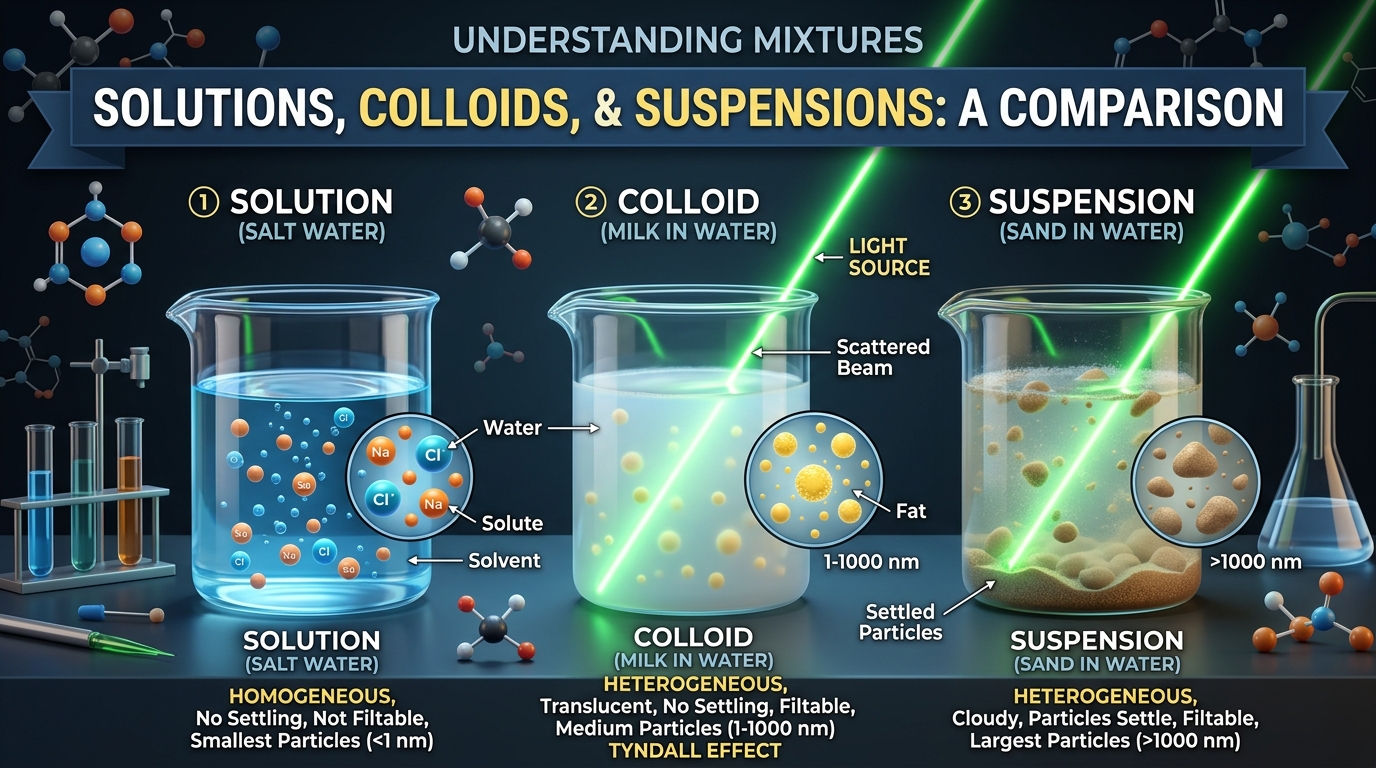
Colloids are heterogeneous mixtures where solute particle size ranges between 1 nm and 1000 nm (10⁻⁹ m to 10⁻⁶ m).
| Dispersed Phase | Dispersion Medium | Colloid Name | Examples |
|---|---|---|---|
| Liquid | Gas | Liquid Aerosol | Fog, Mist, Cloud, Insecticide Spray |
| Solid | Gas | Solid Aerosol | Smoke, Automobile Exhaust, Dust Storm |
| Gas | Liquid | Foam | Whipped Cream, Shaving Cream, Soap Suds |
| Liquid | Liquid | Emulsion | Milk, Butter, Face Cream, Mayonnaise |
| Solid | Liquid | Sol | Paint, Muddy Water, Blood, Cell Fluids |
| Liquid | Solid | Gel | Jelly, Cheese, Gelatin, Boot Polish |
Optical and Kinetic Properties of Colloids
- Tyndall Effect: Scattering of light beam by colloidal particles, rendering the light path visible (seen in dense forest canopy or dusty room spotlight).
- Brownian Motion: Continuous, erratic, zig-zag motion of colloidal particles caused by unequal collisions with solvent molecules. Imparts stability to colloids by preventing settling.
- Hardy-Schulze Rule: Coagulation power of an effective ion is directly proportional to its valence (e.g., \( \text{Al}^{3+} > \text{Ba}^{2+} > \text{Na}^+ \) for coagulating negative sols).
Part 5: Ideal vs Non-Ideal Solutions & Azeotropes
An Ideal Solution obeys Raoult's Law over the entire concentration range at all temperatures. Intermolecular forces between components are identical: \( F_{A-B} = F_{A-A} = F_{B-B} \). For ideal solutions, \( \Delta H_{\text{mix}} = 0 \) and \( \Delta V_{\text{mix}} = 0 \) (e.g., n-hexane + n-heptane, benzene + toluene).
Non-Ideal Solutions (Deviations from Raoult's Law)
- Positive Deviation (\( F_{A-B} < F_{A-A} \)): Total vapor pressure is higher than predicted. \( \Delta H_{\text{mix}} > 0 \), \( \Delta V_{\text{mix}} > 0 \). Forms a Minimum Boiling Azeotrope (e.g., 95.6% Ethanol + 4.4% Water mixture boils at 351.15 K, lower than pure ethanol 351.5 K and water 373 K).
- Negative Deviation (\( F_{A-B} > F_{A-A} \)): Total vapor pressure is lower than predicted due to strong solute-solvent hydrogen bonding. \( \Delta H_{\text{mix}} < 0 \), \( \Delta V_{\text{mix}} < 0 \). Forms a Maximum Boiling Azeotrope (e.g., 68% Nitric Acid + 32% Water mixture boils at 393.5 K, higher than pure water 373 K).
Part 6: Preparation & Purification of Colloidal Sols
- Bredig's Arc Method (Electrical Disintegration): Used to prepare metallic sols (Gold, Silver, Platinum). An electric arc is struck between metal electrodes submerged in ice-cooled water. Intense heat vaporizes metal, which immediately condenses into colloidal size particles.
- Peptization: Conversion of a freshly precipitated substance into a colloidal sol by shaking with dispersion medium in the presence of a small amount of electrolyte (Peptizing Agent).
Example: \( \text{Fe(OH)}_3 \text{ precipitate} + \text{FeCl}_3 \rightarrow \text{[Fe(OH)}_3\text{]Fe}^{3+} \text{ (Positive Fe(OH)3 Sol)} \). - Dialysis & Electrodialysis: Purification of colloidal sols by separating crystalloid impurities using a semi-permeable parchment/collodion membrane. Application of electric field (Electrodialysis) speeds up ion removal.
Part 7: High-Yield Solutions & Colloids Question Set
Question 1 (RRB JE 2019): According to the Hardy-Schulze Rule, which ion has the highest coagulating power for a negatively charged Arsenic Sulphide (As2S3) sol?
Options: (A) Na⁺ (B) Ba²⁺ (C) Al³⁺ (D) Cl⁻
Answer: (C) Al³⁺.
Detailed Explanation: The Hardy-Schulze rule states that the coagulating power of an ion increases with its valency. For a negative sol, trivalent Al³⁺ is vastly superior to divalent Ba²⁺ and monovalent Na⁺.
Question 2 (NEET 2020): What type of colloidal system is Milk?
Options: (A) Sol (B) Gel (C) Emulsion (D) Aerosol
Answer: (C) Emulsion.
Detailed Explanation: Milk is a liquid-in-liquid emulsion consisting of liquid butterfat dispersed in an aqueous liquid medium, stabilized by casein protein as emulsifier.
Part 8: Advanced Colloid Chemistry & Industrial Emulsions
Colloidal systems permeate food technology, pharmaceutical formulations, and environmental remediation.
1. Emulsions and Emulsifying Agents
An Emulsion is a colloidal dispersion of one liquid in another immiscible liquid.
- Oil-in-Water (O/W) Emulsion: Oil is dispersed phase, Water is dispersion medium (e.g., Milk, Vanishing Cream). Stabilized by proteins or soaps.
- Water-in-Oil (W/O) Emulsion: Water is dispersed phase, Oil is dispersion medium (e.g., Butter, Cold Cream, Cod Liver Oil).
2. Industrial Applications of Colloids
- Cottrell Electrostatic Precipitator: Removes charged smoke dust particles from industrial chimney gases by applying a high voltage potential (30 kV), coagulating ash particles before air discharge.
- Water Purification with Alum: Potash Alum \( \text{K}_2\text{SO}_4 \cdot \text{Al}_2(\text{SO}_4)_3 \cdot 24\text{H}_2\text{O} \) releases trivalent \( \text{Al}^{3+} \) ions, coagulating negatively charged suspended clay particles in muddy water via the Hardy-Schulze effect.
- Delta Formation at River-Sea Junctions: River water is a colloidal sol of clay particles. When it meets salty ocean water containing electrolytes (\( \text{Na}^+, \text{Mg}^{2+} \)), the clay coagulates and deposits to build fertile river deltas (e.g., Sundarbans Delta).
Part 9: Comprehensive Solutions & Colloid Master Formula Table
| Concentration / Colligative Term | Governing Formula | Temperature Dependency | Key Laboratory / Industrial Use |
|---|---|---|---|
| Molarity (M) | \( M = \frac{\text{Moles of Solute}}{\text{Volume of Solution in Litres}} \) | Temperature Dependent (Volume changes with T) | Standard volumetric titrations & solution preparation |
| Molality (m) | \( m = \frac{\text{Moles of Solute}}{\text{Mass of Solvent in kg}} \) | Temperature Independent (Mass is invariant) | Colligative property calculations (\( \Delta T_b, \Delta T_f \)) |
| Mole Fraction (x) | \( x_A = \frac{n_A}{n_A + n_B} \) | Temperature Independent | Vapor pressure & gas solubility calculations (Raoult & Henry) |
| Henry's Law | \( P = K_H \cdot x \) | Solubility decreases with higher T | Carbonated soft drinks & deep-sea diving Heliox gas |
| Boiling Point Elevation | \( \Delta T_b = i \cdot K_b \cdot m \) | Proportional to particle molality | Determining molar mass of non-volatile solutes |
| Freezing Point Depression | \( \Delta T_f = i \cdot K_f \cdot m \) | Proportional to particle molality | Antifreeze solutions (ethylene glycol in car radiators) |
| Osmotic Pressure (\( \pi \)) | \( \pi = i C R T = i \left(\frac{n}{V}\right) R T \) | Increases linearly with T | Desalination of seawater via Reverse Osmosis (RO) |
High-Yield Practice Questions & Concept Review
Question 1: What is Reverse Osmosis (RO) and how does it purify seawater?
Answer: Normal Osmosis is the spontaneous flow of solvent from dilute solution to concentrated solution across a semi-permeable membrane. If a hydrostatic pressure GREATER than the Osmotic Pressure (P > π) is applied to the concentrated seawater side, pure water molecules are forced backward through the membrane into the fresh water side, leaving dissolved salts behind.
Question 2: Calculate the freezing point of a solution containing 62 g Ethylene Glycol [C2H6O2, M = 62 g/mol] in 500 g Water (Kf for water = 1.86 K·kg/mol).
Answer: Moles of solute n = 62 / 62 = 1.0 mol. Molality m = 1.0 mol / 0.5 kg = 2.0 m. For non-electrolyte ethylene glycol, i = 1.
Depression ΔTf = i × Kf × m = 1 × 1.86 × 2.0 = 3.72 K.
New Freezing Point = 0°C - 3.72°C = -3.72°C (269.43 K).
Part 10: Quantitative Colligative Property Solved Problems
Comprehensive Step-by-Step Solved Problem:
Problem: Calculate the Osmotic Pressure of a solution containing 17.1 g of Sucrose [\( \text{C}_{12}\text{H}_{22}\text{O}_{11} \), Molar Mass = 342 g/mol] dissolved in 500 mL of water at 27°C (R = 0.0821 L·atm/mol·K).
Solution: Step 1: Calculate moles of sucrose: \( n = \frac{17.1 \text{ g}}{342 \text{ g/mol}} = 0.050 \text{ mol} \).
Step 2: Calculate Molar Concentration C: \( C = \frac{n}{V_{(\text{L})}} = \frac{0.050 \text{ mol}}{0.500 \text{ L}} = 0.100 \text{ M} \).
Step 3: Convert T to Kelvin: \( T = 27 + 273.15 = 300.15 \text{ K} \).
Step 4: For non-electrolyte sucrose, \( i = 1 \).
Osmotic Pressure \( \pi = i C R T = 1 \times 0.100 \text{ mol/L} \times 0.0821 \text{ L atm mol}^{-1}\text{K}^{-1} \times 300.15 \text{ K} = \mathbf{2.464 \text{ atm}} \) (249.6 kPa).
Part 11: Summary Table of Concentration Units & Temperature Dependence
| Concentration Unit | Formula | Temperature Dependent? | Reasoning |
|---|---|---|---|
| Molarity (M) | Moles of Solute / Litres of Solution | Yes | Solution volume expands/contracts with temperature changes |
| Molality (m) | Moles of Solute / kg of Solvent | No | Mass of solvent remains invariant with temperature changes |
| Mole Fraction (x) | nA / (nA + nB) | No | Ratio of mole quantities; completely independent of thermal expansion |
| Mass Percentage (w/w) | (Mass of Solute / Total Mass) × 100 | No | Mass measurements are invariant with temperature |
| Normality (N) | Gram Equivalents / Litres of Solution | Yes | Volume term present in denominator |
Frequently Asked Questions (FAQ) & High-Yield Exam Tips
Q: Why is Molality (m) preferred over Molarity (M) for precision experiments?
A: Molality (m) measures moles of solute per kg of solvent (mass-based) and is independent of temperature. Molarity (M) measures per Litre of solution (volume-based) and changes with thermal expansion/contraction.
Q: What are the 4 Colligative Properties?
A: 1. Relative Lowering of Vapor Pressure, 2. Elevation of Boiling Point (ΔTb = Kb·m), 3. Depression of Freezing Point (ΔTf = Kf·m), 4. Osmotic Pressure (π = iCRT).
Q: What is the Tyndall Effect?
A: The Tyndall Effect is the scattering of a visible light beam by colloidal particles in a suspension, making the path of light clearly visible.
Q: What is the van 't Hoff factor (i) for NaCl and Glucose?
A: For Glucose (non-electrolyte), i = 1. For NaCl (completely dissociates into Na+ and Cl-), i = 2.
Q: What is Henry's Law formula and its real-world application?
A: Henry's Law formula is P = KH·x. Applied in soft drink carbonation (CO2 dissolved under high pressure) and deep-sea diving breathing mixtures (Helium diluted to prevent nitrogen bends).
Master Chemistry & General Science on RRBCONTENTS
Access full study notes, interactive formula cheat sheets, and daily competitive exam updates.
Full Science Study Notes → Practice Chemistry PYQs →Join our official Telegram channel for instant study resources: @rrbcontents