CLIMATE CHANGE IN INDIA: CAUSES, REGIONAL IMPACTS, COP26 PANCHAMRIT TARGETS, INTERNATIONAL SOLAR ALLIES & NET ZERO 2070 (COMPLETE GUIDANCE FOR COMPETITIVE EXAMS)
Chapter 1
INTRODUCTION
Climate Change is universally recognized as the single greatest existential crisis facing humanity in the 21st century. Defined as long-term shifts in global temperatures and atmospheric weather patterns, modern climate change is overwhelmingly driven by anthropogenic (human-induced) activities—specifically the burning of fossil fuels (coal, oil, natural gas), widespread deforestation, industrialization, and intensive agricultural practices that release vast quantities of greenhouse gases (GHGs) into the atmosphere.
For a developing nation like India, climate change poses a double vulnerability. On one hand, India's geographic diverse coastline (7,516 km), fragile Himalayan ecosystems, and rain-fed agrarian economy make it one of the most climate-vulnerable nations in the world. Extreme weather events—ranging from intense heatwaves, urban flooding, and erratic monsoons to severe cyclones (e.g. Biparjoy, Tauktae, Amphan) and glacial lake outburst floods (GLOF)—directly threaten food security, water availability, and coastal infrastructure.
On the other hand, as the world's third-largest energy consumer, India must balance its climate responsibilities with the socio-economic imperative of lifting millions of citizens out of poverty and expanding industrial infrastructure.
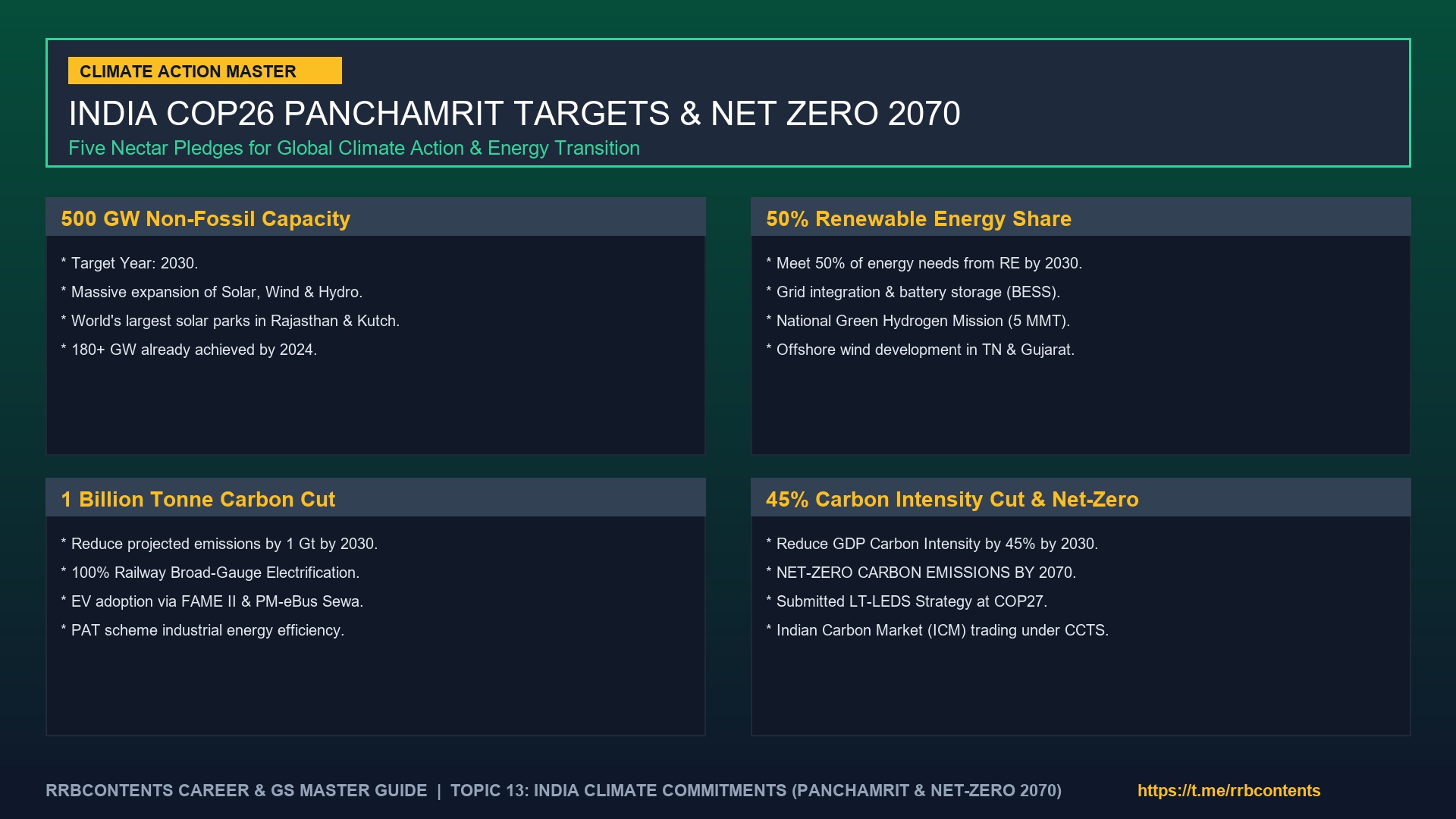
Rising to this global challenge, India has emerged as a global climate leader. At the COP26 UN Climate Summit in Glasgow (2021), Prime Minister Narendra Modi unveiled India's visionary "Panchamrit" (Five Nectar Pledges), including the historic commitment to achieve Net-Zero Carbon Emissions by 2070 and generate 500 GW of Non-Fossil Energy Capacity by 2030. Furthermore, India has spearheaded global climate institutions such as the International Solar Alliance (ISA), the Coalition for Disaster Resilient Infrastructure (CDRI), and the Lifestyle for Environment (LiFE) Movement.
For aspirants preparing for competitive examinations such as UPSC Civil Services (GS Paper III Environment & Ecology), State Public Service Commissions (BPSC, UPPSC, MPPSC, RAS), SSC CGL, and Forestry services, a thorough mastery of climate change science, UNFCCC COP milestones, Paris Agreement NDCs, Panchamrit targets, ISA, NAPCC 8 missions, and domestic renewable energy policies is essential.
This comprehensive master career guide provides an exhaustive breakdown of Climate Change in India. We cover every environmental detail—from GHG drivers and climate impact tables to Paris Agreement NDCs, Panchamrit pledges, ISA, NAPCC 8 missions, 12 exam-focused FAQs, and essential revision tools.
---
The IPCC's Sixth Assessment Report (AR6) warns that human activities have unequivocally warmed the atmosphere, ocean, and land, urging global carbon emissions to peak before 2025 and fall by 43% by 2030 to limit warming to 1.5°C.
Chapter 2
THE SCIENCE OF CLIMATE CHANGE & GREENHOUSE GAS (GHG) DRIVERS
THE SCIENCE OF CLIMATE CHANGE & GREENHOUSE GAS (GHG) DRIVERS - Illustrative Reference
Climate change is driven by the enhanced Greenhouse Effect, where certain atmospheric gases trap solar infrared radiation emitted by the Earth, preventing it from escaping into space:
Solar Radiation Enters Earth's Atmosphere
       │
       ▼
Earth's Surface Absorbs Heat & Re-radiates Thermal Infrared Rays
       │
       ▼
Accumulated Greenhouse Gases (CO2, CH4, N2O, F-Gases) Trap Heat
       │
       ▼
Global Average Surface Temperature Rises (Global Warming)
| Greenhouse Gas (GHG) | Primary Anthropogenic Sources | Global Warming Potential (GWP 100-Yr) | Atmospheric Lifetime |
|---|---|---|---|
| Carbon Dioxide ($CO_2$) | Coal power generation, petrol/diesel transport, deforestation, steel & cement industries. | 1 (Base Benchmark) | 100 to 1,000 Years |
| Methane ($CH_4$) | Paddy rice cultivation, ruminant livestock enteric fermentation, landfills, natural gas leaks. | 28 – 36 Times $CO_2$ | ~12 Years |
| Nitrous Oxide ($N_2O$) | Synthetic chemical nitrogen fertilizers, livestock manure management, industrial nitric acid. | 265 – 298 Times $CO_2$ | ~114 Years |
| Fluorinated Gases (HFCs, PFCs, $SF_6$) | Air conditioning refrigerants, foam blowing agents, semiconductor manufacturing. | 1,000 to 23,500 Times $CO_2$ | Up to 50,000 Years |
---
Chapter 3
IMPACT OF CLIMATE CHANGE ON INDIA
Climate Change Impacts across Indian Geography
├── 1. Himalayan Region: Glacial retreat, GLOF outbursts & flash floods
├── 2. Coastal Zones (7,516 km): Sea level rise, storm surges & intense cyclones
├── 3. Indo-Gangetic Plains: Heatwaves, groundwater depletion & crop yield loss
└── 4. Monsoonal Systems: Erratic monsoons (longer dry spells + sudden cloudbursts)
---
1. Erratic Monsoon Patterns & Agriculture: Monsoon rains supply 75% of India's annual rainfall. Climate change has increased the frequency of short-duration, high-intensity cloudbursts interrupted by prolonged dry spells, damaging rain-fed crops (Kharif rice, pulses, oilseeds).
2. Himalayan Glacial Melting & GLOF: The HKH (Hindu Kush Himalaya) region—known as the "Third Pole"—is losing ice rapidly. Accelerated glacial retreat threatens long-term water flows in the Ganges, Indus, and Brahmaputra rivers while triggering catastrophic Glacial Lake Outburst Floods (GLOF) (e.g. Chamoli 2021 & Sikkim 2023 disasters).
3. Sea Level Rise & Coastal Submergence: Sea level rise along the Indian coast (approx 1.7 to 3.3 mm per year) threatens mega-coastal cities (Mumbai, Chennai, Kolkata, Kochi) and low-lying island ecosystems like the Sundarbans.
4. Extreme Heatwaves & Thermal Stress: Severe heatwave days have expanded across North and Central India, exceeding 45°C-48°C thresholds, harming outdoor agricultural and construction workers and causing severe thermal stress.
---
Chapter 4
GLOBAL CLIMATE FRAMEWORKS: UNFCCC, KYOTO PROTOCOL & PARIS AGREEMENT
Evolution of Global Climate Treaties
├── 1. Rio Earth Summit (1992): Adoption of UNFCCC treaty
├── 2. Kyoto Protocol (1997 - COP3): Binding emission targets for Annex-I developed nations
├── 3. Paris Agreement (2015 - COP21): Legally binding treaty targeting < 2°C (1.5°C limit) via NDCs
└── 4. COP26 Glasgow (2021): Net-Zero pledges & India's Panchamrit targets
Adopted at the Rio Earth Summit in 1992, the United Nations Framework Convention on Climate Change (UNFCCC) established the principle of Common But Differentiated Responsibilities and Respective Capabilities (CBDR-RC), acknowledging that developed nations historically contributed the vast majority of historical emissions.
Adopted at COP3 in Kyoto, Japan. It placed binding emission reduction targets on Annex-I developed countries and established flexible market mechanisms such as the Clean Development Mechanism (CDM) and Carbon Trading.
- Temperature Goal: Keep the increase in global average temperature well below 2°C above pre-industrial levels, and pursue efforts to limit the temperature increase to 1.5°C.
- Nationally Determined Contributions (NDCs): Every country submits self-determined national climate targets updated every five years.
---
Chapter 5
# COP28 Dubai Summit Highlights: Loss & Damage Fund & Global Stocktake:
1. Operationalization of Loss & Damage Fund: Formally operationalized a dedicated Loss & Damage Fund hosted by the World Bank to provide financial compensation to vulnerable developing nations suffering catastrophic climate damages (such as sea level rise and extreme tropical cyclones).
2. First Global Stocktake (GST): Concluded the inaugural 5-year assessment of global progress under the Paris Agreement, explicitly calling for "transitioning away from fossil fuels in energy systems in a just, orderly and equitable manner".
3. Tripling Renewable Energy & Doubling Energy Efficiency: Called on all nations to triple global renewable energy capacity to 11,000 GW by 2030 and double the rate of global energy efficiency improvements.
Chapter 6
INDIA'S "PANCHAMRIT" TARGETS AT COP26 (GLASGOW 2021)
India's COP26 Panchamrit Climate Commitments
├── 1. 500 GW Non-Fossil Energy Capacity by 2030
├── 2. 50% Energy Requirements from Renewable Energy by 2030
├── 3. 1 Billion Tonnes (1 Gt) Carbon Emission Reduction by 2030
├── 4. 45% Reduction in Carbon Intensity of GDP by 2030 (vs 2005 levels)
└── 5. NET-ZERO CARBON EMISSIONS BY 2070
| Panchamrit Target # | Pledge Description | Base Benchmark / Target Year | Strategic Implementation Pathway |
|---|---|---|---|
| Pledge 1 | Reach 500 GW Non-Fossil Energy Capacity | By 2030 | Massive expansion of Solar Parks, Wind, Hydro & Nuclear power. |
| Pledge 2 | Meet 50% of Energy Needs from Renewables | By 2030 | Grid integration of renewable energy, battery storage & green hydrogen. |
| Pledge 3 | Reduce total projected Carbon Emissions by 1 Billion Tonnes | By 2030 | Energy efficiency in heavy industries, railway electrification & EV adoption. |
| Pledge 4 | Reduce Carbon Intensity of GDP by 45% | By 2030 (vs 2005) | Updated from earlier 33-35% target submitted in 2015. |
| Pledge 5 | Achieve NET-ZERO Carbon Emissions | By 2070 | Full decarbonization of power, industry, transport & carbon sinks. |
---
- What is CBAM? The European Union's Carbon Border Adjustment Mechanism (CBAM) imposes a carbon tariff on carbon-intensive imports (steel, aluminum, cement, fertilizers, electricity, hydrogen) entering the EU market from 2026.
- Impact on India: Indian steel and aluminum exports face potential 20-35% import tariffs. India has challenged CBAM at the WTO, arguing that it violates the UNFCCC principle of Common But Differentiated Responsibilities (CBDR) and acts as a protectionist trade barrier against developing nations.
Chapter 7
INTERNATIONAL CLIMATE LEADERSHIP BY INDIA
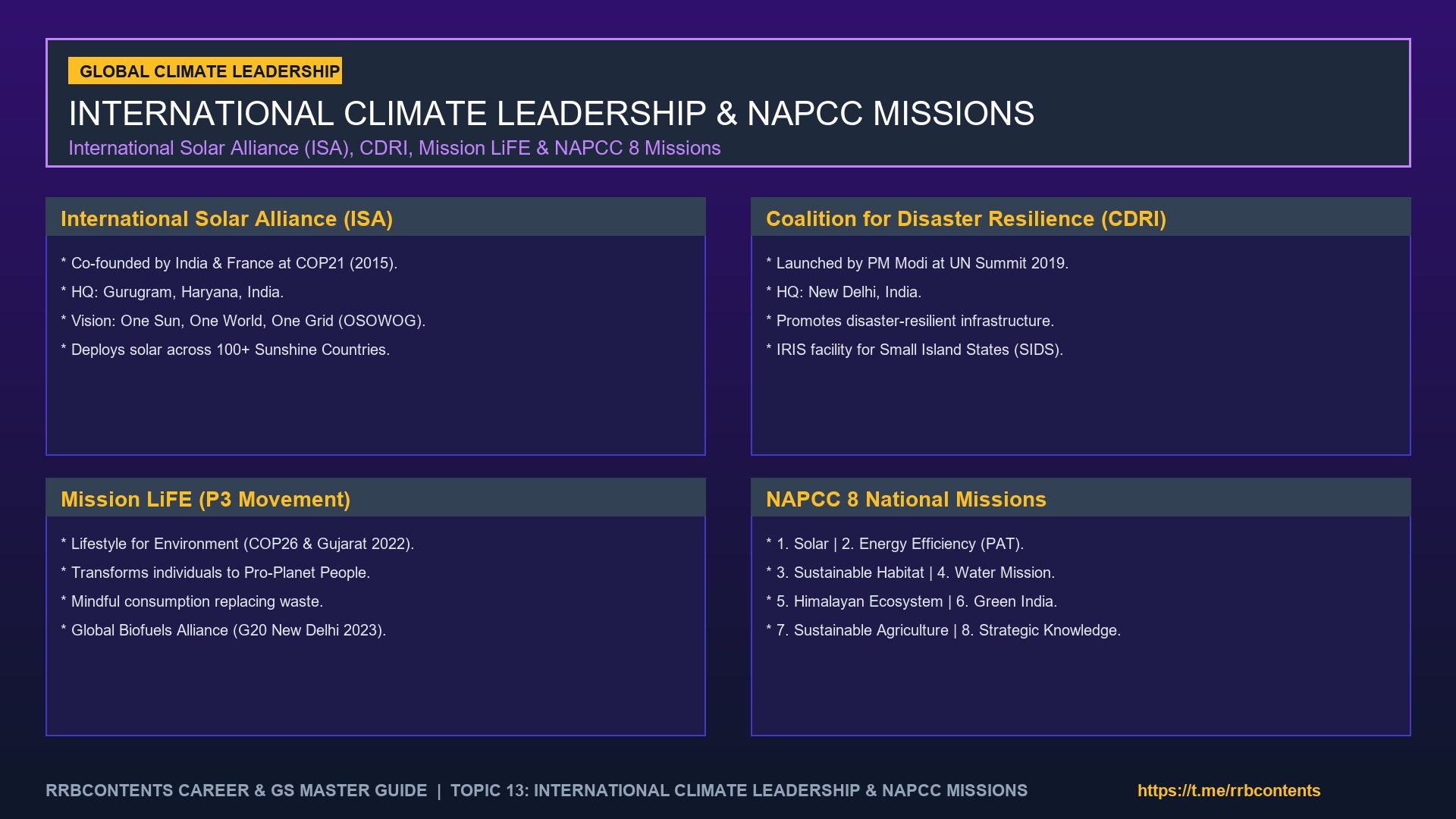
- Co-Founders: Launched jointly by India and France at COP21 in Paris (2015).
- Headquarters: Gurugram, Haryana, India (First international intergovernmental organization headquartered in India).
- Mandate: Mobilize over $1 Trillion in investments for solar energy deployment across Sunshine Countries (located fully or partially between the Tropic of Cancer and Tropic of Capricorn).
- Flagship Vision: "One Sun, One World, One Grid" (OSOWOG).
- Launched: By PM Narendra Modi at the UN Climate Action Summit in New York in 2019.
- Headquarters: New Delhi, India.
- Mandate: Promotes the resilience of new and existing infrastructure systems (power, transport, telecommunications, water) against climate hazards and natural disasters.
- Concept: Introduced by PM Modi at COP26 and launched officially in Gujarat in 2022.
- Vision: Replaces mindless, destructive consumption with mindful, deliberate utilization of resources, transforming individuals into "Pro-Planet People" (P3).
- Launched: During India's G20 Presidency in New Delhi (2023) alongside USA, Brazil, and 19 other nations.
- Mandate: Accelerating global adoption of sustainable biofuels (ethanol blending, compressed bio-gas CBG) to decarbonize transportation.
---
- Low-Carbon Electricity Expansion: Phasing in nuclear energy expansion (targeting 20 GW nuclear by 2031-32), green hydrogen energy storage, and flexible thermal plant operations.
- Integrated Low-Carbon Transport: Target of 30% electric vehicle (EV) sales penetration by 2030 (FAME II & PM-eBus Sewa), achieving 100% railway electrification, and blending 20% ethanol in petrol (E20 target achieved by 2025).
- Sustainable Urbanization: Energy-efficient building codes (ECBC & Eco-Niwas Samhita), municipal solid waste methane capture, and climate-resilient urban infrastructure.
Chapter 8
# Article 6 of Paris Agreement & The Indian Carbon Market (ICM):
- Article 6.2 & 6.4 of Paris Agreement: Establishes international carbon trading frameworks allowing countries to trade Internationally Transferred Mitigation Outcomes (ITMOs) toward meeting their NDCs.
- Indian Carbon Market (ICM): Established under the Energy Conservation (Amendment) Act, 2022, the Bureau of Energy Efficiency (BEE) operates the Carbon Credit Trading Scheme (CCTS), issuing Carbon Credit Certificates (CCCs) to obligated industrial entities achieving carbon intensity reduction targets.
- Green Credit Programme (GCP): Launched at COP28 by India as a voluntary market-based mechanism to incentivize pro-environmental actions (afforestation, water conservation, sustainable agriculture) by individuals and corporates, issuing Green Credits.
A Central Sector Scheme established in 2015-16 to support climate adaptation projects in vulnerable sectors (agriculture, horticulture, forestry, water resources, coastal management) across Indian states, implemented by NABARD.
Chapter 9
DOMESTIC CLIMATE ACTION: NAPCC & NATIONAL MISSIONS
NAPCC Eight National Missions
├── 1. National Solar Mission (Target 100 GW solar power)
├── 2. National Mission for Enhanced Energy Efficiency (NMEEE - PAT Scheme)
├── 3. National Mission on Sustainable Habitat (Energy efficient buildings & urban transit)
├── 4. National Water Mission (20% increase in water-use efficiency)
├── 5. National Mission for Sustaining the Himalayan Ecosystem (Glacial monitoring)
├── 6. National Mission for a Green India (Afforestation & 33% forest cover goal)
├── 7. National Mission for Sustainable Agriculture (Climate resilient farming)
└── 8. National Mission on Strategic Knowledge for Climate Change (R&D climate modeling)
1. Perform, Achieve and Trade (PAT) Scheme: Market-based mechanism under NMEEE mandating energy-intensive industrial sectors (steel, cement, fertilizers) to reduce specific energy consumption, trading Energy Saving Certificates (ESCerts).
2. Energy Conservation (Amendment) Act, 2022: Mandates non-fossil energy use for buildings/industries and establishes the Indian Carbon Market (ICM) for carbon credit trading.
3. National Green Hydrogen Mission (2023): Outlay of ₹19,744 Crore targeting 5 Million Metric Tonnes (MMT) of Green Hydrogen production annually by 2030.
---
In alignment with the National Action Plan on Climate Change (NAPCC), all 28 States and 8 Union Territories have formulated State Action Plans on Climate Change (SAPCC) detailing state-specific climate adaptation strategies for agriculture, water resources, and forestry.
Chapter 10
IMPORTANCE FOR COMPETITIVE EXAMS & QUICK REVISION
1. Panchamrit Targets: 500 GW Non-fossil by 2030; 50% Renewable energy by 2030; 1 Billion tonnes CO2 cut by 2030; 45% Carbon intensity cut by 2030; Net-Zero by 2070.
2. ISA Headquarters: Gurugram, India (Co-founded by India & France at COP21 in 2015).
3. NAPCC 8 Missions: Solar, Energy Efficiency (PAT), Sustainable Habitat, Water, Himalayan Ecosystem, Green India, Sustainable Agriculture, Strategic Knowledge.
4. Key Institutions: CDRI (HQ New Delhi), Mission LiFE (Pro-Planet People P3), Global Biofuels Alliance (G20 2023).
---
Chapter 11
FREQUENTLY ASKED QUESTIONS (FAQS)
Chapter 12
# Q1: What is India's target year for achieving Net-Zero Carbon Emissions?
Answer: India officially committed to achieving Net-Zero Carbon Emissions by 2070 at the COP26 Glasgow Climate Summit in 2021.
Chapter 13
# Q2: What are the "Panchamrit" targets announced by India at COP26?
Answer: The five pledges are: 500 GW non-fossil capacity by 2030; 50% energy from renewables by 2030; 1 billion tonnes CO2 reduction by 2030; 45% carbon intensity reduction by 2030; and Net-Zero by 2070.
Chapter 14
# Q3: Where is the headquarters of the International Solar Alliance (ISA) located?
Answer: The ISA headquarters is located in Gurugram, Haryana, India (the first international intergovernmental body headquartered in India).
Chapter 15
# Q4: What is the main goal of the Paris Agreement (COP21)?
Answer: To limit global average temperature rise to well below 2°C above pre-industrial levels, and pursue efforts to limit it to 1.5°C.
Chapter 16
# Q5: How many National Missions are under the National Action Plan on Climate Change (NAPCC)?
Answer: NAPCC comprises Eight National Missions launched in 2008.
Answer: A market-based mechanism under the National Mission for Enhanced Energy Efficiency (NMEEE) where energy-intensive industries trade Energy Saving Certificates (ESCerts).
Answer: Mission LiFE (Lifestyle for Environment) is a global movement launched by India encouraging individuals to adopt environmentally conscious lifestyles as "Pro-Planet People" (P3).
Chapter 17
# Q8: Which gases are the primary drivers of anthropogenic greenhouse effect?
Answer: Carbon Dioxide ($CO_2$), Methane ($CH_4$), Nitrous Oxide ($N_2O$), and Fluorinated gases (HFCs, PFCs, $SF_6$).
Chapter 18
# Q9: What is the Global Warming Potential (GWP) of Methane compared to $CO_2$?
Answer: Methane ($CH_4$) has a Global Warming Potential 28 to 36 times higher than $CO_2$ over a 100-year timescale.
Chapter 19
# Q10: What is the National Green Hydrogen Mission target by 2030?
Answer: To produce at least 5 Million Metric Tonnes (MMT) of Green Hydrogen per annum by 2030.
Answer: A global partnership launched by India in 2019 (HQ New Delhi) promoting disaster-resilient climate infrastructure.
Chapter 20
# Q12: What is the Indian Carbon Market (ICM) created under the 2022 Energy Conservation Amendment Act?
Answer: A domestic carbon credit trading framework mandating designated industrial entities to meet carbon intensity reduction targets.
---
Chapter 21
# Q13: What is the Loss and Damage Fund operationalized at COP28?
Answer: A dedicated fund hosted by the World Bank to compensate climate-vulnerable developing nations for losses caused by extreme climate disasters.
Answer: India's Long-Term Low-Emission Development Strategy (LT-LEDS) submitted at COP27 details sectoral roadmaps for achieving Net-Zero by 2070.
Chapter 22
# Q15: What is the E20 target for ethanol blending in India?
Answer: The E20 target mandates blending 20% ethanol in petrol by 2025-26 to reduce crude oil imports and carbon emissions.
Answer: CBAM is a carbon tariff imposed by the European Union on carbon-intensive imports (steel, aluminum, cement) entering EU markets.
Chapter 23
# Q17: What is the Green Credit Programme (GCP) launched by India?
Answer: The Green Credit Programme is a voluntary market mechanism launched at COP28 to incentivize environmental activities (like tree planting and water restoration) with tradeable Green Credits.
- RE Installed Capacity: India has achieved over 180+ GW of Non-Fossil Fuel Power Capacity (including Solar, Wind, Bio-power, and Large Hydro), surpassing its original 2015 Paris NDC commitment of 40% non-fossil capacity nine years ahead of the 2030 deadline!
- Bhadla Solar Park (2,245 MW): Located in Jodhpur, Rajasthan, Bhadla is the world's largest operational solar park, spanning over 14,000 acres.
- Khavda Renewable Energy Park (30 GW): Currently under construction in the Rann of Kutch, Gujarat, spanning 726 sq km, destined to become the world's largest hybrid solar-wind energy park.
Chapter 24
CLIMATE CHANGE ADAPTATION VS MITIGATION
Aspirants must clearly distinguish between these two core climate strategies:
| Feature | Climate Change Mitigation | Climate Change Adaptation |
|---|---|---|
| Primary Goal | Reduce or prevent greenhouse gas emissions at source. | Adjust to actual or expected future climate impacts to minimize harm. |
| Action Scale | Global benefit | Local and regional benefit |
| Examples | Renewable energy transition, carbon capture, electric vehicles. | Sea walls, drought-resistant crops, early warning systems, rainwater harvesting. |
---
Chapter 25
# Carbon Border Adjustment Mechanism (CBAM):
- EU policy imposing a carbon tariff on carbon-intensive goods (steel, cement, aluminum, fertilizers, electricity, hydrogen) imported into the EU.
- Designed to prevent "carbon leakage" — where companies move production to countries with weaker environmental regulations.
- Poses a major trade challenge for developing exporters like India.
---
Chapter 26
# Climate Resilient Agriculture (NICRA Project):
- National Innovations in Climate Resilient Agriculture (NICRA): Network project of ICAR launched in 2011.
- Focuses on developing climate-resilient crop varieties (drought-tolerant, flood-tolerant, heat-resistant rice/wheat), rainwater harvesting, and custom hiring centers for farm machinery.
---
Chapter 27
# Sovereign Green Bonds (SGBs) Framework in India:
- Issued by the Government of India under the Union Budget 2022-23 mandate to mobilize capital for green infrastructure projects.
- Proceeds are deposited in the Consolidated Fund of India and earmarked exclusively for public sector projects in solar power, wind energy, grid scale battery storage, and afforestation.
---
Chapter 28
CONCLUSION
Climate change is the defining challenge of our era, requiring a harmonious balance between environmental sustainability and socio-economic progress. Through its ambitious Glasgow Panchamrit commitments, 2070 Net-Zero target, rapid expansion of solar and green hydrogen infrastructure, and global leadership in ISA, CDRI, and Mission LiFE, India has established itself as an indispensable climate powerhouse.
For competitive exam aspirants, mastering COP26 Panchamrit pledges, Net-Zero 2070 timelines, ISA mandate, NAPCC 8 missions, and GHG warming potential metrics guarantees complete preparation for scoring top marks in Environment and Ecology.
👉 Official Career Portal: [https://rrbcontents.com](https://rrbcontents.com)
👉 Official Telegram Channel: [Join RRBCONTENTS Telegram (@rrbcontents)](https://t.me/rrbcontents)
---
Chapter 29
ADDITIONAL EXAM INSIGHTS & CASE STUDIES
---
Chapter 30
# UNFCCC COP HISTORY — KEY MILESTONES FOR EXAM
| COP | Year | Location | Key Outcome |
|---|---|---|---|
| COP3 | 1997 | Kyoto, Japan | Kyoto Protocol — binding targets for Annex-I nations |
| COP13 | 2007 | Bali, Indonesia | Bali Action Plan — Roadmap for post-2012 agreement |
| COP15 | 2009 | Copenhagen, Denmark | Copenhagen Accord — voluntary pledges, no binding deal |
| COP21 | 2015 | Paris, France | Paris Agreement — 1.5 degree C goal; NDCs; launched ISA |
| COP26 | 2021 | Glasgow, Scotland | India's Panchamrit 5 targets; Coal phase-down language; CDRI |
| COP27 | 2022 | Sharm el-Sheikh, Egypt | Loss and Damage Fund formally agreed; India's LT-LEDS submitted |
| COP28 | 2023 | Dubai, UAE | First Global Stocktake; fossil fuel transition language; L&D Fund operationalized |
Mnemonic for COP locations: "Kyoto Burned Copenhagen's Paris Glass Shield — Dubai" = Kyoto > Bali > Copenhagen > Paris > Glasgow > Sharm el-Sheikh > Dubai.
---
At COP26 in November 2021, PM Narendra Modi announced India's Panchamrit (Sanskrit: Five Nectars) — the most ambitious climate pledges in India's history. These have since been incorporated into India's Updated NDC (Nationally Determined Contribution) submitted to the UNFCCC in August 2022.
| Panchamrit Target | Specific Goal | Strategic Instrument |
|---|---|---|
| 1. 500 GW Non-Fossil Capacity | Install 500 GW of electricity capacity from non-fossil fuel sources by 2030 | Solar parks (Bhadla, Khavda), wind farms (Gujarat, Tamil Nadu), nuclear (Kakrapar) |
| 2. 50% Energy from Renewables | Half of total electricity requirement from renewable energy by 2030 | Grid-scale battery storage, pumped hydro, green hydrogen |
| 3. 1 Billion Tonne CO2 Reduction | Reduce total cumulative carbon emissions by 1 billion tonnes by 2030 | Railway electrification (100% target), EV push (FAME II), PAT scheme |
| 4. 45% Emission Intensity Reduction | Reduce emission intensity of GDP by 45% by 2030 vs. 2005 baseline | Upgraded NDC from earlier 33-35% Paris 2015 pledge |
| 5. Net-Zero by 2070 | Achieve net-zero carbon emissions by 2070 | Full decarbonization of power, industry, transport + carbon sink expansion |
Exam Fact: India's Updated NDC (2022) incorporates Panchamrit targets 1 and 4 into its official UNFCCC submission — specifically, 500 GW non-fossil capacity and 45% emission intensity reduction by 2030.
---
1. 500 GW non-fossil fuel-based electricity capacity — Equivalent to about 5 times India's total installed capacity in 2005.
2. 50% cumulative electric power installed capacity from non-fossil fuel-based energy resources — Ensuring clean energy dominates India's grid by 2030.
3. Reduction of emissions intensity of GDP by 45% over 2005 levels — Decoupling economic growth from carbon output.
Exam Alert: Net-Zero by 2070 is NOT formally part of the NDC submitted to UNFCCC — it is a national long-term goal announced at COP26. The NDC covers only the three 2030 targets listed above.
---
Chapter 31
# NATIONAL ACTION PLAN ON CLIMATE CHANGE (NAPCC) — ALL 8 MISSIONS WITH LEAD MINISTRIES
Launched in June 2008 under PM Manmohan Singh, NAPCC is India's overarching domestic climate governance framework. It comprises 8 National Missions, each assigned to a specific nodal ministry:
| Mission | Full Name | Nodal Ministry | Key Target / Component |
|---|---|---|---|
| 1. NSM | National Solar Mission | Ministry of New and Renewable Energy (MNRE) | 100 GW solar power by 2022; now 500 GW non-fossil by 2030 |
| 2. NMEEE | National Mission for Enhanced Energy Efficiency | Ministry of Power | PAT (Perform, Achieve and Trade) scheme; ESCerts trading; Star labelling |
| 3. NMSH | National Mission on Sustainable Habitat | Ministry of Housing and Urban Affairs | Energy Conservation Building Code (ECBC); urban transit; solid waste methane capture |
| 4. NWM | National Water Mission | Ministry of Jal Shakti | 20% improvement in water-use efficiency; integrated river basin management |
| 5. NMSHE | National Mission for Sustaining the Himalayan Ecosystem | MoEFCC | Glacier monitoring (HIMANSH station Spiti); biodiversity conservation; eco-sensitive zones |
| 6. NMGI | National Mission for a Green India (GIM) | MoEFCC | Afforestation of 10 million hectares; increase forest and tree cover to 33% |
| 7. NMSA | National Mission for Sustainable Agriculture | Ministry of Agriculture and Farmers Welfare | Climate-resilient farming; soil health cards; crop diversification; NICRA project |
| 8. NMSKCC | National Mission on Strategic Knowledge for Climate Change | Dept. of Science and Technology (DST) | Climate research and modelling; global collaboration; human resource development |
Mnemonic (First Letters): S-E-H-W-He-G-A-K = "Some Elephants Happily Walk, Helping Grow Africa's Knowledge"
---
In accordance with NAPCC, all 28 States and 8 Union Territories were mandated to formulate their own State Action Plans on Climate Change (SAPCC). Key features:
- Purpose: To localize national climate commitments into state-specific adaptation and mitigation strategies covering agriculture, water resources, forests, coastal management, public health, disaster management, and energy efficiency.
- Implementation: State Designated Agencies (SDAs) coordinate SAPCC activities under State Departments of Environment.
- Example: Kerala's SAPCC specifically addresses sea-level rise threats along its 590 km coastline; Himachal Pradesh's SAPCC focuses on glacial retreat and hydropower vulnerability; Gujarat's SAPCC covers drought-prone regions and coastal saline intrusion.
- Funding: States receive support through the National Adaptation Fund for Climate Change (NAFCC), administered by NABARD, established in 2015-16 as a Central Sector Scheme.
---
Chapter 32
# LOSS AND DAMAGE FUND — COP27 SHARM EL-SHEIKH 2022
- What is Loss and Damage? Refers to economic and non-economic losses suffered by developing nations due to unavoidable climate impacts — sea-level rise, extreme storms, droughts, desertification — that cannot be addressed through adaptation alone.
- COP27 Historic Decision: For the first time, developed nations formally agreed to create a financial mechanism specifically for Loss and Damage. This had been resisted for over 30 years by wealthy countries fearing legal liability.
- COP28 Operationalization: At COP28 Dubai (2023), the fund was operationalized with the World Bank as interim host for 4 years. Initial pledges totaled approximately $700 million, far below the estimated $400 billion per year needed by vulnerable nations.
- India's Position: India strongly advocated for this Fund, invoking the CBDR-RC (Common But Differentiated Responsibilities and Respective Capabilities) principle as the moral basis for climate finance.
---
1. Common Responsibility: All nations share a common obligation to protect the global climate system for present and future generations.
2. Differentiated Responsibility: The level of responsibility differs based on each country's historical contribution to GHG emissions and its economic capacity to act.
India's CBDR Argument in Practice:
- India's per capita emissions stand at approximately 1.9 tonnes CO2/year — far below the global average of 4.7 tonnes, USA at 14.9 tonnes, and Australia at 15.1 tonnes.
- Developed nations (USA, EU, UK, Australia) have contributed over 80% of cumulative historical CO2 emissions since industrialization, while India contributed less than 4%.
- India demands climate finance of $100 billion/year (agreed at Copenhagen 2009, unmet by 2020 deadline) from developed nations before accelerating its own transition.
- India challenged the EU's Carbon Border Adjustment Mechanism (CBAM) at the WTO as a violation of CBDR and an unjust protectionist trade barrier.
---
Chapter 33
# CARBON CREDIT MARKET — ARTICLE 6 OF PARIS AGREEMENT
| Article 6 Sub-Article | Mechanism | Explanation |
|---|---|---|
| Article 6.2 | Bilateral Cooperative Approaches | Countries trade Internationally Transferred Mitigation Outcomes (ITMOs) to count toward their NDCs |
| Article 6.4 | UN-Supervised Carbon Market | Replaces CDM (Kyoto Protocol's Clean Development Mechanism); UN issues carbon credits from verified projects |
| Article 6.8 | Non-Market Approaches | Technology transfer, capacity building, policy support — not involving carbon trading |
India's Carbon Market: Under the Energy Conservation (Amendment) Act 2022, the Bureau of Energy Efficiency (BEE) operates the Carbon Credit Trading Scheme (CCTS). Industrial units achieving above-target energy efficiency improvements earn Carbon Credit Certificates (CCCs) tradeable domestically and potentially linkable to international Article 6 markets.
---
| Parameter | Detail |
|---|
Prepare with RRBCONTENTS
Free mock tests, previous year papers, and daily current affairs for UPSC, SSC & Railway exams.
Start Free Mock Tests →Continue Reading
Explore More Articles
Knowledge Hub
More Blog Articles
In-depth articles on Polity, Economy, Environment and Current Affairs.
Study Material
Exam Study Notes
Subject-wise notes and digests for Railway, SSC, Banking and State PSC exams.
Current Affairs
Daily Current Affairs & GK
Daily updates and static GK bank with active-recall quizzes.