Introduction
The Constitution of India, adopted on November 26, 1949, and enforced on January 26, 1950, is often described as a living document because of its ability to evolve with changing times while preserving its foundational principles. As of August 2026, the Indian Constitution has been amended 106 times through Constitutional Amendment Acts passed by the Parliament of India. These amendments have shaped the nation's governance, expanded individual rights, strengthened democratic institutions, and addressed emerging social and economic challenges. From the very first amendment in 1951 — which introduced the Ninth Schedule to protect land reform laws — to the 106th Amendment in 2023 — which provided one-third reservation for women in legislatures — every amendment tells a story of India's evolving constitutional jurisprudence. For aspirants preparing for competitive examinations like RRB, SSC, Banking, and UPSC Prelims, the topic of constitutional amendments is among the most high-frequency areas in the Indian Polity section. This article provides a complete, detailed, and exam-focused treatment of all important constitutional amendments with their key features and significance.
The Amendment Process Under Article 368
Before examining individual amendments, it is essential to understand how the Indian Constitution is amended. Article 368 of the Constitution prescribes the procedure for amendment. The framers of the Constitution deliberately made the amendment process neither too rigid (like the US Constitution) nor too flexible (like the British Constitution), but a balanced combination of both.
There are three categories of amendments based on the majority required:
Category 1 – Simple Majority
Certain provisions of the Constitution can be amended by a simple majority of the members present and voting in each House of Parliament. These do not technically fall under Article 368. Examples include the creation of new states, changes to state boundaries, and provisions relating to citizenship.
Category 2 – Special Majority
Most constitutional amendments require a special majority, meaning a majority of the total membership of each House and a majority of not less than two-thirds of the members present and voting. This is the standard procedure under Article 368.
Category 3 – Special Majority Plus Ratification by States
Certain amendments that affect the federal structure require, in addition to the special majority in Parliament, ratification by the legislatures of at least half of the states. Provisions requiring this include election of the President, extent of executive power, the Supreme Court and High Courts, distribution of legislative powers, representation of states in Parliament, and Article 368 itself.
The Basic Structure Doctrine
The Basic Structure Doctrine, established by the Supreme Court of India in the landmark Kesavananda Bharati v. State of Kerala case (1973), is a fundamental principle of Indian constitutional law. The doctrine holds that while Parliament has wide powers to amend the Constitution under Article 368, it cannot alter the "basic structure" or "basic features" of the Constitution.
The basic features identified by the Supreme Court over various judgments include the supremacy of the Constitution, republican and democratic form of government, secular character of the Constitution, separation of powers, federal character, sovereignty, unity and integrity of India, judicial review, rule of law, and the harmony between Fundamental Rights and Directive Principles.
This doctrine is crucial for examination preparation because questions frequently test whether Parliament's amending power is unlimited (the answer is no, due to the Basic Structure Doctrine).
Complete Table of Important Constitutional Amendments
The following table covers all the major constitutional amendments that are relevant for competitive examinations. Each amendment is presented with its year and key features.
| Amendment | Year | Key Features and Significance |
|---|---|---|
| 1st | 1951 | Added the Ninth Schedule to protect land reform laws from judicial review. Introduced reasonable restrictions on freedom of speech under Article 19. Added Articles 31A and 31B. |
| 2nd | 1952 | Readjusted the scale of representation in the Lok Sabha (one member per 7.5 lakh population instead of the original 5 lakh). |
| 3rd | 1954 | Replaced the Concurrent List Entry 33 with provisions for state control over production, supply, and distribution of essential commodities. |
| 4th | 1955 | Included provisions to ensure that laws relating to acquisition of property cannot be challenged on grounds of violation of Fundamental Rights. |
| 5th | 1955 | Empowered the President to fix a time limit within which states must express their views on proposed central legislation affecting them. |
| 7th | 1956 | Reorganised states on a linguistic basis. Abolished the classification of states into Part A, B, C, and D and introduced the current Union Territory concept. Provided for a common High Court for two or more states. |
| 9th | 1960 | Ceded certain Indian territories (Berubari Union) to Pakistan, implementing the Nehru-Noon Agreement. |
| 13th | 1962 | Created the state of Nagaland with special provisions under Article 371A. |
| 14th | 1962 | Incorporated Pondicherry (Puducherry) into the Indian Union and provided for the creation of legislatures for Union Territories. |
| 15th | 1963 | Raised the retirement age of High Court judges from 60 to 62 years. |
| 21st | 1967 | Included Sindhi as the 15th language in the Eighth Schedule. |
| 24th | 1971 | Affirmed Parliament's power to amend any part of the Constitution, including Fundamental Rights. Made it mandatory for the President to give assent to a Constitution Amendment Bill. |
| 25th | 1971 | Curtailed the fundamental right to property. Provided that no law giving effect to Directive Principles in Article 39(b) and (c) shall be challenged on the ground of violation of Articles 14, 19, or 31. |
| 26th | 1971 | Abolished the privy purses and privileges of former rulers of princely states. |
| 31st | 1973 | Increased the maximum strength of the Lok Sabha from 525 to 545 seats. |
| 36th | 1975 | Made Sikkim the 22nd state of the Indian Union. |
| 38th | 1975 | Made the declaration of Emergency by the President non-justiciable (i.e., not open to judicial review). Empowered the President to issue different proclamations of Emergency on different grounds. |
| 39th | 1975 | Placed the election disputes involving the President, Vice-President, Prime Minister, and Speaker beyond the jurisdiction of courts. |
| 42nd | 1976 | Known as the "Mini-Constitution." Added "Socialist," "Secular," and "Integrity" to the Preamble. Added Fundamental Duties (Part IV-A, Article 51A). Curtailed the power of judicial review and the writ jurisdiction of High Courts. Made Directive Principles superior to Fundamental Rights. Extended the term of Lok Sabha and State Assemblies from 5 to 6 years. Transferred five subjects from the State List to the Concurrent List (education, forests, protection of wild animals and birds, weights and measures, administration of justice). |
| 43rd | 1977 | Restored the power of the Supreme Court and High Courts to pronounce upon the constitutional validity of laws. Reversed parts of the 42nd Amendment. |
| 44th | 1978 | Major corrective amendment reversing the excesses of the 42nd Amendment. Restored the term of Lok Sabha and State Assemblies to 5 years. Removed the Right to Property from Part III (Fundamental Rights) and made it a legal right under Article 300A. Replaced "internal disturbance" with "armed rebellion" as a ground for national emergency. Provided that Fundamental Rights under Articles 20 and 21 cannot be suspended even during a national emergency. Introduced safeguards against the misuse of Emergency provisions. |
| 52nd | 1985 | Introduced the Anti-Defection Law by adding the Tenth Schedule. Laid down provisions for disqualification of members on grounds of defection from their political parties. |
| 56th | 1987 | Provided for a special court for Goa and converted Goa from a Union Territory into a full state (the 25th state). |
| 58th | 1987 | Provided for the publication of an authoritative text of the Constitution in Hindi. |
| 61st | 1989 | Reduced the voting age for Lok Sabha and State Assembly elections from 21 years to 18 years by amending Article 326. |
| 65th | 1990 | Established the National Commission for Scheduled Castes and Scheduled Tribes (later split into two separate commissions by the 89th Amendment). |
| 69th | 1991 | Provided special status to Delhi by designating it as the National Capital Territory (NCT) and establishing a legislative assembly and council of ministers for Delhi. |
| 73rd | 1992 | Granted constitutional status to Panchayati Raj Institutions by adding Part IX and the Eleventh Schedule (29 subjects). Made the establishment of Gram Sabhas, three-tier Panchayat systems, reservation for SC/ST and women (one-third), five-year terms, and State Election Commissions mandatory. Established the State Finance Commission for Panchayats. |
| 74th | 1992 | Provided constitutional recognition to Urban Local Bodies (Municipalities) by adding Part IX-A and the Twelfth Schedule (18 subjects). Established a framework for municipalities, wards committees, reservation for SC/ST and women, and State Finance Commissions. |
| 76th | 1994 | Added Tamil Nadu's reservation law (providing 69% reservation) to the Ninth Schedule to protect it from judicial review. |
| 84th | 2001 | Extended the freeze on delimitation of Lok Sabha and State Assembly constituencies based on the 1971 Census until the first Census after 2026. |
| 86th | 2002 | Made education a Fundamental Right by inserting Article 21A, providing free and compulsory education for children aged 6 to 14 years. Modified Article 45 (DPSP) to provide early childhood care for children below 6 years. Added a Fundamental Duty for parents to provide educational opportunities to children aged 6-14. |
| 89th | 2003 | Bifurcated the National Commission for Scheduled Castes and Scheduled Tribes into two separate commissions: the National Commission for Scheduled Castes (Article 338) and the National Commission for Scheduled Tribes (Article 338A). |
| 91st | 2003 | Limited the size of the Council of Ministers to 15% of the total strength of the Lok Sabha (at the Centre) and of the Legislative Assembly (in states). Strengthened the anti-defection law by making legislators who are disqualified under the Tenth Schedule ineligible to be appointed as ministers. |
| 92nd | 2003 | Added four languages to the Eighth Schedule: Bodo, Dogri, Maithili, and Santhali, bringing the total to 22 official languages. |
| 97th | 2011 | Gave constitutional status and protection to co-operative societies by adding Part IX-B. Made the right to form co-operative societies a Fundamental Right under Article 19(1)(c). |
| 99th | 2014 | Established the National Judicial Appointments Commission (NJAC) for the appointment of judges to the Supreme Court and High Courts. However, this amendment was struck down by the Supreme Court in 2015 as being violative of the Basic Structure (independence of the judiciary). |
| 100th | 2015 | Gave effect to the India-Bangladesh Land Boundary Agreement (LBA). Facilitated the exchange of 162 enclaves between India and Bangladesh, and amended the First Schedule of the Constitution. |
| 101st | 2016 | Introduced the Goods and Services Tax (GST), India's biggest indirect tax reform. Inserted Articles 246A, 269A, and 279A. Established the GST Council under Article 279A as a constitutional body. |
| 102nd | 2018 | Granted constitutional status to the National Commission for Backward Classes (NCBC) by inserting Article 338B. Empowered the President to specify the backward classes for each state and union territory. |
| 103rd | 2019 | Provided 10% reservation in educational institutions and government jobs for Economically Weaker Sections (EWS) of citizens by amending Articles 15 and 16. The reservation is available to those not covered under existing SC/ST/OBC reservations. The Supreme Court upheld the validity of this amendment in 2022. |
| 104th | 2020 | Extended the reservation of seats for Scheduled Castes and Scheduled Tribes in the Lok Sabha and State Legislative Assemblies for another 10 years (until January 25, 2030). Discontinued the nomination of Anglo-Indian members to the Lok Sabha and State Assemblies. |
| 105th | 2021 | Restored the power of State Governments to identify and notify their own list of Socially and Educationally Backward Classes (SEBCs/OBCs). This amendment was enacted in response to the Supreme Court's judgment in the Maratha reservation case, which had held that only the Central Government could identify backward classes. |
| 106th | 2023 | Known as the Nari Shakti Vandan Adhiniyam. Provides for one-third reservation of seats for women in the Lok Sabha, State Legislative Assemblies, and the Legislative Assembly of the NCT of Delhi. The reservation will be implemented after a delimitation exercise based on the Census conducted after the commencement of this Act. Includes rotation of reserved seats. |
Landmark Amendments Explained in Detail
The 42nd Amendment (1976) – The "Mini-Constitution"
The 42nd Amendment, enacted during the Emergency period under Prime Minister Indira Gandhi, is the most extensive single amendment to the Indian Constitution. It made sweeping changes across multiple areas. The Preamble was modified to include the words "Socialist," "Secular," and "Integrity," transforming the description of India from a "Sovereign Democratic Republic" to a "Sovereign Socialist Secular Democratic Republic." The amendment added Fundamental Duties for citizens in a new Part IV-A, inspired by the Soviet Constitution. It shifted five subjects — education, forests, protection of wild animals and birds, weights and measures, and administration of justice — from the State List to the Concurrent List, thereby expanding central legislative power. The amendment curtailed the judiciary's power of judicial review and made the Directive Principles of State Policy superior to Fundamental Rights in case of conflict. The term of the Lok Sabha and State Assemblies was extended from five to six years. This amendment is frequently described as an attempt to establish parliamentary supremacy over the judiciary and is one of the most heavily examined topics in competitive examinations.
The 44th Amendment (1978) – Restoring Constitutional Balance
The 44th Amendment, passed under the Janata Party government of Prime Minister Morarji Desai, was specifically designed to undo the damage caused by the 42nd Amendment and to prevent the recurrence of Emergency-era excesses. Its most significant provision was the removal of the Right to Property from Part III of the Constitution, making it merely a legal right under Article 300A. This change ended decades of conflict between Parliament and the Judiciary over land reform legislation and property rights. The amendment replaced "internal disturbance" with "armed rebellion" as a ground for declaring a national emergency, making it much harder for governments to misuse Emergency powers for political purposes. It also provided that the Fundamental Rights guaranteed under Articles 20 (protection against conviction for offences) and 21 (protection of life and personal liberty) cannot be suspended even during a national emergency.
The 73rd and 74th Amendments (1992) – Empowering Local Self-Government
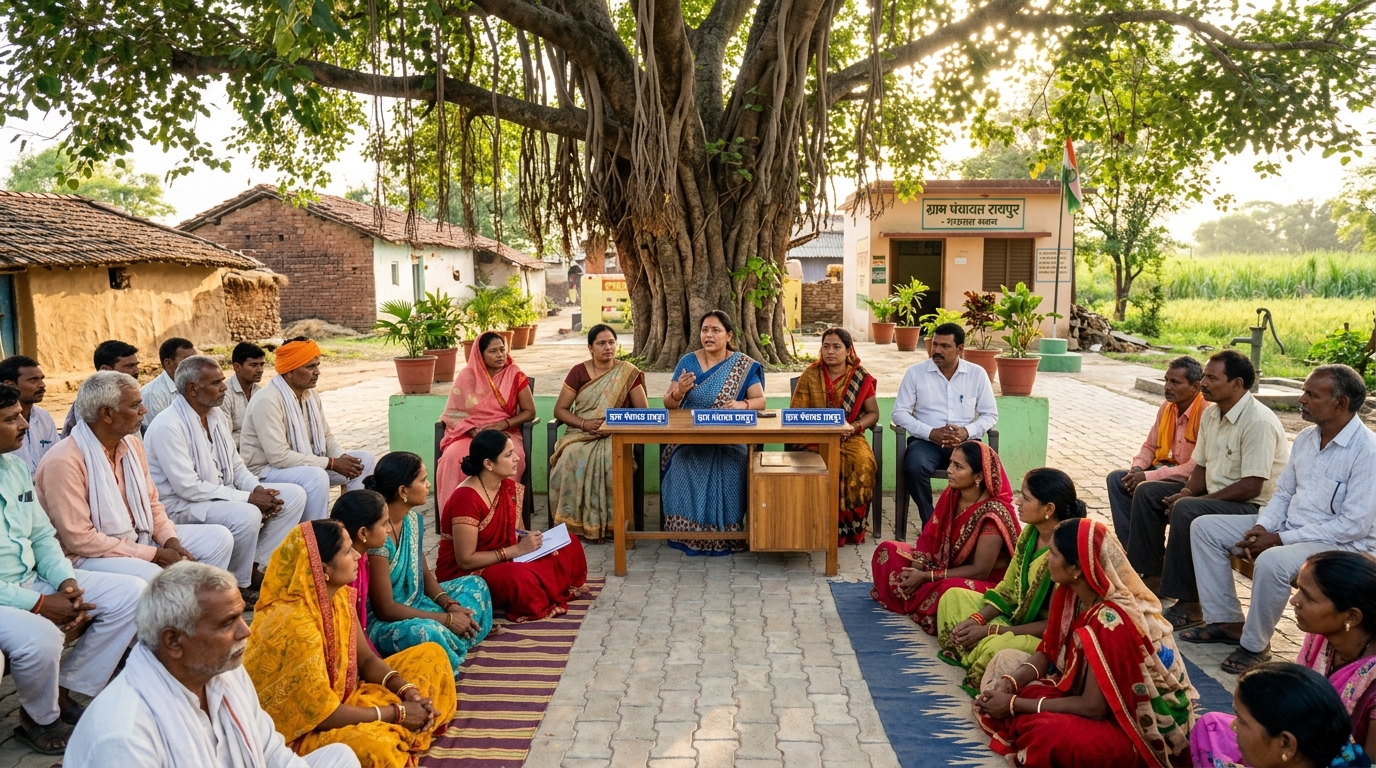
The 73rd and 74th Amendments are among the most transformative constitutional changes in Indian history. Together, they constitutionalised the three-tier system of local self-government, fulfilling the vision of Mahatma Gandhi for village self-governance and the Directive Principles under Article 40. The 73rd Amendment established a uniform structure for Panchayati Raj across India, mandating Gram Sabhas, three-tier Panchayats (village, block, and district levels), direct elections, five-year terms, reservation of seats for Scheduled Castes, Scheduled Tribes, and women (not less than one-third), and State Election Commissions and State Finance Commissions. The 74th Amendment did the same for urban areas, establishing constitutional provisions for municipalities, municipal corporations, and nagar panchayats. The Eleventh Schedule (29 subjects for Panchayats) and Twelfth Schedule (18 subjects for Municipalities) were added to specify the functional domains of these bodies.
The 101st Amendment (2016) – GST Revolution
The 101st Amendment enabled the implementation of the Goods and Services Tax (GST), India's most significant indirect tax reform since independence. The amendment created a concurrent taxing power for the Centre and states through Article 246A, established the GST Council under Article 279A as a joint forum of the Centre and states, and provided for an integrated tax on inter-state supply (IGST). The GST replaced a complex web of central and state indirect taxes — including excise duty, service tax, VAT, Central Sales Tax, entertainment tax, and octroi — with a single unified tax, creating a common national market.
The 106th Amendment (2023) – Women's Reservation
The 106th Amendment, popularly known as the Nari Shakti Vandan Adhiniyam, reserves one-third of all seats in the Lok Sabha and State Legislative Assemblies for women. Within this one-third reservation, sub-reservation is provided for women belonging to Scheduled Castes and Scheduled Tribes. The reservation will come into effect only after a delimitation exercise is conducted based on the first Census undertaken after the commencement of the Act. The reserved seats will be rotated after each delimitation exercise. This amendment was a historic milestone in Indian democracy, as the Women's Reservation Bill had been pending in various forms before Parliament for over 27 years before its eventual passage.
Amendment Procedure – Key Comparison Table
| Feature | Simple Majority | Special Majority | Special Majority + State Ratification |
|---|---|---|---|
| Required Majority | Members present and voting | Total membership + 2/3 present and voting | Same as Special + Half of state legislatures |
| Article Reference | Not under Article 368 | Article 368 | Article 368 |
| Examples | New state creation, boundary changes | Fundamental Rights, DPSPs | Election of President, SC/HC provisions |
The Ninth Schedule and Its Constitutional Significance
The Ninth Schedule holds a unique position in Indian constitutional law and has been the subject of several important amendments. Introduced by the 1st Amendment in 1951, the Ninth Schedule was created to shield certain laws — particularly those related to land reform and zamindari abolition — from judicial review on the grounds that they violated Fundamental Rights. Laws placed in the Ninth Schedule could not be challenged in any court on the basis that they contravened any Fundamental Right.
Over the decades, successive governments used constitutional amendments to add more and more laws to the Ninth Schedule. By 2007, the Ninth Schedule contained 284 Acts. The scope of laws protected expanded far beyond land reform to include reservations, nationalisation of industries, and state-specific legislation. This expansion raised serious constitutional concerns about the potential abuse of the Ninth Schedule to bypass fundamental rights protections.
In the landmark I.R. Coelho v. State of Tamil Nadu case (2007), the Supreme Court held that laws placed in the Ninth Schedule after April 24, 1973 (the date of the Kesavananda Bharati judgment) are subject to judicial review if they violate the basic structure of the Constitution. This judgment significantly curtailed the blanket immunity previously enjoyed by Ninth Schedule laws and restored the balance between parliamentary sovereignty and judicial review.
Schedules Affected by Constitutional Amendments
The Indian Constitution originally had eight schedules. Through various amendments, the number has grown to twelve. Understanding which amendment introduced which schedule is essential for competitive examinations.
| Schedule | Subject | Introduced By |
|---|---|---|
| First Schedule | States and Union Territories | Original Constitution (amended by multiple state reorganisation amendments) |
| Second Schedule | Salaries and emoluments of constitutional functionaries | Original Constitution |
| Third Schedule | Forms of oaths and affirmations | Original Constitution |
| Fourth Schedule | Allocation of Rajya Sabha seats to states and UTs | Original Constitution |
| Fifth Schedule | Administration of Scheduled Areas and Tribal Areas | Original Constitution |
| Sixth Schedule | Administration of tribal areas in Assam, Meghalaya, Tripura, and Mizoram | Original Constitution |
| Seventh Schedule | Union, State, and Concurrent Lists | Original Constitution (modified by 42nd Amendment) |
| Eighth Schedule | Official Languages | Original (modified by 21st and 92nd Amendments) |
| Ninth Schedule | Acts protected from judicial review | 1st Amendment (1951) |
| Tenth Schedule | Anti-Defection provisions | 52nd Amendment (1985) |
| Eleventh Schedule | Powers of Panchayats (29 subjects) | 73rd Amendment (1992) |
| Twelfth Schedule | Powers of Municipalities (18 subjects) | 74th Amendment (1992) |
Amendments Related to Reservation and Social Justice
Reservation in India has been one of the most frequently amended areas of the Constitution, reflecting the ongoing effort to address historical inequalities and ensure proportional representation.
The original Constitution provided for reservation of seats for Scheduled Castes and Scheduled Tribes in the Lok Sabha and State Assemblies for an initial period of 10 years. This reservation has been extended seven times through the 8th (1959), 23rd (1969), 45th (1980), 62nd (1989), 79th (1999), 95th (2009), and 104th (2020) Amendment Acts, with the current extension lasting until January 25, 2030.
The 77th Amendment (1995) added Article 16(4A), allowing the state to make provisions for reservation in promotions for Scheduled Castes and Scheduled Tribes. The 81st Amendment (2000) permitted the carry-forward of unfilled reserved vacancies. The 82nd Amendment (2000) allowed relaxation of qualifying marks for SC/ST candidates. The 85th Amendment (2001) provided for consequential seniority in promotions for SC/ST government employees.
The 103rd Amendment (2019) introduced the Economically Weaker Sections (EWS) reservation, marking the first time that economic criteria alone — without reference to caste — became the basis for constitutional reservation in India. The amendment was challenged before the Supreme Court, which upheld its validity in the Janhit Abhiyan v. Union of India case (2022) by a 3:2 majority, while noting that economic criterion as a standalone basis for affirmative action does not violate the basic structure.
Decade-Wise Trend of Constitutional Amendments
Analysing the frequency and nature of amendments by decade provides valuable insight into the evolving priorities of Indian governance. This analysis is useful for answering analytical questions in examinations.
| Decade | Number of Amendments | Key Themes |
|---|---|---|
| 1950s | 7 | Land reform, state reorganisation, property rights |
| 1960s | 11 | New states (Nagaland, Punjab, Haryana), language inclusion, territorial adjustments |
| 1970s | 16 | Emergency era (38th-42nd), corrective measures (43rd-44th), privy purses abolition |
| 1980s | 9 | Anti-defection law, voting age reduction, Goa statehood |
| 1990s | 11 | Panchayati Raj (73rd-74th), Mandal implementation aftermath, Delhi NCT status |
| 2000s | 14 | Education as right, cooperative societies, OBC commission, language addition |
| 2010s | 8 | GST, NCBC, EWS reservation, India-Bangladesh LBA |
| 2020s (till Aug 2026) | 3 | SC/ST reservation extension, state OBC list power, women's reservation |
The 1970s saw the highest amendment activity due to the political turbulence of the Emergency period and the subsequent corrective measures by the Janata Party government. In contrast, the 2020s have seen fewer but highly significant amendments addressing social representation and federal balance.
The Relationship Between Amendments and Landmark Supreme Court Judgments
Several constitutional amendments have been enacted either in response to or in anticipation of Supreme Court judgments. Understanding this interplay between the legislature and judiciary is crucial for higher-level examinations.
The Golaknath v. State of Punjab (1967) judgment held that Parliament could not amend Fundamental Rights. In response, Parliament passed the 24th Amendment (1971) to explicitly affirm its power to amend any part of the Constitution.
The Kesavananda Bharati v. State of Kerala (1973) case established the Basic Structure Doctrine, setting a permanent limit on Parliament's amending power. The 42nd Amendment (1976) attempted to override this by inserting a clause that "no amendment shall be called in question in any court," but this provision was subsequently struck down by the Supreme Court in Minerva Mills v. Union of India (1980).
The Mandal Commission case (Indra Sawhney v. Union of India, 1992) upheld 27% OBC reservation but imposed a 50% ceiling on total reservation. The 77th Amendment (1995) and subsequent amendments addressed issues of reservation in promotions that arose from this case.
More recently, the Supreme Court's judgment in Maratha reservation case (2021) prompted the 105th Amendment (2021) to restore states' power to identify their own OBC lists.
Important Points for Competitive Examinations
- As of August 2026, the Indian Constitution has been amended 106 times.
- The 1st Amendment (1951) introduced the Ninth Schedule to protect land reform laws from judicial review.
- The 7th Amendment (1956) reorganised states on a linguistic basis.
- The 42nd Amendment (1976) is called the "Mini-Constitution" and added "Socialist," "Secular," and "Integrity" to the Preamble.
- The 42nd Amendment introduced Fundamental Duties (Part IV-A).
- The 44th Amendment (1978) removed the Right to Property from Fundamental Rights.
- The 44th Amendment replaced "internal disturbance" with "armed rebellion" for national emergency.
- Articles 20 and 21 cannot be suspended even during a national emergency (44th Amendment).
- The 52nd Amendment (1985) introduced the Anti-Defection Law (Tenth Schedule).
- The 61st Amendment (1989) reduced the voting age from 21 to 18 years.
- The 73rd Amendment (1992) constitutionalised Panchayati Raj with Part IX and the Eleventh Schedule.
- The 74th Amendment (1992) constitutionalised Municipalities with Part IX-A and the Twelfth Schedule.
- The 86th Amendment (2002) made education a Fundamental Right (Article 21A) for children aged 6-14.
- The 91st Amendment (2003) limited the Council of Ministers to 15% of the House's strength.
- The 92nd Amendment (2003) added Bodo, Dogri, Maithili, and Santhali to the Eighth Schedule, making the total 22 languages.
- The 101st Amendment (2016) introduced GST and established the GST Council.
- The 103rd Amendment (2019) provided 10% EWS reservation.
- The 104th Amendment (2020) extended SC/ST reservation until 2030 and removed Anglo-Indian nomination.
- The 106th Amendment (2023) provides one-third reservation for women in Lok Sabha and State Assemblies.
- The Basic Structure Doctrine (Kesavananda Bharati case, 1973) limits Parliament's amending power.
- The 99th Amendment (NJAC) was struck down by the Supreme Court as violating the Basic Structure.
- The 100th Amendment (2015) implemented the India-Bangladesh Land Boundary Agreement.
Judicial Review and Constitutional Amendments
The evolution of judicial review in relation to constitutional amendments forms one of the most intellectually rich chapters of Indian constitutional law. In the early years of the Republic, in Shankari Prasad v. Union of India (1951) and Sajjan Singh v. State of Rajasthan (1965), the Supreme Court held that Parliament's power to amend the Constitution under Article 368 was absolute and included the power to amend Fundamental Rights.
However, this view underwent a dramatic shift in Golaknath v. State of Punjab (1967), where an eleven-judge bench ruled by a 6:5 majority that Fundamental Rights were transcendental and immutable, thereby declaring that Parliament had no power to abridge or take away any of the Fundamental Rights. To neutralize the impact of Golaknath, Parliament enacted the 24th Amendment (1971), explicitly amending Article 13 and Article 368 to clarify that Parliament possessed the power to amend any part of the Constitution.
The ultimate reconciliation arrived with the landmark 13-judge bench decision in Kesavananda Bharati v. State of Kerala (1973). By a 7:6 majority, the court overruled Golaknath and acknowledged Parliament's power to amend any part of the Constitution, including Fundamental Rights, provided that such amendment did not alter, damage, or destroy the basic structure or essential features of the Constitution. Subsequent judgments, such as Minerva Mills (1980), L. Chandra Kumar (1997), and I.R. Coelho (2007), reaffirmed that judicial review itself is a basic feature of the Constitution, ensuring that no constitutional amendment is entirely beyond the scrutiny of the highest court.
Impact of Constitutional Amendments on Indian Federalism
Federalism in India is often described as quasi-federal, possessing a strong unitarian bias. Constitutional amendments over the past seven decades have played a pivotal role in fine-tuning the distribution of legislative, administrative, and financial powers between the Union and the States.
The 7th Amendment (1956) laid the foundation for linguistic states, reorganizing internal boundaries to align with regional linguistic and cultural identities, thereby strengthening democratic federalism. The 42nd Amendment (1976), enacted during the Emergency, transferred several key subjects—such as education, forests, and administration of justice—from the State List to the Concurrent List, shifting the balance significantly toward central authority.
In contrast, recent amendments have sought a cooperative federal model. The 101st Amendment (2016) created the GST Council, a unique constitutional body embodying cooperative federalism where the Centre and States collectively decide indirect tax policies. Similarly, the 105th Amendment (2021) clarified state powers regarding the identification of Socially and Educationally Backward Classes (SEBCs), restoring state autonomy following judicial interpretations. Understanding these structural shifts is vital for aspirants analyzing the dynamic nature of Indian federal governance.
Conclusion
The 106 constitutional amendments enacted since 1950 reflect the dynamic and adaptive nature of the Indian Constitution. From land reforms and linguistic reorganisation in the early decades to GST implementation and women's reservation in recent years, these amendments have continually reshaped the relationship between the state and its citizens, between the Centre and the states, and between fundamental rights and directive principles. For competitive examination aspirants, mastering this topic requires a systematic approach. Focus on memorising the amendment number, year, and key provision for the 30-35 most important amendments. Understand the amendment procedure under Article 368 and the three categories of amendments. Study the Basic Structure Doctrine and its implications. Pay particular attention to the 42nd, 44th, 73rd, 74th, 86th, 101st, 103rd, and 106th Amendments, as these are the most frequently tested. The comprehensive table and detailed explanations in this article are designed to serve as a one-stop reference for all examination-relevant aspects of constitutional amendments.
For more exam preparation content, notes, and mock tests, join our Telegram channel: https://t.me/rrbcontents (@rrbcontents)