Indian agriculture moves to the rhythm of the monsoon. The arrival, intensity and withdrawal of the rains divide the agricultural year into distinct seasons, each with its own temperature regime, moisture availability and crop calendar.
Table of Contents
Overview
India's 3 Cropping Seasons at a Glance
Monsoon Season (June–Oct)
Rice, Maize, Jowar, Bajra, Cotton, Groundnut, Soybean, Arhar
Winter Season (Oct–April)
Wheat, Barley, Gram, Mustard, Peas, Lentils
Summer Window (April–June)
Watermelon, Muskmelon, Cucumber, Fodder crops, Vegetables
Chapter 1
The Climatic Framework of Indian Cropping Seasons
Indian agriculture moves to the rhythm of the monsoon. The arrival, intensity and withdrawal of the rains divide the agricultural year into distinct seasons, each with its own temperature regime, moisture availability and crop calendar. These seasons—Kharif, Rabi and Zaid—are not arbitrary administrative categories. They reflect the deep adaptation of farming systems to the subcontinent’s climatic pulse. Understanding them requires more than memorising lists of crops. It demands a grasp of the agro-climatic logic that places rice in the deltas, wheat on the northern plains, cotton on the black soils and short-duration vegetables in the hot months between the main harvests.
This article examines the three cropping seasons in detail. It explains the climatic triggers that define each season, the major crops grown, the soil and temperature conditions they require, and their geographical distribution across India. It also considers how irrigation, new varieties and changing rainfall patterns are modifying traditional calendars, and why the subject remains central to questions of food security and rural livelihoods.
The southwest monsoon normally reaches the Kerala coast in early June and covers most of the country by mid-July. It withdraws from the northwest by mid-September and from the southern peninsula by early December. This large-scale seasonal reversal of winds and rainfall creates two primary windows for rain-fed cultivation and a shorter third window that depends on residual moisture or irrigation.
Temperature adds another layer of control. Many crops have specific thermal requirements for germination, vegetative growth, flowering and grain filling. Photoperiod sensitivity further restricts certain varieties to particular seasons. Soil moisture and the ability of different soils to retain or drain water complete the set of constraints. The result is a relatively stable division of the year into Kharif (roughly June–October), Rabi (October–March/April) and Zaid (April–June).
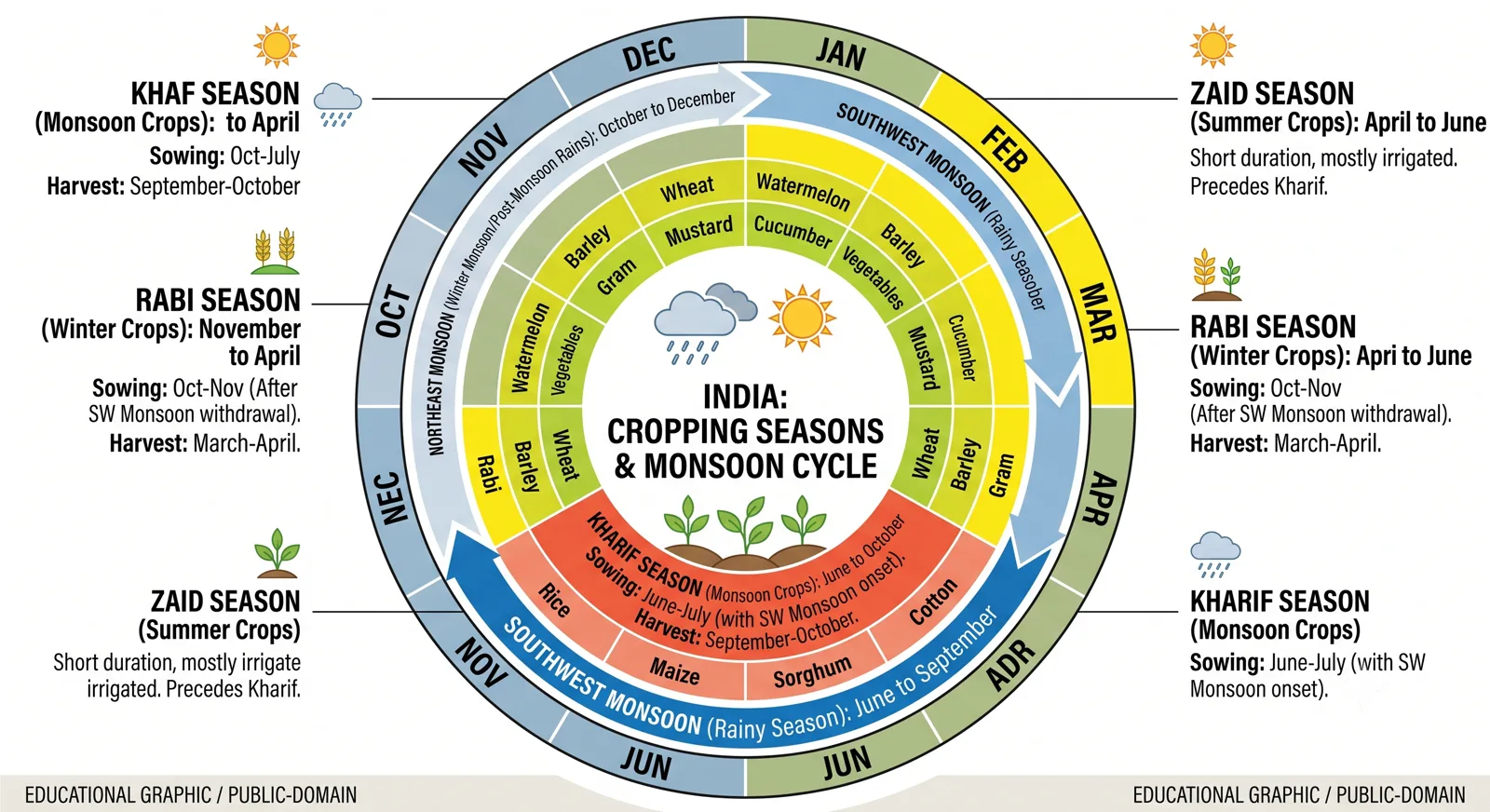
Infographic: India's Cropping Seasons & Monsoon Cycle (Kharif, Rabi & Zaid)
Chapter 2
Kharif Season: The Monsoon Harvest
Kharif crops are sown with the onset of the southwest monsoon and harvested after the rains withdraw. They are often called the summer or monsoon crops. Because they rely heavily on rainfall, their success is closely tied to the timely arrival and adequate spatial distribution of the monsoon.
Rice is the dominant Kharif cereal. It thrives in areas with high temperature, abundant water and alluvial or clayey soils that can hold standing water. The major rice belts include the eastern Gangetic plains, the coastal deltas of the Mahanadi, Godavari, Krishna and Cauvery, the Brahmaputra valley, and the irrigated tracts of Punjab and Haryana. West Bengal, Uttar Pradesh, Punjab, Andhra Pradesh, Telangana, Odisha, Bihar and Assam together account for the bulk of production. Traditional varieties were photoperiod-sensitive and tall; modern semi-dwarf varieties respond to fertiliser and can be grown in a wider range of water regimes, including under controlled irrigation.
Maize has expanded rapidly as a Kharif crop, especially in peninsular and central India. It tolerates a wider range of soils than rice but still requires moderate to high rainfall or irrigation during its growth period. Karnataka, Madhya Pradesh, Maharashtra, Andhra Pradesh, Telangana and Bihar are important producers. Coarse cereals such as jowar (sorghum), bajra (pearl millet) and ragi (finger millet) remain vital in the low-rainfall tracts of Rajasthan, Maharashtra, Karnataka and Andhra Pradesh. These crops are hardy, adapted to high temperatures and intermittent moisture, and continue to support food and fodder security in dryland regions.
Cotton is a major industrial Kharif crop. It needs a long frost-free period, moderate rainfall (or irrigation) and prefers the black cotton soils of the Deccan and the alluvial soils of Gujarat and Punjab. Maharashtra, Gujarat, Telangana, Andhra Pradesh, Haryana and Rajasthan are the principal growing states. The introduction of Bt hybrids transformed yields and pest management, though debates about seed costs and resistance management continue.
Other significant Kharif crops include groundnut (Gujarat, Andhra Pradesh, Tamil Nadu, Rajasthan, Karnataka), soybean (Madhya Pradesh, Maharashtra, Rajasthan), sugarcane (which occupies the field for more than one season but is often planted in Kharif), and a range of pulses such as arhar (tur), urad and moong.
The geographical pattern of Kharif cultivation closely follows the isohyets and the distribution of irrigation. Where monsoon rainfall is reliable and soils are heavy, rice dominates. Where rainfall is lower and soils are lighter or black, millets, cotton and oilseeds become more prominent.
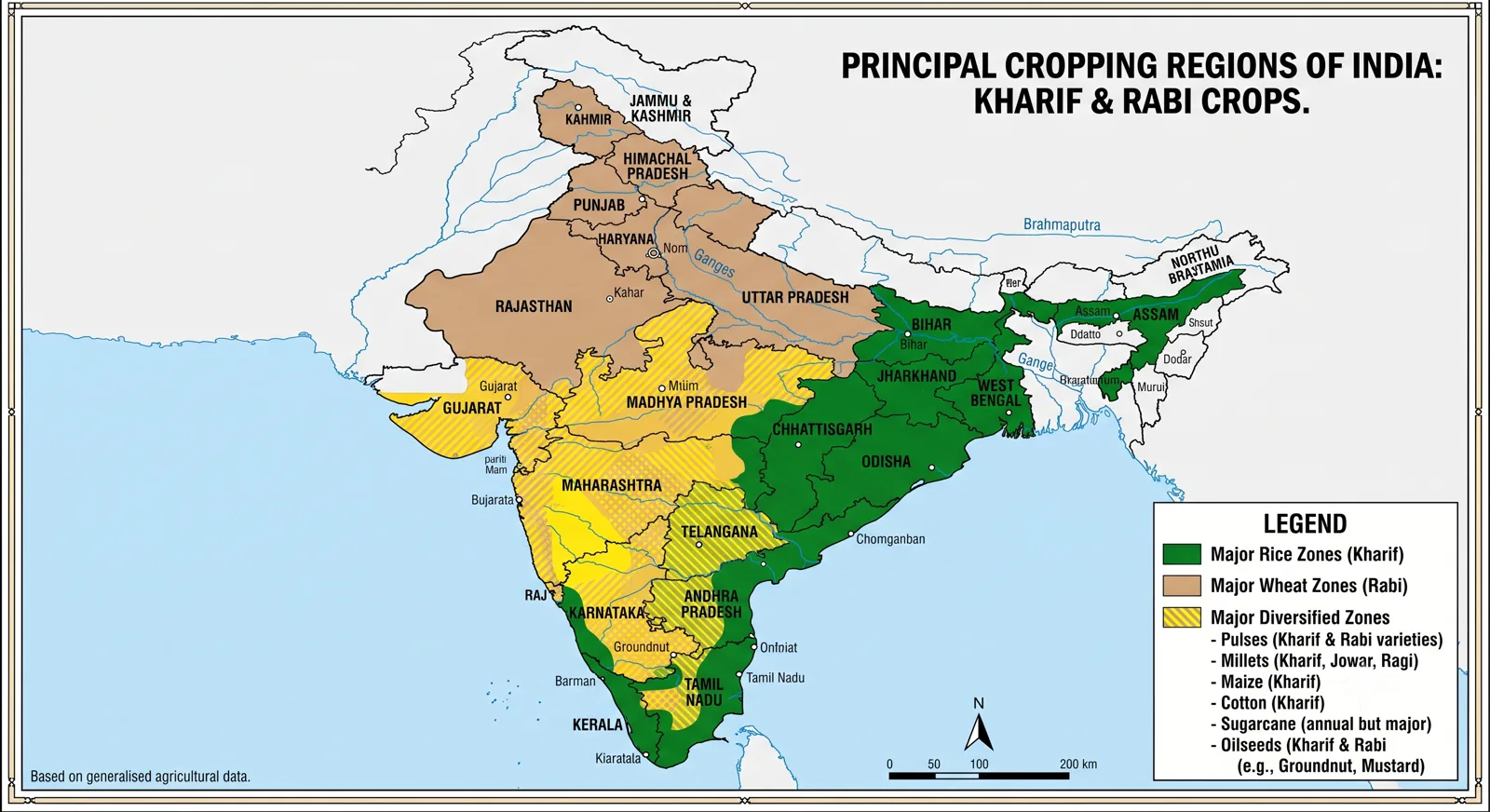
Map: Principal Cropping Regions of India — Major Rice Zones (Kharif) & Major Wheat Zones (Rabi)
Chapter 3
Rabi Season: The Winter Crop
Rabi crops are sown after the monsoon rains have receded and the land has been prepared, usually from October onwards. They grow through the cool winter months and are harvested in spring (March–April). In northern India the western disturbances bring light winter rain that is particularly beneficial for wheat and other Rabi crops. Elsewhere, irrigation is often decisive.
Wheat is the principal Rabi cereal and the foundation of food security in northern and northwestern India. It requires cool temperatures during the growing period, bright sunshine at maturity, and moderate water supply. The ideal soil is well-drained alluvial loam. The Indo-Gangetic plains—Punjab, Haryana, Uttar Pradesh, Bihar and Rajasthan—form the core wheat belt. Madhya Pradesh has emerged as a major producer in recent decades through the expansion of irrigation and suitable varieties. The Green Revolution package of high-yielding varieties, fertiliser and controlled water was applied most successfully to wheat, transforming India from a food-deficit to a surplus nation in this crop.
Barley is grown in similar but often more marginal conditions, especially in Rajasthan and Uttar Pradesh. Gram (chickpea) is the most important Rabi pulse; it is cultivated across Madhya Pradesh, Rajasthan, Maharashtra, Uttar Pradesh and Andhra Pradesh. Mustard and rapeseed are the leading Rabi oilseeds, with Rajasthan, Haryana, Madhya Pradesh and Uttar Pradesh as major producers. Their yellow flowers form a distinctive landscape feature of the northern plains in winter. Other Rabi crops include peas, lentils (masur) and a range of spices and vegetables.
Because Rabi crops grow in the drier part of the year, their area and productivity are strongly influenced by the availability of irrigation. Canal and groundwater irrigation have allowed the wheat–rice double cropping system to expand across large parts of the northern plains, creating both impressive production gains and serious concerns about groundwater depletion and soil health.
Supercharge Your Exam Preparation
Get exclusive study materials, daily quizzes, and expert guidance directly on Telegram. Join thousands of successful aspirants today!
Join @RRBCONTENTS on TelegramChapter 4
Zaid Season: The Short Summer Window
Zaid is the short season between the harvest of Rabi and the sowing of Kharif, roughly April to June. It is possible only where residual soil moisture remains or where irrigation is available. Temperatures are high, so crops must be heat-tolerant and short-duration.
Typical Zaid crops include watermelon, muskmelon, cucumber, bitter gourd and other vegetables, as well as fodder crops and some pulses such as summer moong. In parts of the northern plains and irrigated southern tracts these crops provide important additional income and nutritional diversity. The season is limited in areal extent compared with Kharif and Rabi, yet it has grown in significance with the expansion of tube-well irrigation and the demand for fresh produce in urban markets.
Chapter 5
Comparative Overview & Contemporary Challenges
Comparative Overview of the Three Seasons
Kharif is rainfall-dependent, warm and humid, and dominated by rice, coarse cereals, cotton and oilseeds. Rabi is cooler, largely irrigated in its most productive zones, and dominated by wheat, gram and mustard. Zaid is hot, short and irrigation- or residual-moisture-dependent, focused on vegetables and quick-maturing pulses. The three seasons together allow the possibility of multiple cropping where water and labour permit. The wheat–rice system of the northwest and the rice–rice systems of the southern deltas are the most intensive expressions of this possibility.
Soil preferences also differ. Rice favours soils that can be puddled and retain water. Wheat prefers well-drained loams. Cotton performs best on moisture-retentive black soils. Millets tolerate poorer, lighter soils. These preferences reinforce the regional specialisation already shaped by climate.
Changing Patterns and Contemporary Challenges
Several forces are altering the traditional calendars. Expansion of irrigation has reduced dependence on the exact timing of the monsoon for many farmers, yet it has also created new vulnerabilities—power shortages, groundwater decline and rising costs. New short-duration and photo-insensitive varieties have increased flexibility in sowing dates. Climate change is introducing greater variability in monsoon onset and rainfall intensity, as well as higher temperatures that can stress Rabi crops during grain filling.
Crop diversification is being actively promoted to reduce the environmental pressure of continuous rice–wheat cropping and to improve nutritional outcomes. Coarse cereals, pulses and oilseeds are receiving renewed policy attention. At the same time, market demand, minimum support prices and procurement systems continue to favour the dominant cereals in many regions.
Chapter 6
Exam Relevance & Closing Perspective
Exam Relevance
Cropping seasons and major crops form a staple of both the geography and the Indian economy sections of competitive examinations. Prelims questions frequently test which crops belong to which season, the leading producing states, or the climatic conditions required by a particular crop. Mains questions may ask for a comparison of Kharif and Rabi agriculture, an analysis of the factors behind the concentration of wheat or rice production, or a discussion of the sustainability of current cropping patterns. Answers that combine climatic explanation with distributional facts and a sense of contemporary change perform best. Map-based questions on crop distribution remain common and reward precise regional knowledge.
Closing Perspective
The division of the Indian agricultural year into Kharif, Rabi and Zaid is a practical response to the monsoon climate. Each season exploits a different combination of temperature and moisture, and each supports a characteristic set of crops that have shaped regional diets, economies and landscapes. As irrigation, plant breeding and market forces continue to modify these patterns, the underlying climatic logic remains. For policymakers and farmers alike, the challenge is to work with that logic rather than against it—sustaining productivity while protecting the soil and water resources on which the entire system rests. For the student of geography and economy, the cropping seasons offer a clear demonstration of how climate, soil and human decision-making interact to produce the agricultural geography of India.
Chapter 7
Cropping Seasons of India — Frequently Asked Questions
What is the main difference between Kharif and Rabi seasons?
Which are the major Kharif crops of India?
Why is wheat concentrated in northern and northwestern India?
What is the Zaid season and which crops are grown in it?
Kharif Rain, Rabi Irrigation, Zaid Gap
Season questions are crop-plus-month pairs. A full mock will mix rice, wheat and zaid watermelon with other GS; previous-year papers show the usual traps.
Start Free Mock Tests →Continue on RRBCONTENTS
Explore More
Knowledge Hub
More Blog Articles
In-depth, exam-focused articles on Indian geography, agriculture, monuments and static GK.
Study Material
Exam Study Notes
Subject-wise notes and digests for Railway, SSC, Banking and State PSC exams.
Current Affairs
Daily Current Affairs & GK
Daily updates and a 70-day static GK bank with active-recall quizzes.
"Indian agriculture moves to the rhythm of the monsoon. The arrival, intensity and withdrawal of the rains divide the agricultural year into distinct seasons."
For the student of geography and economy, the cropping seasons offer a clear demonstration of how climate, soil and human decision-making interact to produce the agricultural geography of India.