 RRB
RRB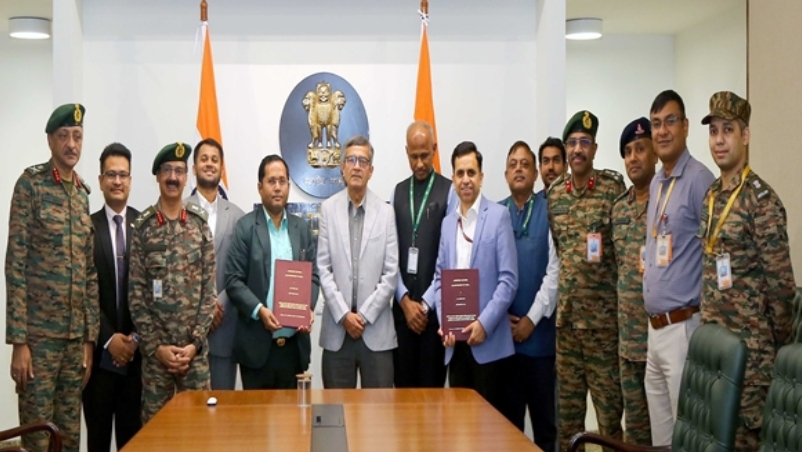
The Ministry of Defence has finalised contracts worth around ₹1,577 crore with Tata Advanced Systems Limited and NIBE Private Limited for advanced loiter munition systems meant for the Indian Army. The deals were signed under the fast-track procedure and cover the munitions themselves along with the necessary accessories and support packages.
Loiter munitions are often described as kamikaze drones or suicide drones in common conversation. In practical terms, they are designed to stay airborne over a target area for a useful period of time, identify the objective, and then dive onto it carrying a warhead. They combine the ability to watch an area like a reconnaissance drone with the capacity to strike like a precision missile. In several recent conflicts, these systems have shown their value against armoured vehicles, artillery positions and other high-value targets while keeping the operators at a safer distance. The choice of the fast-track route reflects a clear requirement from the Army for quicker induction of modern tools. Standard defence procurement can take years from the initial request to actual delivery. The fast-track process allows the forces to bring in urgently needed equipment in a shorter time while still following the required financial and technical checks. Officials familiar with the process say this balance between speed and accountability has become more important as the nature of warfare continues to change.
Tata Advanced Systems and NIBE will deliver systems designed to meet the specific operational needs of the Indian Army. Both companies have been steadily expanding their work in the unmanned systems and precision munitions space. This fits into the larger national effort to build more defence equipment inside the country. The contracts are expected to create work for Indian engineers, technicians and a range of suppliers further down the chain.
This particular procurement sits within a wider pattern of recent acquisitions. Over the last few years the government has repeatedly underlined the need for greater self-reliance in critical weapon systems. Domestic work on drones, loiter munitions, artillery and electronic warfare equipment has received consistent attention. The aim is to reduce dependence on long foreign supply lines and to give the armed forces systems that can be maintained and upgraded more easily at home.
Defence officials point out several practical advantages that loiter munitions offer in the Indian context. They can be launched from relatively simple platforms. Their logistics footprint is smaller than that of manned aircraft. Commanders can engage targets with a higher degree of precision. In mountainous and high-altitude areas, where flying conventional aircraft becomes more difficult, these systems provide an additional and flexible option. The contracts also highlight the growing space for private companies in India’s defence sector. For a long time the field was dominated by public sector undertakings. Policy changes over recent years have allowed private firms to take on more substantial roles in design, development and production. Tata Advanced Systems has already built a presence in aerospace and defence electronics. NIBE has focused on specialised munitions and related technologies. The current deals show that both are moving further into operational systems for the Army.
Once the systems arrive, the Army will need to train operators, integrate the platforms with existing command-and-control networks, and develop tactics that suit Indian conditions. Delivery is expected to follow the schedule laid down in the contracts. More precise details on quantities and timelines are likely to become available as the systems move closer to induction.
The signing comes at a time when several other modernisation efforts are also under way. These include upgrades to artillery, improvements in air defence, and the continued development of indigenous missiles and unmanned systems. Taken together, they form part of a longer effort to prepare the armed forces for a wider range of situations along the borders and beyond.
The financial value of ₹1,577 crore is substantial. The real measure of the deal, however, will be the capability these systems bring once they are in service. Precision, the ability to stay over an area for longer, and reduced risk to soldiers are the main strengths they add. How well they perform in training and, later, in operational conditions will decide how large a role they play in future force planning.
For the moment, the contracts represent another concrete step towards equipping the Indian Army with modern systems that are supported by domestic industry and delivered through a faster process. The coming months will show how smoothly the induction proceeds and how quickly the new capability becomes part of regular operations.