Home › Blog › Delhi Laxmi Yojana: Understanding the ₹2,500 Women’s Financial Assistance Scheme, Rules, and Recent Political Controversy
Delhi Laxmi Yojana: Understanding the ₹2,500 Women’s Financial Assistance Scheme, Rules, and Recent Political Controversy
Direct Benefit Transfer (DBT) cash assistance schemes aimed at women have emerged as central pillars of state-level social welfare and electoral discourse across India. In the National Capital Territory of Delhi, the flagship welfare initiative—officially designated as the Delhi Lakshmi Yojana (commonly referred to as Delhi Laxmi Yojana) and formerly drafted under the banner of the Mahila Samriddhi Yojana—promises a direct monthly payout of ₹2,500 to eligible resident women.
With a dedicated allocation of ₹5,110 crore in the Delhi State Budget presented by Chief Minister and Finance Minister Rekha Gupta, the scheme aims to provide direct income support to an estimated 1.5 million socio-economically vulnerable women.
However, as the application portal nears its scheduled launch, the scheme has become embroiled in intense political and ideological debate. The controversy centers on newly approved Cabinet exclusion criteria—specifically a three-child restriction clause, a family criminal record bar, and a single-beneficiary per household cap.
This comprehensive, fact-verified analysis provides an in-depth breakdown of the Delhi Laxmi Yojana, its administrative framework, eligibility and exclusion rules, its financial execution, and a detailed examination of the recent political clash between major political parties.
1. What is Delhi Laxmi Yojana? Objectives, Budget, and Operational Architecture
The Delhi Laxmi Yojana is a state-level social security initiative designed to deliver direct monetary assistance to economically disadvantaged women residing within the NCT of Delhi.
| DELHI LAXMI YOJANA AT A GLANCE | |
|---|---|
| Monthly Financial Payout | ₹2,500 per month (₹30,000 annually) |
| Target Demographic | Resident women aged 21 to 60 years |
| Total State Budget Allocation | ₹5,110 Crore |
| Disbursement Mechanisms | Direct Benefit Transfer (DBT), CBDC, or Fixed Deposit (FD) / RD options |
| Beneficiary Cap | Restricted to the eldest eligible woman per qualifying household |
A. Core Objectives and Welfare Mandate
The primary objective of the Delhi Laxmi Yojana is to enhance household financial independence, reduce gender-based economic vulnerability, and assist low-income families in meeting daily living expenses. During the budget presentation, the government highlighted that direct cash transfers into bank accounts owned solely by women lead to improved household nutritional security, higher educational retention for children, and greater female financial autonomy.
B. Payment Flexibility and Digital Currency Integration
Unlike traditional welfare schemes that rely strictly on standard commercial bank transfers, the Delhi Laxmi Yojana incorporates innovative disbursement choices:
- Direct Benefit Transfer (DBT): Direct credit into Aadhaar-seeded savings bank accounts.
- Central Bank Digital Currency (CBDC): Digital Rupee e-wallets issued by the Reserve Bank of India (RBI) to enable instant, fee-free digital transactions.
- Fixed Deposit (FD) / Recurring Deposit (RD) Options: Beneficiaries can elect to automatically divert a portion of their monthly ₹2,500 payout into high-yield state bank deposits to build long-term savings.
2. Eligibility Criteria: Who Qualifies for the ₹2,500 Monthly Aid?
To ensure that financial resources reach genuine, economically vulnerable households without overextending the state exchequer, the Delhi Cabinet established strict qualification parameters.
Applicant Eligibility Key Metrics
• Ten-Year Residency Mandate: Continuous residence in NCT of Delhi for at least 10 years.
• Age Bracket: Women aged 21 to 60 years.
• Income Cap: Annual family income ≤ ₹2.5 Lakhs.
• Eldest Female Rule: Only the eldest eligible woman per household qualifies.

3. The Exclusion Clauses: Who Is Barred From Delhi Laxmi Yojana?
While the scheme promises wide coverage across Delhi's 1.55 million ration card-holding demographic, the cabinet finalized several restrictive exclusions that filter out a significant portion of applicants.
| Exclusion Category | Mandatory Ineligibility Rule |
|---|---|
| Family Size Restriction | Mothers with more than 3 living children are strictly barred. |
| Criminal Record Bar | Families with any member facing active criminal records or convictions. |
| Asset & Consumption Limits | Families owning a 4-wheeled vehicle or consuming >2,400 electricity units/yr. |
| Tax & Business Limits | Families filing Income Tax Returns or registered under GST frameworks. |
| Institutional Employment | Families with members employed in Central/State Govt, PSUs, or Local ULBs. |
| Pension Overlap | Women receiving state/central old-age, widow, or disability pensions. |
4. The Recent Controversy: Decoding the Political and Ideological Clash
The announcement of the eligibility rules for the Delhi Laxmi Yojana triggered an immediate political debate across the National Capital Territory. The controversy revolves around three main issues: the ideological clash over the three-child exclusion rule, political arguments over implementation delays, and structural debates regarding criminal record exclusions.
Flashpoint 1: The Three-Child Rule vs. Demographic Calls
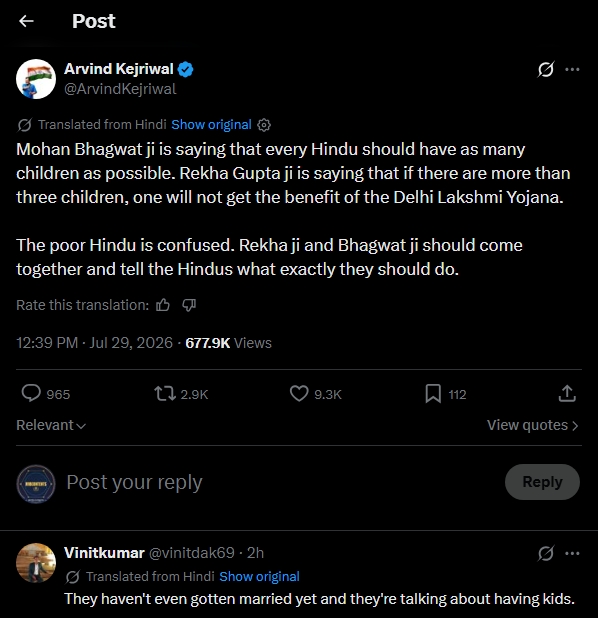
The most intense political argument emerged over the rule excluding women with more than three children. Opposition leader Arvind Kejriwal publicly highlighted what he described as an ideological contradiction with RSS Chief Mohan Bhagwat's early-2026 remarks in Lucknow encouraging larger Hindu family sizes, posting: "Hindus are confused. Rekha ji and Bhagwat ji should together tell people what Hindus are supposed to do."
Flashpoint 2: Implementation Delays Following Election Promises
Nearly six months elapsed between the formation of the new state government and the finalization of the eligibility framework in July 2026, drawing criticism from opposition parties regarding cash flow management.
Flashpoint 3: CAG Audit Legacy
A historical CAG audit of the previous Delhi Ladli Scheme revealed ₹618.4 crore unspent and a 69% enrollment drop, which the present government cited to justify stringent online Aadhaar-DBT verification.
5. Comparative Matrix: Delhi Laxmi Yojana vs. Major State Cash Transfer Schemes
| Feature / Metric | Delhi Laxmi Yojana (Delhi) | Ladli Behna Yojana (MP) | Gruha Lakshmi (Karnataka) | Subhadra Yojana (Odisha) |
|---|---|---|---|---|
| Monthly Payout | ₹2,500 / month | ₹1,250 / month | ₹2,000 / month | ~₹833 / month |
| Age Eligibility | 21 to 60 Years | 21 to 60 Years | 18+ Years | 21 to 60 Years |
| Household Cap | Only Eldest Woman | Multiple Allowed | Female Head | One per Family |
| Income Limit | Up to ₹2.5 Lakhs | Up to ₹2.5 Lakhs | Non-Taxpaying | Up to ₹2.5 Lakhs |
| Child Count Cap | Max 3 Living Children | No Child Limit | No Child Limit | No Child Limit |
6. Step-by-Step Application and Verification Workflow
For eligible women seeking to enroll in the Delhi Laxmi Yojana once the official portal opens on August 1, 2026, the state government outlined a digital application process handled through the e-District and WCD portals.

Key Takeaways
The Core Benefit: Provides ₹2,500/month (₹30,000/year) directly to eligible resident women in Delhi.
Single-Beneficiary Cap: Restricted to the eldest eligible woman aged 21–60 in qualifying households.
Strict Exclusions: >3 living children, 4-wheeler ownership, >2,400 electricity units/yr, income taxpayers, and family criminal records disqualified.
Stay Updated & Excel in Your Preparations
Track latest policy updates, current affairs, and comprehensive study materials on RRBCONTENTS.
Latest News Portal → Daily Current Affairs →Join our official Telegram channel for instant updates: @rrbcontents