Between 1206 and 1526 the Sultanate experimented with different models of centralisation, revenue extraction and cultural synthesis — shaping later Mughal practice and the social landscape that Indian society still carries.
Table of Contents
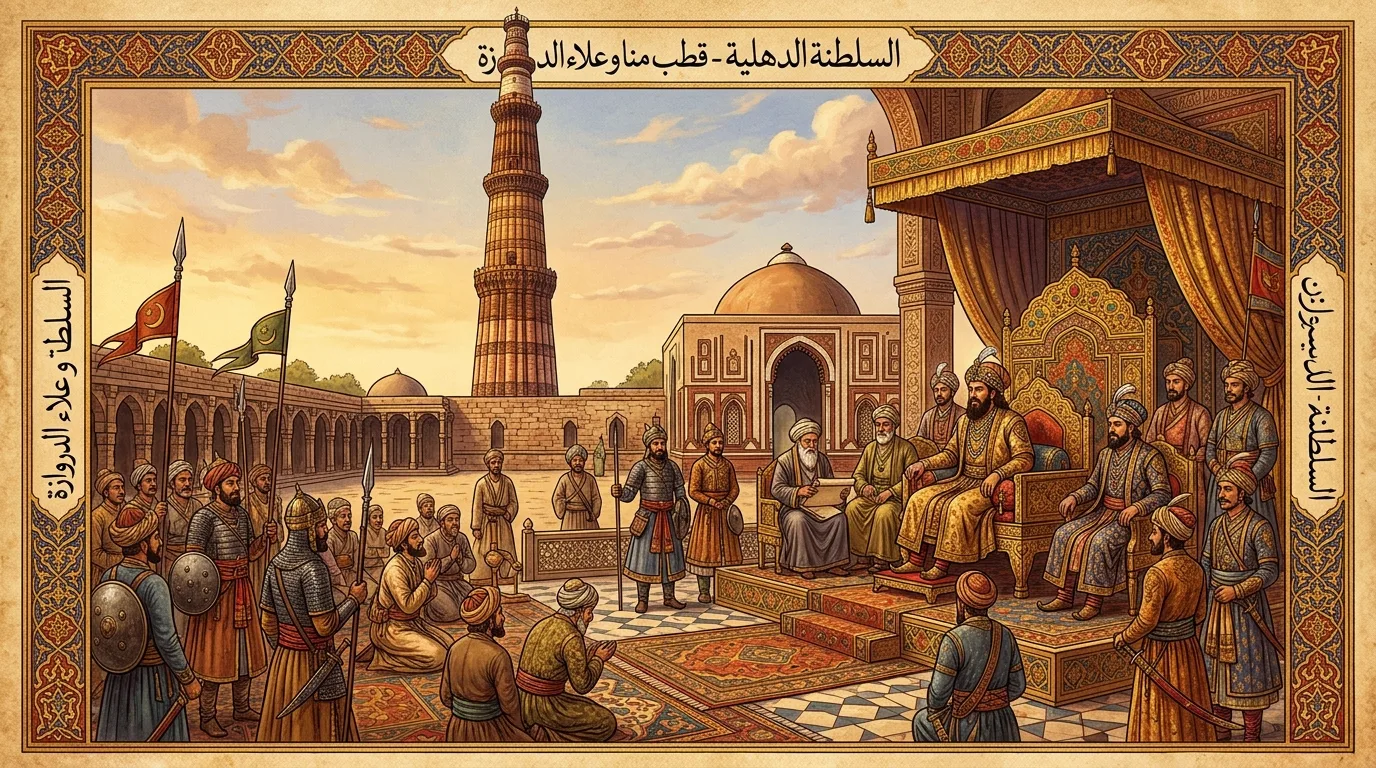
A grand historical illustration of the Delhi Sultanate era showing the Qutub Minar, Islamic architecture, and a royal court scene with a Sultan on a throne surrounded by nobles
The political history of medieval North India is often reduced to a list of sultans and battles. That approach leaves aspirants with half the picture. The real value of the Delhi Sultanate for competitive examinations lies in understanding how five successive dynasties organised power, extracted resources, and left lasting cultural marks on the subcontinent. Between 1206 and 1526 the Sultanate experimented with different models of centralisation, revenue extraction and cultural synthesis. Some experiments succeeded, some collapsed spectacularly, and almost all of them shaped later Mughal practice and the social landscape that Indian society still carries.
This article examines the administration, economy and cultural impact of the Slave (Mamluk), Khalji, Tughlaq, Sayyid and Lodi dynasties in comparative perspective. The focus remains firmly on structures, processes and consequences rather than chronological narrative alone.
Chapter 1
Setting the Political Stage
The Delhi Sultanate did not emerge as a fully formed state in 1206. Qutb-ud-din Aibak inherited a military occupation rather than a settled administration. The early decades were spent converting a network of Turkish slave commanders and local collaborators into something resembling a government. Each later dynasty inherited institutions from its predecessor and modified them according to its own military and fiscal needs. The result is a long experiment in Indo-Islamic statecraft whose failures are as instructive as its successes.
For examination purposes the topic appears under medieval Indian history, polity and culture. Questions frequently test comparative understanding: differences in the iqta system across dynasties, Alauddin Khalji’s market regulations, Muhammad bin Tughlaq’s administrative experiments, or the shift from Turkish to Afghan political culture under the Lodis. A clear comparative framework therefore serves aspirants better than isolated dynasty-wise notes.
Chapter 2
Administrative Framework Across the Dynasties
The core administrative challenge remained constant: how to control a large territory with a relatively small group of Turkish or Afghan military elites while extracting enough surplus to maintain a standing army. Solutions varied significantly.
Slave Dynasty (1206–1290)
Iltutmish is the real architect of the early Sultanate administration. He regularised the iqta system by making land assignments temporary and transferable, thereby preventing the growth of hereditary local power. The chihalgani, or group of forty, formed an informal council of Turkish nobles that both supported and constrained the sultan. Balban later broke the power of this group and emphasised the divine nature of kingship through elaborate court ceremonies and a strict hierarchy. The spy system (barid) was strengthened under him to keep provincial governors under watch. The administrative language remained Persian, and the ruling elite stayed predominantly Turkish. Local Hindu intermediaries continued to collect land revenue in many areas, a practical necessity that the early sultans never fully overcame.
Khalji Dynasty (1290–1320)
Alauddin Khalji introduced a sharper degree of centralisation. He reduced the size of individual iqtas, paid many soldiers in cash rather than land assignments, and kept detailed registers of the army (huliya and dagh). Provincial governors were kept on a tight leash; any sign of independence invited swift military response. The revenue department was expanded and the assessment of cultivated land became more systematic in the Doab region. Alauddin’s administration was highly personalised around the sultan’s will. After his death the structure weakened rapidly because it depended so heavily on one man’s energy and ruthlessness.
Tughlaq Dynasty (1320–1414)
Ghiyasuddin Tughlaq restored a measure of balance after the Khalji excesses. Muhammad bin Tughlaq, however, attempted the most ambitious administrative experiments of the entire Sultanate period. The transfer of the capital to Daulatabad, the token currency experiment, and the planned expansion into Khurasan all required an unusually centralised and ambitious bureaucracy. Most of these experiments failed, but they reveal an attempt to treat the entire subcontinent as a single administrative unit. Firoz Shah Tughlaq moved in the opposite direction. He made iqtas hereditary in practice, created new departments for public works and charity, and gave greater autonomy to provincial officers. The result was a more stable but less dynamic administration that slowly lost control over distant provinces.
Sayyid Dynasty (1414–1451)
The Sayyids ruled a truncated Sultanate. Their administration was largely a continuation of late Tughlaq practices on a smaller scale. Real power often rested with local governors and Afghan nobles. The centre’s ability to appoint and transfer officers declined sharply. The period is useful for examining what happens when the coercive and fiscal capacity of the centre collapses.
Lodi Dynasty (1451–1526)
The Lodis were Afghans and brought a different political culture. Bahlul Lodi treated the Afghan nobles as partners rather than servants. The concept of the sultan as first among equals replaced the more absolute Turkish model. Sikandar Lodi restored some central control and shifted the capital to Agra for better supervision of the Doab. Ibrahim Lodi’s attempt to reassert absolute authority against the Afghan nobles created the internal divisions that Babur later exploited. Administratively the Lodis relied more on tribal and clan loyalties than on the impersonal bureaucratic mechanisms favoured by the Khaljis and early Tughlaqs.
Comparative Table: Key Administrative Features
| Feature | Slave Dynasty | Khalji Dynasty | Tughlaq Dynasty | Sayyid Dynasty | Lodi Dynasty |
|---|---|---|---|---|---|
| Nature of kingship | Evolving, Balban’s divine theory | Highly absolutist | Experimental then conservative | Weak, nominal | First among equals (Afghan) |
| Iqta system | Regularised by Iltutmish | Reduced size, cash salaries | Hereditary under Firoz | Weak control | Clan-based assignments |
| Army organisation | Nobles’ contingents | Standing army, branding | Large but poorly controlled | Fragmented | Tribal levies |
| Provincial control | Through transferable iqtas | Strict supervision | Ambitious then loose | Minimal | Shared with Afghan chiefs |
| Intelligence system | Strengthened by Balban | Effective under Alauddin | Present but uneven | Weak | Limited |
This table highlights the pendulum movement between centralisation and decentralisation that characterises the entire period.
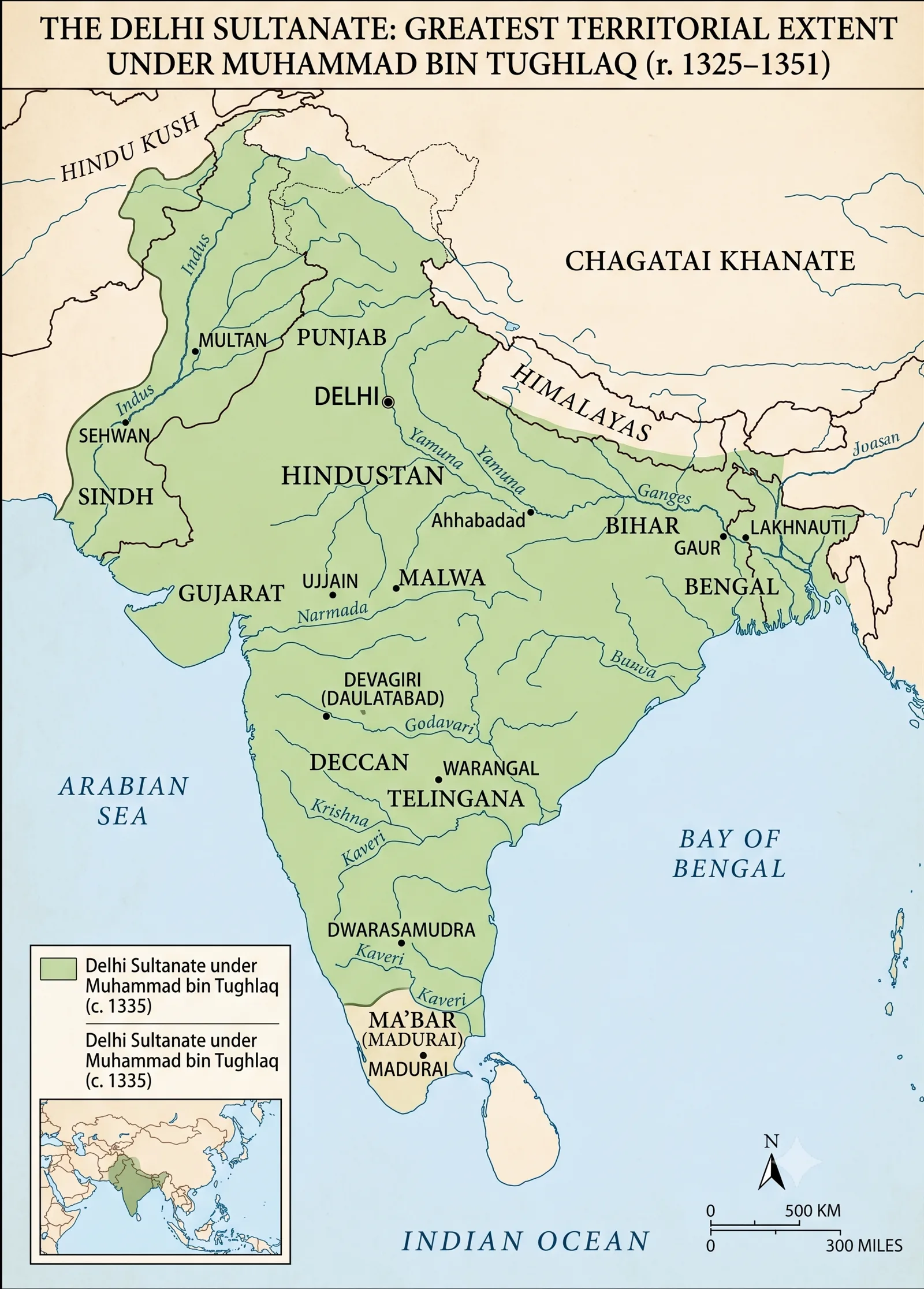
Map showing the greatest territorial extent of the Delhi Sultanate under Muhammad bin Tughlaq (r. 1325-1351) spanning from the Himalayas to the deep south
Chapter 3
Economic Organisation and Revenue Systems
Agriculture remained the foundation of the Sultanate economy. The primary fiscal instrument was the land tax, usually claimed as a share of produce. The exact share and the method of assessment changed with political needs.
Under the early Slave sultans the revenue demand was often left to local Hindu chiefs and intermediaries. Iltutmish and Balban tried to increase the state’s direct share, but the administrative machinery was still limited. Alauddin Khalji carried out the most thorough revenue reforms. In the fertile Doab he measured land, fixed the state’s share at 50 per cent of the produce, and collected it largely in kind. He also regulated prices of essential commodities in Delhi so that the large standing army could be maintained on relatively modest cash salaries. These market controls were an extraordinary exercise in state intervention and remain one of the most frequently examined topics in the economic history of the period.
Muhammad bin Tughlaq attempted to raise revenue in the Doab to finance his ambitious projects. The increase coincided with famine and produced widespread revolt. Firoz Shah Tughlaq lowered the demand, abolished some irregular taxes, and invested in canals and gardens that expanded cultivation in parts of the Punjab and Haryana. His public works had a clear economic rationale: improved irrigation increased the taxable surplus over the long term.
Trade, both internal and external, flourished at different points. The Khalji and early Tughlaq periods saw expansion of overland trade with Central Asia and maritime contacts through Gujarat and Bengal ports. The state taxed trade but also provided a degree of security along major routes when the centre was strong. Urban centres such as Delhi, Multan, Lahore and later Jaunpur and Agra grew as administrative and commercial hubs. Craft production, especially textiles, metalwork and construction materials, expanded to meet the demands of the court, the army and the urban population.
The later Sayyid and Lodi periods witnessed economic contraction in the core regions around Delhi because of political instability, though regional economies in Gujarat, Bengal and the Deccan continued to develop outside effective Sultanate control.
Chapter 4
Cultural and Social Impact
The cultural impact of the Delhi Sultanate is best understood as a process of interaction rather than simple imposition. Persian became the language of administration and high culture. A new architectural vocabulary emerged that combined Islamic forms with local building techniques and decorative motifs. The Qutb complex in Delhi, begun under Aibak and Iltutmish, set the template. Alauddin’s Alai Darwaza and the extensions to the Qutb Minar show greater confidence and scale. The Tughlaqs preferred massive, sloping walls and fortresses such as Tughlaqabad and the forts at Hisar and Jaunpur. Lodi architecture is more refined and includes the beautiful garden tombs that influenced later Mughal garden design.
Literature in Persian flourished. Historians such as Minhaj-us-Siraj, Ziauddin Barani and later Yahya bin Ahmad Sirhindi produced works that remain primary sources. Poetry, both religious and secular, found patronage. At the same time, the period saw the early growth of vernacular literature in different regions, partly stimulated by the new political and cultural environment.
Religious life was marked by the expansion of Sufi orders. The Chishti and Suhrawardi silsilas established networks of hospices that became centres of social welfare and cultural exchange. While the sultans varied in their personal orthodoxy, the overall atmosphere allowed considerable interaction between Muslim mystics and the local population. The Bhakti movement in North India also gained momentum during these centuries, creating parallel spaces of devotion that sometimes overlapped with Sufi practices.
Socially the Sultanate created new elite groups of Turkish, Khalji, Tughlaq and later Afghan origin. At the same time it incorporated sections of the existing Hindu aristocracy as intermediaries and, in some cases, as military allies. The result was a layered society in which religious identity mattered, yet political and economic roles often cut across simple communal lines. The position of women in the ruling elite is illustrated by the brief reign of Razia and by the influence of royal women in several courts, though the general patriarchal framework remained strong.
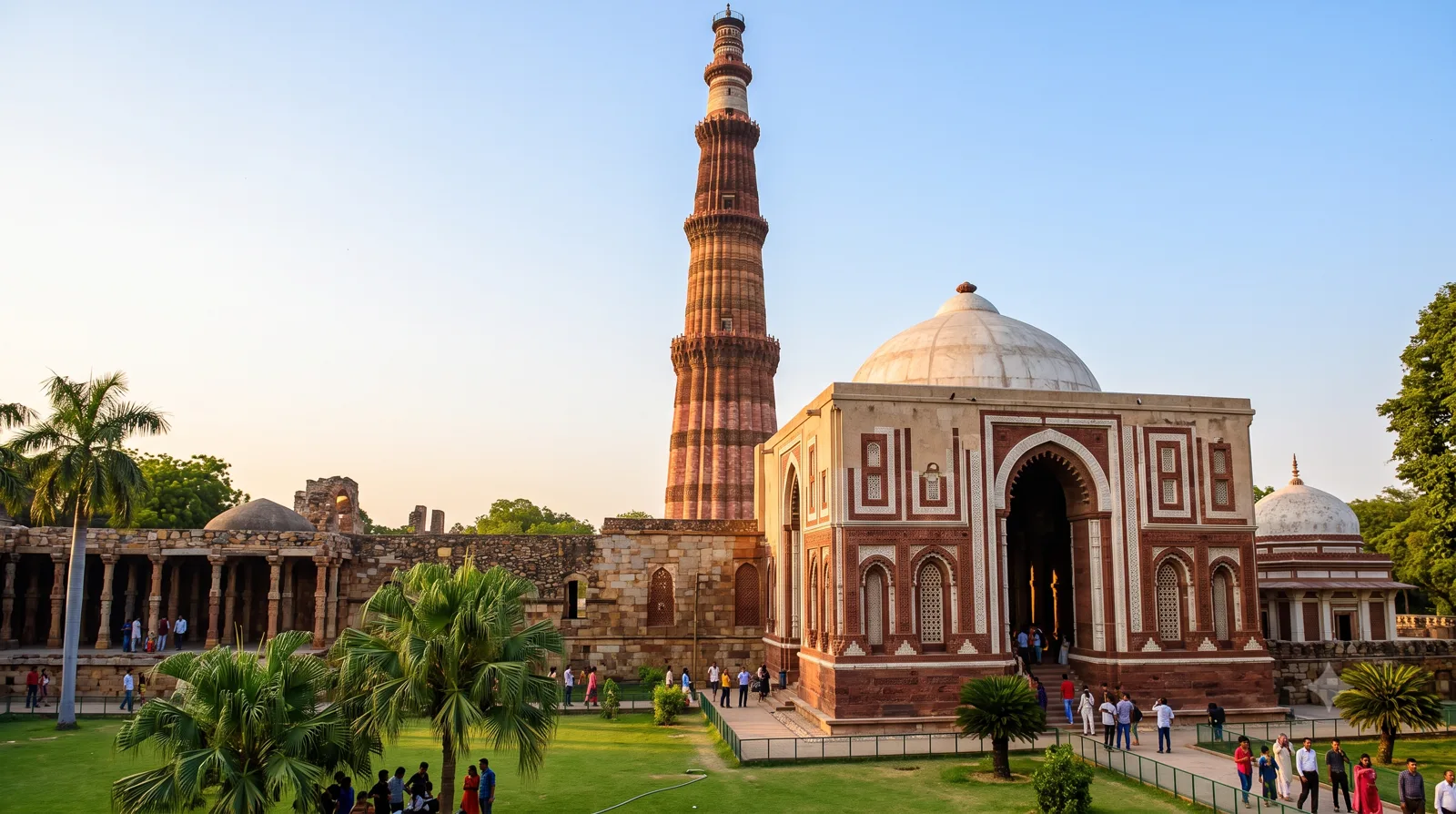
A photograph of the Qutub Minar complex displaying Indo-Islamic architecture with its distinctive towering minaret and domed structures
Chapter 5
Long-term Significance and Exam Relevance
The administrative and fiscal experiments of the Delhi Sultanate provided the institutional foundation on which the Mughals later built. The iqta system evolved into the jagir system. Alauddin’s attempts at measurement and cash salaries foreshadowed aspects of Sher Shah’s and Akbar’s revenue systems. The cultural synthesis visible in architecture, language and religious practice became a defining feature of medieval Indian civilisation.
For competitive examinations the topic tests several skills simultaneously: the ability to compare institutions across time, to link political decisions with economic consequences, and to assess cultural change without falling into simplistic narratives of conflict or harmony. Questions may ask for an evaluation of Alauddin’s market reforms, a comparison of Balban’s and Alauddin’s theories of kingship, or the reasons for the failure of Muhammad bin Tughlaq’s experiments. Aspirants who can move fluently between administrative detail, economic logic and cultural outcome perform better than those who memorise isolated facts.
The Sultanate also offers useful case studies in state formation under conditions of military conquest, the limits of centralisation in a pre-modern agrarian society, and the ways in which ruling elites adapt or fail to adapt to local conditions. These themes remain relevant for understanding later periods of Indian history as well.
Chapter 6
Conclusion
The five dynasties of the Delhi Sultanate did not follow a single administrative or economic script. The Slave rulers laid institutional foundations, the Khaljis pushed centralisation and market control to new limits, the Tughlaqs oscillated between bold experimentation and conservative consolidation, the Sayyids presided over contraction, and the Lodis introduced an Afghan style of shared sovereignty. In each phase the interaction between political power, agrarian surplus and cultural expression produced outcomes that still shape historical understanding of medieval India. For the serious aspirant the period rewards careful comparative study rather than dynasty-by-dynasty memorisation.
Chapter 7
Frequently Asked Questions
What were the main differences in the iqta system under the Slave and Khalji dynasties?
Why are Alauddin Khalji’s market reforms important for competitive exams?
How did the political culture of the Lodi dynasty differ from earlier Turkish dynasties?
What is the long-term significance of Delhi Sultanate administration for later Indian history?
Ready for the Real Test?
Prepare for your exams with the best GS resources, daily notes & free mock tests.
Start Free Mock Tests →Continue on RRBCONTENTS
Explore More
Knowledge Hub
More Blog Articles
In-depth, exam-focused articles on Indian history, governance, rivers, monuments and static GK.
Study Material
Exam Study Notes
Subject-wise notes and digests for Railway, SSC, Banking and State PSC exams.
Current Affairs
Daily Current Affairs & GK
Daily updates and a 70-day static GK bank with active-recall quizzes.