Dharmendra Pradhan: The Chanakya Modi Couldn’t Fire
From 1997 Student Protest to BJP’s Master Strategist and Education Minister
Home › Blog › Polity & Governance › Deep Analysis
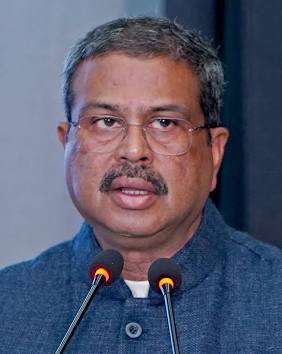
When nationwide protests erupted across India over paper leaks, grace-mark distortions, and operational failures in the National Eligibility cum Entrance Test (NEET-UG) and UGC-NET examinations, the political temperature in New Delhi reached a boiling point. Opposition parties led by the Indian National Congress demanded the immediate resignation of Union Education Minister Dharmendra Pradhan. Youth organizations and satirical student movements like the Cockroach Janta Party (CJP), along with NSUI and AISA, laid siege to streets near Jantar Mantar and Parliament.
Yet, amid the fiercest public pressure faced by any Cabinet minister in the Narendra Modi administration, Dharmendra Pradhan retained his position. To understand why the Modi-Shah leadership stood behind Pradhan requires an examination of his evolution from a student activist injured in a 1997 police crackdown to the principal architect of the BJP’s electoral machine in Eastern India.
Born on June 26, 1969, in Talcher, located in Odisha’s industrial Angul district, Dharmendra Pradhan’s political lineage was established early. His father, Debendra Pradhan, was a respected Bharatiya Janata Party leader who served as a Union Minister of State in the Atal Bihari Vajpayee government. Pradhan completed his education at Talcher College and earned a Master’s degree in Anthropology from Utkal University, Bhubaneswar. His background in anthropology—the study of human societies and cultural dynamics—offered early insights into demographic structuring and caste coalitions.
Pradhan entered student politics in 1983 through the Akhil Bharatiya Vidyarthi Parishad (ABVP). By 1995, he had risen to become the National Secretary of ABVP. A key historical episode occurred in 1997. As a young ABVP student leader protesting outside the Odisha Secretariat in Bhubaneswar against widespread state paper leaks and administrative corruption, Pradhan faced police baton charges and was injured, along with several fellow protesters, during the crackdown. Decades later, as India’s Union Education Minister, he found himself managing a nationwide paper leak crisis from inside the Cabinet.
Pradhan’s electoral career began in 2000 when he was elected to the Odisha Legislative Assembly from the Pallahara constituency. In 2004, Pradhan entered parliament by winning the Deogarh Lok Sabha seat. Recognizing his organizational skills, the BJP leadership appointed him National President of the Bharatiya Janata Yuva Morcha (BJYM) from 2004 to 2006.
Between 2007 and 2014, Pradhan served as BJP General Secretary and handled key state election assignments:
His performance led to his nomination to the Rajya Sabha from Bihar in 2012, cementing his role in the party’s central decision-making body.
When Narendra Modi assumed office as Prime Minister in May 2014, Dharmendra Pradhan was appointed Minister of State (Independent Charge) for Petroleum and Natural Gas. In September 2017, he was elevated to Cabinet rank.
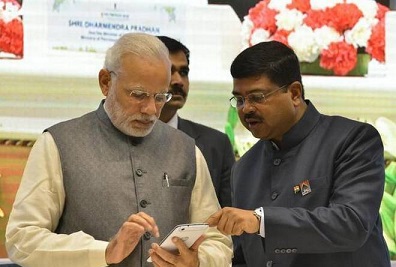
Pradhan became the longest-continuously serving Petroleum Minister in independent Indian history. His tenure delivered major political and economic outcomes:
Pradhan expanded the Industrial Training Institute (ITI) network by over 40% and oversaw the establishment of the National Council for Vocational Education and Training (NCVET).
Taking over in July 2021, Pradhan inherited the execution of the National Education Policy (NEP 2020), launching PM SHRI Schools (14,500+ institutes), the National Credit Framework (NCrF), and facilitating foreign university campuses in India (Deakin and Wollongong in GIFT City).
Dharmendra Pradhan’s primary value to the BJP leadership lies in his election management abilities. He is routinely tasked with high-stakes state assignments:
The high point of Pradhan’s electoral triumph in June 2024 was followed, two years later, by the most severe administrative crisis of his ministerial career. NEET-UG 2026 was conducted on May 3, 2026, for over 2.27 million aspirants nationwide seeking undergraduate medical and dental admissions. Within days, reports emerged that a pre-circulated guess paper overlapped with the actual question paper by as many as 120 to 140 questions in some subjects.
Facing mounting evidence of a compromised exam, the NTA cancelled NEET-UG 2026 on May 12, 2026, and announced a re-examination while waiving additional fees for existing registrants. The Rajasthan Police Special Operations Group (SOG) launched an investigation that led to multiple arrests. The crisis carried a severe human cost: days after the exam was scrapped, a 23-year-old aspirant died by suicide, intensifying public anger nationwide. This 2026 fiasco echoed an earlier, separate controversy from June 2024, when a batch of candidates was found to have received identical perfect 720/720 scores at a single Haryana test center due to erroneously awarded grace marks — a scandal that had already dented public trust in the NTA and led to the cancellation of that year’s UGC-NET exam over dark web leaks. Nationwide student agitations led by NSUI, AISA, and CJP paralyzed university hubs in both crises and led to heavy parliamentary disruptions.
Despite intense political heat and daily opposition demands, Prime Minister Modi did not remove Dharmendra Pradhan. Analysts highlight four key reasons:
To stabilize the system, Pradhan executed major operational and legal reforms:
Dharmendra Pradhan’s political trajectory illustrates the inner workings of modern Indian party governance, where election strategy, demographic representation, and execution capabilities intersect. From his beginnings as an ABVP student activist injured in the 1997 police crackdown, Pradhan has established himself as a central figure in the ruling BJP.
His long-term governance legacy will depend on his ability to successfully reform the National Testing Agency, execute the Radhakrishnan Committee’s recommendations, and restore public trust in India's entrance examination system.
A) 1983
B) 1997
C) 2000
D) 2004
Correct Answer: B
Explanation: In 1997, Dharmendra Pradhan was baton-charged and injured outside the Odisha Secretariat while protesting state paper leaks.
A) Deogarh
B) Sambalpur
C) Bhubaneswar
D) Puri
Correct Answer: B
Explanation: Pradhan contested from Sambalpur in 2024, securing 592,162 votes and winning by a margin of 119,836 votes.
A) 3 Years
B) 5 Years
C) 10 Years
D) Life Imprisonment
Correct Answer: C
Explanation: The Act mandates 5 to 10 years of imprisonment and a minimum ₹1 Crore fine for organized examination crime.
A) Dr. K. Radhakrishnan
B) K. Kasturirangan
C) Subodh Kumar Singh
D) Pradeep Singh Kharola
Correct Answer: A
Explanation: Former ISRO Chairman Dr. K. Radhakrishnan headed the 7-member expert committee that submitted 101 reform recommendations.
A) PM SVANidhi
B) Pradhan Mantri Ujjwala Yojana (PMUY)
C) PM-KISAN
D) PM SHRI
Correct Answer: B
Explanation: The PM Ujjwala Yojana was launched in May 2016 under Pradhan's petroleum ministry tenure.
The Modi administration adheres to a doctrine of not yielding to opposition resignation demands, combined with Pradhan's critical status as an OBC leader, his historic election victory in Odisha, and a focus on systemic NTA reform over symbolic dismissal.
In 1997, as a young ABVP leader protesting outside the Odisha Secretariat against state paper leaks and corruption, Pradhan was baton-charged by police and injured, along with other student protesters.
The Act introduces strict penalties for organized cheating syndicates, including 5 to 10 years imprisonment, a minimum fine of ₹1 Crore, property attachment of offender firms, while explicitly protecting genuine student candidates.
The High-Level Committee submitted 101 recommendations including transitioning high-stakes exams like NEET to Computer-Based Testing (CBT), ending contract staffing in NTA, granting statutory status to NTA, and implementing two-stage digital question paper encryption.
Prepare for civil services and state public service exams with updated notes on ministries, acts, and electoral reforms.
Solve PYQs → Study Notes →Join our official Telegram community for daily study updates: @rrbcontents