Dr. Jitendra Singh: Between Orbit and the Street
Juxtaposition of Scientific Achievements and Ground-Level Political Dialogue
Home › Blog › Polity & Governance › Dr. Jitendra Singh
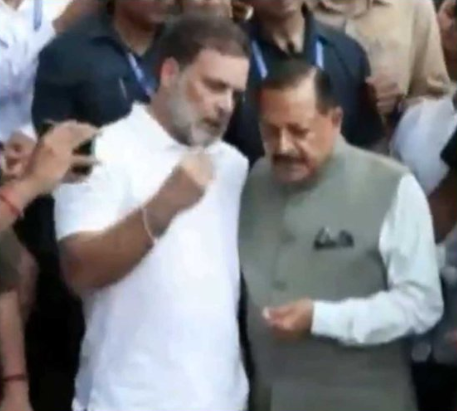
On Tuesday, Union Minister of State Dr. Jitendra Singh occupied two very different stages of Indian public life. In the morning, he was highlighting critical technical progress on the Gaganyaan crew module. By afternoon, he was standing outside 7 Lok Kalyan Marg, speaking face-to-face with Leader of Opposition Rahul Gandhi amid a Congress sit-in against police action on protesting students.
The juxtaposition is instructive. It captures both the expansion of India’s space programme and the sharp political contestation over youth discontent.
On 18 July, Skyroot Aerospace’s Vikram-1 successfully placed satellites into a 450-km orbit, becoming the first privately developed Indian rocket to achieve orbital flight. The mission marked a tangible outcome of the 2020 space sector reforms that allowed private entities to build and operate launch vehicles. Dr. Singh, who holds independent charge of the Department of Space, publicly congratulated the team and framed the success as evidence that the policy shift from a government monopoly to a mixed ecosystem is delivering results.
Three days later, he announced that ISRO had completed three critical qualification tests on the Gaganyaan crew module. These tests strengthen the systems designed to protect astronauts during re-entry and recovery — a necessary step before uncrewed orbital flights expected later this year and the eventual crewed mission.
Singh has repeatedly projected that India’s space economy, currently estimated at $8–9 billion, could reach $40–45 billion within a decade. The claim rests on the rapid growth of space startups (now over 400), technology transfer from ISRO, and the Indian Space Policy 2023. Whether the projection materialises will depend on sustained investment, regulatory clarity, and the ability of private firms to move from demonstration flights to commercial reliability. Still, the trajectory is clear: India is no longer only launching government satellites; it is attempting to build a competitive launch and services industry.
While these developments were being noted, a different drama unfolded in central Delhi. On 20 July, students marching under the Cockroach Janta Party banner toward Parliament — protesting alleged irregularities in NEET-UG 2026 and repeated examination failures — faced police use of force, including lathi charge and tear gas. Injuries were reported. The Opposition accused the government of suppressing legitimate youth anger.
The following day, Congress leaders, led by Rahul Gandhi and Mallikarjun Kharge, staged a sit-in outside the Prime Minister’s residence at 7 Lok Kalyan Marg. The choice of location was deliberate. It placed the protest in a high-security zone and forced a political response.
That response came in the form of Dr. Jitendra Singh. As Minister of State in the PMO, he was the natural government interlocutor. Accompanied by the Union Home Secretary, he spoke briefly with Rahul Gandhi and, according to multiple accounts, asked the Congress leaders to end the protest and vacate the area. The conversation was short. The sit-in continued.
Dr. Singh’s dual appearance is not accidental. He is one of the few ministers who simultaneously oversees a high-technology portfolio and sits in the Prime Minister’s Office. This combination makes him useful for both projecting scientific ambition and managing political friction. He is neither a pure technocrat nor a hard-edged political enforcer. That middle position allows him to speak the language of startups and orbital mechanics in the morning and carry a government message to the Leader of Opposition in the afternoon.
The larger picture remains unresolved. India’s space programme is accumulating real capabilities — private orbital launch, human-rating of systems, and a growing startup base. At the same time, the intensity of the student protests and the Opposition’s decision to take the issue to the Prime Minister’s doorstep underline a parallel reality: large sections of the young population feel the system of examinations and opportunity is failing them. Dr. Jitendra Singh currently stands at the intersection of these two stories. One is about expanding the frontier of Indian technology. The other is about the politics of managing discontent on the ground. Both will continue.
A) Vikram-S by Skyroot Aerospace
B) Vikram-1 by Skyroot Aerospace
C) Agnibaan by Agnikul Cosmos
D) SSLV-D3 by ISRO
Correct Answer: B
Explanation: On July 18, 2026, Skyroot Aerospace's Vikram-1 successfully placed satellites into a 450-km orbit, completing its first orbital flight.
A) Department of Atomic Energy
B) Department of Space
C) Ministry of Electronics & IT
D) Ministry of New and Renewable Energy
Correct Answer: B
Explanation: Dr. Jitendra Singh is the Minister of State (Independent Charge) for the Department of Space, alongside overseeing the PMO.
A) 2014
B) 2018
C) 2020
D) 2023
Correct Answer: C
Explanation: The Indian government introduced far-reaching space sector reforms in 2020, establishing IN-SPACe to facilitate private participation.
A) Jantar Mantar
B) India Gate Canopy
C) 7 Lok Kalyan Marg (PM's Residence)
D) Parliament House Main Gate
Correct Answer: C
Explanation: The sit-in was staged directly outside the Prime Minister's official residence at 7 Lok Kalyan Marg, prompting the intervention.
A) $15–20 Billion
B) $40–45 Billion
C) $75–80 Billion
D) $100 Billion
Correct Answer: B
Explanation: Dr. Jitendra Singh has projected that India's space economy will grow from its current estimate of $8–9 billion to $40–45 billion within the next decade.
Dr. Jitendra Singh serves as the Union Minister of State (Independent Charge) for Science & Technology and Earth Sciences, and MoS in the Prime Minister's Office (PMO), Personnel, Public Grievances, Pensions, Atomic Energy, and Space.
He projects that India's space economy, currently valued at $8–9 billion, could reach $40–45 billion within the next decade.
Opposition leaders, led by Rahul Gandhi and Mallikarjun Kharge, staged a sit-in to protest against police action (lathi charge and tear gas) on students demonstrating over alleged irregularities in NEET-UG 2026.
He highlighted Skyroot Aerospace's Vikram-1 rocket successfully placing satellites into orbit on July 18, 2026, as a major outcome of the 2020 space sector reforms.
Prepare for upcoming competitive exams by studying space programs, government structures, and current administrative profiles.
Solve PYQs → Study Notes →Join our official Telegram community for daily study updates: @rrbcontents