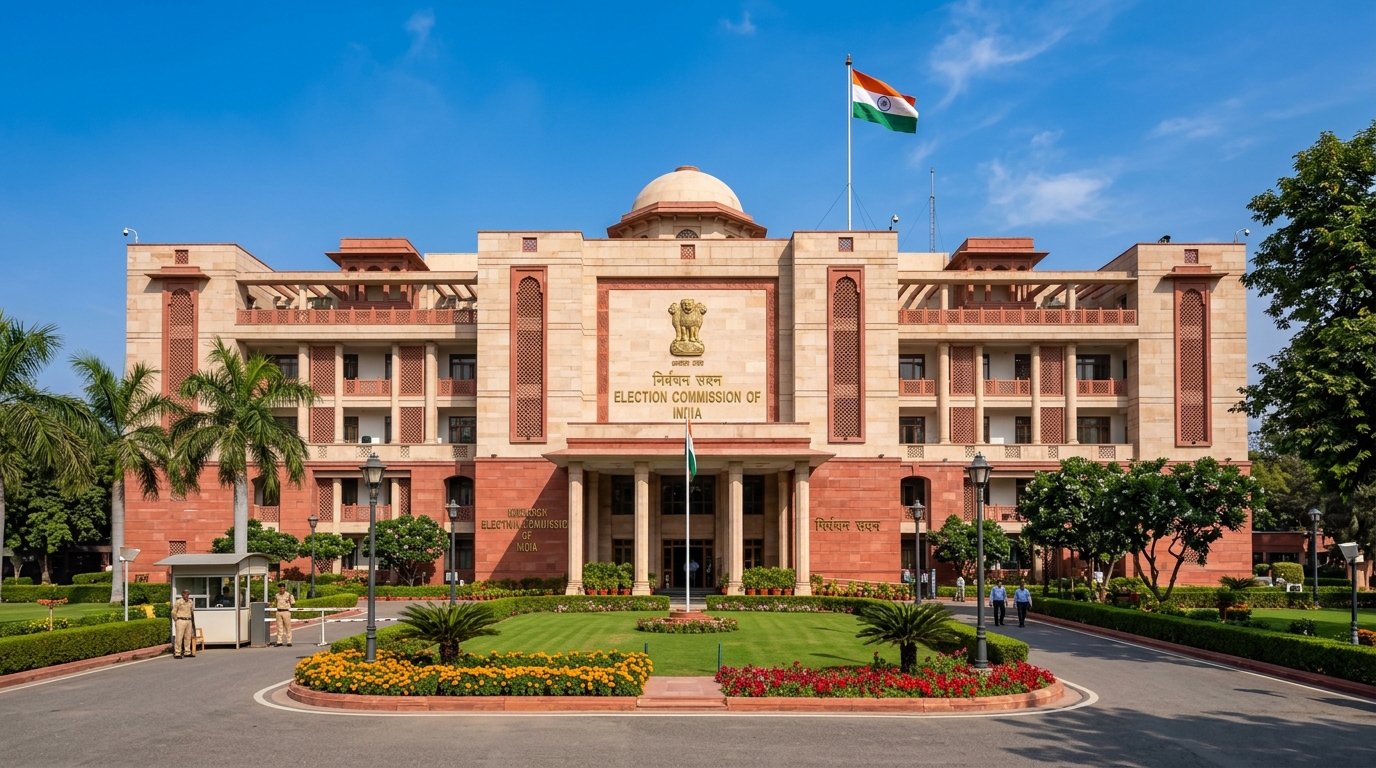
ELECTION COMMISSION OF INDIA: POWERS, COMPOSITION, ARTICLE 324, ELECTORAL REFORMS & LANDMARK PROVISIONS (COMPLETE GUIDANCE FOR COMPETITIVE EXAMS)
Chapter 1
INTRODUCTION
The Election Commission of India (ECI) is an autonomous, permanent constitutional authority established directly under the Constitution of India to ensure the conduct of free, fair, transparent, and periodic elections across the democratic republic. Founded on 25th January 1950 (celebrated annually since 2011 as National Voters' Day), the ECI serves as the bedrock of Indian democracy.
Under Part XV (Elections) of the Indian Constitution, Article 324(1) vests the superintendence, direction, and control of the preparation of electoral rolls for, and the conduct of, all elections to:
- 1. Parliament of India (Lok Sabha and Rajya Sabha).
- 2. State Legislatures (Legislative Assemblies and Legislative Councils).
- 3. Office of the President of India.
- 4. Office of the Vice-President of India.
(Crucial Note for Exams: The Election Commission of India does NOT conduct elections to local bodies—Panchayats and Municipalities. Elections to local bodies are conducted by independent State Election Commissions established under Articles 243-K and 243-ZA).
In a country of over 1.4 billion people with nearly 970 million eligible voters, conducting multi-phase elections across diverse geographical terrains is an administrative marvel often hailed as the "largest democratic exercise on Earth."
For aspirants preparing for competitive examinations such as UPSC Civil Services, State Public Service Commissions (BPSC, UPPSC, MPPSC, RAS), SSC CGL, and Banking exams, mastering the Constitutional provisions, multi-member composition, appointment changes under the 2023 Act, powers, Model Code of Conduct (MCC), and electoral reforms is essential.
This comprehensive master career guide provides an exhaustive breakdown of the Election Commission of India. We cover every legal detail—from constitutional articles and appointment rules to EVM-VVPAT technology, political party recognition criteria, landmark Supreme Court rulings, committee reports, 12 exam-focused FAQs, and essential memory tools.
---
Chapter 6
CONSTITUTIONAL ARTICLES AT A GLANCE (ARTICLES 324 TO 329)
| Constitutional Article | Subject Matter / Provisions |
|---|---|
| Article 324 | Superintendence, direction, and control of elections vested in the Election Commission. |
| Article 325 | No person to be ineligible for inclusion in, or to claim to be included in a special, electoral roll on grounds of religion, race, caste, or sex. |
| Article 326 | Elections to the House of the People (Lok Sabha) and State Legislative Assemblies to be on the basis of Adult Suffrage (Voting age 18 years). |
| Article 327 | Power of Parliament to make provision with respect to elections to Legislatures (RPA 1950 & RPA 1951). |
| Article 328 | Power of State Legislature to make provision with respect to elections to such Legislature. |
| Article 329 | Bar to interference by courts in electoral matters (Delimitation of constituencies cannot be questioned in court). |
---
Chapter 7
COMPOSITION AND EVOLUTION OF THE ELECTION COMMISSION
25th January 1950 to 15th October 1989: Single-Member Body (Only Chief Election Commissioner)
       │
       ▼ (61st Constitutional Amendment Act 1988 reduced voting age from 21 to 18 yrs)
16th October 1989 to 1st January 1990: Multi-Member Body (1 CEC + 2 Election Commissioners)
       │
       ▼ (Brief reversal to single-member body)
1st October 1993 to Present: Multi-Member Body Permanently (1 CEC + 2 Election Commissioners)
- The Commission currently consists of the Chief Election Commissioner (CEC) and two Election Commissioners (ECs).
- Equal Status & Powers: All three Commissioners possess equal powers, equal salary, and identical allowances (equivalent to the salary and perks of a Supreme Court Judge).
- Decision-Making: In case of any difference of opinion among the CEC and other Election Commissioners, the matter is decided by majority vote.
- The CEC and Election Commissioners hold office for a term of 6 years or until they attain the age of 65 years, whichever is earlier.
- They can resign at any time by writing to the President of India.
- Removal of Chief Election Commissioner (CEC): The CEC can be removed from office ONLY in like manner and on like grounds as a Judge of the Supreme Court of India. (Requires a motion passed by a Special Majority in both Houses of Parliament on grounds of proved misbehavior or incapacity).
- Removal of Other Election Commissioners: Other Election Commissioners cannot be removed from office EXCEPT on the recommendation of the Chief Election Commissioner.
---
Chapter 8
THE NEW APPOINTMENT ACT 2023: SELECTION PROCEDURE
In March 2023, the Supreme Court Constitution Bench ruled in Anoop Baranwal v. Union of India that appointments of CEC and ECs should be made by a committee comprising the PM, CJI, and Leader of Opposition until Parliament enacts a law.
Subsequently, Parliament enacted The Chief Election Commissioner and other Election Commissioners (Appointment, Conditions of Service and Term of Office) Act, 2023, replacing the 1991 Act.
New Appointment Workflow under 2023 Act
├── Step 1: Search Committee (Headed by Cabinet Secretary + 2 Union Secretaries)
│      └── Prepares a panel of 5 eligible names
│
└── Step 2: Selection Committee
       ├── 1. Prime Minister of India (Chairperson)
       ├── 2. Leader of Opposition in Lok Sabha (Member)
       └── 3. Union Cabinet Minister nominated by Prime Minister (Member)
              │
              ▼
Result: President of India appoints CEC / ECs based on Selection Committee's recommendation
1. Search Committee: Headed by the Cabinet Secretary, prepares a panel of 5 persons for consideration by the Selection Committee.
2. Selection Committee: Comprises the Prime Minister (Chairperson), Leader of Opposition / Leader of Largest Opposition Party in Lok Sabha, and a Union Cabinet Minister nominated by the PM.
3. Qualifications: Appointees must be persons who are holding or have held a post equivalent to Secretary to the Government of India.
4. Protection from Legal Action: Protects current and former CECs and ECs from civil or criminal proceedings for actions taken in good faith during official duties.
---
Chapter 9
POWERS AND FUNCTIONS OF THE ELECTION COMMISSION
Powers of Election Commission of India
├── 1. Administrative Powers (Rolls, EPIC, Schedules, MCC, Party Recognition)
├── 2. Advisory Powers (Disqualification of MPs/MLAs under Art 103/192)
└── 3. Quasi-Judicial Powers (Disputes over Party Splits & Election Symbols)
---
1. Representation of the People Act, 1950 (RPA 1950):
- Deals with pre-election administrative procedures.
- Allocation of seats in Lok Sabha and State Legislative Assemblies.
- Delimitation of parliamentary and assembly constituencies.
- Qualifications of voters and preparation of Electoral Rolls.
- Registration of electors and appointment of Chief Electoral Officers (CEOs), District Election Officers (DEOs), and Electoral Registration Officers (EROs).
2. Representation of the People Act, 1951 (RPA 1951):
- Deals with actual conduct of elections and post-election procedures.
- Qualifications and disqualifications for membership of Parliament and State Legislatures (Section 8 disqualification for criminal conviction).
- Registration of political parties (Section 29A).
- Conduct of elections, nomination procedures, polling, counting of votes, and deposit forfeitures.
- Definition of Corrupt Practices and Electoral Offenses (e.g., bribery, booth capturing, promoting enmity between classes under Section 123).
- Election Petitions and dispute resolution mechanisms.
1. Standardized ECI Electoral Registration Forms:
- Form 6: Application for new voter registration / inclusion of name in electoral roll for first-time voters attaining 18 years.
- Form 6A: Application for registration of Non-Resident Indian (NRI) overseas electors.
- Form 7: Application for objection / deletion of a name in the electoral roll.
- Form 8: Application for correction of entries, transposition of residence, or issuing replacement EPIC card.
2. SVEEP (Systematic Voters' Education and Electoral Participation):
- ECI's flagship voter awareness program organizing campus voter registration drives, National Voters' Day events, voter pledge ceremonies, and appointing National Cultural Icons (e.g., Pankaj Tripathi, Sachin Tendulkar, Rajkummar Rao) to boost voter turnout in low-percentage urban and rural constituencies.
Chapter 10
# 1. ADMINISTRATIVE POWERS
- Electoral Rolls & EPIC: Prepares and periodically revises electoral rolls and issues Electors Photo Identity Cards (EPIC) to eligible voters.
- Notification of Election Schedule: Fixes and notifies election dates, polling schedules, nomination filings, scrutiny dates, and counting schedules.
- Enforcement of Model Code of Conduct (MCC): Enforces the Model Code of Conduct during election periods to ensure a level playing field, preventing ruling parties from misusing government machinery.
- Recognition of Political Parties: Registers political parties under Section 29A of the Representation of the People Act, 1951, granting them status as National or State Recognized Parties.
- Symbol Allocation: Allocates official election symbols to recognized political parties and independent candidates under the Election Symbols (Reservation and Allotment) Order, 1968.
- Expenditure Monitoring: Fixes ceiling limits on election expenditure for candidates and appoints Election Expenditure Observers.
---
Chapter 11
# The Delimitation Commission & Electoral Boundary Readjustment (Article 82 & 170):
- Constitutional Articles: Article 82 (Readjustment after each census for Parliament) and Article 170 (Readjustment for State Assemblies).
- Delimitation Commission Composition: Independent body chaired by a retired Supreme Court Judge, with the Chief Election Commissioner and State Election Commissioners as ex-officio members.
- Finality of Delimitation Orders (Article 329): Orders passed by the Delimitation Commission carry the force of law and CANNOT be questioned in any court of law.
- Constitutional Freeze (84th Amendment 2001): The total number of Lok Sabha seats is frozen at 543 based on the 1971 Census until the first census taken after the year 2026. Boundary readjustment within states was completed under the 2002 Delimitation Commission based on the 2001 Census.
- Service Voters & ETPBS: Armed Forces personnel, paramilitary forces, and diplomatic officers posted abroad vote via Electronically Transmitted Postal Ballot System (ETPBS), where encrypted ballots are transmitted digitally and returned by post.
- NRI Voting Rights (Section 20A RPA 1950): Non-Resident Indians (NRIs) holding valid Indian passports can register as voters using Form 6A. Currently, NRIs must be physically present at their home polling booth in India to vote, with proposals for proxy voting or ETPBS under consideration.
Chapter 12
# 2. ADVISORY POWERS
- Disqualification of Legislators: Advises the President of India on disqualification of Members of Parliament (Article 103) and the Governor of a State on disqualification of MLAs (Article 192) on grounds of holding office of profit or corrupt practices. (Note: Disqualification under the Anti-Defection Law / 10th Schedule is decided by the Speaker/Chairman, NOT ECI).
- President's Rule Elections: Advises the President whether elections can be held in a state under President's Rule after 1 year to enable extension.
---
Chapter 13
# 3. QUASI-JUDICIAL POWERS
- Acts as a court for settling disputes relating to splits, mergers, and symbol claims among rival factions of recognized political parties.
- Landmark Case: In Sadiq Ali v. Election Commission of India (1972), the Supreme Court upheld ECI's authority to decide symbol disputes based on the test of majority in organizational and legislative wings.
---
- 8 Core Components: General Conduct, Meetings, Processions, Polling Day, Polling Booths, Observers, Party in Power (preventing misuse of official vehicles, government advertisements, or announcing new welfare schemes after election announcement), and Election Manifestos.
- cVIPIGIL Mobile App: Citizen-centric mobile app enabling voters to report MCC violations (photos/videos with GPS tagging) directly to ECI, with mandatory resolution within 100 minutes.
- Social Media Guidelines: Pre-certification of political advertisements on social media platforms (Meta, X/Twitter, Google) by ECI Media Certification and Monitoring Committees (MCMC).
To curb paid news and unverified political advertisements during election campaigns, ECI operates Media Certification and Monitoring Committees (MCMC) at district and state levels, mandating pre-certification for all TV, radio, print, and digital advertisements.
Criteria for National Party Status:
- 1. Secures at least 6% of total valid votes polled in four or more States in a general election to Lok Sabha or State Assembly, AND wins at least 4 Lok Sabha seats from any State(s); OR
- 2. Wins at least 2% of total seats in Lok Sabha (11 seats out of 543) in a general election, and these candidates are elected from at least 3 different States; OR
- 3. Is recognized as a State Party in at least four States.
Criteria for State Party Status:
- 1. Secures at least 6% of total valid votes polled in the State Assembly general election AND wins at least 2 Assembly seats.
- 2. Secures at least 6% of total valid votes polled in the State during Lok Sabha general election AND wins at least 1 Lok Sabha seat from that State.
- 3. Wins at least 3% of total Assembly seats OR 3 seats in the State Assembly, whichever is higher.
- 4. Wins at least 1 Lok Sabha seat for every 25 seats allocated to the State in Lok Sabha.
- 5. Secures at least 8% of total valid votes polled in the State in the last general election to Lok Sabha or Assembly (added in 2011).
---
Chapter 23
# Special Postal Ballot Facilities for Senior Citizens & Persons with Disabilities (PwD):
Under recent electoral rule amendments, ECI provides home voting facilities via postal ballot for senior citizens aged 85+ years and Persons with Benchmark Disabilities (40%+ disability), escorted by polling teams with videography.
Chapter 24
EVOLUTION OF ELECTORAL REFORMS AND TECHNOLOGY IN INDIA
Key Milestones in Electoral Reforms
├── 1982: Electronic Voting Machines (EVM) introduced (Paravur, Kerala)
├── 1988: 61st Amendment reduced voting age from 21 to 18 Years
├── 1993: Electors Photo Identity Card (EPIC) introduced by CEC T.N. Seshan
├── 2004: 100% EVM usage across all Lok Sabha constituencies
├── 2013: NOTA (None of the Above) introduced (PUCL Judgment)
├── 2013: VVPAT (Voter Verifiable Paper Audit Trail) introduced (Noksen, Nagaland)
└── 2024: Electoral Bonds Scheme struck down by SC (ADR Case)
1. Electronic Voting Machines (EVM): Manufactured by ECIL (Hyderabad) and BEL (Bengaluru). Tamper-proof standalone machines operating on battery power without internet connectivity.
2. Voter Verifiable Paper Audit Trail (VVPAT): Introduced following Supreme Court directions in Subramanian Swamy v. ECI (2013). VVPAT prints a paper slip showing candidate name, serial number, and party symbol for 7 seconds behind a sealed glass window before dropping into a locked box.
3. None of the Above (NOTA): Introduced following the landmark Supreme Court ruling in PUCL v. Union of India (2013), allowing voters to register a secret negative vote.
4. Electoral Bonds Judgment (2024): In Association for Democratic Reforms (ADR) v. Union of India, a 5-Judge Constitution Bench struck down the 2018 Electoral Bonds Scheme as unconstitutional, holding that anonymous political donations violate voters' Right to Information under Article 19(1)(a).
---
Chapter 25
MAJOR COMMITTEES ON ELECTORAL REFORMS
| Committee / Commission Name | Year | Key Recommendations & Impact |
|---|---|---|
| Tarkunde Committee | 1975 | Recommended reducing voting age to 18 years, multi-member ECI, and minimum voting age reform. |
| Dinesh Goswami Committee | 1990 | Recommended introduction of EVMs, ban on independent candidates contesting multiple seats, and state funding in kind. |
| Vohra Committee | 1993 | Highlighted the dangerous nexus between politicians, bureaucrats, and criminal syndicates (Criminalization of Politics). |
| Indrajit Gupta Committee | 1998 | Recommended partial State Funding of Elections in kind (fuel, paper, media time) to curb black money. |
| Law Commission 255th Report | 2015 | Recommended regulation of political finance, paid news restrictions, and disqualification on filing false affidavits. |
---
ECI manages the National Voters' Service Portal (NVSP / voterportal.eci.gov.in) and the toll-free 1950 Voters' Helpline number, providing instant online services for voter search, EPIC download, and polling station location tracking.
Chapter 26
IMPORTANCE FOR COMPETITIVE EXAMS & QUICK REVISION
1. Articles: Art 324 (Superintendence of ECI), Art 325 (No discrimination in rolls), Art 326 (Adult Suffrage 18 Yrs), Art 329 (Bar on court interference).
2. Composition: 1 CEC + 2 ECs. Equal status & powers. Term 6 Yrs / 65 Yrs age.
3. Removal: CEC removed like SC Judge (Parliament Special Majority). Other ECs removed on CEC's recommendation.
4. 2023 Appointment Act: Selection Committee = PM + LoP + Union Cabinet Minister.
---
Chapter 27
FREQUENTLY ASKED QUESTIONS (FAQS)
Answer: Article 324 of the Indian Constitution vests the superintendence, direction, and control of elections in the Election Commission of India.
Answer: Local body elections are conducted by independent State Election Commissions under Articles 243-K and 243-ZA, NOT by the Election Commission of India.
Chapter 28
# Q3: Which Constitutional Amendment reduced the voting age from 21 to 18 years?
Answer: The 61st Constitutional Amendment Act, 1988 (enacted in 1989) reduced the voting age from 21 years to 18 years under Article 326.
Chapter 29
# Q4: How is the Chief Election Commissioner (CEC) removed from office?
Answer: The CEC can be removed from office ONLY in like manner and on like grounds as a Supreme Court Judge—by an order of the President passed after a Special Majority in both Houses of Parliament on proved misbehavior or incapacity.
Chapter 30
# Q5: Who constitutes the Selection Committee under the new 2023 ECI Appointment Act?
Answer: The Selection Committee comprises: (1) Prime Minister of India (Chairperson), (2) Leader of Opposition in Lok Sabha, and (3) a Union Cabinet Minister nominated by the Prime Minister.
Chapter 31
# Q6: What is the tenure of office for Chief Election Commissioner and Election Commissioners?
Answer: They hold office for a term of 6 years or until attaining the age of 65 years, whichever is earlier.
Chapter 32
# Q7: What is the significance of the VVPAT machine in Indian elections?
Answer: Voter Verifiable Paper Audit Trail (VVPAT) prints a paper slip showing the candidate's name and symbol for 7 seconds, allowing the voter to visually verify that their vote was recorded accurately.
Chapter 33
# Q8: What did the Supreme Court rule regarding Electoral Bonds in 2024?
Answer: In ADR v. Union of India (2024), a 5-Judge Constitution Bench struck down the Electoral Bonds Scheme as unconstitutional, holding that anonymous political funding violates the voters' Right to Information under Article 19(1)(a).
Answer: MCC is a set of guidelines issued by ECI for conduct of political parties and candidates during elections, coming into force immediately upon election announcement.
Answer: As per recent ECI notifications, national parties include BJP, INC, AAP, CPI(M), BSP, and NPP (National People's Party).
Chapter 34
# Q11: Who was the first Chief Election Commissioner of Independent India?
Answer: Sukumar Sen was the first Chief Election Commissioner of India (1950–1958).
Chapter 35
# Q12: Who was the first female Chief Election Commissioner of India?
Answer: V.S. Ramadevi was the first female Chief Election Commissioner of India (serving in 1990).
---
Chapter 36
# Q13: What is the cVIGIL mobile app created by the Election Commission?
Answer: cVIGIL is an innovative mobile application developed by ECI allowing citizens to report live Model Code of Conduct (MCC) violations by uploading geotagged photos/videos, which are investigated within 100 minutes.
Chapter 37
# Q14: Is the Model Code of Conduct (MCC) enforceable by law?
Answer: The MCC itself does NOT possess statutory backing. However, specific violations within the MCC (such as bribery, hate speech, or liquor distribution) are punishable under corresponding provisions of the Indian Penal Code (BNS) and the Representation of the People Act, 1951.
Answer: The District Collector / District Magistrate (DM) acts as the ex-officio District Election Officer (DEO), supervising election machinery, polling booth setup, and polling officer training across the district.
Chapter 38
# Q16: What is the purpose of Form 6 in voter registration?
Answer: Form 6 is used by eligible Indian citizens (attaining 18 years of age) to apply for new voter registration and inclusion of their name in the electoral roll.
Answer: ETPBS is a secure digital ballot delivery system used by ECI to transmit postal ballots electronically to registered Service Voters (Armed Forces personnel) stationed across remote border outposts.
- Senior Administrative Leadership: Assisted by Deputy Election Commissioners (senior IAS officers), Director Generals, and Principal Secretaries overseeing election management divisions.
- State Chief Electoral Officer (CEO): At the state level, the election machinery is headed by the Chief Electoral Officer (CEO), an IAS officer appointed by ECI in consultation with the State Government under Section 13A of RPA 1950.
- District & Field Machinery: The District Magistrate / Collector acts as District Election Officer (DEO), appointing Returning Officers (RO) for constituencies and Presiding Officers (PO) for polling booths.
- Independent Observers Network: ECI deploys three cadres of senior Central service officers during elections:
1. General Observers (IAS): Monitor polling booth arrangements and free/fair conduct.
2. Expenditure Observers (IRS/IA&AS): Monitor candidate spending and black money movement.
3. Police Observers (IPS): Monitor security force deployment and law-and-order.
Chapter 39
RECOGNITION OF NATIONAL AND STATE POLITICAL PARTIES
The Election Commission grants statutory recognition to political parties based on performance under the Election Symbols (Reservation and Allotment) Order, 1968:
Criteria for National Party Status:
- 1. Secures at least 6% of valid votes polled in any four or more States at a General Election to Lok Sabha or Legislative Assembly AND wins at least 4 seats in Lok Sabha from any State(s); OR
- 2. Wins at least 2% of total seats in Lok Sabha (11 seats) and these candidates are elected from at least three different States; OR
- 3. Recognized as a State Party in at least four States.
---
Chapter 44
# Statutory Advisory Functions of ECI:
- Advises the President on disqualifications of Members of Parliament under Article 103.
- Advises the Governor on disqualifications of Members of State Legislature under Article 192.
- Advises the President whether elections can be held in a State under President's Rule after 1 year to extend it up to 3 years.
---
Chapter 45
# Anoop Baranwal v. Union of India (2023) Landmark Judgment:
- SC Constitution Bench ruled that Chief Election Commissioner and Election Commissioners shall be appointed by the President on the advice of a 3-member Selection Committee:
Chapter 46
1. Prime Minister of India (Chairperson)
Chapter 47
2. Leader of Opposition in Lok Sabha (or leader of largest opposition party)
Chapter 48
3. Chief Justice of India
- Parliament subsequently enacted the CEC and Other ECs (Appointment, Conditions of Service and Term of Office) Act, 2023, substituting the CJI with a Union Cabinet Minister nominated by the PM.
---
Chapter 49
CONCLUSION
The Election Commission of India is the democratic anchor of the Indian Republic. By managing complex multi-phase elections across 970 million voters, deploying advanced EVM-VVPAT technologies, enforcing the Model Code of Conduct, and maintaining strict neutrality, the ECI has earned global acclaim as a gold standard in election administration.
For competitive exam aspirants, mastering Article 324 through Article 329, ECI composition, 2023 appointment rules, and technological milestones guarantees a solid foundation for scoring top marks in Indian Polity.
👉 Official Career Portal: [https://rrbcontents.com](https://rrbcontents.com)
👉 Official Telegram Channel: [Join RRBCONTENTS Telegram (@rrbcontents)](https://t.me/rrbcontents)
---
Chapter 50
Model Code of Conduct (MCC) — Key Provisions
The Model Code of Conduct is one of the most significant instruments through which the Election Commission of India ensures free and fair elections. It is important to understand that the MCC has no statutory backing — it is entirely based on political consensus and voluntary compliance by political parties. It was first used in Kerala elections in 1960 and has evolved considerably since then, becoming a comprehensive document governing electoral conduct.
The MCC comes into force immediately when the election schedule is announced by the ECI. This announcement triggers a series of restrictions on the government of the day:
- Prohibition on use of government machinery: Ministers and ruling party candidates cannot use official vehicles, government staff, or government funds for election campaigning. Government bungalows cannot be used as campaign offices.
- Ban on new policy announcements: The government cannot announce new welfare schemes, policy changes, or project inaugurations after the MCC is enforced, as this would amount to using state power to influence voters.
- Expenditure limits (2022 revision): Lok Sabha candidates — Rs 95 lakhs maximum; State Assembly candidates — Rs 40 lakhs maximum. Candidates must submit a detailed account of election expenditure within 30 days of declaration of results.
- Enforcement powers: ECI can censure candidates, recommend cancellation of party registration, issue show-cause notices, and in extreme cases, recommend suspension of government officials found complicit in MCC violations.
- The MCC applies not just to candidates and parties but also to the government machinery, including bureaucrats and police officials who must act neutrally during the election period.
---
Chapter 51
Electoral Reforms: Key Amendments & Supreme Court Orders
| Reform | Year | Details |
|---|---|---|
| Electronic Voting Machine (EVM) | 1982 (pilot), 2004 (full rollout) | First used in 50 Paravur constituency, Kerala in 1982; fully adopted for all constituencies from 2004 General Elections |
| VVPAT (Voter Verifiable Paper Audit Trail) | 2013 onwards | First used in Noksen constituency, Nagaland in 2013 by-election; provides paper slip confirmation of vote cast |
| NOTA (None of The Above) | 2013 | Introduced following PUCL v. Union of India Supreme Court judgment; allows voters to reject all candidates |
| EPIC Scheme (Elector's Photo Identity Card) | 1993 | Launched under T.N. Seshan as CEC; aimed at delisting bogus voters and ensuring verified electoral rolls |
| Simultaneous Elections (One Nation One Election) | Proposed 2024 | Recommended by Kovind Committee (2024); requires constitutional amendments to Articles 83, 85, 172, 174 |
| Paid News Ban | 2010 | ECI circular mandating disclosure of paid news as election expenditure; not a statutory provision yet |
---
Chapter 52
SVEEP (Systematic Voters' Education and Electoral Participation)
SVEEP is ECI's flagship nationwide voter awareness programme aimed at maximizing voter participation and creating an informed electorate. It is a multi-media, multi-stakeholder initiative that uses government, civil society, and media partnerships.
Target groups: SVEEP specifically focuses on segments with historically low voter turnout — first-time voters (18–19 age group), women voters (especially in gender gap constituencies), urban voters who tend to abstain, persons with disabilities (PwD), migrant workers, and electors in remote/difficult terrain areas.
Key strategies: Celebrity brand ambassadors are appointed as National Icons by ECI; massive social media campaigns are run on Instagram, Twitter, and YouTube; TV and radio spots in regional languages; campus ambassador programmes in colleges; special enrollment drives on January 1 each year (voter registration deadline).
Results: India's voter turnout in the 2024 General Elections was 65.79%, with approximately 66.44 crore votes cast out of 96.88 crore registered voters — making the 2024 Lok Sabha election the largest democratic exercise in human history by number of registered voters. The election involved over 10.5 lakh polling stations spread across 543 constituencies.
---
Chapter 53
IMAGE GENERATION PROMPTS
`A high-resolution, realistic digital photograph of the Nirvachan Sadan building (Election Commission of India Headquarters) in New Delhi under clear blue skies, showing the official emblem and lush green forecourt. Professional architectural lighting, 8k resolution, photorealistic quality.`
`A detailed realistic photo illustration of an Indian polling official assisting a female voter in casting her vote on an Electronic Voting Machine (EVM) attached with a VVPAT unit inside a clean rural polling booth in India. High detail, warm interior lighting, photorealistic quality.`
Prepare with RRBCONTENTS
Free mock tests, previous year papers, and daily current affairs for UPSC, SSC & Railway exams.
Start Free Mock Tests →Continue Reading
Explore More Articles
Knowledge Hub
More Blog Articles
In-depth articles on Polity, Economy, Environment and Current Affairs.
Study Material
Exam Study Notes
Subject-wise notes and digests for Railway, SSC, Banking and State PSC exams.
Current Affairs
Daily Current Affairs & GK
Daily updates and static GK bank with active-recall quizzes.