ENVIRONMENTAL PROTECTION IN INDIA: CONSTITUTIONAL PROVISIONS, MAJOR LEGISLATIVE ACTS, STATUTORY INSTITUTIONS & NATIONAL GREEN TRIBUNAL (NGT) ACT 2010 (COMPLETE GUIDANCE FOR COMPETITIVE EXAMS)
Chapter 1
INTRODUCTION
Environmental protection is a cornerstone of sustainable development, public health, and constitutional governance in modern India. As rapid industrial expansion, urbanization, and population growth place immense pressure on natural ecosystems, establishing robust legal frameworks and statutory institutions is vital to safeguard clean air, water sources, forest cover, and rich biodiversity.
India possesses one of the world's most comprehensive and progressive environmental jurisprudence systems. The foundation of environmental governance is embedded directly within the Constitution of India through the Directive Principles of State Policy (Article 48A) and Fundamental Duties (Article 51A(g)), complemented by the judicial expansion of Article 21 (Right to Life) to include the right to a clean, healthy, and pollution-free environment.
Over the decades, India has enacted milestone federal legislation—ranging from the Wildlife (Protection) Act, 1972 and Water (Prevention and Control of Pollution) Act, 1974 to the landmark Environment (Protection) Act, 1986 (enacted after the Bhopal Gas Tragedy as an "Umbrella Act") and the Biological Diversity Act, 2002.
To enforce these laws, specialized statutory bodies were established—such as the Central Pollution Control Board (CPCB), National Biodiversity Authority (NBA), National Tiger Conservation Authority (NTCA), and Genetic Engineering Appraisal Committee (GEAC). Crucially, in 2010, Parliament enacted the National Green Tribunal (NGT) Act, 2010, establishing one of the world's few specialized fast-track environmental courts.
For aspirants preparing for competitive examinations such as UPSC Civil Services (GS Paper III Environment & Law), State Public Service Commissions (BPSC, UPPSC, MPPSC, RAS), Judicial Services, and Forestry exams, a thorough mastery of environmental constitutional articles, major acts, CPCB/NBA powers, and NGT jurisdiction is essential.
This comprehensive master career guide provides an exhaustive breakdown of Environmental Protection in India. We cover every legal and environmental detail—from constitutional provisions and 6 major environmental acts to CPCB/NBA structures, NGT 7-act jurisdiction, 12 exam-focused FAQs, and essential revision tools.
---
Chapter 2
# Central Pollution Control Board (CPCB) Sameer App & Air Quality Index (AQI):
# Central Pollution Control Board (CPCB) Sameer App & Air Quality Index (AQI): - Illustrative Reference
CPCB monitors ambient air quality across 8 categories (PM2.5, PM10, NO2, SO2, CO, O3, NH3, Pb) releasing real-time Air Quality Index (AQI) values via Sameer App.
Chapter 3
CONSTITUTIONAL PROVISIONS FOR ENVIRONMENTAL PROTECTION
Constitutional Environmental Framework
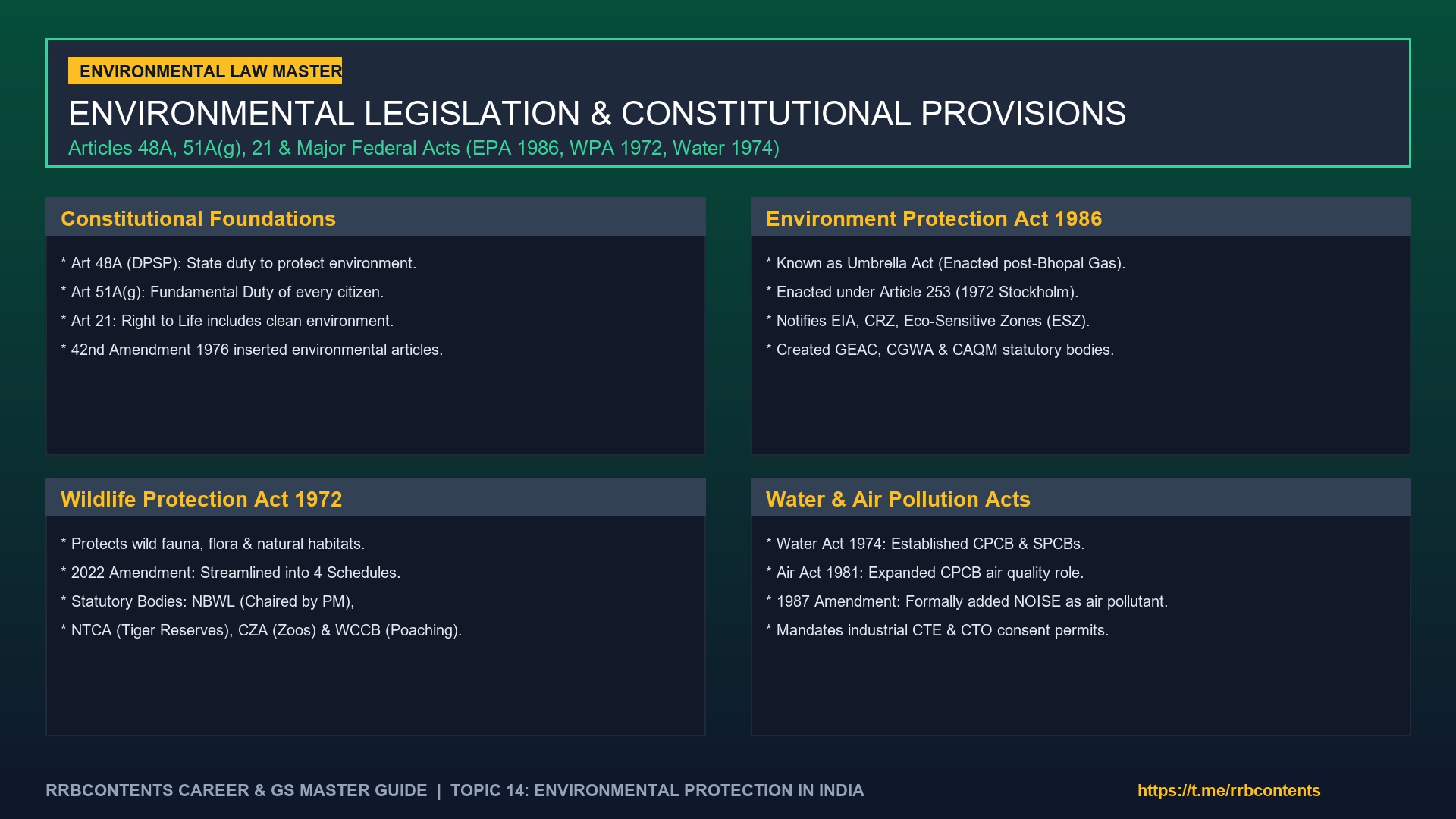
├── Article 48A (Part IV DPSP): Duty of State to protect environment, forests & wildlife
├── Article 51A(g) (Part IV-A Fundamental Duty): Duty of every citizen to protect & improve environment
└── Article 21 (Part III Fundamental Right): Expanded by Judiciary to include Right to Clean Environment
1. Article 48A (Directive Principles of State Policy):
- States: "The State shall endeavour to protect and improve the environment and to safeguard the forests and wildlife of the country."
2. Article 51A(g) (Fundamental Duties):
- Mandates that it shall be the duty of every citizen of India "to protect and improve the natural environment including forests, lakes, rivers and wildlife, and to have compassion for living creatures."
3. Article 21 (Right to Life and Personal Liberty):
- Through landmark judicial rulings (Subhash Kumar v. State of Bihar 1991 and M.C. Mehta v. Union of India), the Supreme Court ruled that the Right to Life under Article 21 includes the Right to enjoy pollution-free water and air for full enjoyment of life.
---
- Buffer Zone Width: Acts as a transition zone around protected areas up to 10 km (or specified distance).
- Prohibited Activities: Commercial mining, sawmills, major polluting industries, and commercial use of firewood.
Chapter 4
MAJOR ENVIRONMENTAL ACTS IN INDIA: AN OVERVIEW
Major Environmental Legislation Framework
├── 1. Wildlife (Protection) Act, 1972 (Protection of wild flora/fauna; created NTCA & CZA)
├── 2. Water (Prevention and Control of Pollution) Act, 1974 (Established CPCB & SPCBs)
├── 3. Forest (Conservation) Act, 1980 (Central clearance for forest land diversion)
├── 4. Air (Prevention and Control of Pollution) Act, 1981 (Expanded CPCB; Noise added 1987)
├── 5. Environment (Protection) Act, 1986 ("Umbrella Act" enacted under Article 253)
└── 6. Biological Diversity Act, 2002 (3-Tier Structure: NBA, SBB, BMC)
---
Chapter 5
DETAILED BREAKDOWN OF PRIMARY LEGISLATIVE ACTS
- Enacted: 1972 (Majorly amended in 2006 and 2022).
- Objective: Protection of wild animals, birds, plants, and their habitats.
- Schedules (2022 Amendment): Streamlined from 6 schedules down to 4 Schedules:
- Schedule I: Highest protection for animal species (Tigers, Elephants, Rhinos, Lions, Great Indian Bustards). Heavy criminal penalties for poaching.
- Schedule II: Animal species subject to specified protection.
- Schedule III: Protected Plant Species.
- Schedule IV: CITES (Convention on International Trade in Endangered Species) specimens.
- Statutory Bodies Created under WPA 1972:
1. National Board for Wildlife (NBWL): Chaired by the Prime Minister of India.
2. National Tiger Conservation Authority (NTCA): Statutory body overseeing Project Tiger and Tiger Reserves.
3. Central Zoo Authority (CZA): Regulates and accredits zoos across India.
4. Wildlife Crime Control Bureau (WCCB): Statutory multi-disciplinary intelligence agency fighting illegal wildlife trade.
---
- Enacted: 1974 (Amended in 1988 & 2024).
- Primary Impact: Established the Central Pollution Control Board (CPCB) at the national level and State Pollution Control Boards (SPCBs) in all states.
- Core Functions: Lays down water quality standards, conducts water pollution monitoring, and mandates industrial effluents to obtain "Consent to Establish" (CTE) and "Consent to Operate" (CTO).
---
- Enacted: 1981 (Amended in 1987).
- Primary Impact: Expanded CPCB and SPCBs to monitor and control atmospheric air pollution.
- Key Amendment (1987): Formally included NOISE as an air pollutant under the Air Act.
---
4-Stage EIA Clearance Workflow
├── Stage 1: Screening (Category A projects cleared by Central EAC | Category B by State SEAC)
├── Stage 2: Scoping (Drafting Terms of Reference ToR for baseline environmental data)
├── Stage 3: Public Consultation (Public Hearing in local language + Written Comments)
└── Stage 4: Appraisal (Final review by Expert Appraisal Committee & grant of EC)
- CRZ-I (Ecologically Sensitive Areas): Mangroves, coral reefs, sand dunes, turtle nesting grounds. NO new construction permitted.
- CRZ-II (Developed Urban Coastal Areas): Developed municipal areas where construction is permitted on landward side of existing road/structure.
- CRZ-III (Rural Coastal Areas): Rural areas divided into CRZ-III A (densely populated rural areas with No Development Zone NDZ reduced from 200m to 50m from High Tide Line HTL) and CRZ-III B (rural areas with NDZ of 200m).
- CRZ-IV (Water Area): Territorial water limits up to 12 nautical miles and tidal water bodies.
- Enacted: 1986 under Article 253 of the Constitution (to give effect to international decisions made at the 1972 Stockholm UN Conference).
- Trigger Event: Enacted in the immediate aftermath of the Bhopal Gas Tragedy (December 1984) to fill legal gaps in pollution control.
- Why Called "Umbrella Act": Provides an overarching legal umbrella framework coordinating all central and state environmental authorities.
- Executive Powers delegated to Central Govt under EPA 1986:
- Environmental Impact Assessment (EIA) Notifications: Mandates prior environmental clearance for major infrastructure and industrial projects.
- Coastal Regulation Zone (CRZ) Notifications: Regulates development along 7,516 km coastline.
- Eco-Sensitive Zones (ESZ): Notifies buffer zones around National Parks and Wildlife Sanctuaries.
- Hazardous Waste & Plastic Waste Management Rules.
- Statutory Authorities Created under EPA 1986:
1. Central Ground Water Authority (CGWA): Regulates commercial groundwater extraction.
2. Genetic Engineering Appraisal Committee (GEAC): Statutory body under MoEFCC responsible for appraisal of proposals relating to release of Genetically Modified (GM) organisms and crops (e.g. Bt Cotton, GM Mustard) into the environment.
3. Commission for Air Quality Management (CAQM): Oversees air quality in NCR and adjoining areas.
---
- Enacted: 2002 to implement the UN Convention on Biological Diversity (CBD).
- Three-Tier Statutory Architecture:
1. National Biodiversity Authority (NBA): Statutory body headquartered in Chennai, Tamil Nadu. Regulates access to biological resources and fair/equitable benefit sharing (ABS).
2. State Biodiversity Boards (SBBs): State-level regulation of commercial biodiversity access.
3. Biodiversity Management Committees (BMCs): Established at the local Gram Panchayat and Municipal level. Mandated to prepare the People's Biodiversity Register (PBR) documenting local bio-resources and traditional ecological knowledge.
---
- Exempted Strategic Lands: Exempts border infrastructure lands located within 100 km of international borders/LAC/LOC for strategic national security projects from prior central forest clearance.
- Scope Definition: Clarified that the Act applies to land notified as forest under the Indian Forest Act 1927 or recorded as forest in government records after 1980.
- Promoting Agroforestry: Encourages private land tree plantation and agroforestry by exempting private non-forest land plantations.
- Background: Whenever forest land is diverted for non-forest purposes under the Forest Conservation Act 1980, the user agency must pay Net Present Value (NPV) of forest land and fund compensatory afforestation on equivalent non-forest land.
- Statutory Fund Structure: CAF Act 2016 created the National Compensatory Afforestation Fund (holding 10% of funds) and State Compensatory Afforestation Funds (holding 90% of funds).
- Utilization Rules: Funds utilized exclusively for artificial afforestation, assisted natural regeneration, wildlife protection, and forest infrastructure.
Chapter 6
NATIONAL GREEN TRIBUNAL (NGT) ACT, 2010
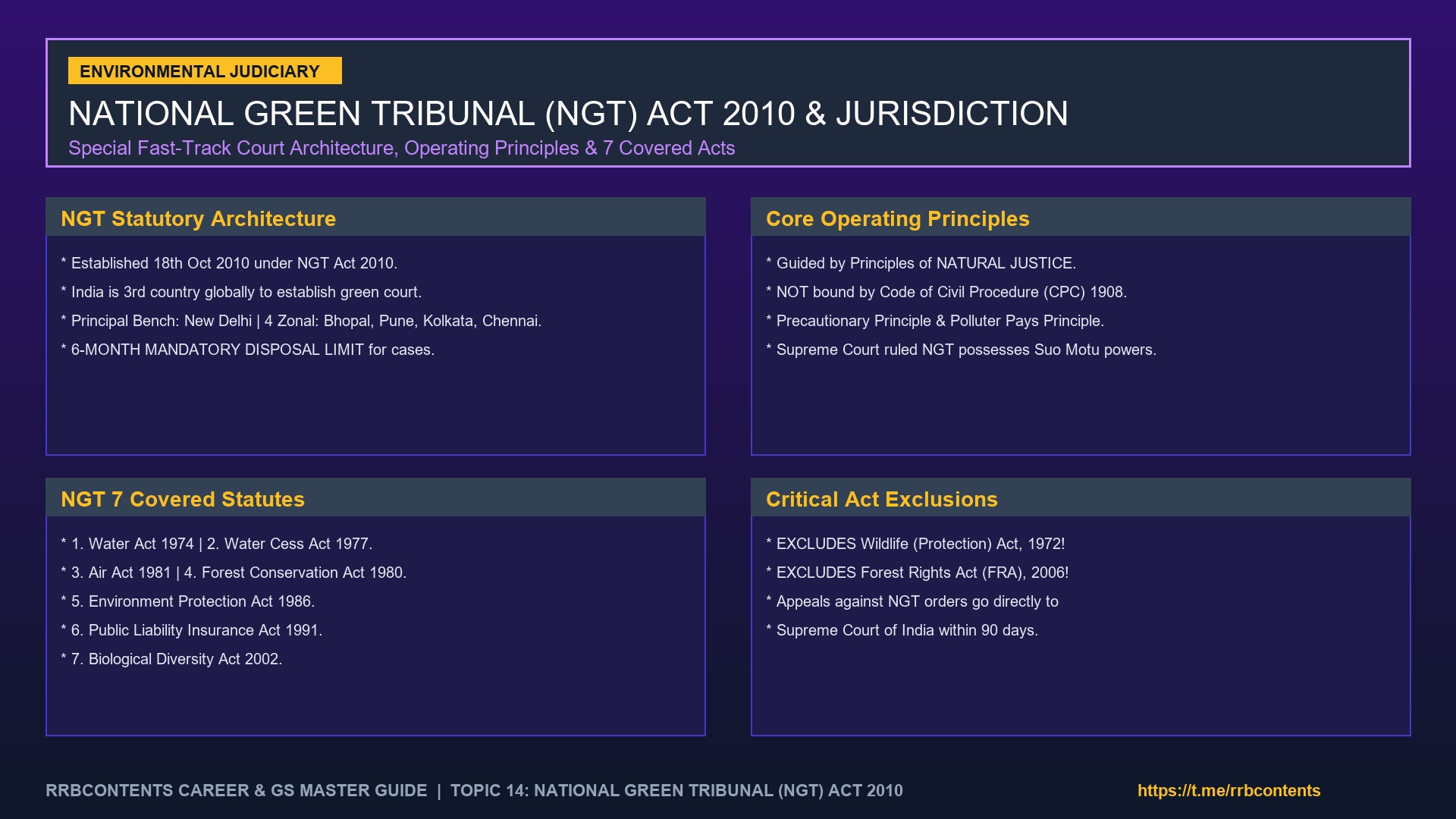
The National Green Tribunal (NGT) was established on 18th October 2010 under the National Green Tribunal Act, 2010. India became only the third country in the world (after Australia and New Zealand) to establish a specialized environmental tribunal.
National Green Tribunal (NGT) Architecture
├── Statutory Status: Special fast-track environmental court established under NGT Act 2010
├── Constitutional Basis: Article 21 (Right to a Healthy Environment)
├── Benches: Principal Bench (New Delhi) + 4 Zonal Benches (Bhopal, Pune, Kolkata, Chennai)
├── 6-Month Disposal Mandate: Mandatory disposal of cases within 6 months of filing
├── Legal Procedure: Guided by Principles of NATURAL JUSTICE (NOT bound by CPC 1908)
└── Core Operating Principles: Precautionary Principle, Polluter Pays Principle & Sustainable Dev
---
Chapter 7
COMPOSITION AND STRUCTURE OF NGT
| Component / Parameter | Statutory Provision & Structure |
|---|---|
| Chairperson | Appointed by Central Govt in consultation with Chief Justice of India (CJI). Must be a retired Supreme Court Judge or retired High Court Chief Justice. |
| Judicial Members | Minimum 10 to Maximum 20 full-time Judicial Members (retired SC/HC Judges). |
| Expert Members | Minimum 10 to Maximum 20 Expert Members (Ph.D. in Science/Engineering with 15 years experience in environment). |
| Benches Network | Principal Bench: New Delhi. 4 Zonal Benches: Bhopal (Central), Pune (Western), Kolkata (Eastern), Chennai (Southern). |
| Procedure & Evidence | NOT bound by the Code of Civil Procedure (CPC), 1908 or Indian Evidence Act, 1872. Guided by Principles of Natural Justice. |
| Appeals Route | Appeals against NGT orders go directly to the Supreme Court of India within 90 days. |
---
Chapter 8
NGT JURISDICTION: THE 7 COVERED ACTS VS EXCLUSIONS
NGT 7 Covered Statutes
├── 1. Water (Prevention and Control of Pollution) Act, 1974
├── 2. Water (Prevention and Control of Pollution) Cess Act, 1977
├── 3. Air (Prevention and Control of Pollution) Act, 1981
├── 4. Forest (Conservation) Act, 1980
├── 5. Environment (Protection) Act, 1986
├── 6. Public Liability Insurance Act, 1991
└── 7. Biological Diversity Act, 2002
1. Wildlife (Protection) Act, 1972.
2. Scheduled Tribes and Other Traditional Forest Dwellers (Recognition of Forest Rights) Act, 2006 (FRA).
---
Chapter 9
# Commission for Air Quality Management in National Capital Region (CAQM) Act, 2021:
- Jurisdiction: Covers National Capital Region (NCR) and adjoining areas across Punjab, Haryana, Rajasthan, and Uttar Pradesh.
- Overriding Powers: CAQM decisions override state government decisions on air pollution, stubble burning control, vehicle emission norms, and industrial fuel restrictions.
Chapter 10
# Solid Waste Management Rules 2016 & Plastic Waste Management Rules 2021:
Chapter 11
IMPORTANCE FOR COMPETITIVE EXAMS & QUICK REVISION
1. Constitutional Articles: Article 48A (DPSP - State duty); Article 51A(g) (Fundamental Duty - Citizen duty); Article 21 (Right to clean environment).
2. EPA 1986 ("Umbrella Act"): Enacted under Article 253 post-Bhopal Gas Tragedy; created GEAC, CGWA & EIA notifications.
3. NGT 2010 Fast Facts: Est. 18th Oct 2010; Principal Bench New Delhi + 4 Zonal Benches (Bhopal, Pune, Kolkata, Chennai); 6-month case disposal mandate; Guided by Natural Justice.
4. NGT Jurisdiction: Covers 7 Acts; Excludes Wildlife Protection Act 1972 & Forest Rights Act 2006!
---
Chapter 12
FREQUENTLY ASKED QUESTIONS (FAQS)
Chapter 13
# Q1: Which article of the Indian Constitution makes it a Fundamental Duty of citizens to protect the environment?
Answer: Article 51A(g) inserted by the 42nd Constitutional Amendment Act, 1976.
Chapter 14
# Q2: Why is the Environment (Protection) Act, 1986 referred to as an "Umbrella Act"?
Answer: Because it provides an overarching framework coordinating all central and state environmental authorities and pollution control agencies created under previous acts.
Chapter 15
# Q3: Which constitutional article authorized Parliament to enact the Environment (Protection) Act, 1986?
Answer: Article 253 (Legislation for giving effect to international agreements—specifically the 1972 Stockholm Conference).
Answer: The National Biodiversity Authority (NBA) is headquartered in Chennai, Tamil Nadu.
Chapter 16
# Q5: What is the statutory time limit for NGT to dispose of an environmental application?
Answer: The NGT is legally mandated to dispose of applications within 6 months of filing.
Chapter 17
# Q6: Is the National Green Tribunal bound by the Code of Civil Procedure (CPC), 1908?
Answer: NO. The NGT is not bound by the CPC 1908 or the Indian Evidence Act 1872; it is guided by the Principles of Natural Justice.
Answer: The Wildlife (Protection) Act, 1972 and the Forest Rights Act (FRA), 2006 are excluded from NGT jurisdiction.
Answer: The Prime Minister of India serves as the ex-officio Chairperson of the NBWL.
Chapter 18
# Q9: Which committee is responsible for approving Genetically Modified (GM) crops in India?
Answer: The Genetic Engineering Appraisal Committee (GEAC), a statutory body under the Ministry of Environment, Forest and Climate Change (MoEFCC).
Answer: In Bhopal, Pune, Kolkata, and Chennai (Principal Bench in New Delhi).
Chapter 19
# Q11: Which act formally added Noise as an air pollutant in India?
Answer: The 1987 Amendment to the Air (Prevention and Control of Pollution) Act, 1981.
Answer: A comprehensive record prepared by local Biodiversity Management Committees (BMCs) documenting local biological resources and traditional knowledge.
---
Chapter 20
# Q13: What are the 4 stages of Environmental Impact Assessment (EIA) clearance?
Answer: The 4 stages are Screening, Scoping, Public Consultation (Public Hearing), and Appraisal.
Chapter 21
# Q14: What is the No Development Zone (NDZ) under CRZ-III A of 2019 Notification?
Answer: Under CRZ-III A (densely populated rural coastal areas), the No Development Zone (NDZ) was reduced from 200 meters to 50 meters from the High Tide Line (HTL).
Chapter 22
# Q15: What is the 100 km border exemption under the 2023 Forest Conservation Amendment Act?
Answer: Exemption from prior central forest clearance for strategic national security infrastructure projects within 100 km of international borders, LAC, or LOC.
Chapter 23
# Q16: How are funds shared between National and State CAMPA under CAF Act 2016?
Answer: 90% of funds are allocated to State Compensatory Afforestation Funds and 10% to the National Fund.
Answer: A statutory authority created in 2021 to regulate and control air pollution and stubble burning in Delhi-NCR and adjoining states.
- No-Fault Liability Principle: Mandates industrial units handling hazardous substances to take mandatory public liability insurance policies, providing immediate relief to victims of industrial accidents regardless of any wrongful act or negligence.
- Environmental Relief Fund (ERF): Created under the Act to disburse compensation when claims exceed insurance coverage limits.
Chapter 24
ECO-MARK SCHEME & GREEN RATING SYSTEMS
Chapter 25
# Eco-Mark Scheme (1991):
- Issued by Central Pollution Control Board (CPCB) under Environment Protection Act 1986.
- Logo: An earthen pot (Matka) — symbolizes eco-friendly, recyclable, natural materials.
- Awarded to consumer products satisfying environmental criteria alongside BIS quality standards.
Chapter 26
# Green Rating for Integrated Habitat Assessment (GRIHA):
- India's national rating system for green buildings, developed by TERI and Ministry of New and Renewable Energy (MNRE).
- Assesses building sustainability across energy performance, water conservation, and waste management.
---
Chapter 27
# Public Liability Insurance Act, 1991:
- Enacted in response to the 1984 Bhopal Gas Tragedy.
- Mandates industrial units handling hazardous substances to take out public liability insurance policies.
- Provides immediate relief to persons affected by accidents occurring while handling hazardous substances on a no-fault liability basis.
---
Chapter 28
CONCLUSION
Environmental protection in India represents an intricate synthesis of constitutional imperatives, federal statutes, statutory regulatory authorities, and specialized judicial oversight. By empowering statutory bodies like the CPCB, NBA, and GEAC, enforcing EIA compliance under the Environment Protection Act 1986, and delivering swift environmental justice through the National Green Tribunal, India strives to balance economic growth with ecological preservation.
Strengthening public participation through People's Biodiversity Registers (PBR), enforcing the Polluter Pays Principle, and strictly monitoring industrial pollution will ensure ecological security for future generations.
For competitive exam aspirants, mastering constitutional provisions (48A, 51A(g), 21), EPA 1986 delegated powers, NGT 7-act jurisdiction, and statutory committee structures guarantees complete preparation for scoring top marks in Environmental Law and Governance.
👉 Official Career Portal: [https://rrbcontents.com](https://rrbcontents.com)
👉 Official Telegram Channel: [Join RRBCONTENTS Telegram (@rrbcontents)](https://t.me/rrbcontents)
---
Chapter 29
ADDITIONAL EXAM INSIGHTS & CASE STUDIES
---
Chapter 30
# ENVIRONMENT PROTECTION ACT 1986 — KEY SECTIONS FOR EXAM
The Environment (Protection) Act 1986 is called the "Umbrella Act" because it provides a comprehensive overarching framework. The following sections are most frequently tested in exams:
| Section | Provision | Exam Relevance |
|---|---|---|
| Section 2 | Definitions — Environment, Environmental Pollutant, Environmental Pollution | Foundation for understanding scope of Act |
| Section 3 | Powers of Central Government to take measures for protection of environment | Widest powers: set standards, regulate industrial operations, restrict areas of industry, restrict use of hazardous substances |
| Section 5 | Power to give directions — Central Govt can issue binding written directions to any person, officer, or authority | Includes directions to close, prohibit, or regulate industries; override all state directions |
| Section 7 | No person to discharge/emit environmental pollutants exceeding prescribed standards | Core pollution prohibition |
| Section 15 | Penalties — Imprisonment up to 5 years OR fine up to Rs 1 lakh (or both); continuing violations attract Rs 5,000 per day additional fine | Most tested penalty provision |
| Section 16 | Offences by Companies — when offence committed by company, every person in charge (Director, Manager, Secretary) at time of offence is deemed guilty | Corporate liability principle |
| Section 19 | Cognizance of offences — No court shall take cognizance of any offence except on complaint of Central Government or authorized officer | Procedural protection against frivolous litigation |
Exam Alert: Under Section 15, if the violation continues beyond one year after conviction, imprisonment can extend to 7 years.
---
Chapter 31
# AIR (PREVENTION AND CONTROL OF POLLUTION) ACT 1981 — CPCB AND SPCBS
- Enacted: 1981; Amended: 1987 (to include Noise as an air pollutant)
- CPCB (Central Pollution Control Board): Established under the Water Act 1974 but its functions were extended to air pollution monitoring under the Air Act 1981.
- Headquarters: New Delhi
- Chairman: A civil servant appointed by Central Govt
- Powers: Set national ambient air quality standards; publish national air quality data; advise Central Govt; coordinate with SPCBs
- SPCBs (State Pollution Control Boards): Created in every state under both Water Act 1974 and Air Act 1981.
- Powers: Grant "Consent to Establish" (CTE) and "Consent to Operate" (CTO) to industries; monitor industrial emissions; enforce standards; shut down polluting units
- Composition: Chairman (appointed by State Govt) + officials + experts
- Key Provision: Industries must obtain SPCB consent before establishing or operating any plant that may emit air pollutants. Violators face criminal prosecution under Section 37-39 of Air Act.
---
Chapter 32
# WATER (PREVENTION AND CONTROL OF POLLUTION) ACT 1974 — STRUCTURE AND POWERS
- Enacted: 1974; Amended: 1988 (strengthened powers) and 2024 (decriminalization of minor offences)
- Historic First: Established the Central Pollution Control Board (CPCB) — India's apex body for pollution monitoring and regulation.
- Key Provisions:
1. Section 17: CPCB functions — to plan and cause execution of nationwide programs for prevention, control, and abatement of water pollution
2. Section 25: Prohibition on discharge of trade effluents into water bodies without state board consent
3. Section 33-A: Power of Board to issue direction to close, prohibit, or regulate operations of any industry
4. Water Pollution Cess Act 1977: Companion legislation levying cess on water consumed by industries for self-treatment and disposal
- 2024 Amendment: Decriminalized minor water pollution offences, replacing criminal penalties with civil monetary penalties to reduce industry harassment while preserving major penalty provisions.
---
Chapter 33
# FOREST CONSERVATION ACT 1980 — SECTION 2 AND FOREST DIVERSION
- Section 2 (Most Important): No state government or other authority shall make, except with prior approval of the Central Government, any order directing that:
- Reserved Forest shall cease to be reserved forest
- Forest land shall be used for non-forest purposes
- Forest land shall be leased to private parties
- Re-afforestation shall not be carried out on forest land denuded
- Non-Forest Purpose: Includes cultivation of cash crops, orchards, industries, residential colonies, dams, roads — essentially any use that is not directly related to managing and protecting forests.
- Compensatory Afforestation: When Central Govt grants forest diversion clearance, user agency must:
Chapter 34
1. Pay Net Present Value (NPV) of forest ecosystem services (up to Rs 10 lakh per hectare for dense forest)
Chapter 35
2. Fund compensatory afforestation on equivalent non-forest land
- 2023 Amendment (Van Adhiniyam 2023): Exempted strategic security infrastructure within 100 km of international borders from requiring central clearance — controversial among conservationists.
---
Chapter 36
# FOREST RIGHTS ACT 2006 — INDIVIDUAL AND COMMUNITY RIGHTS FOR SCHEDULED TRIBES
Categories of Rights Recognized:
| Category | Type | Rights Granted |
|---|---|---|
| Individual Forest Rights (IFR) | Land rights | Rights to cultivate forest land occupied before 13 December 2005 (up to 4 hectares per family) |
| Community Forest Rights (CFR) | Governance rights | Rights of Gram Sabha over community forest resources — NTFPs, grazing, water bodies, sacred groves |
| Community Forest Resource Rights | Self-governance | Rights to protect, regenerate, conserve, and manage community forest within traditional boundary |
| Developmental Rights | Infrastructure | Rights to establish or regularize schools, health centers, anganwadis, roads within forest villages |
Key Procedural Points:
- Claims filed before Sub-Divisional Level Committee (SDLC)
- Verification by District Level Committee (DLC) chaired by District Collector
- Final title issued by State Govt
- Gram Sabha is the basic unit of recognition — holds primary authority over CFR claims
- FRA is NOT covered under NGT jurisdiction (critical exam distinction)
Milestone Judgment: In the Godavarman case (Writ Petition 202/1995), the Supreme Court directed that no dereservation of forests or mining without court permission, effectively recognizing community rights in forest governance.
---
Chapter 37
# BIOLOGICAL DIVERSITY ACT 2002 — THREE-TIER STRUCTURE IN DETAIL
The Biological Diversity Act 2002 implements India's obligations under the UN Convention on Biological Diversity (CBD, 1992) and the Nagoya Protocol on Access and Benefit Sharing (ABS):
| Tier | Body | Location/Level | Primary Function |
|---|---|---|---|
| National | National Biodiversity Authority (NBA) | Chennai, Tamil Nadu | Regulate access to biological resources by foreign nationals/companies; approve biodiversity-related IPR applications; negotiate benefit-sharing agreements |
| State | State Biodiversity Boards (SBBs) | State capitals | Regulate access by Indian citizens/companies to commercial use of bio-resources; advise state govts on biodiversity conservation |
| Local | Biodiversity Management Committees (BMCs) | Gram Panchayat and Municipal Ward level | Prepare People's Biodiversity Register (PBR); protect local knowledge; regulate access at local level; levy collection fees |
Benefit Sharing Mechanism: When foreign companies access Indian biological resources or traditional knowledge for commercial purposes, they must pay negotiated benefit-sharing amounts to NBA, which are distributed to local communities through Biodiversity Heritage Sites and community funds.
People's Biodiversity Register (PBR): A comprehensive document prepared by BMCs recording local bio-resources (plants, animals, fungi, microorganisms) and associated traditional knowledge. Currently, over 1,70,000 BMCs have been constituted across India.
---
The National Green Tribunal (NGT) was established on 18 October 2010 under the National Green Tribunal Act 2010. India became only the third country globally (after Australia and New Zealand) to create a specialized environmental court.
Composition:
| Position | Qualification | Numbers |
|---|---|---|
| Chairperson | Retired SC Judge or retired HC Chief Justice; appointed by CJI in consultation with Central Govt | 1 (at Principal Bench, New Delhi) |
| Judicial Members | Retired SC or HC Judges | Minimum 10, Maximum 20 |
| Expert Members | Minimum Ph.D. + 15 years experience in environment/science/engineering | Minimum 10, Maximum 20 |
Bench Locations:
| Bench | Location | Jurisdiction |
|---|---|---|
| Principal Bench | New Delhi | Pan-India; all original applications |
| Central Zonal Bench | Bhopal, Madhya Pradesh | Central India states |
| Western Zonal Bench | Pune, Maharashtra | Western India states |
| Eastern Zonal Bench | Kolkata, West Bengal | Eastern India states |
| Southern Zonal Bench | Chennai, Tamil Nadu | Southern India states |
Operating Principles:
1. Precautionary Principle: If there is scientific uncertainty about environmental harm, assume harm and prevent the activity.
2. Polluter Pays Principle: The party responsible for pollution bears the cost of remediation and compensation.
3. Principle of Sustainable Development: Development must meet present needs without compromising future generations.
Time Limit: NGT must dispose of applications within 6 months of filing (Statutory mandate — critical exam point).
---
Chapter 38
# CAMPA — COMPENSATORY AFFORESTATION MANAGEMENT AND PLANNING AUTHORITY
Background: Every time forest land is diverted for non-forest purposes (mines, dams, highways, industries) under the Forest Conservation Act 1980, the user agency must deposit funds for compensatory afforestation and Net Present Value (NPV).
Problem: For over two decades (1990-2009), states did not utilize these funds, which accumulated in a Supreme Court-monitored Ad hoc CAMPA account.
Solution — Compensatory Afforestation Fund (CAF) Act 2016:
- National Compensatory Afforestation Fund: Receives 10% of total collections
- State Compensatory Afforestation Funds: Receives 90% of collections (distributed to states based on forest area diverted)
- Utilization: Funds used exclusively for:
Chapter 39
1. Artificial afforestation and natural regeneration
Chapter 40
2. Wildlife protection and management of protected areas
Chapter 41
3. Forest infrastructure (roads, fire management, patrolling)
Chapter 42
4. Catchment area treatment of river basins
NPV Amounts: Vary by forest density — from Rs 5.81 lakh/hectare for open scrub forest to Rs 10.43 lakh/hectare for dense tropical forests (revised 2022).
---
| Category | Description | Key Restrictions |
|---|
Prepare with RRBCONTENTS
Free mock tests, previous year papers, and daily current affairs for UPSC, SSC & Railway exams.
Start Free Mock Tests →Continue Reading
Explore More Articles
Knowledge Hub
More Blog Articles
In-depth articles on Polity, Economy, Environment and Current Affairs.
Study Material
Exam Study Notes
Subject-wise notes and digests for Railway, SSC, Banking and State PSC exams.
Current Affairs
Daily Current Affairs & GK
Daily updates and static GK bank with active-recall quizzes.