FINANCE COMMISSION OF INDIA: ARTICLE 280, ROLE, VERTICAL & HORIZONTAL TAX DEVOLUTION, 15TH & 16TH FC RECOMMENDATIONS (COMPLETE GUIDANCE FOR COMPETITIVE EXAMS)
Chapter 1
INTRODUCTION
The Finance Commission of India is a premier quasi-judicial constitutional body established under Article 280 of the Constitution of India. Functioning as the "financial balance wheel" of Indian fiscal federalism, the Finance Commission is tasked with the critical responsibility of resolving vertical and horizontal fiscal imbalances between the Union Government and the States.
In a federal democracy, the division of taxation powers and expenditure responsibilities between the Centre and States is inherently asymmetrical. While the Central Government possesses high-yielding, elastic tax bases (such as Income Tax, Corporation Tax, Central GST, and Customs Duties), State Governments bear the primary burden of expensive socio-economic expenditures (such as public health, education, police, agriculture, and rural development). To rectify this vertical fiscal imbalance (between Centre and States) and horizontal fiscal imbalance (among States with varying economic capacities), the Constitution mandates the President of India to constitute a Finance Commission every five years.
The recommendations of the Finance Commission determine how tens of trillions of rupees in central tax revenues are shared, shaping state budgets, local body grants to Panchayats and Municipalities, disaster management funds, and regional economic development across India.
For aspirants preparing for competitive examinations such as UPSC Civil Services (GS Paper II & GS Paper III Economics), State Public Service Commissions (BPSC, UPPSC, MPPSC, RAS), SSC CGL, and RBI Grade B exams, a thorough mastery of Article 280, composition criteria, devolution formulas, 14th/15th/16th Finance Commission reports, and Centre-State fiscal relations is essential.
This comprehensive master career guide provides an exhaustive breakdown of the Finance Commission of India. We cover every legal detail—from constitutional articles and qualification rules under the 1951 Act to 15th FC weightage tables, 16th FC terms of reference, Grants-in-Aid under Article 275, 12 exam-focused FAQs, and essential revision tools.
---
Chapter 2
HISTORICAL EVOLUTION & CONSTITUTIONAL BASIS
HISTORICAL EVOLUTION & CONSTITUTIONAL BASIS - Illustrative Reference
Meston Award (1920) & Niemeyer Award (1936) under Government of India Act 1935
       │
       ▼ (26th January 1950 - Enactment of Indian Constitution)
Article 280 Mandates Presidential Constitution of Finance Commission Every 5 Years
       │
       ▼ (Finance Commission (Miscellaneous Provisions) Act, 1951)
Parliament Defines Qualifications & Disqualifications of FC Members
       │
       ▼ (1st Finance Commission 1951 Chaired by K.C. Neogy)
1st FC Recommendations Implemented for 1952-57 Period
       │
       ▼ (December 2023 - 16th Finance Commission Constituted)
16th FC Constituted under Dr. Arvind Panagariya for 2026-31 Period
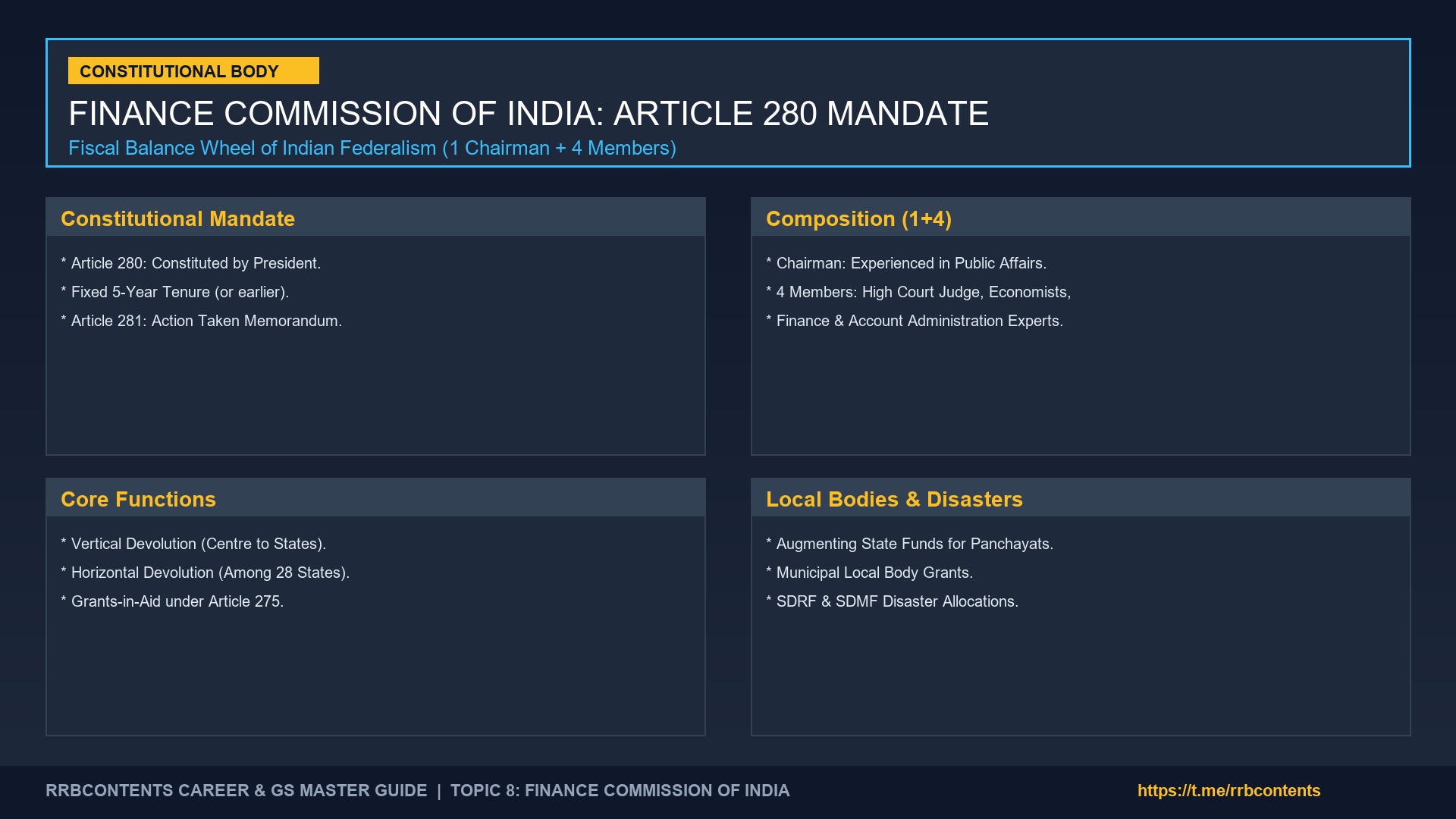
- Article 280(1): The President shall, within two years from the commencement of this Constitution and thereafter at the expiration of every fifth year or at such earlier time as the President considers necessary, by order constitute a Finance Commission.
- Article 280(2): Parliament may by law determine the qualifications which shall be requisite for appointment as members of the Commission and the manner in which they shall be selected.
- Article 281: The President shall cause every recommendation made by the Finance Commission together with an explanatory memorandum as to the action taken thereon (Action Taken Memorandum / TAM) to be laid before each House of Parliament.
---
Chapter 3
COMPOSITION AND QUALIFICATIONS OF FC MEMBERS
Under Article 280(2) and the Finance Commission (Miscellaneous Provisions) Act, 1951, the Commission consists of a Chairman and four other Members appointed by the President of India.
Finance Commission Composition (1 Chairman + 4 Members)
├── Chairman: Person having experience in public affairs
    ├── Member 1: High Court Judge or qualified to be appointed as one
    ├── Member 2: Person having specialized knowledge of finance & accounts of government
    ├── Member 3: Person having wide experience in financial matters & administration
    └── Member 4: Person having special knowledge of economics
1. Chairman: Must be a person having wide experience in public affairs.
2. Four Members: Must be selected from amongst persons who:
- Are, or have been, or are qualified to be appointed as Judges of a High Court; OR
- Have specialized knowledge of finance and accounts of the Government; OR
- Have had wide experience in financial matters and in administration; OR
- Have special knowledge of economics.
- Is of unsound mind.
- Is an undischarged insolvent.
- Has been convicted of an offense involving moral turpitude.
- Has such financial or other interest as is likely to affect prejudicially his functions as a member.
---
Chapter 4
MANDATORY CONSTITUTIONAL FUNCTIONS OF THE FINANCE COMMISSION
Core Mandate of Finance Commission (Article 280(3))
├── 1. Vertical Devolution (Distribution of net tax proceeds between Centre & States)
├── 2. Horizontal Devolution (Allocation of tax shares among individual States)
├── 3. Grants-in-Aid Principles (Determining Art 275 grants out of Consolidated Fund)
├── 4. Local Bodies Augmentation (Augmenting State funds for Panchayats & ULBs - Art 280(3)(bb)/(c))
└── 5. Sound Finance Reference (Any other financial matter referred by President)
---
Chapter 5
# Complete Chronological History of All 16 Finance Commissions (1951 to Present):
| FC # | Chairman | Year Constituted | Operational Period | Key Devolution Highlights |
|---|---|---|---|---|
| :-: | :--- | :-: | :-: | :--- |
| 1st | K.C. Neogy | 1951 | 1952 – 1957 | First FC; fixed States' income tax share at 55%. |
| 2nd | K.S. Santhanam | 1956 | 1957 – 1962 | Increased income tax share to 60%; union excise share 25%. |
| 3rd | A.K. Chanda | 1960 | 1962 – 1966 | Increased income tax share to 66.66%. |
| 4th | P.V. Rajamannar | 1964 | 1966 – 1969 | Increased income tax share to 75%. |
| 5th | Mahavir Tyagi | 1968 | 1969 – 1974 | Maintained 75% income tax share. |
| 6th | K. Brahmananda Reddy | 1972 | 1974 – 1979 | Increased income tax share to 80%; recommended relief grants. |
| 7th | J.M. Shelat | 1977 | 1979 – 1984 | Increased excise duty share from 20% to 40%. |
| 8th | Y.B. Chavan | 1982 | 1984 – 1989 | Introduced Income Distance criterion for horizontal tax sharing. |
| 9th | N.K.P. Salve | 1987 | 1989 – 1995 | Introduced normative approach to state revenue forecasting. |
| 10th | K.C. Pant | 1992 | 1995 – 2000 | Recommended Alternative Scheme of Devolution (29% gross tax). |
| 11th | A.M. Khusro | 1998 | 2000 – 2005 | First under 80th Amendment; share fixed at 29.5% of divisible pool. |
| 12th | C. Rangarajan | 2002 | 2005 – 2010 | Increased share to 30.5%; introduced fiscal responsibility targets. |
| 13th | Vijay Kelkar | 2007 | 2010 – 2015 | Share 32.0%; recommended GST roadmap & renewable energy grants. |
| 14th | Y.V. Reddy | 2013 | 2015 – 2020 | Historic 42.0% share; abolished distinction between plan & non-plan grants. |
| 15th | N.K. Singh | 2017 | 2021 – 2026 | Share 41.0%; 2011 Census used; 12.5% Demographic Performance. |
| 16th | Dr. Arvind Panagariya | 2023 | 2026 – 2031 | Currently reviewing Centre-State tax sharing formula. |
- Divisible Pool of Taxes (Article 270): Under the 80th Constitutional Amendment Act, 2000, all central taxes and duties (Income Tax, Corporation Tax, CGST, IGST, Central Excise) form part of the central divisible pool, EXCEPT cesses and surcharges levied by the Centre for specific purposes, and administrative costs.
| Finance Commission | Chairman | Period | Vertical Devolution Share to States |
|---|---|---|---|
| 11th Finance Commission | A.M. Khusro | 2000 – 2005 | 29.5% of net central taxes |
| 12th Finance Commission | C. Rangarajan | 2005 – 2010 | 30.5% of net central taxes |
| 13th Finance Commission | Vijay Kelkar | 2010 – 2015 | 32.0% of net central taxes |
| 14th Finance Commission | Y.V. Reddy | 2015 – 2020 | 42.0% (Historic structural jump of 10%) |
| 15th Finance Commission | N.K. Singh | 2021 – 2026 | 41.0% (1% adjusted for UTs of J&K & Ladakh) |
---
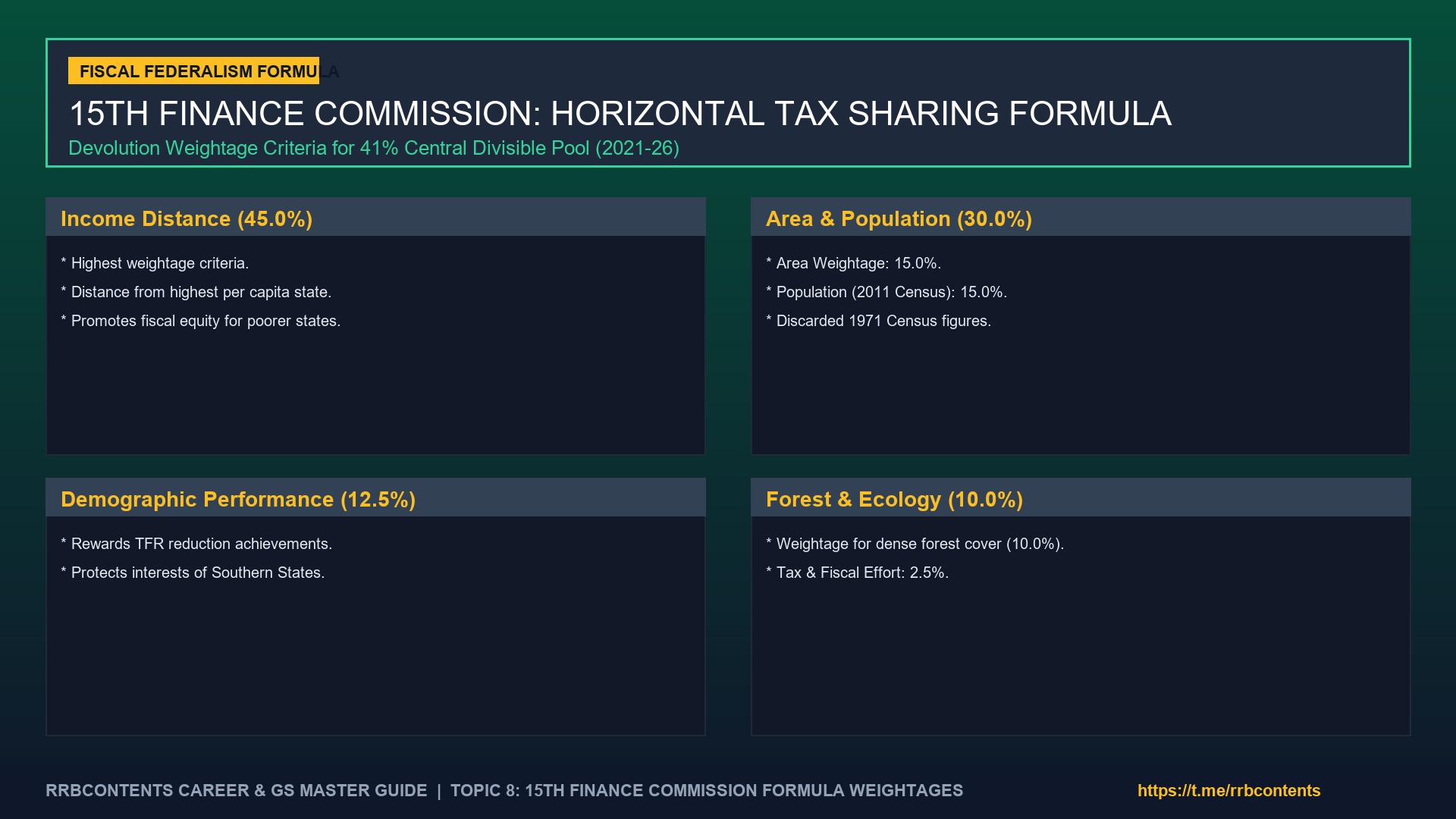
15th FC Horizontal Tax Sharing Formula Weightages
├── 1. Income Distance (45.0%): Measures relative economic backwardness
├── 2. Area (15.0%): Spatial extent & administrative terrain costs
├── 3. Population - 2011 Census (15.0%): Absolute demographic footprint
├── 4. Demographic Performance (12.5%): Rewards states lowering Total Fertility Rate (TFR)
├── 5. Forest & Ecology (10.0%): Dense forest cover preservation reward
└── 6. Tax & Fiscal Effort (2.5%): Tax collection efficiency reward
- Equalization Principle: States with lower per capita income receive proportionally higher funds per capita, ensuring that poorer states (e.g., Bihar, UP, Jharkhand) have adequate fiscal resources to provide basic public services at comparable taxation levels.
| Devolution Indicator / Criterion | Weightage (%) | Rationale & Practical Calculation Method |
|---|---|---|
| Income Distance | 45.0% | Distance of a state's Per Capita GSDP from the highest per capita income state (Haryana/Telangana). Higher weightage gives more funds to lower-income states (e.g., Bihar, UP, MP) to promote equity. |
| Area | 15.0% | Larger states incur higher administrative and infrastructure costs. Minimum area cap of 2% applied for smaller states. |
| Population (2011 Census) | 15.0% | Reflects absolute public expenditure needs based on the 2011 Census. (15th FC completely discarded 1971 Census figures). |
| Demographic Performance | 12.5% | Introduced to reward Southern and Western states (e.g., Kerala, TN, Andhra, Karnataka) that successfully achieved TFR reduction. Calculated as inverse of TFR. |
| Forest & Ecology | 10.0% | Calculated based on a state's share of Very Dense and Moderately Dense Forest cover. Rewards states preserving ecological carbon sinks. |
| Tax & Fiscal Effort | 2.5% | Rewards states demonstrating higher tax collection efficiency relative to their economic potential. |
---
1. Statutory Grants (Article 275):
- Recommended by the Finance Commission out of the Consolidated Fund of India.
- Charged on the Consolidated Fund of India (non-votable expenditure).
- Aimed at helping financially weaker states achieve financial equilibrium and funding SC/ST welfare schemes.
2. Discretionary Grants (Article 282):
- Granted by the Union Government (and States) for any public purpose.
- Formerly utilized by the Planning Commission to channel Centrally Sponsored Schemes (CSS).
- Discretionary in nature and NOT bound by Finance Commission recommendations.
- Cost-Sharing Pattern: Total recommended allocation of ₹1.60 Lakh Crore for State Disaster Risk Management Funds (SDRMF).
- Funding Ratio: Central and State contributions maintain an 80:20 ratio for North-Eastern and Himalayan States (Himachal Pradesh, Uttarakhand, UT of J&K), and a 75:25 ratio for all other States.
- Mitigation Funds: For the first time, allocation was split into SDRF (80% for response & relief) and SDMF (20% for proactive disaster mitigation) projects.
Chapter 6
# 3. GRANTS-IN-AID UNDER ARTICLE 275
Apart from tax devolution, the Finance Commission recommends statutory Grants-in-Aid under Article 275 out of the Consolidated Fund of India to specific States needing financial assistance:
1. Revenue Deficit Grants (Post-Devolution): Provided to states that still face a deficit on revenue accounts after receiving their share of tax devolution (e.g., West Bengal, Kerala, Himachal Pradesh, NE States).
2. Local Government Grants: Grants to Panchayats and Urban Local Bodies for basic civic amenities (water supply, sanitation, solid waste management).
3. Sector-Specific Grants: Grants for primary education, health, agriculture, and judiciary.
4. State-Specific Grants: Grants for historic monument preservation, coastal protection, and regional development projects.
---
Chapter 7
15TH FINANCE COMMISSION (N.K. SINGH COMMISSION) DEEP DIVE
The 15th Finance Commission was constituted under N.K. Singh in November 2017. Due to the reorganization of Jammu & Kashmir in 2019 and economic changes, it submitted two reports: an interim report for 2020-21 and a final report for 2021-22 to 2025-26.
- Devolution Share: Fixed vertical devolution at 41% for States.
- Total Transfers: Recommended total transfers of ₹103.7 Lakh Crore over 2021-26 (Tax devolution ₹42.2 Lakh Cr + Grants ₹10.3 Lakh Cr).
- Local Body Grants: Recommended ₹4.36 Lakh Crore for local bodies (60% tied to drinking water and sanitation; 40% untied).
- Performance Incentives for Local Bodies: Mandated online auditing of accounts (AuditOnline) and publication of annual accounts as prerequisite conditions for receiving local body grants.
- Fiscal Deficit Targets: Recommended Central fiscal deficit target of 4.0% of GDP by 2025-26, and State fiscal deficit limit of 3.0% of GSDP.
---
Chapter 8
16TH FINANCE COMMISSION (DR. ARVIND PANAGARIYA)
The Central Government officially constituted the 16th Finance Commission on 31st December 2023 under the chairmanship of eminent economist Dr. Arvind Panagariya (former Vice-Chairman of NITI Aayog).
16th Finance Commission Snapshot
├── Chairman: Dr. Arvind Panagariya (Eminent Economist)
├── Secretary: Ritvik Ranjanam Pandey (IAS)
├── Period of Recommendations: 5 Years (1st April 2026 to 31st March 2031)
└── Report Submission Deadline: 31st October 2025
Chapter 9
1. Distribution of net proceeds of taxes between Union and States under Chapter I, Part XII of Constitution.
Chapter 10
2. Principles governing Grants-in-Aid under Article 275.
Chapter 11
3. Measures needed to augment State Consolidated Funds to supplement Panchayat and Municipality resources.
Chapter 12
4. Reviewing disaster management financing arrangements under the Disaster Management Act, 2005.
---
When Goods and Services Tax (GST) was introduced via the 101st Constitutional Amendment Act in 2017, State Governments surrendered their constitutional autonomy over sales tax and VAT:
- 5-Year Compensation Guarantee: The Centre guaranteed a 14% annual revenue growth rate for States, promising GST Compensation Cess to make up for any revenue shortfall for 5 years (2017 to June 2022).
- Post-2022 Fiscal Stress: The expiry of the GST compensation period in June 2022 created significant revenue gaps for manufacturing states (such as Gujarat, Maharashtra, Tamil Nadu, and Haryana). State Governments have urged the 16th Finance Commission to address this structural revenue shock in its 2026-31 recommendations.
- FRBM Act 2003 Oversight: Evaluates Centre and State debt-to-GDP ratios, recommending a combined debt ceiling of 60% of GDP (40% Centre + 20% States).
- Fiscal Deficit Anchors: Recommends binding fiscal deficit targets (3% of GSDP for States) with additional 0.5% borrowing limits linked to power sector reforms.
Chapter 13
ISSUES & CONFLICTS IN CENTRE-STATE FISCAL RELATIONS
Under Article 270, cesses and surcharges levied by the Central Government do NOT form part of the central divisible pool shared with States. Over the last decade, cesses/surcharges have grown to over 18-20% of total Central gross tax revenue, effectively shrinking the actual divisible pool available for 41% sharing!
Southern States (Tamil Nadu, Kerala, Karnataka, Andhra Pradesh) protested against the 15th FC terms of reference mandating the use of the 2011 Census instead of 1971, arguing that it penalizes states that successfully controlled population growth. (Mitigated by introducing the 12.5% Demographic Performance weightage).
Central Government restrictions under Article 293(3) limiting state market borrowings to 3% of GSDP, including state PSU off-budget liabilities, have led to legal challenges by states (e.g., State of Kerala v. Union of India, 2024).
---
Prior to the 14th Finance Commission, 11 states (8 North-Eastern states + Himachal Pradesh, Uttarakhand, J&K) enjoyed Special Category Status (SCS) receiving 90:10 central grant funding:
- 14th FC Reform: Following the increase in vertical devolution to 42%, the distinction between Special Category States and General Category States for plan assistance was formally phased out.
- Special Assistance Grants: To compensate vulnerable hill states, the 15th FC introduced targeted sector-specific and post-devolution revenue deficit grants.
Chapter 14
IMPORTANCE FOR COMPETITIVE EXAMS & QUICK REVISION
1. Core Articles: Art 280 (FC Constitution & Mandate), Art 281 (Action Taken Memorandum), Art 270 (Divisible Pool), Art 275 (Grants-in-Aid).
2. Composition: 1 Chairman + 4 Members. Qualifications fixed by Finance Commission Act 1951.
3. 14th vs 15th Devolution: 14th FC = 42% (Y.V. Reddy); 15th FC = 41% (N.K. Singh).
4. 15th FC Criteria: Income Distance (45%), Area (15%), Population 2011 (15%), Demographic Performance (12.5%), Forest & Ecology (10%), Tax Effort (2.5%).
---
Chapter 15
FREQUENTLY ASKED QUESTIONS (FAQS)
Answer: Article 280 of the Indian Constitution governs the establishment, composition, and functions of the Finance Commission.
Chapter 16
# Q2: Who appoints the Chairman and Members of the Finance Commission?
Answer: The President of India appoints the Chairman and four members of the Finance Commission every five years (or earlier).
Chapter 17
# Q3: What is the current vertical tax devolution share recommended by the 15th Finance Commission?
Answer: The 15th Finance Commission recommended a vertical devolution share of 41% of the net central tax pool to States (1% reduced from 42% to adjust for UTs of J&K and Ladakh).
Answer: Eminent economist Dr. Arvind Panagariya (former Vice-Chairman of NITI Aayog) is the Chairman of the 16th Finance Commission.
Answer: No. Under Article 270, proceeds of cesses and surcharges levied by the Central Government are retained exclusively by the Centre and do NOT form part of the central divisible pool.
Chapter 18
# Q6: Which criterion holds the highest weightage in the 15th Finance Commission horizontal devolution formula?
Answer: Income Distance holds the highest weightage at 45.0%, aimed at reducing economic disparities among States.
Answer: Vertical Devolution is the allocation of central tax proceeds from the Centre to all States collectively (41%). Horizontal Devolution is the distribution of that 41% share among individual 28 States based on socio-economic criteria.
Chapter 19
# Q8: Who was the Chairman of the 1st Finance Commission of India?
Answer: K.C. Neogy was the Chairman of the 1st Finance Commission of India (constituted in 1951 for 1952-57 period).
Answer: Grants-in-Aid are statutory funds recommended by the Finance Commission and paid out of the Consolidated Fund of India to specific States needing financial assistance for revenue deficits, local bodies, or disasters.
Chapter 20
# Q10: Why did the 15th Finance Commission introduce the 'Demographic Performance' criterion?
Answer: Weighted at 12.5%, it was introduced to reward States (especially Southern States) that successfully controlled population growth and reduced Total Fertility Rates (TFR).
Chapter 21
# Q11: Are recommendations of the Finance Commission legally binding on the Government?
Answer: No. Recommendations of the Finance Commission under Article 280 are advisory in nature. However, by constitutional convention, vertical tax devolution recommendations are accepted without modification.
Chapter 22
# Q12: Which Finance Commission recommended the historic jump in tax devolution from 32% to 42%?
Answer: The 14th Finance Commission chaired by Y.V. Reddy recommended the historic jump from 32% to 42% for the 2015-20 period.
---
Chapter 23
# Q13: What is the primary difference between Article 275 and Article 282 Grants?
Answer: Article 275 Grants are statutory grants recommended by the Finance Commission and charged on the Consolidated Fund of India. Article 282 Grants are discretionary grants made by the Central Government for public schemes.
Chapter 24
# Q14: Which Finance Commission first used the 2011 Census data for tax allocation?
Answer: The 15th Finance Commission (N.K. Singh) completely discarded the 1971 Census and used the 2011 Census for horizontal tax devolution.
Answer: Former RBI Governor Dr. Y.V. Reddy was the Chairman of the 14th Finance Commission (2015–2020).
Chapter 25
# Q16: What is the funding ratio for State Disaster Response Fund (SDRF) between Centre and States?
Answer: The funding pattern is 80:20 (Centre:State) for North-Eastern and Himalayan States, and 75:25 for all other general States.
Chapter 26
# Q17: What was the 80th Constitutional Amendment Act, 2000 regarding Finance Commission?
Answer: The 80th Amendment enacted the "Alternative Scheme of Devolution", pooling all central taxes and duties (except cesses/surcharges) into a single central divisible pool for sharing with States.
- Member Secretary: Senior IAS officer (e.g., Ritvik Ranjanam Pandey for 16th FC) coordinating state visits and econometric modeling.
- Econometric Advisory Panels: Engages leading research institutions (NIPFP, NITI Aayog, ICRIER, RIS) to analyze state GSDP growth trends, own-tax revenue potential, and public debt sustainability.
- State Memorandum Visits: Commission members undertake official multi-day tours to all 28 state capitals, holding consultations with Chief Ministers, State Finance Ministers, political parties, local body representatives, and trade chambers before finalizing recommendations.
Chapter 27
GRANTS-IN-AID UNDER ARTICLE 275
Apart from tax devolution, Article 275 empowers Parliament to make grants-in-aid to specific states in need of financial assistance. The Finance Commission lays down the governing principles for distributing revenue deficit grants, sector-specific grants, and performance incentives for local self-governments.
---
Chapter 28
HORIZONTAL DEVOLUTION CRITERIA COMPARISON (14TH VS 15TH FINANCE COMMISSION)
| Criteria | 14th Finance Commission | 15th Finance Commission |
|---|---|---|
| Income Distance | 50.0% | 45.0% |
| Population (1971 Census) | 17.5% | — |
| Population (2011 Census) | 10.0% | 15.0% |
| Area | 15.0% | 15.0% |
| Forest Cover / Ecology | 7.5% | 10.0% |
| Demographic Performance | — | 12.5% |
| Tax & Fiscal Effort | — | 2.5% |
---
Chapter 29
# Qualification Criteria for Finance Commission Members:
Under the Finance Commission (Miscellaneous Provisions) Act 1951, the 4 members are selected from:
Chapter 30
1. High Court judge or qualified to be appointed as one.
Chapter 31
2. Person having specialized knowledge of finance and accounts of government.
Chapter 32
3. Person having wide experience in financial matters and administration.
Chapter 33
4. Person having special knowledge of economics.
---
Chapter 34
# Fiscal Capacity Distance / Income Distance Calculation:
- Distance of a State's per capita GSDP from the State with the highest per capita GSDP (traditionally Haryana or Goa).
- Designed to provide higher share of financial resources to economically weaker states (like Bihar, UP, MP) to ensure horizontal fiscal equity across the Indian Union.
---
Chapter 35
# Grant-in-Aid Types Recommended by 15th Finance Commission:
1. Revenue Deficit Grants: Provided to 17 post-devolution deficit states to bridge structural fiscal gaps.
2. Grants to Local Bodies: Tied grants (for sanitation, rainwater harvesting, drinking water) and untied grants to Panchayats and Urban Local Bodies.
3. Sector-Specific Grants: Provided for health infrastructure, school education, agricultural reforms, and higher education.
---
Chapter 36
# Fiscal Efficiency and Capacity Incentives:
- The 15th Finance Commission introduced a specific weight of 2.5% for Tax & Fiscal Effort to reward States that actively increase their tax collection efficiency relative to their GSDP potential.
---
Chapter 37
CONCLUSION
The Finance Commission of India is the indispensable fiscal architect of Indian federalism. By mediating complex Centre-State tax sharing, establishing equitable horizontal devolution criteria, channeling statutory Grants-in-Aid under Article 275, and empowering Panchayats and Municipalities with local body grants, the Commission ensures that the economic pulse of every State remains strong and resilient.
For competitive exam aspirants, mastering Article 280, 15th FC weightages, 16th FC terms of reference, and Centre-State financial relations guarantees complete preparation for scoring top marks in Indian Polity and Economics.
👉 Official Career Portal: [https://rrbcontents.com](https://rrbcontents.com)
👉 Official Telegram Channel: [Join RRBCONTENTS Telegram (@rrbcontents)](https://t.me/rrbcontents)
---
Chapter 38
ADDITIONAL EXAM INSIGHTS & CASE STUDIES
---
Chapter 39
# A. Finance Commission vs Planning Commission vs NITI Aayog - Comparative Table
| Feature | Finance Commission | Planning Commission | NITI Aayog |
|---|---|---|---|
| Constitutional Status | Constitutional (Article 280) | Non-Constitutional | Non-Constitutional |
| Period of Existence | Quinquennial (every 5 years) | 1950-2014 | 2015-present |
| Primary Function | Vertical & horizontal devolution of central taxes to states | Five-Year Plans; allocate plan funds | Think tank; competitive federalism; SDG monitoring |
| Chair | Appointed by President | Prime Minister (ex-officio) | Prime Minister (ex-officio) |
| Binding Nature | Recommendations binding in practice (President acts on them) | Plan allocations were quasi-binding | Purely advisory |
| Statutory Basis | Article 280 of Constitution | Cabinet resolution | Cabinet resolution |
| Abolished/Replaced | Still active (15th FC runs to 2026) | Abolished 2014 | Replaced Planning Commission |
Key Distinction: Finance Commission is a constitutional body mandated to divide the divisible tax pool. NITI Aayog has no fund allocation power. Planning Commission combined both planning and resource allocation - which NITI Aayog separated by design.
---
Chapter 40
# B. All Finance Commissions - Chairpersons & Key Recommendations
| FC No. | Chairperson | Award Period | Devolution % | Key Contribution |
|---|---|---|---|---|
| 1st | K.C. Neogy | 1952-57 | ~30% (grants-based) | Established the basic framework for Centre-State fiscal transfers |
| 5th | Mahavir Tyagi | 1969-74 | - | Introduced grants-in-aid for non-plan revenue deficits |
| 10th | K.C. Pant | 1995-2000 | 29% | Consolidated the divisible pool concept post-80th Amendment |
| 11th | A.M. Khusro | 2000-05 | 29.5% | Recommended fiscal consolidation roadmap for states |
| 12th | C. Rangarajan | 2005-10 | 30.5% | Linked grants to fiscal discipline; introduced debt relief scheme |
| 13th | Vijay Kelkar | 2010-15 | 32% | Introduced disaster relief funding; GST transition planning |
| 14th | Y.V. Reddy | 2015-20 | 42% (highest ever) | Historic jump; new formula emphasising forest cover, demographics |
| 15th | N.K. Singh | 2021-26 | 41% | 1% shifted for J&K UT; new criteria: demographic performance |
Mnemonic for 14th and 15th FC devolution: "42 went to Reddy, 41 came to Singh" - remember the drop by 1% is due to J&K UT carve-out.
---
- Vertical Devolution: 41% of the divisible pool to States (reduced from 42% of the 14th FC; 1% redirected to J&K and Ladakh UTs)
- First-year Report: Due to COVID-19 uncertainty, the 15th FC submitted a one-year report for 2020-21 before submitting its full five-year report for 2021-26 - unprecedented in FC history
- New Criteria Added - Demographic Performance: States that successfully controlled population growth (lower fertility rates) are rewarded - specifically incentivizing states like Kerala, Tamil Nadu, Andhra Pradesh. This was a departure from earlier formulas which implicitly penalized populous southern states
- Criteria and Weights (2021-26):
- Income Distance: 45%
- Population (2011 Census): 15%
- Area: 15%
- Forest and Ecology: 10%
- Demographic Performance: 12.5%
- Tax Effort: 2.5%
- Total grants recommended: Rs 8.16 lakh crore over 2021-26 (local bodies + disaster risk management + sector-specific grants)
- Local Body Grants: Linked to improvement of own-tax revenue and provision of basic services (water, sanitation)
- Sector-specific Grants: New innovation - grants tied to performance in health, education, and agriculture
- Revenue Deficit Grants: 17 states eligible for post-devolution revenue deficit grants totaling Rs 2.94 lakh crore
Exam Alert: The 15th FC is the first to use 2011 population data (all previous FCs used 1971 census data for demographic weightage - a longstanding demand of northern states that was rejected).
---
Chapter 41
IMAGE GENERATION PROMPTS
`A high-resolution, realistic digital photograph of the North Block building of Central Secretariat in New Delhi housing the Ministry of Finance, under clear blue skies with the Indian National Flag. Professional architecture photography, 8k resolution, photorealistic quality.`
`A detailed realistic photo illustration of the Finance Commission of India meeting room in New Delhi, with the Chairman and Commission members reviewing fiscal data charts and state finance reports. High detail, warm interior lighting, photorealistic quality.`
Prepare with RRBCONTENTS
Free mock tests, previous year papers, and daily current affairs for UPSC, SSC & Railway exams.
Start Free Mock Tests →Continue Reading
Explore More Articles
Knowledge Hub
More Blog Articles
In-depth articles on Polity, Economy, Environment and Current Affairs.
Study Material
Exam Study Notes
Subject-wise notes and digests for Railway, SSC, Banking and State PSC exams.
Current Affairs
Daily Current Affairs & GK
Daily updates and static GK bank with active-recall quizzes.