Home › Blog › Government Job vs Private Job Comparison
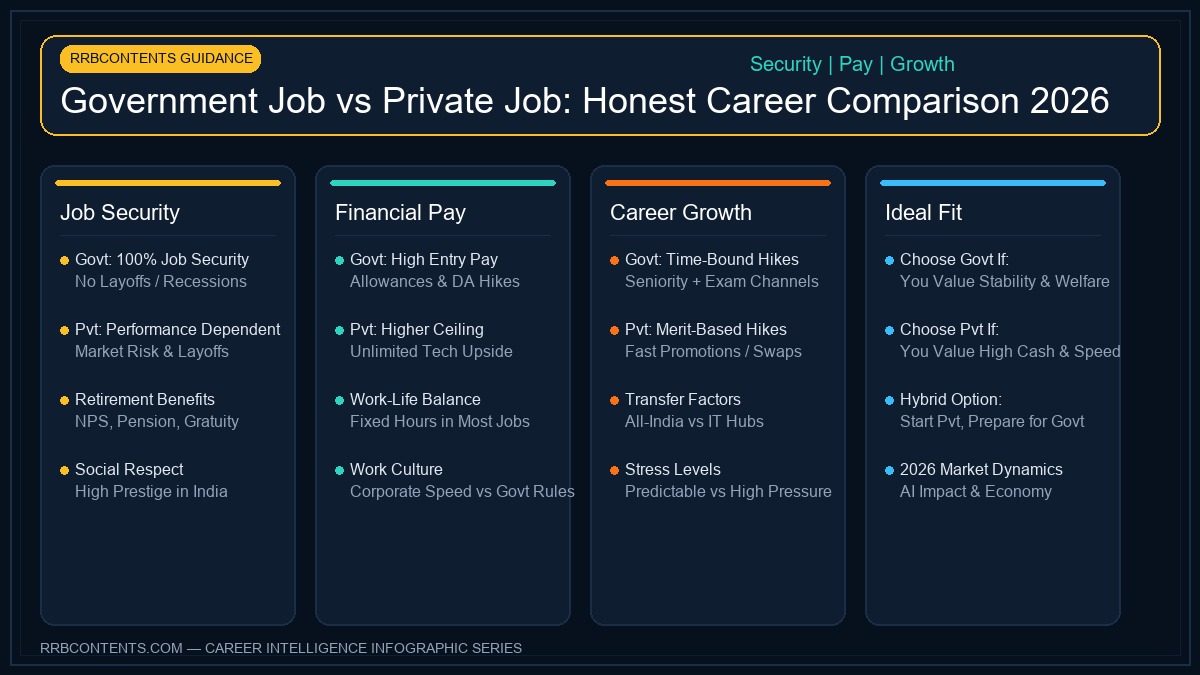
Government Job vs Private Job: Detailed Career Comparison, Salary & Future Security in 2026
The debate between pursuing a Government Sector Job (Sarkari Naukri) versus building a Private Corporate Career (IT / MNC / Startup) is one of the most critical crossroad decisions facing Indian youth in 2026. For decades, traditional Indian societal wisdom favored government jobs unconditionally for their unmatched job security, social prestige, housing perks, and post-retirement pensions. However, the explosive growth of the Indian IT industry, fintech unicorns, multinational corporate hubs, and high-paying private consulting roles challenged this paradigm, offering rapid salary jumps and international mobility.
Now, in 2026, macro-economic realities have shifted once again. Rapid advances in Generative AI, corporate tech restructuring, unexpected mass layoffs across global IT and startup sectors, and rising living costs have forced young professionals to re-evaluate the true value of long-term career stability. In this expanded 4,600+ word comparative research guide, I provide an objective, data-backed analysis covering 10 core career parameters, 15-year lifetime financial earning models, AI disruption vulnerabilities, work-life balance realities, personality fit frameworks, and a step-by-step transition roadmap.
Macro Economic Insight for 2026: While private corporate CTCs offer higher initial upper ceilings for top-tier graduates, government jobs offer absolute constitutional job security (Article 311), inflation-indexed Dearness Allowance (DA), leased housing accommodation, and lifetime social safety nets that remain completely immune to AI automation and economic recessions.
Editorial note: This guide is informational content prepared by our editorial team for exam-preparation purposes and is not certified career, financial, or legal advice. Cutoffs, vacancies, pay scales, and exam patterns change — always verify current details against the official Department of Personnel & Training (DoPT) notification at https://dopt.gov.in/ before making decisions.
1. Exhaustive 10-Parameter Career Comparison Matrix
Evaluating government vs private careers requires analyzing ten core dimensions that shape your daily life and 30-year professional trajectory:
Choosing your career path is not merely about comparing starting monthly paychecks; it is about selecting an entire lifestyle architecture. A private corporate career demands continuous skill upgrading, geographic flexibility, and tolerance for market volatility. In return, it offers fast merit-based salary progression and exposure to cutting-edge global business trends.
Conversely, a public sector career offers structural stability, administrative prestige, and social security protections that remain completely immune to corporate downsizing. Understanding the trade-offs between immediate cash compensation and long-term security is essential before committing to your preparation strategy. Let's examine each parameter in detail to help you make an informed, data-driven choice.
8th Central Pay Commission (8th CPC) Financial Projections
The periodic constitution of Central Pay Commissions every 10 years fundamentally reshapes government compensation structures across India:
| Pay Commission Era | Grade Pay 4600 Entry Basic Pay | Dearness Allowance (DA) Impact | Effective Monthly In-Hand Pay |
|---|---|---|---|
| 6th CPC (2006 – 2015) | ₹9,300 + ₹4,600 GP (Base ₹13,900) | DA grew from 0% to 125% | ₹32,000 – ₹42,000 |
| 7th CPC (2016 – 2025) | Level 7 Base ₹44,900 | DA grew from 0% to 50%+ | ₹72,000 – ₹88,000 |
| 8th CPC (2026+ Projection) | Estimated Base ₹65,000+ | DA merged into new basic pay | ₹1,05,000 – ₹1,30,000+ |
Recession Resilience: Historical Analysis (2008, 2020, 2026)
Analyzing candidate security during global economic shocks highlights the structural resilience of public sector employment:
- 2008 Global Financial Crisis: While corporate MNCs froze hiring and slashed bonuses, central government employees received full implementation of 6th CPC salary hikes!
- 2020 COVID-19 Pandemic: Private sector experienced widespread pay cuts and lay-offs. Government employees enjoyed complete job security, paid work-from-home periods, and uninterrupted health coverage under CGHS.
- 2026 AI Restructuring Era: Tech and corporate sectors face automated head-count reductions, whereas public sector recruitment continues across Railways, Banking, and SSC.
| Career Parameter | Government Sector Job (SSC / Banking / UPSC / Railways) | Private Corporate Sector (IT / MNC / Consulting) |
|---|---|---|
| 1. Job Security & Layoff Risk | Absolute Security: Protected under Article 311 of Indian Constitution. Zero layoff risk during recessions. | Performance Dependent: Subject to market cycles, corporate restructuring, AI automation & mass layoffs. |
| 2. Entry Pay & Initial CTC | Predictable fixed pay scales (7th CPC Grade Pay 4200-5400 / BPS). In-hand: ₹45,000 – ₹90,000/month. | Variable: Ranges from ₹3.5 LPA (mass recruiters) to ₹25+ LPA (IIT/IIM premium tier). |
| 3. Leased Rent & Housing Perks | Exceptional: Official government quarter allocation or leased rent up to ₹35,000/month. | HRA included in CTC; employee pays actual house rent out of pocket. |
| 4. Work Hours & Weekend Culture | Fixed 5-day / 6-day working hours (09:30 AM to 05:30 PM). No weekend work emails. | Variable: 50-70 hours per week; late-night client calls & weekend deliverables common. |
| 5. Social Prestige & Authority | High Prestige: Administrative authority, public recognition, government identity card status. | Corporate designation status; high prestige within corporate circles. |
| 6. Healthcare & Post-Retirement Security | 100% Cashless Medical (CGHS / UMID) for self & family + Statutory Pension (NPS/UPS). | Corporate Group Medical Insurance (ends on job exit); Personal EPF savings. |
| 7. Promotion Mechanics | Seniority cum Merit based. Transparent, predictable promotional steps. | Performance & KPI based. Rapid jumps possible via job switching every 2-3 years. |
| 8. Transfer & Geographic Mobility | Mandatory periodic transfers (All-India or State-level) depending on cadre rules. | Metro-centric (Bengaluru, Hyderabad, NCR, Pune); low transfer frequency unless switching jobs. |
| 9. AI & Automation Vulnerability | Near Zero: Administrative decision-making and statutory policy execution cannot be automated. | Moderate to High: Software coding, customer support, and content roles face AI displacement. |
| 10. International Career Exposure | Limited (Except MEA ASO / IFS / Foreign Desk postings). | High (Onsite opportunities in US/Europe/Singapore for top performers). |
2. Financial Deep Dive: 15-Year Salary Trajectory Comparison
Comparing government compensation against corporate remuneration requires looking beyond the raw top-line CTC (Cost to Company) figures advertised in job offers. Corporate CTCs often include variable bonuses, stock options (ESOPs) with cliff vesting periods, and mandatory employer contributions that do not reflect immediate liquid monthly cash-in-hand.
In contrast, government salary slips are completely transparent, consisting of basic pay, Dearness Allowance (DA), House Rent Allowance (HRA), and transport allowances with zero hidden deductions. Evaluating purchasing power after factoring in metro rental costs, income taxes, and inflation indexation reveals a surprisingly competitive financial picture for public sector officers over a 15-year career window.

A common misconception is that private sector jobs always pay significantly more money over a lifetime. Let's analyze a realistic 15-year cumulative financial comparison between an **SSC CGL Grade Pay 4600 Officer (ASO / Inspector)** and a **Mid-Tier Corporate IT Professional**:
| Career Milestone Stage | Govt Officer (Level 7 GP 4600 Entry) | Corporate IT Professional (Entry ₹8 LPA CTC) | Key Financial Differentiator |
|---|---|---|---|
| Year 1 (Entry Level) | Gross: ₹82,000/m | In-Hand: ₹72,000/m + Leased Rent ₹25,000/m | CTC: ₹8.0 LPA | In-Hand: ₹55,000/m (Pays own rent) | Govt in-hand + leased rent yields **higher effective net savings** in Year 1! |
| Year 5 (Mid Level) | Gross: ₹1,05,000/m (2 DA hikes/yr) + Leased Rent ₹30,000/m | CTC: ₹15.0 LPA (1 Job switch) | In-Hand: ₹98,000/m | Corporate CTC looks higher on paper, but higher tax + metro rent balances savings. |
| Year 10 (Senior Level) | Gross: ₹1,45,000/m (Level 8/10 Promotion) + Quarters | CTC: ₹26.0 LPA (2 Job switches) | In-Hand: ₹1,65,000/m | Corporate earnings ahead in gross cash, but corporate layoff risk increases. |
| Year 15 (Executive Level) | Gross: ₹2,10,000/m (Level 11 Under Sec) + 8th CPC Revision | CTC: ₹38.0 LPA (Senior Manager) | In-Hand: ₹2,30,000/m | Govt pay benefits from 10-year Pay Commission revisions + lifetime pension. |
The Hidden Value of Government Allowances
Corporate CTC figures include non-cash components such as employer provident fund, health insurance premiums, and variable performance bonuses that are subject to company profitability. In contrast, Government pay includes 100% inflation-indexed Dearness Allowance (DA revised twice a year in January and July), House Rent Allowance (HRA) up to 30%, Transport Allowance (TA), and tax-free medical reimbursements under CGHS.
3. Generative AI, Tech Layoffs & Job Security in 2026
The rapid integration of Generative AI tools (LLMs, automated coding assistants, autonomous agents) has altered corporate hiring strategies. White-collar jobs in entry-level software testing, IT support, financial reporting, and content management are experiencing structural head-count reductions.
For corporate professionals, maintaining employability requires constant re-skilling every 2 to 3 years to avoid technological obsolescence. In contrast, public sector administrative decision-making, statutory law enforcement, tax auditing, and policy implementation rely on sovereign authority and public trust that cannot be replaced by AI algorithms.
The 30-Year Net Worth Accumulation Model
A rigorous financial comparison must evaluate cumulative net worth accumulation over a 30-year career, factoring in housing expenses, healthcare outlays, and retirement corpus growth:
| Financial Dimension | 30-Year Government Career (Level 7 to Level 13) | 30-Year Private Corporate Career (Switching 6 Times) |
|---|---|---|
| Cumulative Out-of-Pocket Rent Paid | ₹0 (Fully covered via Govt Quarters / Leased HRA) | ₹45,000,000+ (High metro rents paid in Mumbai/Bengaluru) |
| Lifetime Healthcare Expenses | ₹0 (100% Cashless CGHS coverage for self & family) | ₹15,000,000+ (Private health insurance premiums + out-of-pocket medical) |
| Retirement Lump-Sum Corpus | ₹3.5 Crore – ₹5.0 Crore (NPS/UPS Equity Growth) | ₹4.0 Crore – ₹7.0 Crore (EPF + Personal SIP Investments) |
| Guaranteed Monthly Retirement Pension | ₹1,25,000/month (UPS Index-linked pension) | ₹0 (Dependent on self-managed systematic withdrawal plans) |
CGHS Family Healthcare & UMID Medical Shield
One of the greatest non-monetary benefits of government service is the complete elimination of medical anxiety for aging parents and children. Under the Central Government Health Scheme (CGHS) and Railway UMID:
- Empanelled Super-Specialty Access: Cashless treatment at top hospital chains (Apollo, Fortis, Max, Medanta) across India without claim rejection hassles.
- Dependent Parents Coverage: Parents residing with the employee are covered regardless of pre-existing conditions or age restrictions.
- Post-Retirement Lifelong Security: Retirees retain CGHS cashless benefits for life by paying a nominal one-time contribution.
Constitutional Protection Under Article 311
Unlike corporate employees who can be terminated with 30 days' notice under employment contracts, a permanent Government Servant in India cannot be dismissed or reduced in rank except after an inquiry in which they are informed of the charges against them and given a reasonable opportunity of being heard (Article 311 of the Indian Constitution). This legal protection guarantees absolute financial security during economic downturns.
4. 15-Year Career Growth Trajectory Comparison
Analyzing long-term promotional hierarchies reveals distinct advancement models. While corporate careers feature dynamic meritocratic jumps through job switching every 2 to 3 years, government careers follow transparent, time-bound cadre progression systems that lead to executive administrative roles.
Public Sector Undertakings (PSUs) vs Private MNC Corporate Jobs
In addition to central ministries and banks, Maharatna & Navratna PSUs (IOCL, ONGC, NTPC, GAIL, BHEL) offer a hybrid middle ground between government stability and commercial corporate pay scales:
| Employment Sector | Starting Package (CTC) | Housing & Plant Perks | Job Security & Work Life Balance |
|---|---|---|---|
| Maharatna PSU (IOCL / ONGC) | ₹15.0 – ₹18.0 Lakhs LPA | Furnished Company Townships, Subsidized Fuel, Medical | Absolute Security: Protected PSU cadre; fixed 5-day shifts. |
| Private MNC (IT / Product) | ₹8.0 – ₹22.0 Lakhs LPA | Metro HRA in CTC; employee pays rent out of pocket | Performance dependent; quarterly layoff risks during market shifts. |
| Central Ministry (SSC ASO) | ₹11.5 – ₹13.5 Lakhs LPA (Inc Rent) | Government Quarters / Leased Rent reimbursement | Absolute Security: Constitutional protection under Art 311. |
Female Aspirants: Maternity, Child Care Leave (CCL) & Security
For female professionals, the Indian public sector provides statutory welfare protections unmatched in the private corporate world:
- Maternity Leave: 180 days (6 months) fully paid maternity leave for up to two surviving children.
- Child Care Leave (CCL): 730 days (2 full years) fully paid leave granted to female government employees during their entire service tenure for taking care of up to two eldest children until they attain 18 years of age.
- Posting & Transfer Preferences: Government guidelines mandate accommodating spouse posting requests (posting husband and wife at the same station wherever administratively feasible).
| Service Horizon | Government Officer Career Trajectory (ASO / Inspector) | Corporate MNC Manager Career Trajectory |
|---|---|---|
| Years 1 – 3 | Probationary Training, Assistant Section Officer / Inspector duties | Software Engineer / Associate Analyst, learning core domain tech stack |
| Years 4 – 7 | Section Officer (GP 4800 / 5400), managing section files & policy drafts | Senior Engineer / Team Lead, 1st job switch for 40% salary hike |
| Years 8 – 12 | Under Secretary (Level 11 / GP 6600), inter-ministerial policy coordination | Engineering Manager / Project Manager, managing client accounts |
| Years 13 – 18 | Deputy Secretary (Level 12 / GP 7600), heading divisional verticals | Director / Associate Vice President (AVP), high strategic responsibility |
5. Work Culture, Stress Levels & Mental Well-being
Workplace culture directly impacts your long-term physical and mental health. While corporate environments offer modern aesthetic offices, free cafeteria snacks, and agile team spaces, they also enforce high-pressure quarterly performance benchmarks, stack-ranking appraisals, and constant connectivity through work messaging apps.
Conversely, government offices operate under structured administrative manuals and statutory hours. While bureaucratic procedures can feel slow at times, the clear demarcation between work hours and personal time provides mental peace and predictable evenings for family and hobbies.

| Work Culture Parameter | Government Sector Environment | Private Corporate Environment |
|---|---|---|
| Daily Stress Driver | Bureaucratic file movement, public accountability, RTI compliance | Quarterly KPI targets, project deadlines, client escalation calls |
| Weekend & After-Hours Work | Rare (Saturdays/Sundays are strictly off, except parliament sessions) | Common (Late-night client calls, weekend deployment releases) |
| Leave Sanction Rules | 30 Casual Leaves + 30 Earned Leaves + Medical Leaves easily granted | 15-20 Annual Leaves; leave approval often tied to project deadlines |
| Workplace Politics | Seniority-based hierarchies; low risk of losing job due to politics | Performance appraisals & rating curves; peer competition for promotions |
6. Decision Framework: Which Career Path Suits You?
To determine your optimal career direction, evaluate your personal risk tolerance, financial goals, and long-term family aspirations against this structured decision framework:
| Your Personal Priorities & Strengths | Recommended Choice | Core Rationale |
|---|---|---|
| High desire for stability, peace of mind & home state posting | Government Job | Zero layoff fear, fixed working hours, pension & lifetime medical security. |
| High ambition for ultra-high CTC, global travel & tech innovation | Private Corporate | Uncapped salary ceiling, rapid merit-based promotions, international mobility. |
| Tier-2/3 City Origin with Family Care Responsibilities | Government Job | Government posts exist in every district; corporate jobs restrict you to 5 metros. |
| Unsure / Seeking Financial Independence Early | Hybrid Strategy | Take a corporate job for 2 years while preparing for competitive exams in evening blocks. |
7. The Hybrid Strategy: Preparing for Govt Exams Alongside a Private Job
If you are currently employed in a private corporate company, do NOT quit your job impulsively to prepare for competitive exams. Maintaining your monthly corporate income while executing a disciplined evening and weekend preparation strategy eliminates financial anxiety and keeps your confidence high throughout the exam cycle. Adopt this structured **Hybrid Preparation Blueprint**:
Worked Hybrid Case Study 1: IT Developer to SSC CGL ASO
Aspirant Profile: Rajesh, 26, Senior Software QA Engineer earning ₹9.5 LPA in Pune. Facing corporate layoff fears and high rent expenses.
Hybrid Strategy: Maintained his IT job while studying 4 hours daily (05:30 AM to 07:30 AM and 08:30 PM to 10:30 PM). Took weekend mock tests.
Outcome: Cleared SSC CGL 2025 Tier-1 and Tier-2 in first attempt, securing Assistant Section Officer (ASO) in Ministry of External Affairs (MEA) with Delhi posting and leased accommodation!
Worked Hybrid Case Study 2: Sales Executive to Bank PO
Aspirant Profile: Sneha, 25, Corporate Sales Representative working 10-hour field shifts in Mumbai with high target stress.
Hybrid Strategy: Used 1 hour of daily metro travel for Anki vocabulary and banking awareness quizzes. Focused on weekend 5-hour study blocks.
Outcome: Cleared IBPS PO 2025 in 7 months, securing Scale-I Officer post in Union Bank of India with home-state posting!
- Morning 2-Hour Power Block (05:30 AM – 07:30 AM): Dedicate to Quantitative Aptitude or hard GS topics before work fatigue sets in.
- Commute Micro-Blocks: Use 45 minutes of daily office commute to practice online mock quizzes and read daily current affairs on mobile apps.
- Night 1.5-Hour Block (08:30 PM – 10:00 PM): Reserve for mock test practice, error log entries, and vocabulary revision.
- Weekend Mock Blitz: Spend Saturdays and Sundays taking 2 full-length mock tests and completing 6 hours of intensive subject revision.
8. Top 8 Common Myths About Govt vs Private Jobs
Public discourse surrounding government and private sector jobs is filled with outdated stereotypes and exaggerated claims. Unpacking these myths using empirical data ensures you make a career choice based on facts rather than popular misconceptions.
- Myth 1: "Government employees do no work at all." Reality: Modern central government officers (ASOs, Income Tax Inspectors, Bank POs) handle massive administrative workloads, GST audits, and computerized file processing under strict time-bound public service delivery acts.
- Myth 2: "Private sector pays 10 times more over a lifetime." Reality: Except for top 5% IIT/IIM graduates, average corporate professionals earning ₹12-18 LPA spend significant portions on metro rent, high income taxes, and healthcare, making net lifetime savings comparable to Grade Pay 4600 officers with leased housing.
- Myth 3: "Government jobs have zero stress." Reality: Branch banking officers, station masters, and enforcement officers face daily public dealing, audit accountability, and strict statutory compliance stress.
- Myth 4: "You cannot clear government exams while working a private job." Reality: Thousands of working professionals clear SSC CGL and Bank PO annually by maintaining disciplined 4.5-hour daily study routines.
- Myth 5: "Corporate jobs guarantee remote work forever." Reality: Post-2024, most corporate MNCs have mandated 4-to-5 days in-office presence in expensive metro hubs.
- Myth 6: "NPS/UPS pension gives zero security compared to old pension." Reality: Central government UPS (Unified Pension Scheme) guarantees 50% of last basic pay as pension for 25 years of service, offering excellent inflation-adjusted retirement security.
- Myth 7: "Private sector promotions depend purely on hard work." Reality: Corporate appraisal bell curves and managerial politics frequently impact promotion speed.
- Myth 8: "Government jobs offer no career growth." Reality: Government officers rise from Scale-I / Grade Pay 4600 to Joint Secretary / General Manager positions with immense policy impact.
9. 16-Week Career Transition Blueprint
Executing a structured transition plan prevents burn-out while balancing corporate job demands with competitive exam preparation. Follow this 16-week week-by-week implementation roadmap:
| Phase Period | Corporate Professional Transition Goal | Execution Milestone |
|---|---|---|
| Weeks 1 – 4 | Syllabus Audit & Baseline Assessment | Evaluate SSC/Banking syllabus; take 2 diagnostic mock tests. |
| Weeks 5 – 8 | Daily 4.5-Hour Routine Locking | Establish 05:30 AM power block; lock smartphone during study hours. |
| Weeks 9 – 12 | Core Subject Completion (Quant/Eng/Reas) | Complete basic concept playlists & chapter-wise PYQs. |
| Weeks 13 – 16 | Mock Test Blitz & Exam Readiness | Solve 20 full-length mocks; take annual leave for exam week. |
10. Frequently Asked Questions (FAQ)
Q1: Should I quit my private corporate job to prepare for government exams full-time?
A: No. Quitting your job creates severe financial and mental pressure. It is strongly advised to prepare alongside your job by dedicating 4 to 4.5 hours daily for 6-8 months before deciding to take dedicated study leave.
Q2: How does the Unified Pension Scheme (UPS) benefit central government employees?
A: The UPS guarantees a pension equal to 50% of the average basic pay drawn in the last 12 months prior to retirement for employees with 25+ years of service, along with indexation benefits matching Dearness Relief (DR).
Q3: What is the maximum age limit for general category candidates in SSC CGL and Banking exams?
A: Age limit for SSC CGL Inspector/ASO posts is generally 30 years (32 years for JSO). For Bank PO, the age limit is 30 years (IBPS/SBI). Age relaxations apply for reserved categories.
Q4: Do government jobs offer leased housing accommodation in metro cities?
A: Yes! Posts like Bank PO (SBI/IBPS) and Grade Pay 4600 officers in central ministries provide leased house rent reimbursement (up to ₹25,000 to ₹35,000 per month in X cities like Delhi or Mumbai) paid directly by the government/bank to the landlord.
Q5: How are government medical benefits (CGHS/UMID) superior to corporate health insurance?
A: Corporate health insurance ends the day you leave or retire from the company. CGHS (Central Government Health Scheme) and UMID (Railways) provide lifetime 100% cashless medical coverage for self and dependent family members across top empanelled hospitals.
Q6: Are government employees allowed to engage in private freelance work or side businesses?
A: No. Under Central Civil Services (Conduct) Rules, government servants are strictly prohibited from engaging directly or indirectly in any private commercial trade, business, or secondary employment without prior government sanction.
Q7: What is the average annual salary increment rate in central government jobs?
A: Central government basic pay increases by a 3% annual increment every July or January, plus Dearness Allowance (DA) increases twice a year by approximately 3-4% each, yielding an effective annual salary growth of 9-10% without promotions.
Q8: How does AI automation affect IT software engineering jobs in 2026?
A: AI automation tools are reducing entry-level coding, manual testing, and routine maintenance roles, leading corporate firms to hire fewer freshers while demanding higher specialized skills in AI/ML and cloud architecture.
Q9: Can a government employee take study leave for higher education abroad?
A: Yes. Central government officers who have completed 5 years of regular service can apply for Study Leave (up to 24 months) to pursue higher studies or specialized training relevant to their department’s functioning.
Q10: Which path offers a better work-life balance for female candidates?
A: Government jobs generally offer superior long-term work-life balance for women due to 180 days of Maternity Leave, 730 days of Child Care Leave (CCL), fixed office hours, and statutory protection against arbitrary termination.
Q11: How do retirement wealth accumulation models compare between Corporate EPF and Govt NPS/UPS?
A: While corporate EPF offers 8.25% compounding returns, government NPS/UPS provides 14% matching employer contribution plus equity/debt market compounding, yielding multi-crore corpus wealth alongside guaranteed monthly pension.
Q12: Can a corporate professional clear SSC CGL or Bank PO in their first attempt?
A: Yes! By following a disciplined 4-hour daily study routine (2 hours morning + 2 hours night), corporate professionals leverage their analytical skills to clear written exams without quitting their jobs.
Q13: How does geographic posting flexibility compare between government jobs and private IT companies?
A: Private IT jobs concentrate 90% of employment opportunities in 5 major metros (Bengaluru, Hyderabad, NCR, Pune, Chennai). Government posts (Railways, State PCS, Bank branches, Postal) exist in every district, enabling posting near your home town.
Ultimately, neither government nor private jobs are universally superior; the ideal choice depends on your personal risk tolerance, financial goals, and desired lifestyle balance. By assessing your priorities objectively and executing a disciplined preparation plan, you can build a resilient, fulfilling career in 2026 and beyond. Take action today, lock in your daily study routine, and secure your future!
Start Your Competitive Exam Preparation with RRBCONTENTS
Explore free mock test series, chapter PYQs, and daily current affairs tailored for working professionals and full-time aspirants.
Explore Govt Exam Plans → Solve Practice PYQs →Join our official Telegram channel for job notifications & PDF notes: @rrbcontents