Home › Blog › Indian Politics › History of BJP
The Paradox of Power: History of the BJP and How Congress Policies Enabled Its Political Emergence
The political evolution of the Bharatiya Janata Party (BJP)—from a two-seat parliamentary outlier in 1984 to the dominant force in Indian politics—represents one of the most remarkable transformations in modern democratic history. While political commentators frequently attribute the emergence of the BJP solely to ideological mobilization, organizational network building by the Rashtriya Swayamsevak Sangh (RSS), and charismatic leadership, a deeper historical analysis reveals a compelling paradox: the political strategy and policy missteps of the Indian National Congress (INC) played a direct role in creating the conditions for the BJP's rise.
Throughout the history of independent India, decision points executed by Congress administrations—ranging from Jawaharlal Nehru’s cabinet friction with Syama Prasad Mookerjee to Indira Gandhi’s 1975 Emergency and Rajiv Gandhi’s handling of the Shah Bano case—repeatedly created political openings for right-leaning nationalist opposition movements.
This deep-dive historical investigation traces the history of the BJP, dissects its ideological roots in the Bharatiya Jana Sangh, exposes the less-discussed policy decisions by Congress that catalyzed the party's growth, and provides an analytical timeline of Indian political history.
Table of Contents
- 1. Phase 1: The Precursor Era — Bharatiya Jana Sangh (1951–1977)
- 2. Phase 2: The 1975 Emergency — How Congress Normalized Right-Wing Politics
- 3. Phase 3: The Founding of the BJP (1980) and the 1984 Electoral Defeat
- 4. Phase 4: How Congress Missteps Catalyzed the BJP’s Rise (1985–1992)
- 5. Phase 5: The Tactical Era — From 13 Days to 5 Years (1996–2004)
- 6. Phase 6: The Modern Hegemony — From Coalition to Single-Party Dominance
- 7. Master Comparison Matrix: Key Milestones in BJP History
- 8. High-Yield Academic & Exam Corner (For UPSC & History Aspirants)
- 9. Key Takeaways
Key Takeaways & Core Highlights
- Ideological Roots: The BJP’s lineage traces back to the Bharatiya Jana Sangh, established on October 21, 1951, by Dr. Syama Prasad Mookerjee following his resignation from Nehru’s cabinet over the Liaquat-Nehru pact and Article 370.
- The Emergency Normalization: Indira Gandhi’s 1975 Emergency united disparate Opposition forces, granting former Jana Sangh leaders national administrative legitimacy within the 1977 Janata Party government.
- The 1980 Founding: The BJP was formally established on April 6, 1980, under Atal Bihari Vajpayee after the collapse of the Janata Party over the "Dual Membership" debate.
- Congress Catalysts: Decisions executed by Rajiv Gandhi’s administration—specifically overturning the Shah Bano judgment and unlocking the gates of the Babri Masjid in 1986—provided the ideological momentum for L.K. Advani’s 1990 Ram Rath Yatra.
- Coalition to Majority: The party shifted from a 13-day minority government in 1996 to leading the NDA (1998–2004), before securing consecutive absolute majorities under Narendra Modi in 2014 and 2019.
1. Phase 1: The Precursor Era — Bharatiya Jana Sangh (1951–1977)
The organizational roots of the BJP lie in the Bharatiya Jana Sangh (BJS), founded on October 21, 1951, in New Delhi.
A. The Cabinet Split: Nehru and Syama Prasad Mookerjee
Following Indian independence in 1947, Prime Minister Jawaharlal Nehru formed an inclusive national cabinet that included non-Congress intellectuals and leaders. Among them was Dr. Syama Prasad Mookerjee, a former President of the Hindu Mahasabha, who was appointed as the Union Minister for Industry and Supply.
However, ideological friction between Nehru and Mookerjee escalated over two critical national security issues:
- The Liaquat-Nehru Pact (1950): Mookerjee strongly opposed the bilateral pact with Pakistan, arguing that it failed to protect Hindu minorities in East Pakistan (now Bangladesh).
- The Status of Jammu & Kashmir: Mookerjee rejected Article 370, coining the slogan: "Ek desh mein do Vidhan, do Pradhan aur do Nishan nahi chalenge" ("One country cannot have two constitutions, two prime ministers, and two national emblems").
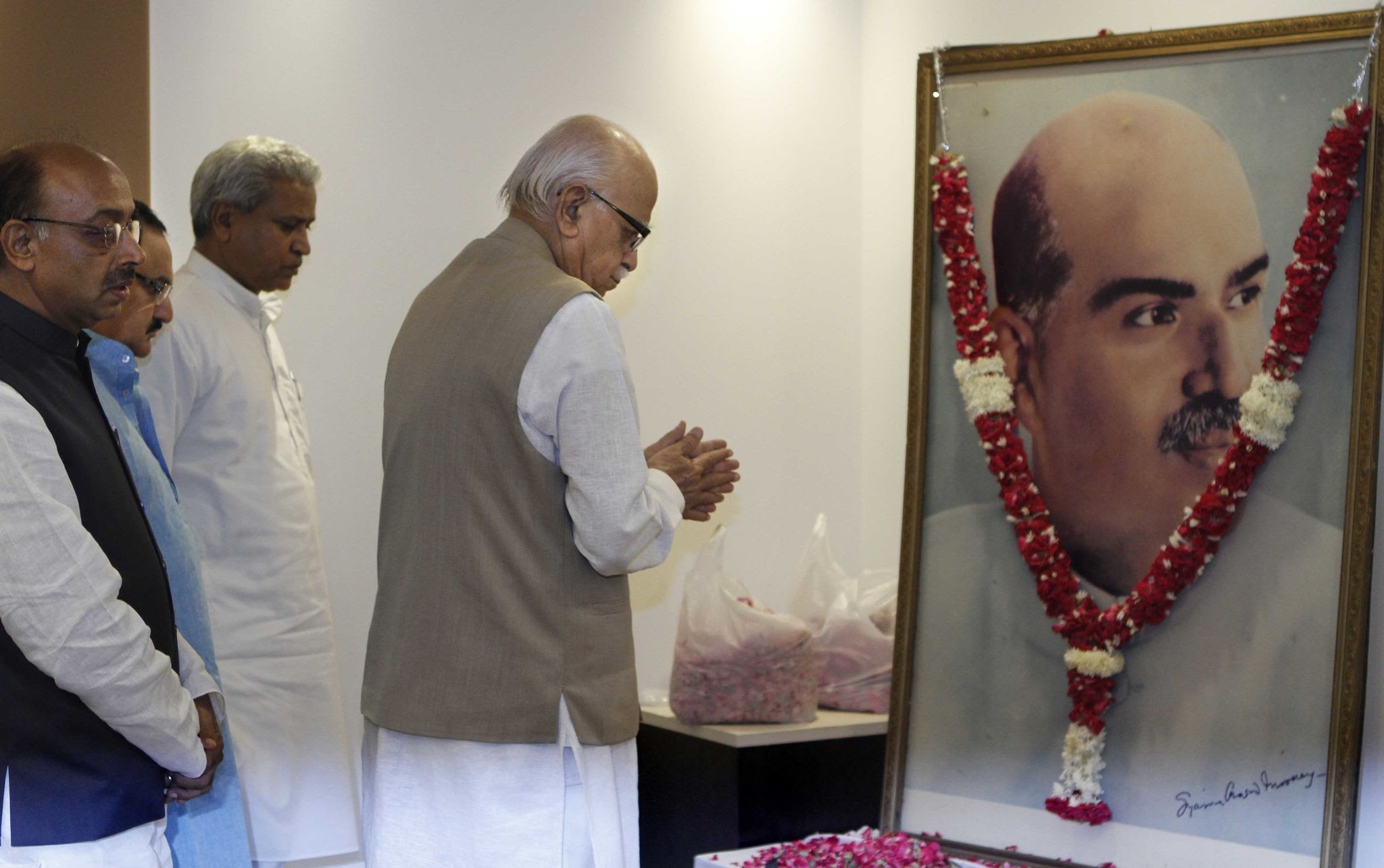
On April 8, 1950, Mookerjee resigned from Nehru’s cabinet in protest. Seeking a structured political platform to counter the Congress party's dominance, he collaborated with the Rashtriya Swayamsevak Sangh (RSS)—then led by M.S. Golwalkar—to establish the Bharatiya Jana Sangh on October 21, 1951.
B. The Early Electoral Performance of the Jana Sangh
In India’s first general election (1951–52), the Jana Sangh contested 94 Lok Sabha seats but won only 3 seats (including Mookerjee from Calcutta South East) with a modest vote share of 3.06%.
Following Mookerjee’s death in detention in Jammu & Kashmir in June 1953, the leadership of the Jana Sangh shifted to ideologues like Pandit Deendayal Upadhyaya, Atal Bihari Vajpayee, and Lal Krishna Advani. Upadhyaya introduced the core philosophy of Integral Humanism (Ekatma Manavavad) in 1965, positioning it as an indigenous alternative to both Western capitalism and Marxist socialism.
ELECTORAL TRAJECTORY OF BHARATIYA JANA SANGH (1951–1971)
Despite steady organizational expansion across North India (the Hindi heartland), the Jana Sangh remained restricted to urban pockets and upper-caste demographics due to the electoral dominance of the Congress party's umbrella coalition.
2. Phase 2: The 1975 Emergency — How Congress Normalized Right-Wing Politics
If the Jana Sangh was an ideological fringe party in the 1950s, it was the Emergency of 1975 imposed by Prime Minister Indira Gandhi that brought Hindu nationalists into mainstream political legitimacy.
A. The JP Movement and Anti-Congress Unification
By 1974, rising inflation, food shortages, and administrative corruption sparked widespread student protests across Gujarat and Bihar. Legendary Gandhian leader Jayaprakash Narayan (JP) emerged from political retirement to lead a nationwide movement for "Sampoorna Kranti" (Total Revolution) against the Indira Gandhi administration.
JP explicitly called upon all Opposition factions—Socialists, Akalis, Congress (O), and the Jana Sangh—to join a unified front. When critics warned JP about the RSS roots of the Jana Sangh, JP famously declared: "If the Jana Sangh is fascist, then I too am a fascist."
This endorsement by a respected Gandhian icon erased the political isolation surrounding Hindu nationalist cadres.
B. Incarceration and the 1977 Janata Party Merger
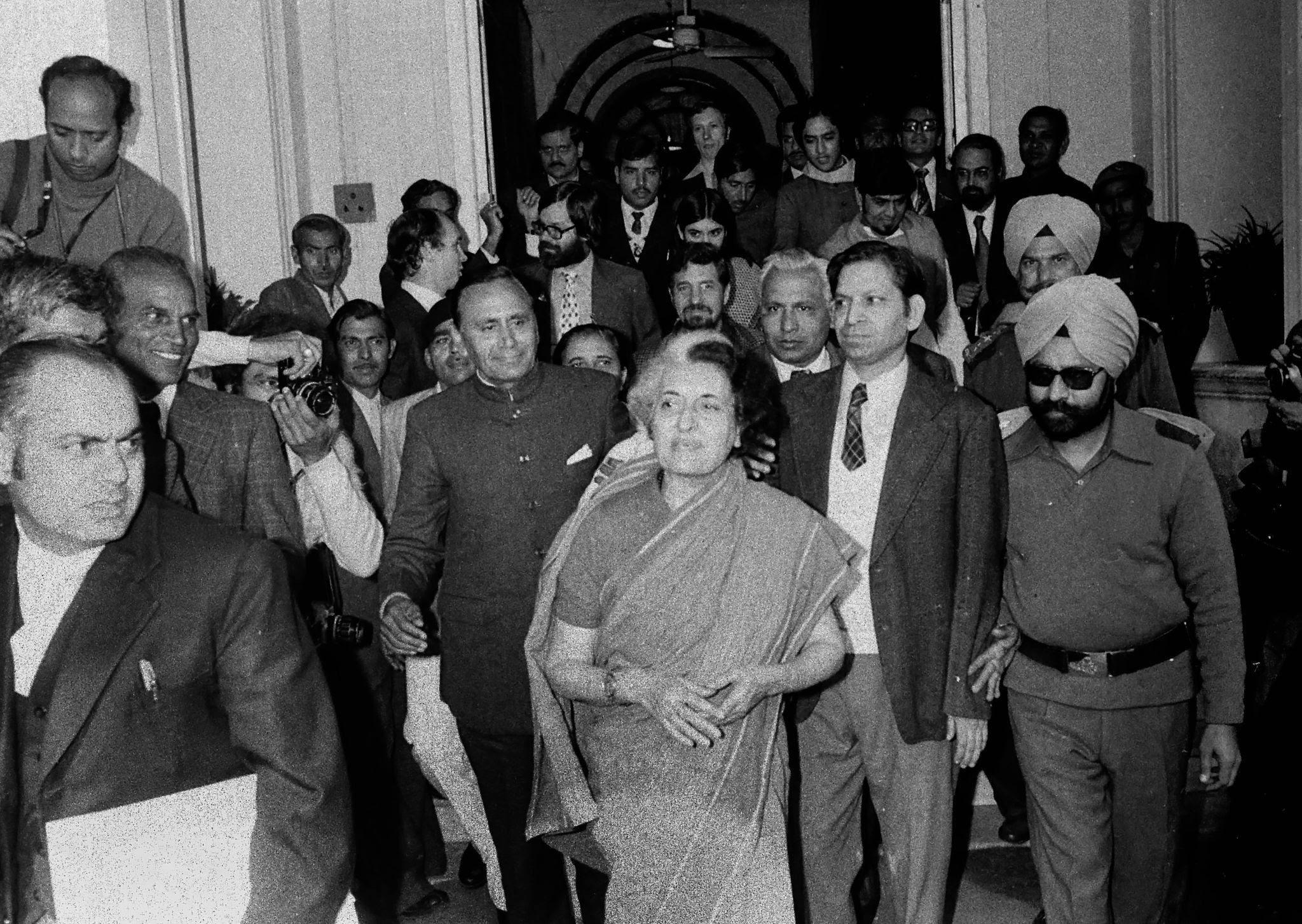
When Indira Gandhi declared a State of National Emergency on June 25, 1975, thousands of political leaders were jailed under the Maintenance of Internal Security Act (MISA). In prisons across India, Jana Sangh leaders like Atal Bihari Vajpayee, L.K. Advani, and Arun Jaitley shared jail cells with Socialist leaders like George Fernandes, Lalu Prasad Yadav, and Nitish Kumar.
When the Emergency was lifted in 1977, the Jana Sangh formally dissolved itself to merge with other anti-Emergency parties to form the Janata Party.
THE 1977 JANATA PARTY CONFLUENCE
Bharatiya Jana Sangh (BJS) + Congress (O) + Bharatiya Lok Dal (BLD) + Socialist Party
➔ MERGED INTO JANATA PARTY ➔ WON 295 SEATS IN 1977 ELECTION
In the March 1977 general election, the Janata Party swept Congress out of power, winning 295 seats. Former Jana Sangh leaders secured major portfolios in Morarji Desai’s Cabinet:
- Atal Bihari Vajpayee became Union Minister for External Affairs.
- Lal Krishna Advani became Union Minister for Information and Broadcasting.
C. The "Dual Membership" Controversy and the Collapse of Janata
The Janata coalition was short-lived. Internal rivalries between Morarji Desai, Charan Singh, and Raj Narain surfaced. In 1979, Socialist leaders within the Janata Party raised the issue of "Dual Membership," demanding that former Jana Sangh members sever their formal ties with the RSS. Vajpayee and Advani refused to disavow their RSS links.
The government collapsed, leading to fresh elections in 1980 that brought Indira Gandhi back to power. Forced out of the Janata Party, the former Jana Sangh members convened in Mumbai to build a new political organization.
3. Phase 3: The Founding of the BJP (1980) and the 1984 Electoral Defeat
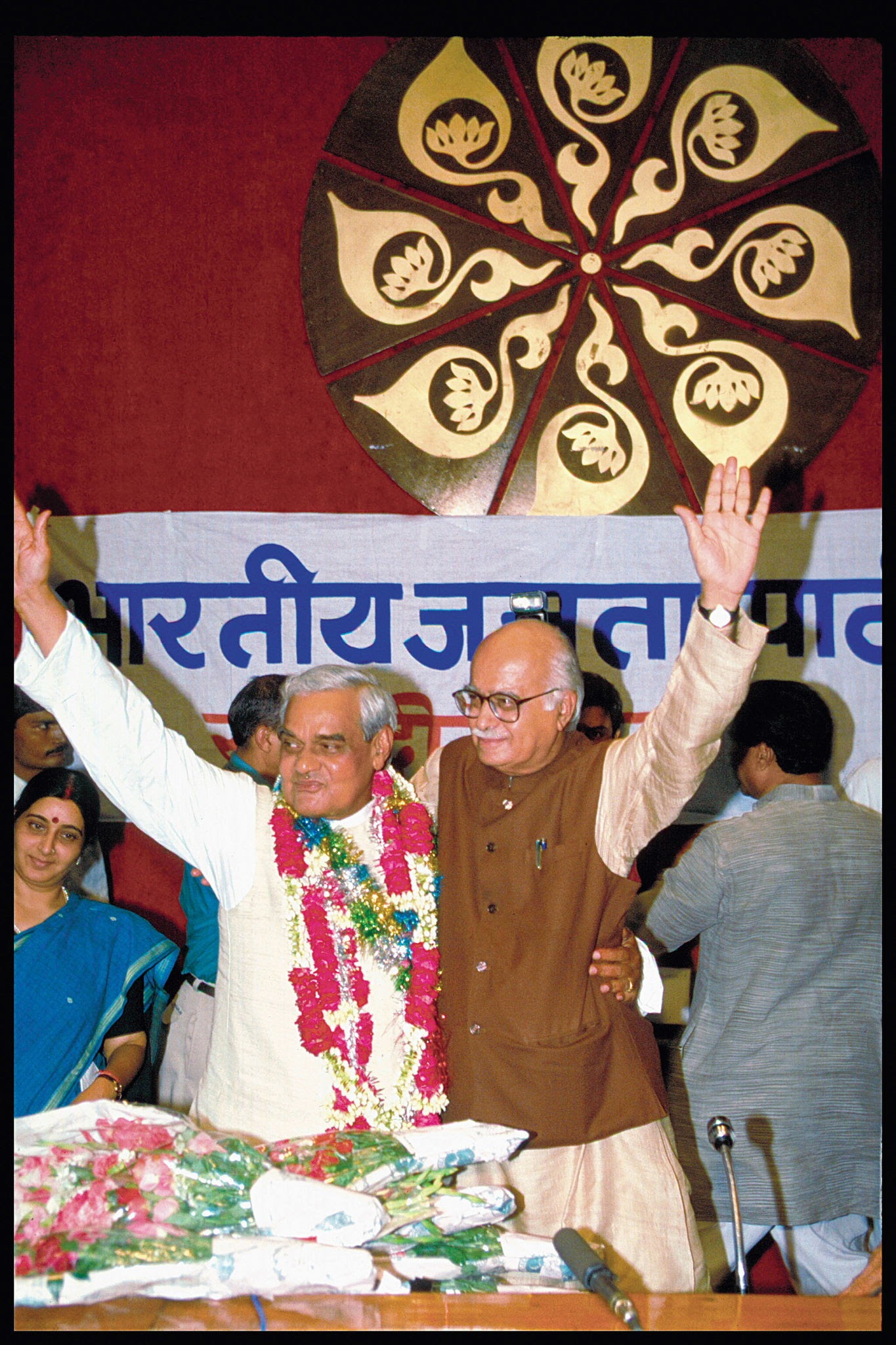
On April 6, 1980, at the Brabourne Stadium in Mumbai, the Bharatiya Janata Party (BJP) was officially founded, with Atal Bihari Vajpayee elected as its founding President.
A. The Moderate Initial Strategy: "Gandhian Socialism"
To distance the new party from accusations of communal exclusivity, Vajpayee adopted a broad-church platform centered on "Gandhian Socialism," positive secularism, and value-based politics. The party adopted the Lotus as its official election symbol.
B. The 1984 Lok Sabha Nadir: Reduced to 2 Seats
On October 31, 1984, Prime Minister Indira Gandhi was assassinated by her bodyguards. The resulting wave of national grief produced a sympathy wave for the Congress party, led by 40-year-old Rajiv Gandhi.
In the December 1984 general elections, Congress won a historic record of 404 out of 514 seats. The BJP was virtually wiped out, winning just 2 seats nationwide:
- Mehsana (Gujarat): Won by Dr. A.K. Patel.
- Hanamkonda (Andhra Pradesh): Won by C. Janga Reddy.
Even party President Atal Bihari Vajpayee lost his election in Gwalior to Madhavrao Scindia. The 1984 defeat triggered deep introspection within the party and the RSS leadership.
4. Phase 4: How Congress Missteps Catalyzed the BJP’s Rise (1985–1992)
The turning point in the history of modern Indian politics occurred between 1985 and 1990. Faced with an absolute majority in Parliament, the Rajiv Gandhi administration executed a series of conflicting decisions that alienated multiple voter bases and handed the BJP an ideological platform.
CONGRESS POLICY DECISIONS THAT ACCELERATED BJP'S GROWTH
A. Misstep 1: The Shah Bano Case (1985–1986)
In April 1985, the Supreme Court of India delivered a landmark judgment in Mohd. Ahmed Khan v. Shah Bano Begum, granting a 62-year-old divorced Muslim woman maintenance rights under Section 125 of the Code of Criminal Procedure (CrPC).
Conservative Muslim clerical bodies protested the verdict, asserting it interfered with Islamic Personal Law. Under pressure from conservative leaders, the Rajiv Gandhi government passed the Muslim Women (Protection of Rights on Divorce) Act, 1986, effectively overturning the Supreme Court ruling.
The BJP's Strategic Exploitation:
Under new party President L.K. Advani (who replaced Vajpayee in 1986), the BJP launched a political campaign accusing Congress of "pseudo-secularism" and "appeasement politics." Advani popularized the slogan: "Justice for All, Appeasement of None." This argument resonated with urban, middle-class voters who felt the state was applying selective standards to religious personal laws.
B. Misstep 2: Unlocking the Gates of Babri Masjid (1986)
To counter accusations of minority appeasement following the Shah Bano legislation, the Congress-led central and Uttar Pradesh state governments (under Chief Minister Vir Bahadur Singh) took a decision regarding the disputed Ram Janmabhoomi–Babri Masjid complex in Ayodhya.
On February 1, 1986, District Judge K.M. Pandey ordered the locks of the inner gates of the Babri Masjid to be opened for Hindu worshippers, an action actively facilitated by state authorities and broadcast on state television (Doordarshan).
Rather than placating Hindu voters, this decision reactivated a long-dormant issue. The Vishwa Hindu Parishad (VHP) and the RSS mobilized a mass campaign for the construction of a Ram temple at the site. The BJP formally endorsed the Ram Janmabhoomi movement at its Palanpur Session in June 1989, turning it into an ideological campaign.
C. Misstep 3: The Bofors Scandal and Anti-Congress Alliances (1987–1989)
In 1987, Swedish radio reported that Swedish arms manufacturer Bofors had paid kickbacks to Indian politicians and defense officials to secure a $1.3 billion artillery contract. Rajiv Gandhi’s former Finance Minister, V.P. Singh, resigned from Congress, formed the Jan Morcha, and united Opposition parties under the National Front.
To defeat Congress in the 1989 general election, V.P. Singh entered into seat-sharing arrangements with both the Left Front and the BJP. This electoral seat-sharing granted national legitimacy to the BJP, enabling it to jump from 2 seats in 1984 to 86 seats in 1989.
D. Misstep 4: Mandal vs. Mandir — Advani’s 1990 Rath Yatra
In August 1990, threatened by internal rivalries within his coalition, Prime Minister V.P. Singh announced the implementation of the Mandal Commission Report, reserving 27% of central government jobs for Other Backward Classes (OBCs). The announcement triggered violent street protests among upper-caste students across North India, threatening to fragment the electorate along caste lines.
To counter caste fragmentation and offer a unifying alternative, BJP President L.K. Advani launched the historic Ram Rath Yatra on September 25, 1990. Traveling in a modified Toyota van designed as an ancient chariot, Advani set out from Somnath in Gujarat bound for Ayodhya in Uttar Pradesh.
When Bihar Chief Minister Lalu Prasad Yadav arrested Advani in Samastipur on October 23, 1990, the BJP withdrew its external support from V.P. Singh’s government, bringing down the administration.
In the mid-term elections of 1991, the BJP’s seat count surged to 120 seats, making it the primary official Opposition party in Parliament. On December 6, 1992, the Babri Masjid structure was demolished by kar sevaks in Ayodhya, altering the trajectory of Indian secular politics.
5. Phase 5: The Tactical Era — From 13 Days to 5 Years (1996–2004)
By the mid-1990s, the era of single-party Congress dominance had ended, giving way to coalition politics. The BJP recognized that while hardline ideological mobilization could win 120 to 160 seats, it needed regional allies to form a government at the Centre.
A. The 13-Day Government (1996)
In the May 1996 elections, the BJP emerged as the single largest party in the Lok Sabha with 161 seats. President Shankar Dayal Sharma invited Atal Bihari Vajpayee to form the government.
However, regional parties remained hesitant to align with the BJP due to its polarising image following the 1992 Ayodhya events. Unable to secure a parliamentary majority, Vajpayee resigned on the floor of the House after 13 days, delivering a televised speech that elevated his public stature:
— Atal Bihari Vajpayee, Lok Sabha Resignation Address (May 28, 1996)
B. The Formation of the National Democratic Alliance (1998–1999)
Learning from 1996, the BJP moderated its rhetoric and formed the National Democratic Alliance (NDA) in 1998, bringing together regional powerhouses like the AIADMK (Tamil Nadu), Samata Party (Bihar), TDP (Andhra Pradesh), and Trinamool Congress (West Bengal).
To reassure coalition partners, the BJP agreed to place three of its core ideological promises on hold:
- The construction of the Ram Temple in Ayodhya.
- The abrogation of Article 370 in Jammu & Kashmir.
- The implementation of a Uniform Civil Code (UCC).
Although the first NDA government fell by a single vote in April 1999 when Jayalalithaa’s AIADMK withdrew support, the BJP returned to power with an expanded majority in the October 1999 elections following India's victory in the Kargil War and the Pokhran-II nuclear tests.
Between 1999 and 2004, Atal Bihari Vajpayee served as Prime Minister, heading the first non-Congress government in Indian history to complete a full five-year term.
6. Phase 6: The Modern Hegemony — From Coalition to Single-Party Dominance
After losing office in 2004 and suffering a second defeat in 2009 under the leadership of L.K. Advani, political commentators declared that the BJP had hit an electoral ceiling.
However, between 2011 and 2014, a new political landscape emerged—again accelerated by Congress governance failures.
A. UPA-2 Scandals and Policy Paralysis (2009–2014)
The second term of the Congress-led United Progressive Alliance (UPA-2) government was plagued by major financial scandals—including the 2G Spectrum allocation, the Coal Block allocation, and the Commonwealth Games financial irregularities.
The nationwide anti-corruption movement led by Anna Hazare in 2011 severely damaged the credibility of the ruling administration. Coupled with rising inflation and perceived "policy paralysis," public frustration reached an all-time high.
B. The Rise of Narendra Modi
In September 2013, the BJP named Gujarat Chief Minister Narendra Modi as its Prime Ministerial candidate for the 2014 general elections.
Modi constructed a campaign combining governance reform, economic development ("Sabka Saath, Sabka Vikas"), and decisive national security.
THE HISTORIC ELECTORAL BREAKTHROUGHS
Under Narendra Modi and strategic organizers like Amit Shah, the BJP transformed from a North Indian urban party into a nationwide political force, expanding into traditional Congress strongholds across Northeast India, Odisha, and rural heartlands.
7. Master Comparison Matrix: Key Milestones in BJP History
| Historical Era | Key Leadership | Electoral Outcome | Primary Political Drivers & Congress Factors |
|---|---|---|---|
| BJS Founding (1951–1953) | Dr. Syama Prasad Mookerjee | 3 Seats (1952) | Resignation from Nehru Cabinet over Liaquat-Nehru pact & Article 370. |
| Emergency Era (1975–1977) | A.B. Vajpayee, L.K. Advani | Janata Party 295 Seats (1977) | Imposition of Emergency by Indira Gandhi; anti-Congress unification. |
| BJP Founding & Defeat (1980–1984) | A.B. Vajpayee | 2 Seats (1984) | Sympathy wave following Indira Gandhi’s assassination. |
| Ayodhya & Mandal Era (1986–1991) | L.K. Advani | 86 Seats (1989) ➔ 120 Seats (1991) | Shah Bano legislation; opening of Babri Masjid locks; 1990 Rath Yatra. |
| First NDA Era (1998–2004) | A.B. Vajpayee, L.K. Advani | 182 Seats (1998/1999) | Moderated coalition strategy; Pokhran-II tests; Kargil War victory. |
| Modern Hegemony (2014–Present) | Narendra Modi, Amit Shah | 282 (2014) ➔ 303 (2019) ➔ 240 (2024) | UPA-2 corruption scandals; governance focus; strong organizational expansion. |
8. High-Yield Academic & Exam Corner (For UPSC & History Aspirants)
For candidates preparing for UPSC Civil Services (GS Paper 2: Indian Constitution, Post-Independence History, Political Parties & Governance):
1. Key Post-Independence Political Concepts
- The "Congress System" (Rajni Kothari): A term coined by political scientist Rajni Kothari to describe the political landscape from 1947 to 1967, where Congress operated as a broad "consensus party" encompassing left, right, and center factions, while Opposition parties acted as "pressure groups."
- Integral Humanism (Ekatma Manavavad): Adopted by the Jana Sangh in 1965 (authored by Deendayal Upadhyaya), this philosophy rejects both Western individualist capitalism and Marxist state socialism, advocating for a holistic development model centered on the individual, society, nature, and the cosmos.
2. Constitutional & Legal Landmark Cases
- Mohd. Ahmed Khan v. Shah Bano Begum (1985): Established that Section 125 CrPC applies universally across religious communities, providing maintenance rights to divorced women. The subsequent legislative override triggered national debates on Article 44 (Uniform Civil Code).
- The 42nd Constitutional Amendment Act (1976): Enacted during the Emergency, it inserted the words "Secular" and "Socialist" into the Preamble of the Constitution of India.
Master General Studies & Indian Polity on RRBCONTENTS
Explore complete exam notes, previous year questions, and daily current affairs updates.
Solve Polity PYQs → Explore History Notes →Join our official Telegram channel: @rrbcontents