Home › Blog › IBPS Customer Service Associate (Clerk)
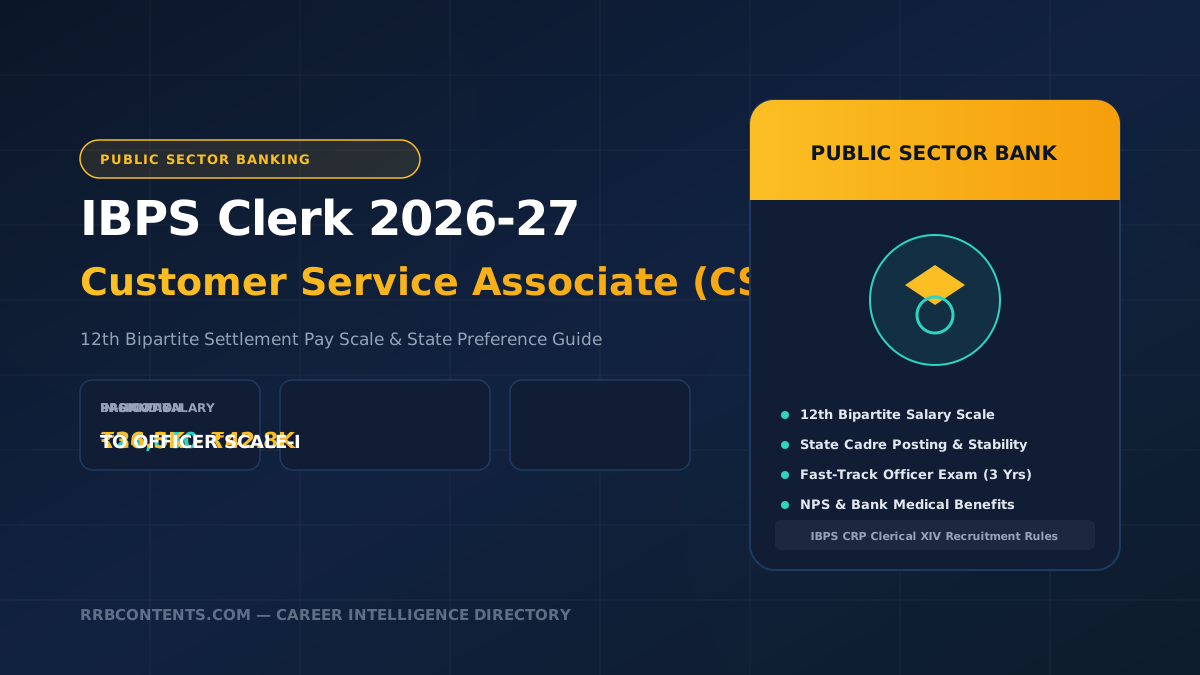
IBPS Clerk 2026-27 Salary, In-Hand Pay & Career Growth Guide
SECTION 1: OPENING HOOK
The IBPS Clerk (CRP CSA 16th) recruitment drive conducted by the Institute of Banking Personnel Selection represents the primary entry portal into clerical and customer-facing cadre positions across 11 participating Public Sector Banks (PSBs)—including Punjab National Bank, Bank of Baroda, Canara Bank, Union Bank of India, Bank of India, Indian Bank, Central Bank of India, Indian Overseas Bank, UCO Bank, Bank of Maharashtra, and Punjab & Sind Bank. Freshly recruited Customer Service Associates (CSAs) enter service under the newly implemented 12th Bipartite Settlement pay structure with a starting basic pay of ₹24,050 per month, translating to an initial gross monthly salary ranging between ₹38,000 and ₹44,000 depending on the posting city classification (Tier-1 Metro, Tier-2, or Tier-3). Unlike supervisory officer roles that demand immediate manager-level accountability, unpredictable working hours, and frequent inter-state transfers, the clerical cadre offers state-encapsulated postings, fixed single-window working hours, and a direct, fast-track promotional gateway into Officer Scale-I (Probationary Officer equivalent) within just two to three years of service through internal competitive examinations.
For an aspirant choosing between banking and other state or central government clerical roles, IBPS Clerk is not merely a routine desk job—it is a fast-paced financial operational role situated at the absolute core of retail banking execution. Navigating this recruitment drive requires a clear understanding of daily counter duties, 12th Bipartite Pay Settlement arithmetic, state-wise merit cut-offs, and career escalation pathways that can elevate a 22-year-old Clerk to a Branch Manager before turning 30. This guide provides an exhaustive, practical breakdown of what serving as an IBPS Clerk (CSA 16th) truly entails—from entry pay slips to 15-year career progression across India's public sector banking network.
SECTION 2: WHAT THE JOB ACTUALLY INVOLVES DAY-TO-DAY
Serving as a Customer Service Associate (Clerk) in a Public Sector Bank involves handling day-to-day front-desk operations, cash transactions, customer account management, and digital banking support across urban, semi-urban, and rural branches. Working hours are structured around core banking hours, typically from 9:45 AM to 5:00 PM for public transactions, with internal back-office settlement running until 6:00 PM or 6:30 PM, Monday through Saturday (excluding the mandatory 2nd and 4th Saturday holidays of every month).
Daily Operational & Front-Desk Workflows:
A typical day begins with mandatory security checks, cash drawer verification, and system login into the bank’s Core Banking Solution (CBS) software platform (such as Infosys Finacle 10.x or TCS BaNCS). In a high-footfall urban or semi-urban branch, a Clerk handles single-window teller duties:
- Cash Counter Operations: Processing cash deposits and cash withdrawals using Finacle transaction menus (e.g., CTM/TM menus), verifying currency notes under ultraviolet counterfeit detectors, and balancing cash drawers at the end of public transaction hours.
- Cheque Processing & CTS Clearing: Verifying cheque signatures against scanned CBS signature records, handling outward and inward Cheque Truncation System (CTS) clearing batches, and processing clearing returns.
- Account Services & Passbook Updates: Printing physical passbooks using thermal passbook printers, issuing demand drafts and banker's cheques, processing NEFT/RTGS counter transfer applications, and modifying account customer masters (KYC updates).
- Financial Inclusion & Social Security Schemes: Enrolling walk-in customers into government social security schemes including Pradhan Mantri Jeevan Jyoti Bima Yojana (PMJJBY), Pradhan Mantri Suraksha Bima Yojana (PMSBY), and Atal Pension Yojana (APY). Clerks also assist walk-in customers with mobile banking activations (such as PNB ONE, Baroda mConnect, or Canara ai1) and debit card reissue requests.
Detailed Counter Transaction Case Study & Finacle Workflow:
When a customer approaches the single-window counter to deposit cash and update an account:
- The Clerk verifies the physical currency notes using an electronic note-counting machine with UV detection.
- In Finacle 10.x, the Clerk enters the transaction menu `CTM` (Cash Transaction Maintenance), inputs the 13-digit account number, verifies the customer name displayed on screen, inputs denomination counts, and posts the transaction.
- A physical receipt is printed, stamped with the teller cash stamp, and handed to the customer.
- For passbook updating, the Clerk inserts the barcode-printed passbook into the automated thermal printer, invoking the `PBP` menu to print outstanding transactions.
During Month-End and Financial Year-End (March–April):
Working realities shift dramatically during quarter-end closing and annual financial year-end reconciliation. During these peak operational cycles, evening working hours extend significantly to reconcile cash registers, clear pending CTS clearing batches, perform interest audit checks, update government pension returns, and balance general ledger accounts. Additionally, modern PSB clerks face increasing mandates to assist in cross-selling bank products, including third-party health and life insurance policies, mutual funds, and credit card applications to walk-in branch customers.
Year-1 Reality vs. Year-5+ Reality:
In their first year, fresh recruits operate under probation under the direct supervision of the Accountant or Branch Manager. Early months are focused on mastering CBS transaction shortcuts, learning cash counting techniques, detecting counterfeit notes using UV currency verification machines, verifying KYC documentation compliance, and managing long customer queues during peak morning hours. Fresh clerks rotate across counter desks—cash counter, passbook/clearing counter, and deposit account opening desks—to acquire comprehensive branch operational exposure.
By Year 5 and beyond, a clerk who chooses to remain in the clerical cadre assumes senior back-office operational responsibility. Experienced clerks handle outward/inward CTS cheque clearing reconciliation, loan documentation verification, government treasury transaction entries, currency chest remittance documentation, and internal audit compliance reporting. However, a significant majority of clerks leverage internal departmental exams by Year 3 to transition into Officer Scale-I, leaving entry-level counter duties entirely behind.
Workplace Setting and Transfers:
The physical setting is entirely indoor and desk-bound inside air-conditioned branch premises. Transfers for clerical staff are generally restricted within the state or assigned banking zone. Female employees and married staff receive posting preferences under standard Indian Banks' Association (IBA) transfer guidelines, making clerical cadre roles geographic stability-friendly compared to officer cadres.
SECTION 3: COMPLETE PAY SCALE & IN-HAND SALARY BREAKDOWN
Salaries for IBPS Clerks (Customer Service Associates) are governed by the 12th Bipartite Settlement signed between the Indian Banks' Association (IBA) and bank unions. The pay scale structure is defined as:
₹24050 - 1340/3 - 28070 - 1650/3 - 33020 - 2000/4 - 41020 - 2340/7 - 57400 - 4400/1 - 61800 - 2680/1 - 64480.
Primary Components of PSB Clerical Salary:
- Basic Pay: Initial entry basic pay is fixed at ₹24,050 per month.
- Special Allowance: Set at 26.5% of Basic Pay under the 12th Bipartite Settlement, plus Dearness Allowance calculated on this special allowance.
- Dearness Allowance (DA): Linked to the All India Consumer Price Index (AICPI) for Industrial Workers, revised quarterly (currently approx. 15.7% of Basic + Special Allowance).
- House Rent Allowance (HRA): Varying by city category—10.25% for Tier-1 Metro cities (Population 45 Lakh+); 9.25% for Tier-2 cities (Population 12–45 Lakh); 8.25% for Tier-3/rural locations.
- Transport Allowance: Fixed allowance for commuting (approx. ₹600–₹850/month + DA thereon).
- Other Allowances: Computer Allowance (fixed at ₹1,500/month), Fuel Reimbursement, Newspaper Allowance, and Medical Allowance (approx. ₹2,350 annually).
- Mandatory Deductions: Defined Contributory Pension Scheme (DCPS/NPS - 10% of Basic Pay + DA), Professional Tax (approx. ₹150–₹200/month).
- Net In-Hand Salary: Gross Salary minus mandatory deductions.
In-Hand Salary Table by City Category (12th Bipartite Estimates):
| City Category / Posting Zone | Basic Pay | Special Allow (26.5%) | DA (Est. 15.7%) | HRA Amount | Computer Allow | Est. Gross Salary | NPS (10%) | Est. Net In-Hand Salary |
|---|---|---|---|---|---|---|---|---|
| Tier-3 / Rural (HRA 8.25%) | ₹24,050 | ₹6,373 | ₹4,777 | ₹1,984 | ₹1,500 | ₹39,484 | ₹2,883 | ₹36,400 - ₹36,600 |
| Tier-2 City (HRA 9.25%) | ₹24,050 | ₹6,373 | ₹4,777 | ₹2,225 | ₹1,500 | ₹39,725 | ₹2,883 | ₹36,650 - ₹36,850 |
| Tier-1 Metro (HRA 10.25%) | ₹24,050 | ₹6,373 | ₹4,777 | ₹2,465 | ₹1,500 | ₹39,965 | ₹2,883 | ₹36,900 - ₹37,100 |
Multi-Year Financial Growth Projection Table (If Remaining in Clerical Cadre):
| Service Stage / Milestone | Est. Service Yrs | Basic Pay | Est. DA (15.7%) | Est. HRA (10.25%) | Est. Gross Salary | Est. Monthly Net In-Hand |
|---|---|---|---|---|---|---|
| Year 1: CSA Entry | 0 Years | ₹24,050 | ₹4,777 | ₹2,465 | ₹39,965 | ₹36,900 - ₹37,100 |
| Year 4: After 3 Annual Increments | 3 Years | ₹28,070 | ₹5,575 | ₹2,877 | ₹45,720 | ₹42,100 - ₹42,400 |
| Year 7: After JAIIB & CAIIB Passed | 6 Years | ₹36,320 | ₹7,215 | ₹3,722 | ₹57,850 | ₹53,200 - ₹53,600 |
| Year 10: Senior CSA Cadre | 9 Years | ₹43,360 | ₹8,610 | ₹4,444 | ₹67,900 | ₹62,400 - ₹62,900 |
Additional Increments and IIBF Certification Perks:
Clerks who clear professional banking examinations conducted by the Indian Institute of Banking & Finance (IIBF)—JAIIB (Junior Associate of Indian Institute of Bankers) and CAIIB (Certified Associate of Indian Institute of Bankers)—receive immediate financial increments. Passing JAIIB awards 1 additional basic pay increment, while passing CAIIB awards 2 additional basic pay increments, boosting monthly basic pay and future pension accumulation early in service.
SECTION 4: CAREER GROWTH & PROMOTION PATH
The clerical cadre in Public Sector Banks features one of the fastest internal promotion mechanisms in the Indian public sector. An ambitious clerk does not need to wait decades for seniority-based upgrades; through merit-based internal competitive exams, a clerk can advance into executive management roles within a few years.
Promotion Channels:
- Merit/Fast-Track Promotion Channel (Promotion to Officer Scale-I):
- Eligibility: 2 to 3 years of continuous clerical service (reduced to 2 years upon passing JAIIB/CAIIB exams).
- Process: Written Internal Promotional Examination (covering General Banking, Finacle Operations, and Accounting) + Service Record / APAR + Interview.
- Designation Achieved: Officer Scale-I (Assistant Manager / Probationary Officer equivalent) at starting basic pay of ₹48,480 (12th Bipartite Scale), jumping to gross monthly salary of ₹65,000–₹75,000.
2. Seniority/Normal Promotion Channel:
- Eligibility: 5 to 7 years of service in the clerical cadre.
- Process: Seniority list evaluation + basic internal written test + interview.
- Designation Achieved: Officer Scale-I (Assistant Manager).
Subsequent Officer Hierarchy Progression:
- Officer Scale-I (Assistant Manager) -> Officer Scale-II (Manager / Branch Manager) [3-4 years service]
- Officer Scale-II -> Officer Scale-III (Senior Manager / Chief Manager) [3-4 years service]
- Officer Scale-III -> Scale-IV (Chief Manager / Regional Head) [3-4 years service]
- Scale-IV -> Scale-V (Assistant General Manager - AGM)
- Scale-V -> Scale-VI (Deputy General Manager - DGM)
- Scale-VI -> Scale-VII (General Manager - GM) / Executive Director (ED) / Managing Director (MD & CEO).
15-Year Career Trajectory Table:
| Stage / Designation | Est. Years of Service | Pay Scale / Basic Pay | Primary Selection Mode | Cadre Level |
|---|---|---|---|---|
| Customer Service Associate (Clerk) | 0 Years | ₹24,050 | IBPS CRP CSA Direct Recruitment | Clerical (State) |
| Officer Scale-I (Assistant Manager) | 2 - 3 Years | ₹48,480 | Internal Fast-Track Exam (JAIIB/CAIIB) | Officer Cadre |
| Officer Scale-II (Branch Manager) | 6 - 7 Years | ₹64,820 | Internal Promotion Exam & Performance | Middle Management |
| Officer Scale-III (Senior Manager) | 10 - 11 Years | ₹78,230 | Merit Promotion & Regional Vetting | Senior Management |
| Scale-IV (Chief Manager / AGM) | 14 - 15 Years | ₹1,02,300 | Board Interview & Performance Record | Executive Management |
Key Determinants of Promotion Speed:
Clearing IIBF certifications (JAIIB and CAIIB) during the first two years of clerical service is the single most critical factor for accelerating promotion to Officer Scale-I. JAIIB syllabus covers 4 papers: Indian Economy & Financial System, Principles & Practices of Banking, Accounting & Financial Management, and Retail Banking. Maintaining a clean operational audit record (zero cash discrepancies or procedure breaches) and securing high APAR ratings from Branch Managers ensure rapid progression through officer scales.
SECTION 5: SELECTION PROCESS EXPLAINED FOR THIS SPECIFIC POST
Selection for IBPS Clerk (CRP CSA 16th) is conducted through a two-tier online objective examination system: Preliminary Examination and Main Examination. There is NO interview stage. Final merit ranking is based 100% on marks obtained in the Main Examination, subject to document verification and local language proficiency validation.
| 1. Preliminary Examination (Online Objective | 100 Marks | Duration: 60 Minutes): |
|---|---|---|
| - English Language: 30 Questions | 30 Marks | 20 Minutes sectional timing. |
| - Numerical Ability: 35 Questions | 35 Marks | 20 Minutes sectional timing. |
| - Reasoning Ability: 35 Questions | 35 Marks | 20 Minutes sectional timing. |
- Nature: Qualifying in nature. Marks obtained in Prelims are NOT counted toward the final merit list. Candidates must clear both sectional cut-offs and overall state-wise cut-offs to qualify for Mains.
| 2. Main Examination (Online Objective | 200 Marks | Duration: 160 Minutes): |
|---|---|---|
| - General / Financial Awareness: 50 Questions | 50 Marks | 35 Minutes sectional timing. |
| - General English: 40 Questions | 40 Marks | 35 Minutes sectional timing. |
| - Reasoning Ability & Computer Aptitude: 50 Questions | 60 Marks | 45 Minutes sectional timing. |
| - Quantitative Aptitude: 50 Questions | 50 Marks | 45 Minutes sectional timing. |
| - Total: 190 Questions | 200 Marks | 160 Minutes. |
- Weightage: 100% evaluative for final provisional allotment.
Marking Scheme & Negative Marking:
- Penalty for Wrong Answers: 0.25 (1/4th) of the marks assigned to that question are deducted for every incorrect entry in both Prelims and Mains. Unanswered questions carry no penalty.
Local Language Proficiency Test (LPT):
Since clerical recruitment is state-specific, candidates must be proficient in the official language of the state/UT for which they apply. Candidates who produce Class 10 or Class 12 mark sheets proving they studied the local language as a subject are exempt. Other shortlisted candidates must clear a basic local language reading, writing, and speaking test administered by the allotted bank prior to joining.
SECTION 6: SKILLS & PREPARATION FOCUS THAT ACTUALLY MATTERS
Cracking IBPS Clerk requires high speed, calculation accuracy, and targeted financial awareness. Because state-wise cut-offs for Clerical Mains regularly reach 75% to 85% of total marks, preparation must focus on high-yield sections.
- Speed Building in Quantitative Aptitude & Data Interpretation:
- Prelims Focus: Master mental math, Vedic multiplication shortcuts, squares/cubes up to 30, simplification/approximation (10-15 questions in Prelims), number series, and quadratic equations.
- Mains Focus: Concentrate on Data Interpretation (DI) sets—bar graphs, pie charts, tabular DI, caselets, and arithmetic word problems (profit & loss, SI/CI, time & work, partnerships).
2. Logical Reasoning & Puzzle Speed:
- Prelims Focus: Solve floor puzzles, linear arrangements, circular seating, scheduling puzzles, syllogisms, inequalities, and coding-decoding within the strict 20-minute sectional timer.
- Mains Focus: Practice high-level multi-variable puzzles, input-output sequences, logical/critical reasoning (statement-assumption, cause-effect), and computer aptitude fundamentals (flowcharts, binary logic).
3. Financial & Banking Awareness (Mains Game-Changer):
The General/Financial Awareness section (50 Marks) offers the highest scoring potential per minute. Focus heavily on:
- Recent RBI monetary policy updates, repo rates, reverse repo rates, and CRR/SLR definitions.
- Banking terminology (NPA, PCA framework, UPI limits, NEFT/RTGS/IMPS mechanisms, DICGC insurance cover up to ₹5 Lakhs).
- Current affairs from the last 5 to 6 months preceding Mains, highlighting financial sector news, government social security schemes, union budget allocations, and international financial institutions (IMF, World Bank, ADB).
4. Standard Reference Textbooks & Mock Test Analytics:
- Reference Textbooks: *Quantitative Aptitude* by R.S. Aggarwal, *Analytical Reasoning* by M.K. Pandey, *Banking Awareness* by Arihant, and RBI Master Circulars.
- Solve at least 30 full-length Prelims mocks and 15 Mains mocks prior to the exam. Analyze test reports to eliminate negative marking penalty trends, maintaining a target accuracy rate above 90%.
SECTION 7: COMPARISON: HOW THIS STACKS UP AGAINST SIMILAR GOVERNMENT CAREERS
Candidates choosing IBPS Clerk often evaluate it against SBI Clerk (Junior Associate) and Railway Recruitment Board (RRB) NTPC Clerical posts.
Comparative Feature Matrix:
| Career Axis | IBPS Clerk (CSA 16th) | SBI Clerk (Junior Associate) | RRB NTPC Junior Clerk (Railways) |
|---|---|---|---|
| Starting In-Hand Salary | ₹36,400 - ₹37,100 (12th Bipartite) | ₹37,500 - ₹39,000 (2 Advance Inc) | ₹32,000 - ₹35,000 (7th CPC L-2) |
| Promotion Speed | Fast-Track Officer Exam (2-3 Yrs) | Fast-Track Officer Exam (3 Yrs) | Slow (Seniority/LDCE 5-7 Yrs) |
| Transfer Policy | Within State / Bank Zone | Within State / Circle | Divisional / Zonal Railways |
| Workplace Environment | Indoor Bank Branch (Desk-Bound) | Indoor Bank Branch (Desk-Bound) | Railway Offices / Stations |
| Public Dealing Stress | High (Single-Window Counter) | Very High (Heavy Branch Crowds) | Moderate to Low (Back Office/Freight) |
Trade-Off Analysis:
- IBPS Clerk vs. SBI Clerk:
- Salary: SBI Clerk offers a slightly higher starting basic pay due to two advance increments granted at entry, resulting in ₹1,500–₹2,000 higher monthly pay than IBPS Clerk.
- Work Pressure: IBPS Clerks often experience slightly lower branch crowding compared to SBI branches, which handle massive footfalls under financial inclusion schemes.
- Career Path: Both offer identical fast-track internal officer conversion routes through JAIIB/CAIIB examinations.
2. IBPS Clerk vs. RRB NTPC Junior Clerk:
- Promotion Velocity: IBPS Clerk wins decisively. A bank clerk can become an Officer Scale-I within 2 to 3 years, whereas a Railway Junior Clerk requires 5 to 8 years to reach supervisory levels.
- Work Environment & Stress: RRB NTPC Junior Clerks experience lower daily public-facing stress compared to bank clerks who handle public cash and cross-selling targets daily.
SECTION 8: REAL TALK: DOWNSIDES & WHAT TO EXPECT
While an IBPS Clerk position provides financial stability and rapid promotion opportunities, candidates should enter the cadre aware of real operational pressures.
- Public Dealing & Counter Stress:
Handling single-window counter operations requires patience and emotional resilience. Dealing with difficult customers, managing long physical queues during peak hours, and addressing public grievances over technical system delays are daily realities.
2. Financial Liability & Cash Balancing:
Cash counter clerks bear direct financial responsibility for their cash drawers. Any cash deficit at the end of the day must be made good by the clerk from their personal funds before closing branch books, making accuracy under pressure paramount.
3. Cross-Selling Targets:
Modern public sector banks actively push retail insurance, pension plans, and mutual fund products. Clerks face increasing pressure from branch managers to meet monthly cross-selling targets alongside routine operational work.
4. Month-End and Closing Work Spikes:
While routine working hours end around 5:00 PM for public transactions, month-end closing, audit cycles, and March financial year-end reconciliation demand late evening office hours.
SECTION 9: FREQUENTLY ASKED QUESTIONS (FAQ)
Q: What is the starting in-hand salary for an IBPS Clerk under the 12th Bipartite Settlement?
A: An entry-level IBPS Clerk (Customer Service Associate) receives an initial basic pay of ₹24,050. Net in-hand monthly salary ranges between ₹36,400 and ₹37,100 depending on city HRA category (8.25%, 9.25%, or 10.25%), special allowance, and quarterly DA revisions.
Q: Is there an interview stage in the IBPS Clerk selection process?
A: No, there is no interview stage. Selection is based 100% on marks scored in the online Main Examination, provided the candidate clears Prelims, satisfies document verification, and passes the Local Language Proficiency Test (LPT) where applicable.
Q: How fast can an IBPS Clerk become a Bank Officer (Scale-I)?
A: A clerk can appear for internal fast-track officer promotional exams after completing 2 to 3 years of service. Passing IIBF certifications (JAIIB and CAIIB) during clerical service reduces eligibility timelines and provides additional basic pay increments.
Q: Can candidates apply for IBPS Clerk vacancies in a state other than their home state?
A: Yes, candidates can apply for any state vacancy. However, they must be proficient in reading, writing, and speaking the official local language of that state and must clear the Local Language Proficiency Test (LPT) prior to joining.
Q: What are the main daily duties of an IBPS Customer Service Associate?
A: Daily duties include front-desk customer service, cash deposits and withdrawals, passbook updates, issuing demand drafts, clearing cheque processing, KYC document verification, and assisting walk-in customers with digital banking products.
Q: Are IBPS Clerical postings transferable across India?
A: No, clerical staff postings are restricted within the specific state or banking zone for which the candidate applied. Inter-state transfers are generally not enforced for clerical cadre staff except under exceptional administrative or mutual request circumstances.
Q: What happens if there is a cash shortfall at the end of the day in a clerk's cash drawer?
A: Clerks bear direct personal financial responsibility for their cash drawers. Any end-of-day deficit must be made good immediately by the clerk out of personal funds before branch general ledgers can be balanced and closed.
SECTION 10: CLOSING CTA
Ready to start your preparation for a banking career? Check the full IBPS Clerk (CRP CSA 16th) Recruitment 2026 notification—including state-wise vacancy charts, eligibility criteria, exam schedules, and fee details—on RRBCONTENTS. For daily banking awareness quizzes, high-level reasoning sets, and real-time exam alerts, join our official Telegram channel at https://t.me/rrbcontents today.
VERIFICATION NOTE & CONFIDENCE CHECK:
- Pay Scale: Basic Pay ₹24,050 and scale structure reflect official 12th Bipartite Settlement scales signed between IBA and bank unions. Special Allowance (26.5%) and Computer Allowance (₹1,500) match 12th Bipartite rules.
- Selection Scheme: Prelims (100 M / 60 Min) and Mains (200 M / 160 Min) reflect official IBPS exam patterns. Absence of interview confirmed.
- Promotional Timelines: Fast-track promotion eligibility (2-3 years with JAIIB/CAIIB) reflects standard PSB officer conversion policies.
Explore Verified Government & PSU Career Guides on RRBCONTENTS
Get official notifications, full syllabus blueprints, and daily exam current affairs.
Apply for IBPS Clerk 2026 → Latest Recruitment Notifications → Exam Preparation Resources →Join our official Telegram channel for instant career alerts: @rrbcontents