"Give me blood, and I shall give you freedom!" — Subhas Chandra Bose's rallying cry transformed defeated soldiers into champions of India's final struggle for independence.
Table of Contents
Chapter 1
The Indian National Army at a Glance
Peak Strength
Troops & civilian volunteers in Southeast Asia
Active Years
Formed in Singapore, revived by Bose in 1943
Red Fort Officers
Shah Nawaz Khan, Prem Sahgal, Gurbaksh Dhillon
Hind
Provisional Govt
Established Oct 1943 by Subhas Chandra Bose
Key Symbolism & Legacy
The Indian National Army (INA) and the Red Fort Trials of 1945–46 shattered the myth of unwavering Indian military loyalty to the British Crown, triggering widespread nationalist upheaval and accelerating the end of British colonial rule in India.
Chapter 2
From Captivity to an Army of Liberation
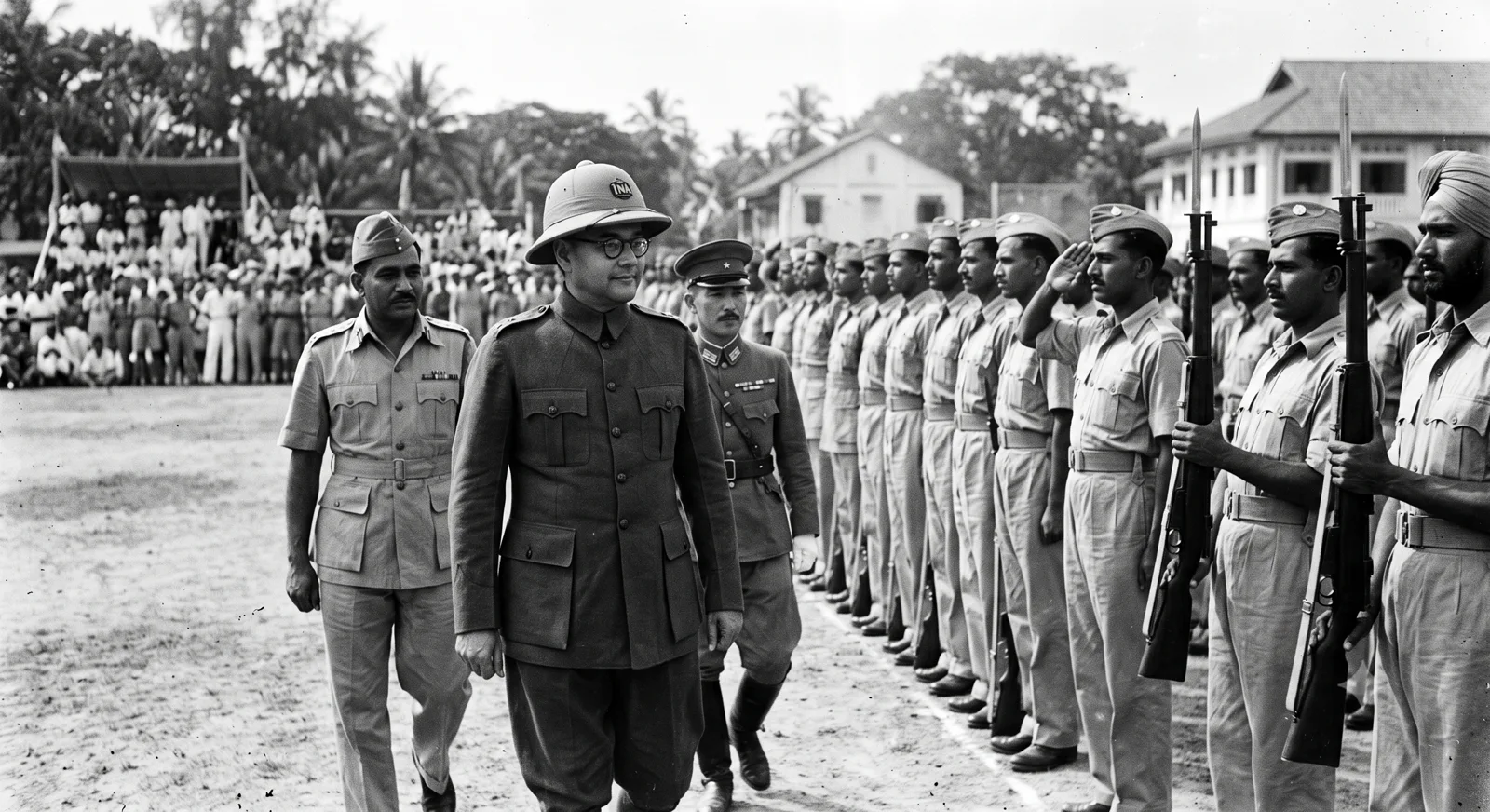
Netaji Subhas Chandra Bose inspecting soldiers of the Indian National Army (Azad Hind Fauj) in Southeast Asia
The Indian National Army occupies an unusual place in the story of India’s freedom. It never won a major battle against the British. Its largest campaign ended in retreat and disintegration. Yet within three years of its military collapse the same army had become a powerful political symbol that helped convince the British that their hold on the Indian armed forces—and therefore on India itself—was slipping. The public response to the Red Fort trials of 1945–46 transformed a defeated force into a catalyst for the final phase of the nationalist struggle. Understanding this paradox is essential for any serious study of the last years of the Raj.
This article reconstructs the full trajectory of the INA: its origins among prisoners of war in Southeast Asia, the decisive intervention of Subhas Chandra Bose, the military campaigns, the composition and ideology of the force, the drama of the Red Fort trials, and the larger political consequences that followed. The narrative pays equal attention to military events and to the shifting climate of opinion inside India.
The story began with the fall of Singapore in February 1942. Tens of thousands of Indian soldiers of the British Indian Army became prisoners of the Japanese. Captain Mohan Singh, an officer of the 14th Punjab Regiment, emerged as a leader among them. With Japanese encouragement he began organising an Indian volunteer force that would fight for independence rather than remain in captivity. The first INA was born out of a mixture of patriotism, resentment against racial discrimination in the British Indian Army, and the simple desire to escape the harsh conditions of the prison camps.
Early progress was uneven. Relations between Mohan Singh and the Japanese soured. By the end of 1942 the first INA had been largely disbanded. The project might have ended there had Subhas Chandra Bose not arrived in East Asia in May 1943. Bose had left India in January 1941, made his way to Germany, and eventually travelled by German and Japanese submarines to Sumatra. From there he flew to Tokyo and then to Singapore. His reputation as a radical nationalist who had challenged both the British and the Congress leadership preceded him. Within weeks he had revived and expanded the INA, given it a clearer political purpose, and established the Provisional Government of Free India (Azad Hind) in October 1943.
Bose’s leadership changed the character of the enterprise. He insisted that the INA must be an army of free Indians, not a Japanese auxiliary force. He recruited not only from prisoners of war but also from the large Indian civilian population of Southeast Asia—Tamil plantation workers, traders, and professionals in Malaya, Singapore and Burma. Women were organised into the Rani of Jhansi Regiment under Captain Lakshmi Swaminathan (later Lakshmi Sahgal). The army adopted a simple, secular greeting—“Jai Hind”—and a tricolour flag with the springing tiger. Bose’s speeches repeatedly emphasised unity across religious and regional lines. In a force that contained Hindus, Muslims and Sikhs in significant numbers, this emphasis was both idealistic and practical.
Chapter 3
The Campaign in the Imphal Sector
The military test came in 1944. Japanese strategists launched an offensive into India through the border regions of Manipur and Nagaland, hoping to disrupt the Allied build-up in Assam and to encourage a rising inside India. The INA was assigned a supporting role. Bose wanted his troops to be the first to plant the flag on Indian soil. Units of the INA crossed into India near Imphal and Kohima in the spring of 1944.
The campaign quickly turned into a disaster for both the Japanese and the INA. Allied air superiority, superior logistics, and the fierce defence of Kohima and Imphal halted the advance. The monsoon turned the jungle tracks into quagmires. Food and ammunition ran short. Disease spread. The INA units, lightly equipped and dependent on Japanese supply lines that themselves collapsed, suffered heavy casualties and began to disintegrate. By the autumn of 1944 the survivors were in retreat through Burma. When the Japanese surrendered in August 1945, the remaining INA soldiers became prisoners of the British once again.
From a purely military point of view the INA had failed. It had not liberated any significant portion of Indian territory, nor had it sparked the internal revolt that Bose had hoped for. Yet the political story was only beginning.
Campaign Overview (1944)
Target Regions
Manipur (Imphal) & Nagaland (Kohima)
Key Obstacles
Monsoon, Allied air superiority & supply collapse
Outcome
Tactical military retreat through Burma (Autumn 1944)
Historical Paradox
Military defeat transformed into political triumph
Chapter 4
The Red Fort Trials and the Turning of Public Opinion
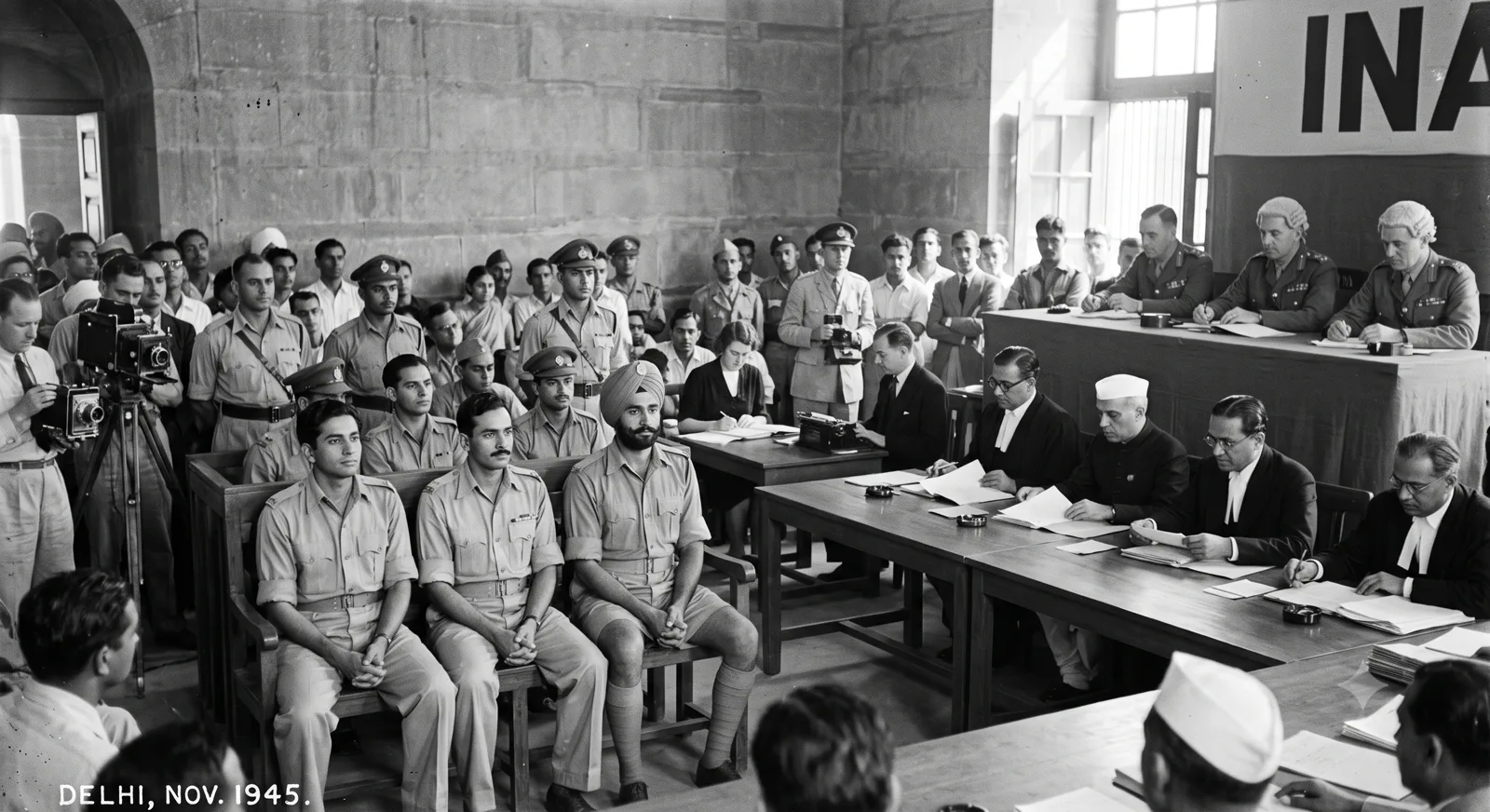
The historic Red Fort court-martial of 1945–46 in Delhi, featuring the trial of INA officers
In November 1945 the British authorities decided to court-martial three INA officers—Shah Nawaz Khan, Prem Kumar Sahgal and Gurbaksh Singh Dhillon—on charges of treason and waging war against the King-Emperor. The venue chosen was the Red Fort in Delhi, a site heavy with Mughal and British symbolism. The decision proved to be one of the most serious political miscalculations of the late colonial period.
The trials attracted intense public attention. The Congress leadership, despite its earlier differences with Bose, took up the defence of the INA officers. Bhulabhai Desai, Tej Bahadur Sapru, Jawaharlal Nehru and others appeared for the accused. The legal argument centred on the status of the Provisional Government of Free India and the right of Indian soldiers to fight under its banner. The political argument was simpler: these men had fought for the freedom of their country.
Outside the court the trials became a mass cause. Students, workers and ordinary citizens demonstrated in cities across the subcontinent. The three accused—one Hindu, one Muslim, one Sikh—embodied a unity that the prosecution could not easily dismiss. Valuable publicity was given to the INA’s secular character and to Bose’s leadership. Even sections of the British Indian Army watched the proceedings with sympathy. When the three officers were convicted but their sentences were later remitted under public pressure, the moral victory belonged to the defendants and to the nationalist movement.
Further trials followed, yet the political damage had already been done. The British high command began to doubt the reliability of Indian troops in any future confrontation with the nationalist movement. Intelligence reports spoke of growing restlessness within the ranks. The Royal Indian Navy mutiny of February 1946, though not directly organised by former INA men, occurred in an atmosphere shaped by the trials and by the widespread feeling that Indian soldiers and sailors no longer owed automatic loyalty to the Raj.
Chapter 5
Composition, Ideology and Internal Life of the INA
The INA was never a mass army by the standards of the Second World War. At its peak it numbered around 40,000–45,000 men and women. Its importance lay less in size than in symbolism and in the social experiment it represented. Recruitment cut across the martial-race categories that the British had carefully maintained. The presence of a women’s regiment was radical for its time. Officers and soldiers shared a common mess in many units, an unusual practice in the old Indian Army. Bose’s insistence on discipline was strict, yet he also cultivated a direct, almost personal style of leadership that inspired intense loyalty.
Ideologically the INA combined nationalism with a vague but genuine social radicalism. Bose spoke of a strong, centralised state after independence, of scientific planning, and of the need to eradicate the social evils that had weakened India. The Provisional Government issued its own currency, postage stamps and propaganda. In the territories it briefly administered it attempted to present itself as a functioning government rather than a mere military formation. These efforts were limited by the realities of war, but they left a lasting impression on those who participated.
Chapter 6
Significance in the Final Phase of British Rule
The INA’s military defeat did not translate into political irrelevance. On the contrary, the story of the army and the drama of the trials accelerated the British realisation that the old instruments of control were failing. The loyalty of the Indian Army had been the ultimate guarantee of British power in India. Once that loyalty appeared uncertain, the cost of remaining in India rose sharply. Officials in London and Delhi began to speak more openly of an early transfer of power.
Within the nationalist movement the INA experience complicated the moral narrative that the Congress had built around non-violence. Bose had chosen a different path—armed struggle with foreign assistance—yet his name and the names of his soldiers became part of the common stock of nationalist heroes. The Congress itself used the trials to mobilise public opinion while carefully maintaining its own preference for negotiated settlement. The result was a broadening of the emotional basis of the freedom struggle at a critical moment.
The INA also left a legacy inside independent India’s military culture. Many former INA officers and men were later absorbed into civilian life or, in some cases, into the new Indian armed forces. The memory of the Rani of Jhansi Regiment contributed to the gradual opening of greater roles for women in the military. Above all, the INA demonstrated that Indian soldiers could fight under an Indian political leadership for an Indian cause—an idea that had been systematically discouraged under British rule.
Chapter 7
Exam Relevance and Analytical Points for UPSC & State PSC
For competitive examinations the INA and the Red Fort trials offer rich material. Questions frequently ask for an assessment of Bose’s contribution, a comparison between the INA’s methods and those of the Congress, or an evaluation of the political impact of the trials. Strong answers emphasise the distinction between military failure and political success. They note the multi-religious composition of both the army and the three principal accused, the role of the trials in eroding British confidence in the Indian Army, and the connection between the INA episode and the wider unrest of 1945–46. Linking the subject to the Cabinet Mission, the Direct Action events, and the final decision to quit India demonstrates the kind of interconnected understanding that examiners reward.
Key Distinction: Military Failure vs Political Victory
Always emphasize that while the 1944 Imphal campaign collapsed militarily, the 1945–46 Red Fort trials mobilized public opinion across religions and broke British faith in armed forces' loyalty.
Secular & Progressive Social Experiment
Highlight the multi-religious officer trio (Hindu, Muslim, Sikh), the Rani of Jhansi women's regiment, the "Jai Hind" greeting, and common mess dining which broke caste & martial-race barriers.
Link to RIN Mutiny & Transfer of Power
Connect the INA trials to the February 1946 Royal Indian Navy (RIN) Mutiny, Cabinet Mission dispatch, and the accelerated timeline of British withdrawal.
Chapter 8
Frequently Asked Questions
Why did the Indian National Army fail militarily but succeed politically?
What was the significance of the three INA officers tried at the Red Fort?
How did Subhas Chandra Bose change the character of the INA?
What was the long-term impact of the INA on the end of British rule?
Practice Zone
🎯 Practice Questions: Test Yourself for UPSC, SSC & RRB
Q1. Who was the initial founder and leader of the first Indian National Army (INA) formed in 1942?
- A. Subhas Chandra Bose
- B. Captain Mohan Singh
- C. Rash Behari Bose
- D. Lakshmi Sahgal
Show Answer
Q2. The three INA officers court-martialed at the historic Red Fort Trials in 1945–46 were:
- A. Shah Nawaz Khan, Prem Kumar Sahgal, Gurbaksh Singh Dhillon
- B. Mohan Singh, Lakshmi Sahgal, Subhas Chandra Bose
- C. Bhulabhai Desai, Tej Bahadur Sapru, Jawaharlal Nehru
- D. Rash Behari Bose, Lakshmi Swaminathan, Shah Nawaz Khan
Show Answer
Q3. What was the name of the all-women combat regiment formed by Netaji Subhas Chandra Bose in the INA?
- A. Sarojini Naidu Brigade
- B. Rani of Jhansi Regiment
- C. Kasturba Gandhi Battalion
- D. Azad Hind Mahila Sena
Show Answer
Q4. Where did Netaji Subhas Chandra Bose establish the Provisional Government of Free India (Azad Hind) in October 1943?
- A. Tokyo
- B. Berlin
- C. Singapore
- D. Rangoon
Show Answer
INA, Red Fort, Three Officers
The INA trials are a modern-India cluster: Bose, the three accused, the 1945–46 mood. After this page, sit a full mock and check the same names in PYQs.
Start Free Mock Tests →Continue on RRBCONTENTS
Explore More
Knowledge Hub
More Blog Articles
In-depth, exam-focused articles on Indian history, freedom struggle, geography and static GK.
Study Material
Exam Study Notes
Subject-wise notes and digests for UPSC, Railway, SSC, Banking and State PSC exams.
Current Affairs
Daily Current Affairs & GK
Daily updates and a 70-day static GK bank with active-recall quizzes.
The Indian National Army was born in the prisoner-of-war camps of Southeast Asia, tested in the jungles of the Indo-Burma frontier, and transfigured in the courtroom of the Red Fort. Its soldiers did not march into Delhi as conquerors. They returned as prisoners and then as symbols. In that transformation lies the real historical significance of the INA. It showed that the British could defeat an Indian army in the field and still lose the deeper battle for the allegiance of the Indian people. By the time the last trials concluded, the question was no longer whether the British would leave India, but how soon and on what terms. In the answer to that question the INA, and the public emotion it generated, played an indispensable part.