Home › Blog › Geopolitics & Global Energy Security
Iran’s Revolutionary Guard on 8 August 2026 Links Strait of Hormuz Reopening to US Blockade Lift and War Damages – Separate from Oman Talks
Key Takeaways & Article Highlights
- Tehran Statement (8 August 2026): IRGC and Supreme National Security Council declare reopening the Strait of Hormuz is conditional on US lifting its naval blockade and paying war compensation.
- Separate from Muscat Talks: Iranian officials confirm that technical navigation talks with Oman are independent of political/military demands made on Washington.
- Disruption Timeline: Traces crisis escalation from 28 February strikes, April US blockade, short-lived June MoU rebound, to renewed July–August traffic restrictions.
- Impact on India: India imports 85–90% of its crude oil; ongoing Gulf transit friction raises freight costs, war-risk insurance premiums, and landed fuel prices.
On 8 August 2026 in Tehran, Mohammad Bagher Zolghadr, secretary of Iran’s Supreme National Security Council, released a statement through state media. He said the Strait of Hormuz would not reopen until the United States corrected its behaviour. The conditions he listed were an end to threats against Iran, a permanent stop to military action against Iran and its allies in Lebanon, Palestine, Yemen and Iraq, the lifting of the US naval blockade on Iranian ports, the withdrawal of American naval and air forces from the region around Iran, compensation for war damages, the lifting of sanctions, and the unconditional release of frozen Iranian assets.
The same day in Tehran, Hossein Mohebbi, spokesperson for the Islamic Revolutionary Guard Corps, stated that reopening the Strait of Hormuz was not linked to the negotiations under way with Oman. He said the waterway would reopen only when the United States accepted Iran’s full set of conditions. Foreign Minister Abbas Araghchi separately confirmed that Iran and Oman were close to an understanding on navigation routes, yet stressed that actual reopening remained subject to the additional demands placed on Washington, including payment for what Iran described as violations of the June memorandum.
The statements closed a chain of events that began on 28 February 2026. That day US and Israeli forces carried out strikes on targets inside Iran. Iranian forces, led by the Revolutionary Guard Navy operating from bases along the northern shore of the strait and from islands including Qeshm and Larak, responded by restricting commercial traffic. Vessels that did not follow Iranian-designated routes faced warnings, warning shots and, in several cases, direct attacks. Pre-war traffic of more than 100 vessels a day and roughly 15 to 20 million barrels of oil per day fell sharply within the first weeks.
In mid-April 2026 the United States imposed a naval blockade directed at Iranian ports and shipping linked to Iran. Traffic through the strait stayed heavily restricted through May. On 17 and 18 June 2026 the two sides signed a memorandum of understanding. Under its terms the United States lifted the blockade and Iran agreed to facilitate safe passage of commercial vessels for a limited period, with future arrangements to be discussed with Oman. In the days after 18 June, tanker tracking data recorded a rebound. On peak days more than 10 million barrels moved through the strait. Iranian loadings rose temporarily to averages near 1.5 to 1.7 million barrels per day according to several trackers.
The recovery did not last. In early July 2026, after further incidents involving commercial ships in the strait and Iranian strikes on facilities linked to US operations, the United States reimposed restrictions. Iranian forces again asserted control over routing. By late July daily commodity-related transits had dropped to low single-digit averages in some assessments, and crude volumes fell back toward the levels seen before the June memorandum. In the first week of August 2026 only limited movements were recorded. On 6 and 7 August vessel tracking showed a handful of tankers and other ships while markets monitored the parallel discussions in Muscat.
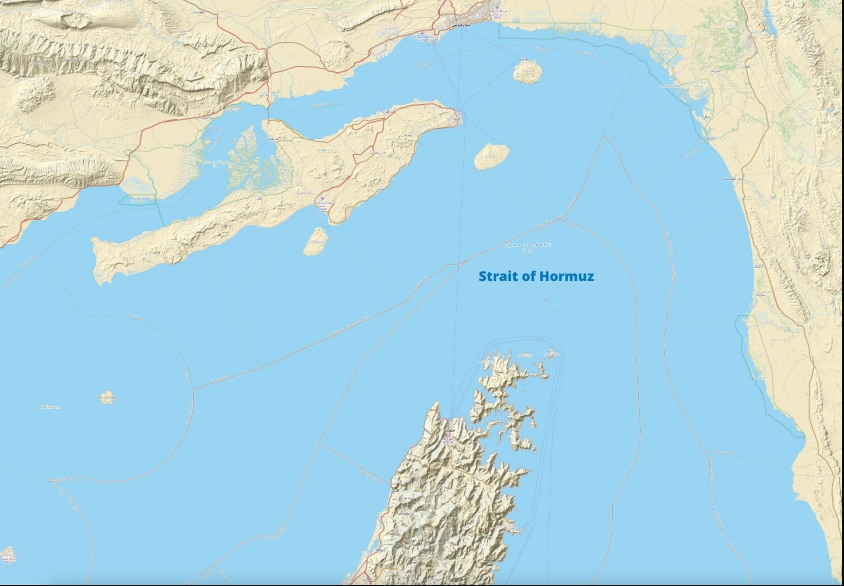
The physical setting of the crisis is fixed. The Strait of Hormuz runs between roughly 26° and 27° North and 56° to 57° East. Iran controls the entire northern coastline. The southern side is formed by Oman’s Musandam Peninsula, with the United Arab Emirates adjacent. The navigable channel at its narrowest is only a few kilometres wide. Iranian export terminals near Kharg Island and the port of Bandar Abbas lie on the Persian Gulf side. Ships must pass from the Persian Gulf into the Gulf of Oman and then the Arabian Sea. Any sustained restriction immediately affects loadings from Iraq, Saudi Arabia, the United Arab Emirates, Kuwait and Iran.
Oil volume data from the period quantify the disruption. Before 28 February 2026 approximately one-fifth of global seaborne oil trade moved through the waterway. After the initial closure and during the blockade phases, daily volumes fell to a few million barrels or lower on many days. During the short window after the June memorandum, total crude movements on peak days climbed toward 10–12 million barrels before collapsing again after the July re-escalation. By early August 2026 traffic remained well below pre-war levels.
India’s position is measurable. The country imports 85 to 90 per cent of its crude oil requirement. Although Russian volumes have taken a large share in recent years, supplies originating in or transiting the Gulf region continue to form a substantial portion of the import basket. Iraq, Saudi Arabia, the UAE and Kuwait remain important sources. When transit through the Strait of Hormuz is restricted, Indian refiners face higher freight rates, elevated war-risk insurance premiums and the need to arrange longer-haul alternatives. The resulting rise in landed costs feeds into domestic fuel prices and the current-account balance. Strategic reserves and diversified sourcing provide partial buffers, yet the short-haul Gulf route retains economic weight.
As of 9 August 2026 the situation remains dual-track. Technical talks between Iranian and Omani officials continue in Muscat. At the same time the statements issued in Tehran on 8 August keep the political and financial conditions directed at the United States separate from those talks. Shipping companies, insurers and refiners continue to operate under higher risk premiums while waiting for the next movement either in the Muscat discussions or in the conditions set by the Revolutionary Guard and the Supreme National Security Council.
The sequence of dated actions, the precise geography of the strait, the recorded oil volumes and the measurable effect on India’s import costs together define the current state of the crisis.
Frequently Asked Questions (FAQ)
What conditions did Iran announce on 8 August 2026 for reopening the Strait of Hormuz?
On 8 August 2026 in Tehran the Supreme National Security Council and the IRGC stated that reopening requires the United States to lift its naval blockade, pay war damages, withdraw forces, lift sanctions, release frozen assets and end threats and attacks on Iran and its allies. These conditions are independent of the talks with Oman.
What is the timeline of key events in the 2026 Strait of Hormuz crisis?
Strikes began on 28 February 2026. The US naval blockade was imposed in mid-April 2026. A memorandum of understanding was signed on 17–18 June 2026. Restrictions were reimposed in July 2026. The latest conditions were announced in Tehran on 8 August 2026 while talks continued in Muscat.
How does the situation affect India’s crude oil imports?
India imports 85–90 per cent of its crude oil. Supplies from the Gulf region that transit or originate near the Strait of Hormuz remain significant. Restrictions raise freight rates, insurance premiums and landed costs.
Join Official RRBCONTENTS Telegram Channel
Get instant updates on daily current affairs, government job alerts, and study notes.
Join Official Telegram (@rrbcontents) →