Home › Blog › Indian Polity › Kapil Sibal CJP Standoff
"Drop the Hubris and Talk": Kapil Sibal Slams Government Over CJP's Neutral Venue Offer Amid Mounting Jantar Mantar Crisis
Track Supreme Court, High Court & State Legal Services recruitment alerts on RRBCONTENTS Jobs Portal.
Key Takeaways & Summary
- Sibal's Critique: Senior Advocate Kapil Sibal slammed the Union Government's refusal to meet CJP student leaders at a neutral venue as "unprecedented arrogance."
- Students' Neutral Venue Offer: CJP offered to negotiate at Jantar Mantar or the Constitution Club to ensure open transparency and avoid closed-door delays.
- Legal FIR Warning: Sibal exposed the police practice of filing open-ended "blanket FIRs" to retroactively target student leaders weeks after protests.
- Medical Transparency Demand: Challenged Delhi Police to release official Medico-Legal Reports (MLRs) for both the 118 injured police officers and 60 injured students.
Table of Contents
- 1. The Anatomy of the Standoff: How the "Neutral Venue" Demand Emerged
- 2. "The Government Shouldn't Have Such Arrogance": Dissecting Kapil Sibal's Statement
- 3. The Legal Warning: Spectre of 2020 Delhi Riots & Retrofitted FIRs
- 4. The Broader Context: Systemic Exam Leaks and NTA Reforms
- 5. Comprehensive Comparison Matrix: CJP, Government, and Kapil Sibal
- 6. High-Yield Exam Corner for Competitive Aspirants
The ongoing confrontation between the Government of India and the youth-led Cockroach Janta Party (CJP) over examination paper leaks reached a pivotal political impasse in New Delhi. Following weeks of demonstrations, hunger strikes, and police action at Jantar Mantar, the student movement expressed willingness to enter formal negotiations with the Union Cabinet—on the explicit condition that talks take place at a neutral venue, such as Jantar Mantar or the Constitution Club of India, rather than inside a minister's private residence.
When the central government rejected the neutral venue proposal and insisted that student delegates meet ministers at official residences, senior advocate, former Union Minister, and independent Rajya Sabha Member of Parliament Kapil Sibal stepped into the national spotlight.
Addressing a crowded press conference in the capital, Sibal delivered a scathing critique of the executive's stance. Accusing the ruling administration of "unprecedented arrogance and political ego," Sibal questioned why location protocols were being prioritized over the academic futures of millions of young citizens.
1. The Anatomy of the Standoff: How the "Neutral Venue" Demand Emerged
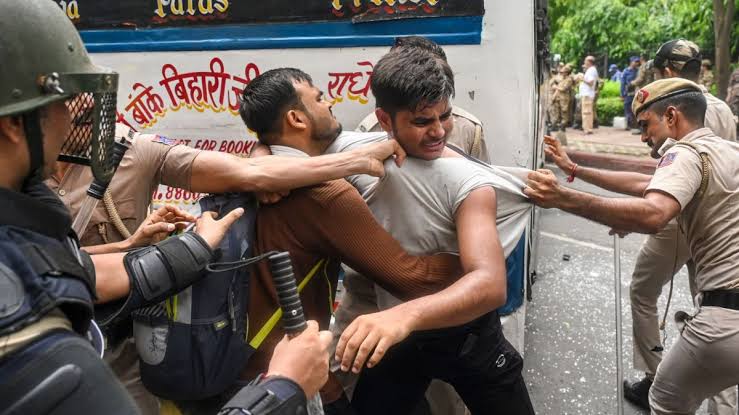
Following the clashes on Janpath on July 20, CJP leaders offered to sit down for formal negotiations with senior Cabinet members, provided talks took place in a neutral, publicly accessible venue like Jantar Mantar or the Constitution Club of India to ensure complete transparency.
2. "The Government Shouldn't Have Such Arrogance": Dissecting Kapil Sibal's Statement
"The students are saying they are ready to talk, and the government says it is ready to talk. The students simply asked the government to come to a neutral venue. The Central Government shouldn't have this much arrogance. Where there should be compromise, empathy, and constructive suggestions, you are creating an artificial stalemate."
3. The Legal Warning: Spectre of 2020 Delhi Riots & Retrofitted FIRs
| Pillar | Sibal's Four-Point Legal Warning |
|---|---|
| 1. MLR Transparency | Demanded public release of Medico-Legal Reports (MLRs) for both 118 police & 60 student casualties. |
| 2. Blanket FIRs Danger | Warned that open FIRs are used to retroactively insert student leaders' names weeks later. |
| 3. Pre-Trial Detention Risk | Pointed to 2020 Delhi Riots tactics where broad conspiracy charges ruined young careers. |
| 4. NSA Overreach | Condemned invoking the National Security Act (NSA) against 20-year-old exam aspirants. |
4. The Broader Context: Systemic Exam Leaks and NTA Reforms
Sibal highlighted that paper leaks are not isolated events, citing recurring scandals across Bihar, Gujarat, Rajasthan, and Uttarakhand from 2016 to 2026. He urged investigating agencies to target high-level organized paper-leak cartels rather than criminalizing student aspirants.
5. Comprehensive Comparison Matrix: CJP, Government, and Kapil Sibal
| Issue / Dimension | CJP / Student Protesters' Stand | Central Government's Stand | Kapil Sibal's Legal Critique |
|---|---|---|---|
| Negotiation Venue | Neutral venue (Jantar Mantar / Constitution Club). | Invites students to Minister's Official Residence. | Slams government arrogance; location shouldn't block dialogue. |
| Past Experience | Delegates faced 2–4 hour delays in anterooms previously. | Maintains official decorum and security requires official venues. | Validates student distrust; closed doors lack transparency. |
| Legal Action / FIRs | Demands unconditional withdrawal of all police cases. | Registers FIRs against individuals damaging public property. | Warns against "retrofitted FIRs" framing students later. |
6. High-Yield Exam Corner for Competitive Aspirants
UPSC GS-2 & Polity Revision Notes
- Right to Assembly (Article 19(1)(b)): Subject to reasonable public order restrictions under Article 19(3).
- Preventive Detention Safeguards (Article 22): Procedural limits under NSA 1980 and doctrine of proportionality.
- Judicial Precedents: Ramlila Maidan Incident (2012) & Himmat Lal (1973) rulings on peaceful protest rights.
Interactive Constitutional Law Quiz
Q1. Which landmark Supreme Court judgment affirmed that the right to hold peaceful public meetings is a fundamental right?
A) Shankari Prasad Case
B) Ramlila Maidan Incident v. Home Secretary (2012)
C) Berubari Union Case
D) Golaknath Case
Correct Answer: B
Explanation:
Ramlila Maidan Incident (2012) affirmed that peaceful assembly is a fundamental right requiring state protection.
Q2. What is the maximum initial period an individual can be held under preventive detention without Advisory Board approval under Article 22?
A) 1 Month
B) 3 Months
C) 6 Months
D) 12 Months
Correct Answer: B
Explanation:
Article 22(4) limits preventive detention without Advisory Board review to a maximum of 3 months.
Master Constitutional Law & Polity Preparation
Explore free study notes, legal case studies, and current affairs on RRBCONTENTS.
Solve Polity PYQs → Check Legal Jobs →Join our official Telegram community: @rrbcontents