Home › Blog › Science & Technology › LHS 1140 b Atmosphere
LHS 1140 b Atmosphere Detected: Is This Our Best Shot at Finding Liquid Water?
Key Takeaways & Scientific Highlights
- The Discovery: On July 17, 2026, researchers published in the journal Science that they detected escaping helium gas in the atmosphere of exoplanet LHS 1140 b.
- Major Milestone: First confirmed atmosphere on a rocky, temperate super-Earth situated within its star's habitable zone outside our solar system.
- Lead Researcher: Dr. Collin Cherubim of Harvard University, utilizing ground-based observations from the Magellan/Clay telescope at Las Campanas Observatory, Chile.
- Exoplanet Profile: Located 49 light-years away in the constellation Cetus; 1.73 times Earth's radius and 5.6 times Earth's mass.
- Water World Hypothesis: Bulk density suggests LHS 1140 b is not a gas giant or mini-Neptune, but a rocky/icy world with 9% to 19% water by mass.
- Climate Profile: Tidally locked, likely forming an "eyeball planet" with a global ice shell and a dayside liquid ocean.
Table of Contents
- 1. The Breakthrough: Helium Detected in Science (July 2026)
- 2. Planet Profile: Dimensions of a Super-Earth
- 3. The Quiet Host: Red Dwarf LHS 1140 and Habitability
- 4. Water World & Eyeball Planet Mechanics
- 5. Behind the Science: Magellan/Clay Telescope vs. JWST
- 6. Geopolitical Comparison: LHS 1140 b vs. Other Habitable Worlds
- 7. The Examiner's Corner: UPSC GS-3 Science & Tech Framework
1. The Breakthrough: Helium Detected in Science (July 2026)
Imagine looking up at the night sky and knowing that, right now, astronomers are peering at a world 49 light-years away that might have an atmosphere, possible oceans, and conditions where liquid water could exist. This week, that imagination became reality in a major way.
On July 17, 2026, a research team led by Dr. Collin Cherubim (doctoral graduate of Harvard University) announced in the prestigious journal Science the detection of helium escaping from the upper atmosphere of LHS 1140 b. This marks the first time scientists have observationally confirmed an atmosphere on a rocky, terrestrial exoplanet located inside the habitable zone of its host star. While we are not talking about complex lifeforms just yet, this discovery brings astrobiology closer than ever to answering one of humanity’s oldest questions: Are we alone?
Dr. Cherubim called it "a big deal," and his colleague Dr. David Charbonneau noted that this is the first clear evidence of a potentially habitable planet with an atmosphere. While the detected helium is not breathable for humans, its presence is a vital proof of concept. If a rocky planet in a red dwarf's habitable zone can hold onto light gas like helium over billions of years, it has the gravity and stability to maintain a secondary atmosphere (like nitrogen, carbon dioxide, or water vapor).
2. Planet Profile: Dimensions of a Super-Earth
LHS 1140 b was initially discovered in 2017 by the MEarth Project—a ground-based array of telescopes designed to monitor nearby red dwarf stars. Over the years, refining the planet's dimensions has altered how we view its composition. The orbital and physical characteristics of this super-Earth are highly promising:
| Physical Parameter | Scientific Value | Earth Comparison |
|---|---|---|
| Radius | \(1.73\text{ }R_\oplus\) (approx. 11,000 km) | ~73% larger than Earth |
| Mass | \(5.6\text{ }M_\oplus\) | ~5.6 times heavier than Earth |
| Orbital Period | 24.737 Days | Much faster year (closer to host star) |
| Orbital Semi-major Axis | 0.0946 AU | Over 10 times closer than Earth to Sun |
| Equilibrium Temperature | 226 K to 230 K (\(-47^{\circ}\text{C}\) to \(-53^{\circ}\text{C}\)) | Chilly baseline (needs greenhouse warming) |
Although LHS 1140 b sits extremely close to its star (just 9.4% of the Earth-Sun distance), its year lasts only 24.7 days. This proximity is habitable because the host red dwarf star is far cooler and dimmer than our Sun. Consequently, the planet receives approximately 40% to 46% of the solar radiation that Earth gets, placing it squarely in the stellar "Goldilocks" zone.
3. The Quiet Host: Red Dwarf LHS 1140 and Habitability
The stellar environment plays a deciding role in exoplanetary habitability. Red dwarfs (M-dwarfs) are the most common stars in our galaxy, constituting about 70% of the stellar population. However, they present a major challenge: young red dwarfs are highly active, emitting powerful ultraviolet (UV) and X-ray flares that can strip a planet of its volatile chemicals and atmosphere.
LHS 1140 is a remarkable exception for several reasons:
- Slower Spin & Low Activity: The star is estimated to be over 5 billion years old. It has transitioned into a quiet phase, exhibiting no major high-energy flaring activity.
- Ecosystem Preservation: The calm radiation environment of the host star has allowed LHS 1140 b to retain its volatile elements and hold onto its secondary atmosphere over geological timescales.
- Trillions of Years of Fuel: Due to their slow nuclear fusion rate, red dwarf stars live for trillions of years, providing a highly stable timeline for potential astrobiological evolution.
4. Water World & Eyeball Planet Mechanics
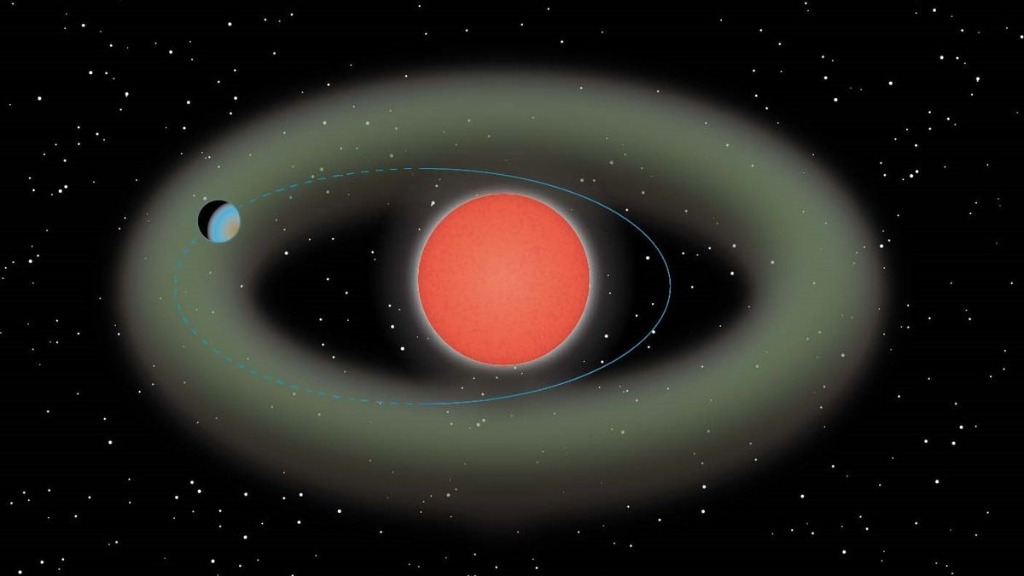
Initial models of LHS 1140 b classified it as a dense, iron-rich rocky super-Earth. However, revised measurements of its mass and radius have lowered its calculated density. The data shows it is less dense than a pure iron-rock structure would predict, leading scientists to favor the water world hypothesis.
LHS 1140 b is estimated to contain 9% to 19% water by mass (compared to Earth's water content, which is a fraction of a percent). This means it holds massive reserves of volatile fluids, likely stored as a thick mantle of ice surrounding a rocky core.
The Eyeball Planet Scenario
Due to its close orbit, LHS 1140 b is likely tidally locked to its star, meaning one hemisphere permanently faces the stellar furnace while the other points to deep space. This locking shapes a unique climate system:
- Frozen Nightside: The hemisphere in permanent darkness is locked in a global ice sheet.
- Dayside "Eyeball" Ocean: At the substellar point (the spot on the planet directly facing the star), temperatures can rise high enough to melt the ice, creating a circular dayside liquid ocean.
- Atmospheric Circulation: Strong wind currents and oceanic heat transport are required to distribute heat from the dayside to prevent the atmosphere from collapsing and freezing out on the dark side.
5. Behind the Science: Magellan/Clay Telescope vs. JWST
The detection of helium was accomplished using high-resolution spectroscopy. As the planet transits in front of its star, a tiny fraction of starlight passes through the thin atmospheric ring surrounding the planet. Gaseous elements absorb specific wavelengths of light, leaving dark absorption lines in the starlight spectrum.
6. Geopolitical Comparison: LHS 1140 b vs. Other Habitable Worlds
LHS 1140 b is now widely regarded as our premier candidate for astrobiological study. The table below compares it with other famous exoplanet targets in the habitable zone:
| Planet Name | Distance | Radius | Host Star Type | Atmospheric Status | Scientific Prospects |
|---|---|---|---|---|---|
| LHS 1140 b | 49 light-years | \(1.73\text{ }R_\oplus\) | Quiet M-dwarf (Old) | Confirmed (Helium, 2026) | Best candidate for secondary atmosphere and water detection. |
| TRAPPIST-1 e | 40 light-years | \(0.92\text{ }R_\oplus\) | Ultra-cool M-dwarf | Unconfirmed / Debated | Tidally locked; active stellar flares may strip atmosphere. |
| Proxima Centauri b | 4.2 light-years | \(1.03\text{ }R_\oplus\) | Active M-dwarf | Not detected | Closest planet, but star flares heavily, making life difficult. |
| K2-18 b | 124 light-years | \(2.6\text{ }R_\oplus\) | M-dwarf | Hydrogen-rich detected | Likely a gas-rich sub-Neptune; biosignatures are highly debated. |
7. The Examiner's Corner: UPSC GS-3 Science & Tech Framework
For civil services candidates, exoplanet discoveries and biosignature science fall under the "Science & Technology" syllabus (Space Exploration and Astronomy Developments). Let's review the analytical angles:
Syllabus Connect: Astrobiology & Space Missions
- Habitable Zone (Goldilocks Zone): The orbital range around a star where temperatures permit liquid water to exist on a planet's surface. Candidates are crucial in the search for extraterrestrial life.
- Biosignatures vs. Abiosignatures: Biosignatures are substances (like combined methane and oxygen) that provide scientific evidence of past or present life. In contrast, helium detection is an abiosignature confirming physical parameters (atmosphere retention) rather than biological activity.
- Ground-Based vs. Space-Based Spectroscopy: While space telescopes (like JWST) avoid atmospheric distortion, ground-based telescopes (like Magellan/Clay) equipped with advanced spectrographs and adaptive optics can perform high-resolution target spectroscopy.
Interactive Practice MCQ Quiz
Q1. Which telescope was utilized to confirm the helium atmosphere of exoplanet LHS 1140 b in July 2026?
A) James Webb Space Telescope (JWST)
B) Hubble Space Telescope (HST)
C) Magellan/Clay ground-based telescope in Chile
D) Extremely Large Telescope (ELT)
Correct Answer: C
Explanation: The 2026 helium detection was achieved using the ground-based Magellan/Clay telescope at the Las Campanas Observatory in Chile, led by Collin Cherubim's team.
Q2. In astronomy, the 'Goldilocks Zone' or Habitable Zone refers to the region where:
A) High-energy radiation is completely blocked by magnetic fields
B) Temperatures are suitable for liquid water to exist on a planet's surface
C) Gravitational forces between binary stars cancel out
D) Methane and oxygen are found in equal atmospheric ratios
Correct Answer: B
Explanation: The habitable zone is defined as the range of distances from a star where liquid water can remain stable on a planet's surface, depending on its atmospheric pressure.
Q3. LHS 1140 b is located approximately how many light-years away from Earth?
A) 4.2 light-years
B) 49 light-years
C) 124 light-years
D) 500 light-years
Correct Answer: B
Explanation: LHS 1140 b orbits a red dwarf star located roughly 49 light-years (or 15 parsecs) away from our solar system in Cetus constellation.
Q4. Refined measurements suggest that LHS 1140 b could have a significant water content, making it a 'water world'. What is the estimated mass fraction of water on the planet?
A) Less than 0.1%
B) 1% to 2%
C) 9% to 19%
D) 50% to 60%
Correct Answer: C
Explanation: Its low density suggests LHS 1140 b holds a significant quantity of water, estimated to be between 9% and 19% of its total mass.
Q5. Why does LHS 1140 b have better prospects for habitability compared to planets orbiting other red dwarf stars like Proxima Centauri?
A) Its star is much younger and hotter than our Sun
B) Its host star is over 5 billion years old and remarkably quiet, with no observed major flares
C) It orbits outside the tidal locking boundary of its star
D) It lacks a magnetic field to attract solar wind particles
Correct Answer: B
Explanation: Red dwarf stars are often highly active, but LHS 1140 is old and quiet. It lacks violent flaring activity, which helps the planet retain its atmosphere over long geological timelines.
Frequently Asked Questions (FAQs)
What is the recent breakthrough regarding LHS 1140 b?
On July 17, 2026, researchers led by Dr. Collin Cherubim of Harvard University published a study in the journal Science confirming the detection of helium escaping from the upper atmosphere of LHS 1140 b. This marks the first time scientists have observationally confirmed an atmosphere on a rocky, terrestrial exoplanet orbiting within the habitable zone of its host star.
How far away is LHS 1140 b and where is it located?
LHS 1140 b is located approximately 48 to 49 light-years away from Earth. It orbits a cool red dwarf star (LHS 1140) located in the constellation Cetus (the Whale).
Why is LHS 1140 b considered a 'water world' candidate?
Refined measurements show LHS 1140 b has a radius of 1.73 Earth radii and a mass of 5.6 Earth masses. Its bulk density is lower than expected for a purely rocky composition, suggesting it could consist of 9% to 19% water by mass, potentially forming a deep global ocean or an icy shell with a dayside liquid ocean.
Which telescope was used to detect helium in LHS 1140 b's atmosphere?
The detection of helium escaping from the planet's upper atmosphere was achieved using spectroscopy from the ground-based Magellan/Clay telescope at the Las Campanas Observatory in Chile.
Practice Space Science & Technology Quiz
Enhance your general knowledge and prepare for UPSC civil services and competitive exams by working through our interactive prep materials.
Solve PYQs → Study Notes →Join our official Telegram community for daily study material: @rrbcontents