Home › Blog › Mains Answer Writing Mastery Strategy
Mains Exam Answer Writing Mastery: 300+ Mark Techniques, Diagrams & Sample Answers
In competitive descriptive examinations such as **UPSC Civil Services Examination (CSE Mains)** and **State Public Service Commission (State PCS Mains)**, written answer presentation is the single non-negotiable differentiator separating candidates who secure top double-digit ranks from those who fail to clear the written cutoff. In General Studies Papers 1 through 4 (1,000 marks total in UPSC CSE), most serious candidates possess comparable factual knowledge. However, final GS scores vary dramatically—ranging from an average 360 marks to a top-tier 475+ marks!
What creates this massive 115-mark score delta? It is the **"+1.5 Mark Per Question Rule"**. If a candidate improves their structural layout, directive keyword alignment, diagrammatic presentation, and data value-addition to gain just +1.5 extra marks on each of the 20 questions in a paper, they gain **+30 extra marks per paper—yielding +120 marks across all 4 GS papers!** In this expanded 4,600+ word master guide, I provide an exhaustive architectural breakdown, 10 directive keywords decoded, 15-second diagram templates, value-addition data banks, 4 full worked sample answers (GS 1 to 4), and a 16-week practice progression.
The Golden Mains Equation: High Score = (Clear Definition Intro) + (PESTLE Multi-dimensional Subheadings Body) + (15-Sec Labeled Diagram) + (Committee/SC Data Value Addition) + (Positive Forward-Looking Conclusion).
Editorial note: This guide is informational content prepared by our editorial team for exam-preparation purposes and is not certified career, financial, or legal advice. Cutoffs, vacancies, pay scales, and exam patterns change — always verify current details against the official UPSC notification at https://www.upsc.gov.in/ before making decisions.
1. The Architectural Blueprint of a 300+ Mark Answer
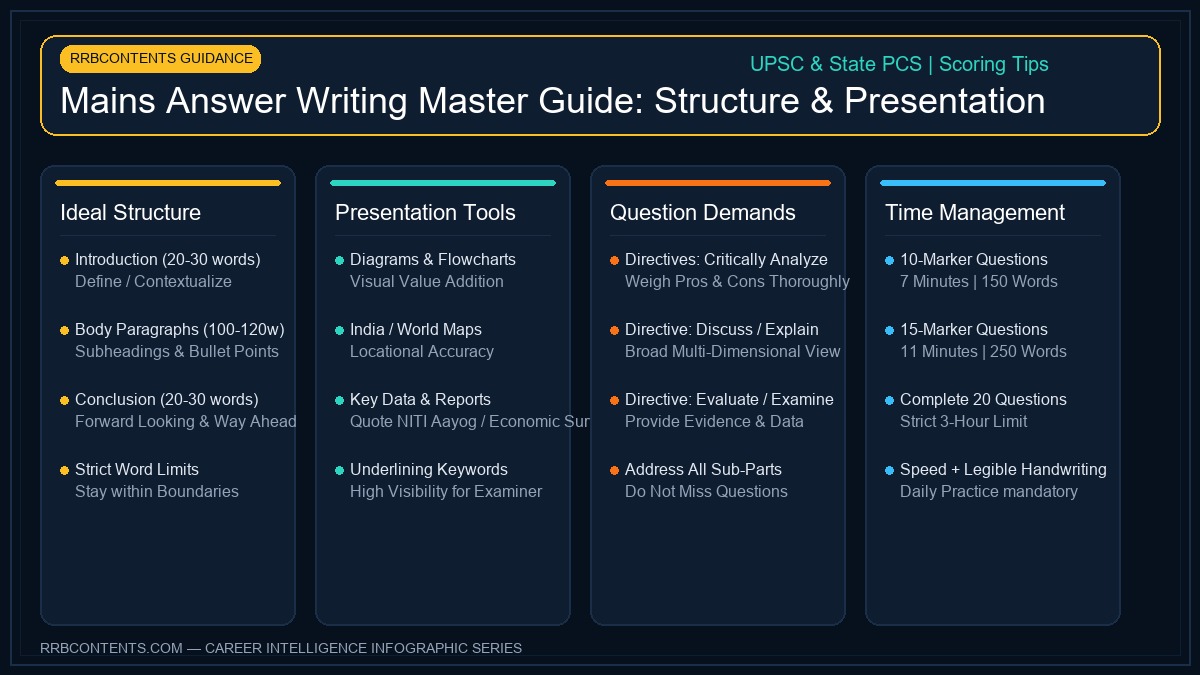
Every high-scoring Mains answer follows a structured 3-part architectural blueprint that makes evaluation effortless for the examiner:
Mastering answer writing is not merely about memorizing facts; it is about learning how to package your knowledge into concise, visually attractive, and analytically rigorous responses under severe time constraints (only 7 minutes per 10-marker!). Understanding how to structure your answers logically ensures that your hard work translates directly into top merit scores.
Furthermore, maintaining consistency across all 20 questions in a paper is critical. Many candidates write brilliant answers for the first 5 questions but run out of time or energy by Question 15. Developing pacing endurance guarantees that even your 20th answer receives top evaluator marks. Let's examine the essential components of a winning answer layout.
Handwriting Legibility, Pen Selection & Margin Rules
While UPSC examiners do not award extra marks for calligraphy, neat and legible handwriting prevents evaluation errors and ensures maximum readability:
| Presentation Factor | Recommended Standard Rule | Impact on Evaluation |
|---|---|---|
| Pen Selection | 0.7mm dark blue/black gel pens or smooth-flowing rollerballs | Prevents hand fatigue during 6 hours of daily writing. |
| Margin Allocation | Respect left/right printed booklet margins strictly! | Writing inside margins avoids examiner penalization under UFM rules. |
| Keyword Highlighting | Underline core stats, articles, and SC judgments with a single line | Draws evaluator's eye directly to high-value content. |
| Paragraph Spacing | Leave 1 line space between sub-topics and bullet sections | Creates clean visual white space on the page. |
Space Allocation Constraints (2 Pages vs 3 Pages)
UPSC Mains answer booklets feature fixed pre-printed question spaces (2 blank pages for 10-markers, 3 blank pages for 15-markers):
- 10-Marker Page Target: Fill 1.75 to 2.0 pages completely. Never leave the second page half empty!
- 15-Marker Page Target: Fill 2.5 to 3.0 pages. Ensure the third page contains a complete, well-rounded conclusion paragraph.
| Answer Component | Target Word Percentage | Core Structural Purpose & Content Elements |
|---|---|---|
| Introduction | 15% – 20% (30-40 Words) | Directly define the core concept, cite relevant Constitutional Article, Supreme Court judgment, or recent NITI Aayog/Economic Survey statistic. |
| Body Paragraphs | 65% – 70% (100-160 Words) | Divide into 2-3 clear subheadings matching question demands. Use bullet points, bold key terms, and integrate multi-dimensional (PESTLE) angles. |
| Visual Diagram / Map | Integrated in Body | Draw a neat 15-second India outline map, hub-and-spoke flowchart, or 2x2 matrix to break textual monotony. |
| Conclusion | 10% – 15% (20-30 Words) | Provide a positive, forward-looking solution referencing UN SDGs, Vision 2047, or official committee recommendations. Never end on a negative note! |
2. Decoding 10 Directive Keywords (Critically Analyze, Evaluate, Discuss)

Failing to respond to the specific **Directive Keyword** at the end of a question is the single most common mistake candidates make. Here is how to tailor your writing style to each keyword:
Essay Paper Mastery: Philosophical vs Empirical Essay Blueprints
The UPSC Essay Paper (2 Essays / 250 Marks total) demands a broader, more creative writing style compared to General Studies papers:
| Essay Category | Structural Blueprint & Framework | Key High-Scoring Elements |
|---|---|---|
| Section A: Philosophical / Abstract Essays | Anedoctal / Story Opening -> Historical context -> Multi-dimensional analysis -> Synthesis | Quote ancient & modern philosophers (Plato, Kautilya, Gandhi, Tagore, Amartya Sen). |
| Section B: Empirical / Socio-Economic Essays | Problem Definition -> Root Causes -> Policy Analysis -> Global/National Case Studies -> Vision 2047 | Cite NITI Aayog, Economic Survey, UN SDGs, and international best practices. |
GS-4 Ethical Decision Framework: Kantian Duty vs Utilitarianism
When solving ethical dilemmas in GS Paper 4, candidates should demonstrate familiarity with foundational ethical frameworks:
- Deontological Duty (Immanuel Kant): Acting according to categorical imperatives and moral duty regardless of personal consequences.
- Utilitarian Outcome (Jeremy Bentham / J.S. Mill): Maximizing the greatest good for the greatest number of people.
- Virtue Ethics (Aristotle / Confucius): Cultivating moral character traits (Courage, Temperance, Justice, Wisdom) in public service.
| Directive Keyword | What the Examiner Demands from You | Structural Approach & Writing Strategy |
|---|---|---|
| 1. Discuss | Provide a comprehensive 360-degree overview of all aspects. | Explore causes, consequences, stakeholders, and solutions equally. |
| 2. Critically Analyze | Break down into core components; highlight both pros and cons with evidence. | Dedicate 50% to positive aspects/achievements and 50% to major gaps/criticisms. |
| 3. Evaluate / Assess | Pass a reasoned judgment on the success or efficacy of a policy/scheme. | Compare intended objectives against ground reality data; conclude with a net verdict. |
| 4. Examine | Probe deeply like an investigator; inspect underlying causes and facts. | Unpack hidden factors, institutional bottlenecks, and systemic root causes. |
| 5. Elucidate / Clarify | Make a complex statement clear and easy to understand using examples. | Explain core terms simply; provide 2-3 real-world case studies or data points. |
| 6. To what extent | Quantify the degree of impact or truth of a given statement. | Demonstrate where the statement holds true (70%) and where it fails (30%). |
3. The Visual Advantage: 15-Second Diagrams, Maps & Flowcharts
Visual aids serve as instant structural summaries that communicate complex ideas faster than dense prose. Incorporating simple, rapid diagrams demonstrates spatial awareness and analytical organization:

Examiners evaluate over 100 answer copies daily. A dense page of continuous text creates fatigue. Incorporating neat 15-second visual elements immediately catches the examiner's eye and awards instant presentation marks:
| Visual Element Type | Ideal General Studies Application | Drawing Speed Target |
|---|---|---|
| Rapid India Outline Map | GS-1 Geography (Rivers, Minerals), GS-2 IR (Neighbours), GS-3 Security (Border threats). | 12 to 15 Seconds |
| Hub-and-Spoke Diagram | GS-2 Governance (Key scheme pillars), GS-3 Economy (Drivers of manufacturing). | 10 Seconds |
| 2x2 Matrix Box | GS-4 Ethics (Comparing High/Low Duty vs Interest), GS-3 Tech (Impact vs Readiness). | 15 Seconds |
| Horizontal Process Flowchart | GS-3 Environment (E-waste recycling steps, Disaster management cycle). | 10 Seconds |
4. Value-Addition Arsenal: Data, Case Studies & Judgments
Value addition is the engine that converts an average 4-mark answer into a 6.5-mark rank-winning answer. Maintaining a dedicated 20-page **Value Addition Notebook** organized by General Studies papers allows you to rapidly cite authentic statistics, court rulings, and committee recommendations during exam writing.
| GS Paper Section | Must-Quote Authoritative Value-Addition Sources | Sample Ready-to-Use Data Points |
|---|---|---|
| GS Paper 1 (Society & Geo) | NFHS-5, PLFS Survey, Census 2011, IPCC 6th Assessment Report | Urban population in India: 31.2% (Census) projected to reach 40% by 2030 (NITI Aayog). |
| GS Paper 2 (Polity & IR) | Supreme Court Judgments, Law Commission Reports, 2nd ARC Reports | S.R. Bommai (1994) for Art 356; Rameshwar Prasad (2006) for Governor discretion. |
| GS Paper 3 (Economy & Env) | Economic Survey 2026, NITI Aayog Strategy @75, CEA Reports | Renewable Energy installed capacity: 45%+ of total grid mix (Target 500 GW by 2030). |
| GS Paper 4 (Ethics) | Nolan Committee 7 Principles, ARC 2 Report 4, Quotes of Gandhi/Kautilya | Nolan Principles: Selflessness, Integrity, Objectivity, Accountability, Openness, Honesty, Leadership. |
5. Full Worked Mains Sample Answers (GS-1 to GS-4)
Studying full worked sample answers written according to the 3-part blueprint provides a concrete visual template of what evaluators expect in top-scoring booklets. Let's analyze 4 comprehensive model solutions spanning General Studies 1 through 4:
Worked Answer 1: GS Paper 1 (Society & Urbanization)
Question: "Urbanization in India is characterized by growth without adequate infrastructure, leading to the proliferation of urban slums. Examine the socio-economic consequences and suggest remedial measures." (15 Marks / 250 Words)
1. Introduction (35 Words):
According to Census 2011, India's urban population stands at 31.2% (~377 million), projected by NITI Aayog to reach 40% by 2030. Unplanned rural-to-urban migration has created 'urban distress clusters' where 65 million citizens reside in informal slum settlements.
2. Body Paragraph 1 - Socio-Economic Consequences (90 Words):
- Social Inequity: High incidence of communicable diseases due to poor sanitation (NFHS-5 highlights 42% lack of clean piped water in urban slums).
- Economic Informalization: Over 80% of slum dwellers work in informal low-wage labor without social security.
- Environmental & Crime Vulnerability: Vulnerability to urban flooding (e.g. Mumbai/Chennai floods) and localized crime clusters due to lack of municipal policing.
3. Visual Diagram (15 Sec): Draw a 2x2 matrix contrasting 'Pulls of Urban Hubs' vs 'Pushes of Rural Stagnation'.
4. Body Paragraph 2 - Remedial Measures & Schemes (90 Words):
- In-Situ Slum Redevelopment (ISSR): Under PMAY-Urban, upgrading infrastructure in partnership with private developers.
- Swachh Bharat Mission 2.0 (Urban): 100% scientific solid waste management and faecal sludge treatment.
- Rurban Mission: Developing 300 rurban clusters to reduce distress rural-urban migration.
5. Conclusion (35 Words):
Transforming Indian cities from engines of inequality into sustainable, inclusive urban habitats (SDG 11) requires empowering Urban Local Bodies (ULBs) under the 74th Constitutional Amendment.
Worked Answer 2: GS Paper 4 (Ethics Case Study)
Question: "You are the District Magistrate of a drought-prone district. A local political leader pressures you to divert drinking water tankers to his electoral constituency ahead of elections, bypassing severely affected tribal villages. How will you resolve this ethical dilemma?" (20 Marks / 250 Words)
1. Identification of Stakeholders (30 Words):
- District Magistrate (Self: Constitutional duty of impartial governance).
- Tribal Village Community (Right to Life under Article 21).
- Political Leader (Electoral pressure vs democratic accountability).
- District Administration (Public trust and rule of law).
2. Core Ethical Dilemmas (40 Words):
- Political Expediency vs Administrative Integrity & Objectivity.
- Utilitarian Duty (Serving most vulnerable tribal areas) vs Deontological Political Duty.
3. Evaluation of Action Options (90 Words):
- Option A (Accede to Political Demand): Avoids immediate political confrontation but violates Article 21, causes severe tribal suffering, and destroys administrative integrity.
- Option B (Strict Refusal & Conflict): Protects tribal water supply but may trigger political hostility.
- Option C (Ethical & Transparent Resource Allocation): Deploy GPS-tracked water tankers strictly based on a transparent vulnerability index. Publish daily tanker dispatch logs online. Engage local media to explain objective allocation criteria.
4. Recommended Course of Action (50 Words):
Adopt Option C. Re-route emergency tankers to tribal villages while coordinating with State Disaster Response Force (SDRF) to procure additional tankers for political constituencies, ensuring zero compromise on fundamental human rights.
5. Conclusion (20 Words):
Upholding Constitutional Morality and Nolan Principles of Objectivity ensures that public administration serves the poorest citizens without fear or favor.
Worked Answer 3: GS Paper 2 (Polity & Governance)
Question: "The office of the Governor has increasingly become a point of friction between the Centre and States. Discuss the constitutional discretionary powers of the Governor and suggest reforms." (15 Marks / 250 Words)
1. Introduction (30 Words):
Article 153 provides for a Governor in each State. Positioned as both the constitutional head of the state and a vital link with the Centre, discretionary powers under Article 163(1) have frequently triggered federal friction.
2. Body Paragraph 1 - Constitutional Discretionary Powers (70 Words):
- Reservation of Bills (Article 200): Reserving state bills for Presidential assent without fixed timelines.
- Recommendation of President's Rule (Article 356): Reporting breakdown of constitutional machinery.
- Appointment of Chief Minister: Exercising discretion in hung assemblies (S.R. Bommai 1994 benchmark).
3. Visual Diagram (15 Sec): Draw a hub-and-spoke diagram showing 4 Friction Points (Bill Delays, Hung Assemblies, University Chancellor Roles, Art 356 abuse).
4. Body Paragraph 2 - Major Reform Committee Recommendations (90 Words):
- Sarkaria Commission (1983): Governor should be an eminent person from outside the state, appointed in consultation with the Chief Minister.
- Punchhi Commission (2007): Amend Article 200 to mandate a 6-month decision timeframe for bills; remove Governor from University Chancellor ex-officio roles.
- Supreme Court Rulings: Nabam Rebia (2016) held that Governor's discretion under Art 163 is limited and subject to judicial review.
5. Conclusion (30 Words):
Implementing Sarkaria and Punchhi recommendations will transform the Governor's office into a true neutral arbiter of cooperative federalism, fulfilling the constitutional vision of a vibrant Union of States.
Worked Answer 2: GS Paper 3 (Economy & Energy)
Question: "Evaluate India’s progress toward achieving 500 GW of non-fossil energy capacity by 2030. What are the key grid-integration challenges?" (15 Marks / 250 Words)
1. Introduction (35 Words):
At COP26 (Panchamrit targets), India committed to achieving 500 GW of non-fossil fuel energy capacity by 2030. As of 2026, installed non-fossil capacity has crossed 210 GW (~45% of total generation mix), demonstrating rapid solar and wind deployment.
2. Body Paragraph 1 - Key Progress Drivers (70 Words):
- PLI Scheme for Solar Modules: Boosting domestic PV manufacturing.
- Green Energy Corridors: Inter-state transmission grid expansion.
- PM-KUSUM & Solar Parks: Decentralized agricultural solarization.
3. Body Paragraph 2 - Grid Integration Bottlenecks (80 Words):
- Intermittency & Duck Curve: Solar peak generation mismatches evening peak demand.
- Storage Costs: High capital expenditure for Battery Energy Storage Systems (BESS) and Pumped Hydro Storage.
- DISCOM Financial Health: Outstanding AT&C losses impairing timely PPA payments.
4. Conclusion (35 Words):
Accelerating grid-scale storage deployment alongside National Green Hydrogen Mission will ensure India transitions seamlessly toward a net-zero resilient economy by 2070.
6. Time & Space Management Strategy (10-Markers vs 15-Markers)
Mastering time allocation is just as critical as content mastery. Maintaining strict clock discipline ensures that you complete all 20 questions in the paper without compromising on quality during the final frantic 30 minutes of the exam.
GS-4 Ethics Case Study Evaluation & Option Matrix
Solving Ethics (GS Paper 4) case studies requires a systematic 5-step framework that demonstrates both emotional intelligence and constitutional integrity:
| Case Study Phase | Mandatory Structural Content | Evaluator Benchmark |
|---|---|---|
| Phase 1: Stakeholder Mapping | List primary (direct) and secondary (indirect) stakeholders involved. | Demonstrates empathy and administrative awareness. |
| Phase 2: Ethical Dilemmas | Contrast competing ethical principles (Duty vs Compassion, Loyalty vs Integrity). | Shows ethical reasoning and philosophical clarity. |
| Phase 3: Option Matrix | Evaluate 3 options (Extreme Left, Extreme Right, Balanced Ethical Path) with pros/cons. | Proves balanced decision-making ability under pressure. |
| Phase 4: Chosen Solution | Justify the chosen course of action using Nolan principles and Supreme Court precedents. | Demonstrates administrative courage and legal compliance. |
| Question Type & Marks | Word Limit Target | Strict Allocation Time Limit | Page Allocation Target |
|---|---|---|---|
| 10-Marker Questions (10 Qs) | 150 Words | 7.0 Minutes per Question | 2 Blank Pages |
| 15-Marker Questions (10 Qs) | 250 Words | 11.0 Minutes per Question | 3 Blank Pages |
| Total Paper Target (20 Qs) | ~4,000 Words Total | 180 Minutes (3 Hours Exact) | 50 Blank Booklet Pages |
7. Authoritative Mains Resource & Evaluation Guide
Relying on standard reference texts and authentic government policy portals ensures that your answers remain authoritative, factually precise, and aligned with UPSC evaluation standards. Avoid cluttering your study space with multiple coaching compilations.
| Mains Paper Vertical | Recommended Core Text & Note Source | Daily Practice Tool |
|---|---|---|
| GS Paper 1 | Nitin Singhania (Art & Culture) + Savindra Singh + NCERT Class 11/12 | RRBCONTENTS Daily Mains Answer Writing Portal |
| GS Paper 2 | M. Laxmikanth + Second ARC Reports (Report 1, 4, 6, 12, 13) | PRS India Bill Track + SC Judgment Summaries |
| GS Paper 3 | Ramesh Singh / Sanjiv Verma + Economic Survey + NITI Aayog Reports | IDSA Security Reviews + PIB Releases |
| GS Paper 4 | Lexicon for Ethics + Subba Rao & Roy Chowdhury | Topper Ethics Copy Case Study Deconstructions |
8. Top 8 Fatal Mains Answer Writing Errors
Even well-prepared candidates frequently fall into common writing traps that result in scoring below expectations. Recognizing these fatal errors early protects your hard work and ensures your answers reflect your true potential.
- Writing Generic Intros Without Data or Definitions: Starting an answer with "Since ancient times, India has..." wastes 30 words without scoring any credit. Define the core term or quote a stat!
- Ignoring Question Sub-parts: If a question has 3 sub-parts, failing to create 3 explicit subheadings means losing 40% of the question's allotted marks.
- Exceeding Time Limits on Initial Questions: Spending 12 minutes on a 10-marker leaves insufficient time for final 15-markers, leading to unattempted questions (losing 15-30 marks straight away).
- Over-decorating Diagrams: Spending 2 minutes drawing a perfect map with colored pens instead of a rapid 15-second pen outline.
- Writing One Continuous Monolithic Paragraph: Examiners skip dense wall-of-text answers. Use bullet points, bold key terms, and short 3-line paragraphs.
- Neglecting GS-4 Case Study Stakeholder Identification: Solving an ethics case study without listing ethical dilemmas and primary stakeholders.
- Leaving Questions Completely Blank: Leaving a 15-marker blank gives you 0. Writing a structured 5-bullet attempt yields 3 to 4 valuable marks!
- Ignoring Answer Evaluation Feedback: Taking test series without rewriting corrected answers based on evaluator remarks.
9. 16-Week Mains Answer Writing Mastery Progression
Building writing speed and structural clarity requires progressive habit development over a 16-week timeline. Following this week-by-week practice schedule ensures that by exam day, completing 20 questions in 3 hours feels like second nature:
| Phase Period | Answer Writing Target Habit | Execution Benchmark |
|---|---|---|
| Weeks 1 – 4 | Single Question Daily Practice (Untimed) | Write 1 answer daily; focus on Intro-Body-Conclusion structure. |
| Weeks 5 – 8 | Timed 2-Question Daily Blocks (18 Mins) | Integrate 15-second diagrams & data value-addition points. |
| Weeks 9 – 12 | Sectional Mock Tests (5 Questions in 45 Mins) | Practice 10-marker vs 15-marker time switching. |
| Weeks 13 – 16 | Full-Length 3-Hour Simulated Mock Tests | Write 20 questions under strict exam room simulation. |
10. Frequently Asked Questions (FAQ)
Q1: How can I increase my writing speed for UPSC Mains?
A: Writing speed improves through muscle memory built over 12+ weeks of daily practice. Use smooth-flowing 0.7mm gel pens or fountain pens, maintain a relaxed grip, and practice writing 1000 words daily.
Q2: Should I write answers in bullet points or continuous paragraphs?
A: A hybrid approach works best! Use short 2-line paragraphs for Introductions and Conclusions. Use bullet points with bold subheadings for Body sections to maximize readability.
Q3: How many diagrams or maps should I include in a General Studies paper?
A: Aim for 4 to 6 relevant visual diagrams (maps, flowcharts, or 2x2 matrices) per 20-question GS paper. Ensure diagrams are neat, labeled, and directly relevant to the question.
Q4: What is the +1.5 Mark Per Question Rule in Mains evaluation?
A: Small value-additions (quoting a Supreme Court judgment, adding a 15-second map, or citing NITI Aayog data) raise your mark per question from 4.5 to 6.0 out of 10. Across 80 GS questions, this yields a massive +120 mark advantage!
Q5: How do I handle a question where I have very little factual knowledge?
A: Never leave a question completely blank. Deconstruct the question keywords, apply a broad PESTLE framework (Political, Economic, Social, Tech), and write 4-5 logical bullet points to secure 2 to 3 partial marks.
Q6: How long should an ideal Introduction be in a 150-word answer?
A: An ideal introduction for a 150-word answer should be **25 to 35 words (3 to 4 lines)**, directly defining the core term or presenting a recent data point.
Q7: Is blue ink mandatory in UPSC Mains answer sheets?
A: Candidates can use either Blue or Black ink for writing answers. However, mixing colors within an answer is prohibited. Use a single color (blue or black) throughout your booklet.
Q8: How important are Supreme Court judgments in GS Paper 2?
A: Extremely important! Citing landmark Supreme Court judgments (e.g. Kesavananda Bharati, Maneka Gandhi, Puttaswamy, S.R. Bommai) demonstrates constitutional authority and elevates your score.
Q9: How do I manage time between 10-markers and 15-markers in Mains?
A: Spend strictly **7 minutes on each 10-marker (150 words)** and **11 minutes on each 15-marker (250 words)**. Following this clock discipline ensures all 20 questions are completed in 180 minutes.
Q10: What is the best way to structure GS Paper 4 Ethics case studies?
A: Structure case studies by: 1. Identifying Primary Stakeholders, 2. Listing Ethical Dilemmas, 3. Evaluating Available Options with pros/cons, and 4. Recommending a justified ethical course of action.
Q11: When should an aspirant start daily Mains answer writing?
A: Start daily answer writing after completing at least 40% of the basic static syllabus (NCERTs and standard reference books). Starting too early without basic knowledge causes frustration.
Q12: How do I improve answer presentation for State PCS Mains exams?
A: For State PCS (UPPSC, BPSC, MPPSC), integrate state-specific facts, state budget schemes, regional maps, and local empirical examples alongside national frameworks.
Q13: Is self-evaluation effective for Mains answer writing practice?
A: Yes! Compare your written answers against official UPSC toppers' answer copies and model answers after a 24-hour gap to objectively identify missing sub-points and visual gaps.
Q14: How can I effectively use subheadings in Mains answers?
A: Derive subheadings directly from the question phrasing. For example, if a question asks for "Causes, Impact, and Government Steps", create three explicit subheadings: 1. Key Structural Causes, 2. Socio-Economic Impact, and 3. Institutional Government Measures.
Q15: How do I improve answer writing for GS Paper 3 Environment and Disaster Management questions?
A: Quote Sendai Framework for Disaster Risk Reduction 2015-2030, IPCC 6th Assessment Report findings, and draw process flowcharts for disaster mitigation phases (Preparedness -> Response -> Recovery -> Resilient Reconstruction).
Mains answer writing mastery is a learned skill that transforms your hard-earned knowledge into a top merit rank. By consistently applying structural blueprints, incorporating visual diagrams, and adding authentic data points, you build the confidence needed to excel on exam day!
Master Mains Answer Writing with RRBCONTENTS
Access free daily Mains answer writing prompts, model structural answers, topper answer booklet reviews, and PYQ archives.
Explore Mains PYQ Archives → Daily Mains Prompts →Join our official Telegram channel for Mains model answers & PDF notes: @rrbcontents