Home › Blog › Makkah Joint Defense Pact 2026
Makkah Joint Defense Pact 2026: Saudi Arabia, Turkey and Pakistan Sign Historic ‘Attack on One is Attack on All’ Treaty – Full Analysis for RRB, SSC, UPSC Aspirants
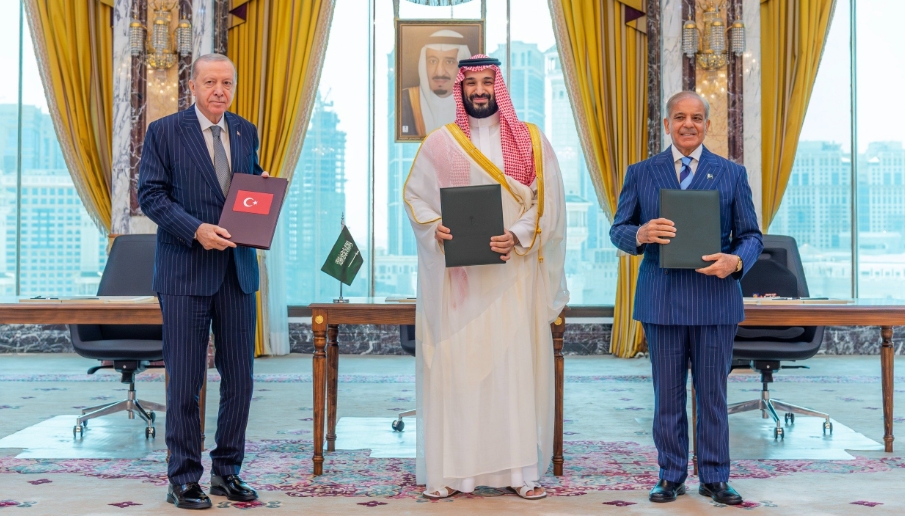
In the quiet heat of a Friday afternoon in Makkah, three leaders sat down at Al-Safa Palace and put their signatures on a document that may quietly redraw the security map of West Asia and the Islamic world. Saudi Crown Prince and Prime Minister Mohammed bin Salman, Turkish President Recep Tayyip Erdoğan and Pakistani Prime Minister Shehbaz Sharif formalised the Makkah Joint Defense Agreement on 7 August 2026. The core clause is simple and deliberate: any armed attack against one of the three states shall be regarded as an attack against them all.
The joint statement issued by the Saudi Press Agency after the Makkah Al-Mukarramah Summit for Joint Defence made the intent clear. The agreement seeks to strengthen collective deterrence, deepen defence cooperation across all sectors, and promote regional peace and stability. It builds on existing bilateral arrangements, most notably the Strategic Mutual Defence Agreement that Saudi Arabia and Pakistan concluded in September 2025. Turkey’s inclusion brings NATO’s second-largest military into the framework and gives the pact a weight that earlier bilateral understandings lacked.
The timing is not accidental. For months the region has lived under the shadow of the wider confrontation that began when the United States and Israel struck Iran in late February 2026. Missile and drone attacks have repeatedly targeted Gulf energy infrastructure. Houthi operations from Yemen have disrupted shipping. Gulf capitals have watched the reliability of traditional security guarantees come under strain. In that atmosphere, Riyadh, Ankara and Islamabad chose to institutionalise a collective-defence commitment of their own.
Pakistan’s Foreign Ministry confirmed the mutual-defence language in almost identical wording. Turkish officials described the pact as purely defensive, open to other regional countries, and not directed against any specific state. Saudi officials were equally careful. Rayed Krimly, the Kingdom’s deputy minister for public diplomacy, stated that the three countries were not seeking to create a new military axis or sectarian bloc, nor were they embarking on an arms race. The focus, he said, remained on sustainable capabilities and deterrence.
The symbolic choice of venue mattered. Signing the agreement in Islam’s holiest city, after the Pakistani Prime Minister had performed Umrah and after Friday prayers, gave the document a resonance that a routine diplomatic ceremony in a capital city could never achieve. Landmarks across Saudi Arabia were later illuminated in the colours of the three national flags, an unusually public celebration of a defence treaty.
For Indian competitive-exam aspirants the development sits at the intersection of several recurring themes in the International Relations syllabus. First, the changing nature of alliances in a multipolar world. Second, the security of the Gulf, which remains vital for India’s energy imports and for the welfare of the large Indian diaspora working in the region. Third, the evolving role of Pakistan in Middle Eastern security architecture. Fourth, Turkey’s simultaneous membership of NATO and its deepening engagement with non-Western partners. Each of these angles can generate questions in both preliminary and main examinations.
Historically, the three countries have maintained dense bilateral defence ties for decades. Pakistan and Saudi Arabia have long cooperated on military training, equipment and occasional deployments. Turkey has supplied Pakistan with advanced platforms and has expanded its defence-industrial footprint across the Gulf. The new trilateral arrangement does not replace those earlier understandings; it layers a collective-defence obligation on top of them. Whether that obligation will ever be tested remains an open question. Previous mutual-defence commitments in the region, including the Saudi-Pakistani pact of 2025 and the older GCC arrangements, have rarely translated into automatic military responses of the kind associated with NATO’s Article 5. Analysts at the Atlantic Council noted that the practical threshold for activation is still undefined because the full text of the agreement has not been made public.
The regional backdrop is the most immediate driver. After the February 2026 escalation, Iranian and allied forces directed repeated attacks toward Saudi and other Gulf targets. Oil export routes faced intermittent pressure. In that environment, Gulf states began exploring supplementary security arrangements that did not depend solely on external powers. The Makkah pact is one visible outcome of that search. It does not signal a rupture with the United States; all three signatories retain important defence relationships with Washington. Rather, it reflects a desire to diversify options and to create a regionally owned deterrent.
India’s interests are engaged on multiple levels. Saudi Arabia is a major crude-oil supplier and an important destination for Indian workers and remittances. Any sustained instability in the Gulf directly affects Indian energy security and the safety of its nationals. Pakistan’s deeper embedding in Gulf security structures is a development New Delhi will watch carefully, even while maintaining its own strong partnership with Riyadh and growing ties with Turkey. The pact does not automatically alter the India-Pakistan military balance on the subcontinent, yet it expands the network of relationships Islamabad can draw upon in a crisis. For UPSC aspirants this is a classic illustration of how extra-regional alliances can influence South Asian strategic calculations without constituting a direct military threat.
Turkey’s position adds another layer of complexity. As a NATO member, Ankara remains formally committed to the Alliance’s collective-defence provisions. At the same time, it has pursued an increasingly autonomous foreign policy that includes defence-industrial partnerships with non-NATO states and a willingness to act independently in the Eastern Mediterranean, the Caucasus and the Middle East. The Makkah agreement is consistent with that pattern: Turkey strengthens its regional security role without formally exiting existing Western structures. Questions about possible tension between the two sets of obligations are legitimate, yet Turkish officials have insisted the new pact is complementary rather than contradictory.
The agreement also carries industrial implications. Erdoğan publicly mentioned the possibility of joint defence-industry projects and counter-terrorism cooperation. Pakistan and Turkey already collaborate on several platforms; Saudi Arabia has been investing heavily in domestic defence manufacturing under Vision 2030. A trilateral framework could accelerate technology sharing, co-production and standardisation. For students of science and technology in the GS paper, or of defence modernisation in the optional subjects, this is a concrete example of how political agreements can drive industrial outcomes.
Reactions outside the three capitals have been measured. Iranian officials issued warnings that reliance on new partners would not guarantee security, a predictable response given the ongoing regional confrontation. Western analysts have focused on the longer-term question of whether the pact signals a gradual dilution of exclusive dependence on American security guarantees. Chinese commentary has treated the development as further evidence of multipolarisation. Indian official statements have so far remained restrained, consistent with New Delhi’s preference for quiet diplomacy on Gulf security matters that do not directly involve its own territory.
For the competitive-exam classroom the event offers several ready-made analytical frames. One is the shift from purely bilateral to minilateral security arrangements among Muslim-majority states. Another is the interaction between energy security, great-power competition and regional agency. A third is the role of religious and historical symbolism in contemporary geopolitics—the choice of Makkah is not incidental. A fourth is the continuing relevance of nuclear status: Pakistan remains the only nuclear-armed Muslim country, a fact that gives the pact an implicit weight even if the agreement itself contains no nuclear language.
Looking ahead, the practical test of the Makkah Joint Defense Agreement will lie in its implementation mechanisms. Will the three countries establish a joint military planning staff? Will they conduct regular combined exercises? Will they create a rapid-consultation mechanism for crises? The joint statement speaks of enhancing all aspects of defence cooperation, yet the details remain to be filled in. The agreement is explicitly open to other regional countries; whether any will seek to join, and on what terms, will shape its longer-term character.
In the immediate term the pact serves as a political signal. It tells potential adversaries that an attack on Saudi energy infrastructure, Turkish interests or Pakistani territory could trigger a wider response. It tells domestic audiences in all three countries that their leaders are actively managing security risks rather than relying solely on external patrons. And it tells the wider international community that the Middle East’s security architecture is no longer a simple hierarchy of American alliances and Iranian resistance. Multiple overlapping arrangements now coexist.
Indian aspirants preparing for RRB, SSC, Bank and UPSC examinations should treat the Makkah pact as more than a single day’s headline. It is a living illustration of several syllabus topics: the evolution of India’s extended neighbourhood, the geopolitics of energy, the changing nature of alliances, the role of middle powers, and the intersection of religion and statecraft in contemporary international politics. Questions can appear in both the factual “who signed what” format and in the more analytical “discuss the implications” style. A clear understanding of the core clause, the regional context, the historical background of the bilateral ties, and the carefully worded disclaimers issued by the signatories will equip candidates to handle either type of question with confidence.
The full text of the agreement has not been released. That absence of detail is itself significant. Collective-defence pacts gain credibility from clarity about thresholds and obligations. Until those details emerge, the Makkah Joint Defense Agreement remains a statement of political will more than a fully operational military alliance. Yet political will, when backed by three substantial military establishments and formalised in Islam’s holiest city, is not a trivial development. On 7 August 2026 three capitals chose to write a new line into the security ledger of the region. How heavily that line will weigh in future crises is a question that only events can answer.
Frequently Asked Questions
What is the core clause of the Makkah Joint Defense Agreement signed on 7 August 2026?
The agreement stipulates that any armed attack against any one of the three states (Saudi Arabia, Turkey or Pakistan) shall be regarded as an attack against them all.
Where and by whom was the Makkah Joint Defense Agreement signed?
It was signed on 7 August 2026 at Al-Safa Palace in Makkah by Saudi Crown Prince Mohammed bin Salman, Turkish President Recep Tayyip Erdoğan and Pakistani Prime Minister Shehbaz Sharif.
Does the pact create a new military axis or nuclear arrangement?
Saudi officials have explicitly stated that the agreement does not represent an effort to establish a military axis or sectarian bloc, nor is it linked to any nuclear ambitions or arms race. It focuses on building sustainable defensive capabilities.
Why is the Makkah pact relevant for Indian competitive exam aspirants?
It illustrates multipolar alliance formation, Gulf energy security, the role of middle powers, Pakistan’s expanding regional security ties, and Turkey’s dual NATO and non-Western partnerships — all recurring themes in UPSC, SSC, RRB and Bank examination syllabi.
Master Geopolitics & International Relations
Comprehensive exam notes and daily updates on major global treaties and strategic developments.
Daily Current Affairs → All Exams →Join our official Telegram channel for instant updates: @rrbcontents