The Mauryan state was an ambitious, intrusive, information-hungry machine built for control. The Gupta state was a more restrained, layered arrangement that left room for local intermediaries and regional initiative.
Table of Contents
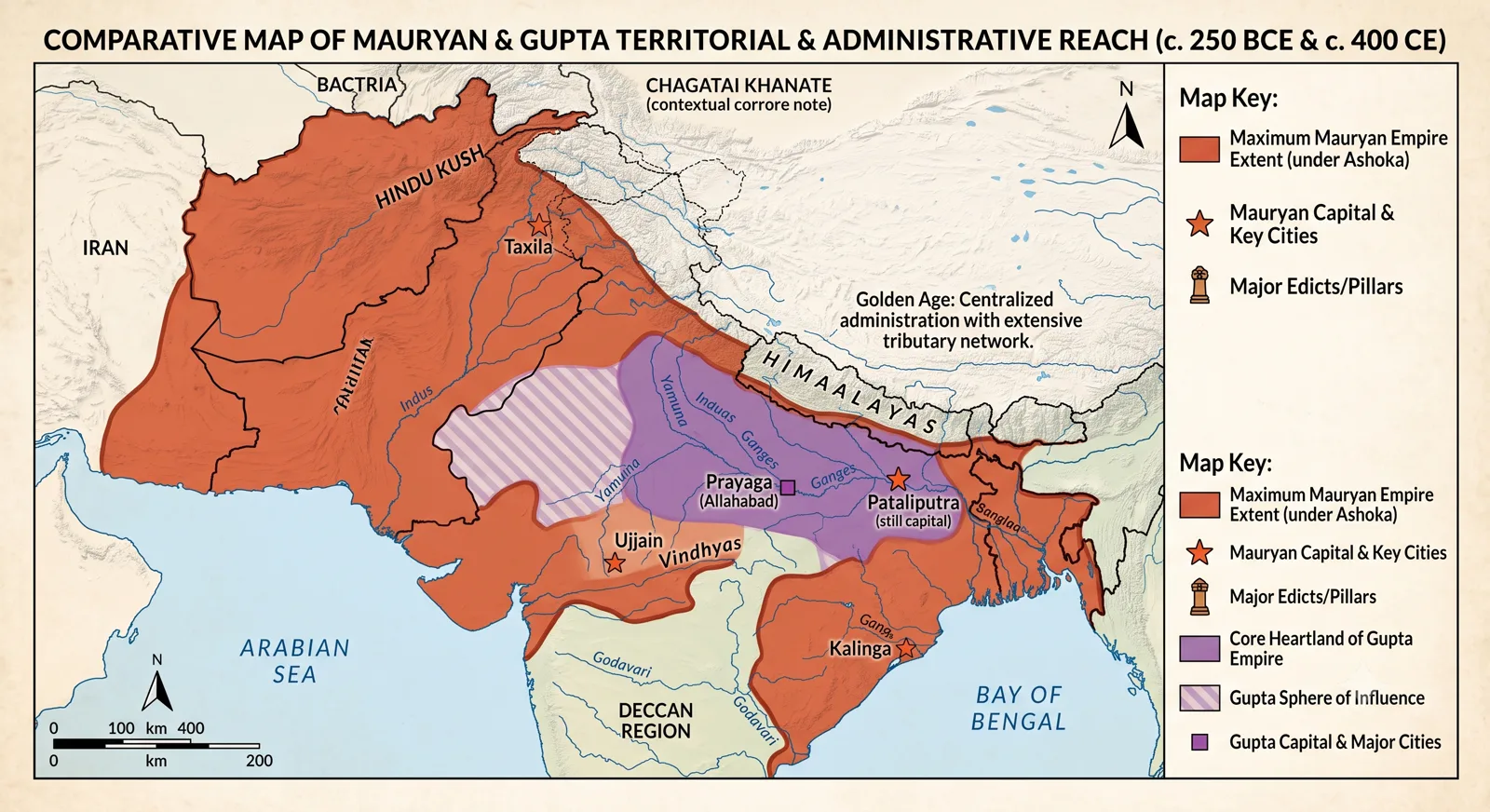
Most students encounter the Mauryan and Gupta empires as two successive high points of ancient Indian political history. The temptation is to treat them as similar “golden ages” separated only by time. That habit blurs the decisive differences in how power was actually organised. The Mauryan state was an ambitious, intrusive, information-hungry machine built for control over a subcontinental territory. The Gupta state was a more restrained, layered arrangement that left greater room for local intermediaries and regional initiative. Understanding the contrast is not an academic luxury; it is the only way to answer the comparative questions that repeatedly appear in UPSC, State PSC and SSC examinations.
This article sets the two systems side by side. It begins with the philosophical and practical foundations of kingship, moves through the central and provincial machinery, examines revenue and military arrangements, and ends with an assessment of strengths, limitations and long-term consequences. Tables are used wherever they clarify differences more efficiently than prose.
Chapter 1
Foundations of Authority and the Idea of Kingship
Mauryan political thought, reflected most clearly in the Arthashastra tradition and in Ashoka’s own edicts, treated the king as the active guardian of order. The ruler was expected to watch, punish, reward and constantly gather information. Ashoka added a moral dimension through Dhamma, yet the administrative tone remained supervisory and centralising. The king’s household, the council of ministers and a large body of officials formed a continuous chain of command that reached deep into the countryside.
Gupta kingship operated on a different register. Inscriptions present the ruler as a great conqueror and upholder of dharma, but the day-to-day exercise of power shows greater willingness to share authority. The Gupta monarch remained the source of legitimacy, yet he governed through a network of subordinates who enjoyed considerable autonomy in return for loyalty and military service. The language of divinity and cosmic order is stronger in Gupta prasastis, but the practical reach of the centre is visibly shorter than in the Mauryan case.
The difference is not merely one of personality. It reflects contrasting answers to the problem of scale. The Mauryas attempted to administer a vast territory with a relatively uniform set of rules and a heavy official presence. The Guptas accepted that large parts of the realm would be managed indirectly.
Get Daily Updates & Premium GS Notes
Get daily updates and premium GS notes directly to your phone!
Chapter 2
Central Government: Structure and Decision-Making
Mauryan central government was elaborate. At the apex stood the king, assisted by a council of ministers (mantriparishad). Below them functioned specialised departments dealing with revenue, military stores, weights and measures, mining, customs and the royal household. The Arthashastra lists numerous superintendents (adhyakshas) responsible for specific sectors of the economy and administration. A sophisticated espionage system fed information upward so that the centre could respond quickly to disorder or disloyalty. Ashoka’s reign added the unique institution of the Dhamma-mahamatras, officers charged with spreading moral principles and looking after the welfare of different social groups.
Gupta central government was leaner. The king remained the focus, and a core of high officials (kumaramatyas and others) handled correspondence, military affairs and the royal seals. Yet the number of specialised central departments appears smaller, and the surviving evidence does not suggest the same density of reporting and supervision that characterised the Mauryan system. Decision-making retained a personal element; much depended on the energy and military success of the individual ruler. When the centre was strong, as under Chandragupta I, Samudragupta and Chandragupta II, the system worked smoothly. When it weakened, the lack of deep institutionalisation became apparent.
Table 1: Central Administrative Features Compared
| Aspect | Mauryan Empire | Gupta Empire |
|---|---|---|
| Nature of kingship | Active, supervisory, information-driven | Legitimising, often indirect |
| Council of ministers | Well-attested, advisory cum executive | Present but less elaborately described |
| Specialised departments | Numerous (adhyakshas for many sectors) | Fewer, more generalised |
| Intelligence / espionage | Highly developed | Limited evidence |
| Moral / welfare officers | Dhamma-mahamatras under Ashoka | No exact parallel |
| Degree of institutionalisation | High | Moderate, more dependent on ruler |
Chapter 3
Provincial and Local Administration
Here the contrast becomes sharper. Mauryan provinces (janapadas or aharas) were placed under governors who were often princes or trusted officials. These governors were transferred or supervised so that local roots did not become too strong. Below the provincial level, the district (vishaya) and the village formed further tiers. Urban administration in cities such as Pataliputra was detailed; Megasthenes’ account, whatever its exaggerations, points to boards that managed different aspects of city life. Village headmen and accountants existed, but they operated within a framework of official oversight.
Gupta provincial administration allowed far more room for intermediaries. Large areas were entrusted to governors who sometimes belonged to subordinate ruling families. District officers (vishayapatis) appear in inscriptions, yet many land grants show that the actual management of rural resources was left to local assemblies, brahmana donees or hereditary chiefs. Village life continued under traditional headmen, but the state’s extractive presence was lighter and more intermittent. The growing practice of land grants to religious beneficiaries and to officials created pockets of privileged autonomy that the Mauryan system had largely avoided.
The difference had long-term consequences. Mauryan administration tried to keep intermediate powers weak. Gupta administration, by relying on them, gradually prepared the ground for the more decentralised political order of the early medieval period.
Chapter 4
Revenue System and Economic Control
Both empires drew the bulk of their resources from land. The Mauryan state claimed a substantial share of agricultural produce, often quantified in later tradition as one-sixth or more, and supplemented it with taxes on trade, mines, forests and various professional groups. Assessment appears to have been systematic in the core areas, and the state maintained storehouses and a bureaucracy capable of collecting and transporting large quantities of grain and other goods. State control over certain economic activities, including mining and some forms of trade, was direct.
Gupta revenue arrangements were less uniform. The traditional share of produce remained the theoretical basis, yet the actual collection was frequently mediated through local elites or through the beneficiaries of land grants. Many grants transferred not only the right to collect revenue but also administrative privileges, reducing the centre’s direct fiscal reach. Trade and urban taxes continued, and the Guptas certainly benefited from commercial prosperity, especially in the western and northern regions. Overall, however, the state’s share of the surplus was smaller and less regularly extracted than under the Mauryas.
Table 2: Revenue and Economic Administration
| Feature | Mauryan | Gupta |
|---|---|---|
| Primary revenue source | Land tax, heavily supervised | Land tax, often mediated |
| Assessment method | Systematic in core regions | Variable, grant-influenced |
| State economic enterprises | Mines, forests, some trade | More limited direct control |
| Land grants | Limited and carefully controlled | Extensive, with administrative rights |
| Urban and trade taxation | Well organised | Present but less centralised |
Chapter 5
Military Organisation
The Mauryan army was large, standing, and maintained at state expense. Accounts speak of vast numbers of infantry, cavalry, chariots and elephants. The state controlled armouries, stables and the supply system. Military officers were part of the same bureaucratic hierarchy that managed civil affairs. This allowed rapid mobilisation but also imposed a heavy fiscal burden.
Gupta military power rested on a combination of a core royal force and the contingents supplied by subordinate rulers and samantas. The king’s own troops remained important, especially the elephant corps and cavalry, yet the system assumed that local powers would contribute men when called upon. This arrangement was flexible and less expensive to maintain permanently, but it made the centre dependent on the loyalty of intermediate chiefs. When that loyalty frayed, military cohesion suffered.
Chapter 6
Judicial and Police Functions
Mauryan justice combined royal edicts, customary law and the decisions of officials. Ashoka’s inscriptions show a strong interest in fair and humane administration of justice, including provisions for appeals and the welfare of prisoners. Police and intelligence functions were closely linked; the same network that reported political disaffection also maintained order.
Gupta judicial arrangements relied more heavily on local bodies and traditional law. Royal officials intervened in serious cases, yet many disputes appear to have been settled by village or caste assemblies. The decline in the density of central reporting meant that everyday law and order depended increasingly on local leadership.
Chapter 7
Strengths, Weaknesses and Historical Trajectory
The Mauryan system excelled at extracting resources and maintaining control over a huge territory for several generations. Its weakness lay in the cost and complexity of the machinery. Once the quality of rulers declined and the fiscal pressure became unbearable, the structure proved difficult to sustain. The Gupta system was lighter, cheaper and more adaptable to regional diversity. Its weakness was the gradual erosion of central authority as intermediaries strengthened their position. By the later Gupta period the empire had already begun to resemble a constellation of semi-autonomous units held together by the prestige of the imperial name.
Neither model was simply “better.” Each answered the political and economic conditions of its time. The Mauryan experiment demonstrated how far a determined centre could go in pre-modern conditions. The Gupta arrangement showed the limits of that ambition and the practical advantages of shared sovereignty.
Chapter 8
Exam Relevance and Answer-Writing Strategy
Comparative questions on Mauryan and Gupta administration appear in both preliminary and main examinations. Successful answers avoid long separate descriptions. They open with a clear statement of the central contrast (centralised supervision versus layered authority), then use specific institutional evidence, and finally assess consequences. Tables of the kind presented above can be mentally recalled and selectively deployed. Linking administrative differences to later historical developments—such as the rise of early medieval polities—adds analytical depth that examiners reward.
The topic also connects with broader themes: the relationship between state power and social structure, the role of ideology (Dhamma versus classical dharma), and the economic basis of political authority. Aspirants who can move between institutional detail and these larger questions perform consistently well.
Chapter 9
Final Assessment
The Mauryan and Gupta administrative systems represent two coherent but distinct solutions to the problem of governing a large agrarian society. One prioritised direct control, detailed information and heavy extraction. The other accepted mediation, rewarded loyalty with autonomy, and lived with a lighter fiscal footprint. The contrast illuminates not only ancient Indian political history but also the perennial tension between central ambition and local reality. For the serious student the comparison remains one of the most instructive exercises in the entire ancient Indian syllabus.
Accelerate Your UPSC Preparation
Accelerate your UPSC preparation with RRB Contents!
Chapter 10
Frequently Asked Questions
What is the most important difference between Mauryan and Gupta administration?
How did land grants affect Gupta administration compared with the Mauryan period?
Why is the comparison of Mauryan and Gupta administration important for competitive exams?
Did the Gupta Empire have a weaker military than the Mauryan Empire?
Don't Just Reread It
Don't just reread the narrative — solve the matching previous-year questions and compare your answers with the structured notes.
Continue on RRBCONTENTS
Explore More
Knowledge Hub
More Blog Articles
In-depth, exam-focused articles on Indian history, polity, geography and static GK.
Study Material
Exam Study Notes
Subject-wise notes and digests for Railway, SSC, Banking and State PSC exams.
Current Affairs
Daily Current Affairs & GK
Daily updates and a static GK bank with active-recall quizzes for competitive exams.