MONETARY POLICY OF RBI: OBJECTIVES, QUANTITATIVE & QUALITATIVE TOOLS, MPC COMPOSITION & INFLATION TARGETING (COMPLETE GUIDANCE FOR COMPETITIVE EXAMS)
Chapter 1
INTRODUCTION
Monetary Policy is the macroeconomic policy formulated and executed by the central bank of a country to manage the money supply, interest rates, credit availability, and liquidity in the economy. In India, the Reserve Bank of India (RBI)—established under the Reserve Bank of India Act, 1934 on 1st April 1935—is the supreme monetary authority.
Prior to 2016, monetary policy decisions in India were taken solely at the discretion of the RBI Governor based on an informal multiple-indicator approach. However, following the landmark recommendations of the Dr. Urjit Patel Committee (2014) and the statutory amendment to the RBI Act by the Finance Act, 2016, India adopted a modern Flexible Inflation Targeting (FIT) framework alongside a statutory Monetary Policy Committee (MPC).
"To maintain price stability while keeping in mind the objective of growth."
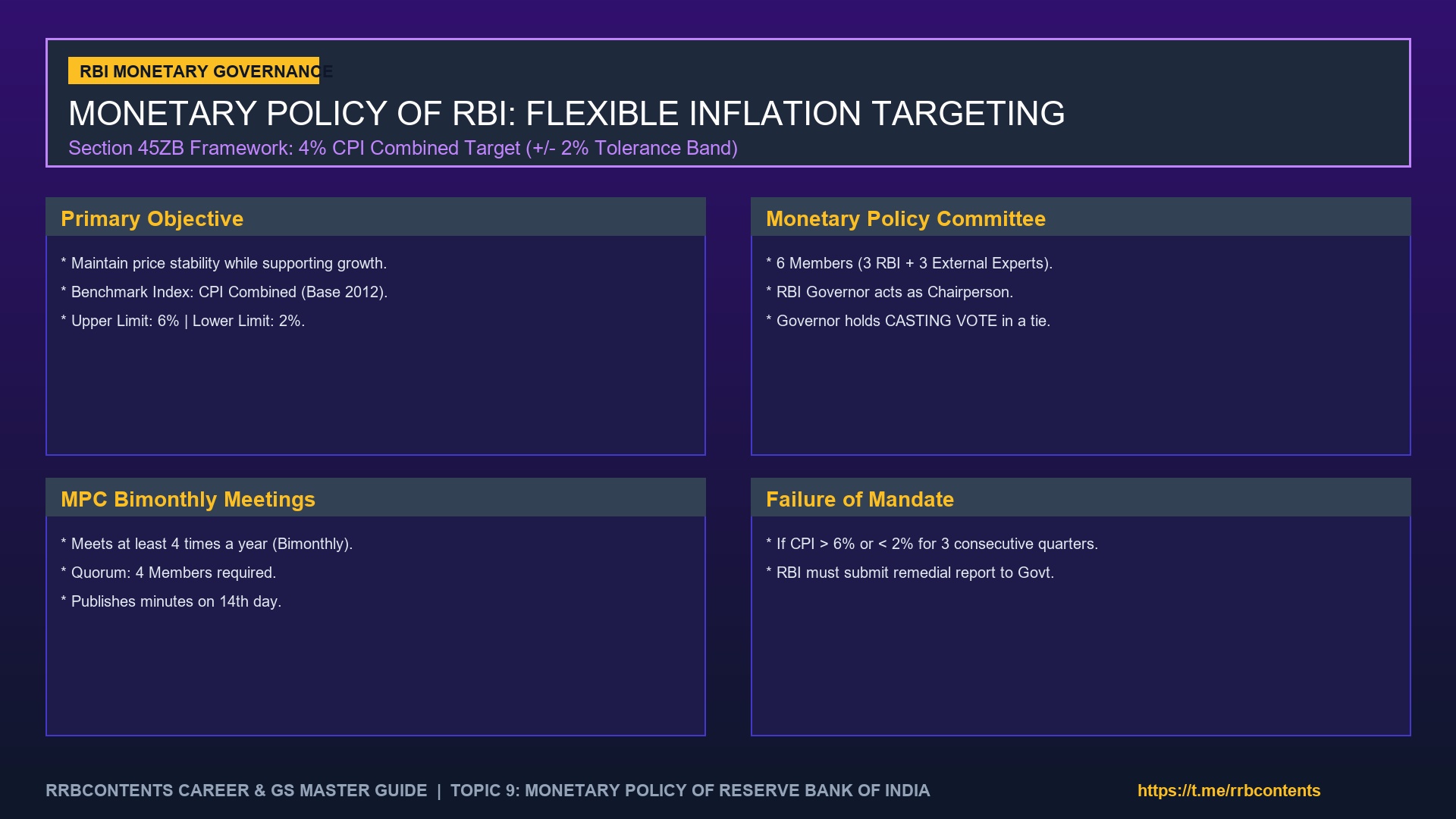
Under the current inflation targeting mandate, the RBI is tasked with maintaining consumer price index (CPI Combined) inflation at 4%, with an allowable tolerance band of +/- 2% (i.e., a lower tolerance limit of 2% and an upper tolerance limit of 6%).
For aspirants preparing for competitive examinations such as UPSC Civil Services (GS Paper III Economics), Banking Exams (IBPS PO, SBI PO, RBI Grade B), State PSCs, and SSC CGL, a thorough mastery of quantitative tools (Repo, MSF, SDF, CRR, SLR, OMO), qualitative tools, MPC voting rules, and liquidity transmission mechanisms is essential.
This comprehensive master career guide provides an exhaustive breakdown of the Monetary Policy of RBI. We cover every legal detail—from statutory articles and MPC 6-member voting rules to policy corridors, liquidity adjustment facilities, 12 exam-focused FAQs, and essential revision tools.
---
Chapter 2
HISTORICAL EVOLUTION OF MONETARY POLICY IN INDIA
HISTORICAL EVOLUTION OF MONETARY POLICY IN INDIA - Illustrative Reference
Phase 1: Controlled Credit Phase (1951 - 1991)
├── Heavy reliance on High CRR & SLR to finance government borrowing (Fiscal Dominance)
       │
       ▼
Phase 2: Financial Sector Reforms & LAF (1991 - 2014)
├── Narasimham Committee Reforms (1991 & 1998)
├── Introduction of Liquidity Adjustment Facility (LAF) in 2000 & Market Stabilization Scheme (MSS) in 2004
       │
       ▼
Phase 3: Statutory Flexible Inflation Targeting (FIT) & MPC Era (2016 - Present)
├── Urjit Patel Committee Report (2014) Recommends Inflation Targeting
├── Amended RBI Act 1934 (Section 45ZB) Enacted via Finance Act 2016
└── 6-Member Statutory Monetary Policy Committee (MPC) Constituted in Oct 2016
---
Chapter 3
THE STATUTORY MONETARY POLICY COMMITTEE (MPC)
The Monetary Policy Committee (MPC) is a statutory 6-member body constituted under Section 45ZB of the RBI Act, 1934, responsible for determining the policy interest rate (Repo Rate) required to achieve the inflation target.
Monetary Policy Committee (MPC) Architecture (6 Members)
│   ├── Member 1: RBI Governor (Ex-officio Chairperson)
│   ├── Member 2: Deputy Governor of RBI in charge of Monetary Policy (Ex-officio Member)
│   └── Member 3: One Officer of RBI nominated by Central Board (Ex-officio Member)
    ├── Member 4: External Economist / Expert (4-Year Term, Non-renewable)
    ├── Member 5: External Economist / Expert (4-Year Term, Non-renewable)
    └── Member 6: External Economist / Expert (4-Year Term, Non-renewable)
1. Meeting Frequency: The MPC is mandated to meet at least four times a year (currently meets bimonthly, i.e., 6 times a year).
2. Quorum: The quorum for an MPC meeting is four members.
3. Voting System & Casting Vote: Each member of the MPC has one vote. Decisions are taken by a simple majority vote. In the event of an equality of votes (a tie), the RBI Governor has a second or Casting Vote.
4. Publishing Minutes: The RBI must publish the minutes of the MPC meeting on the 14th day following the meeting, detailing how each member voted and their statement of reasoning.
5. Failure of Inflation Target: If CPI inflation exceeds 6% or falls below 2% for three consecutive quarters, the RBI is deemed to have failed its mandate and MUST submit a formal report to the Central Government explaining:
- Reasons for failure.
- Remedial actions proposed.
- Estimated time period within which inflation will return to target (4%).
---
Chapter 4
FLEXIBLE INFLATION TARGETING (FIT) FRAMEWORK
CPI Combined Inflation Target (4% +/- 2%)
├── Upper Tolerance Limit: 6.0% (Triggers mandatory RBI report to Govt if breached for 3 consecutive quarters)
├── Target Inflation: 4.0% (Optimal balance between price stability and economic growth)
└── Lower Tolerance Limit: 2.0% (Deflationary risk threshold)
- Target Benchmark Index: CPI (Combined) Consumer Price Index published monthly by the National Statistical Office (NSO), Ministry of Statistics and Programme Implementation (MoSPI).
---
Chapter 5
MONETARY POLICY TOOLS & INSTRUMENTS OF RBI
RBI utilizes a sophisticated combination of Quantitative (General) and Qualitative (Selective) monetary instruments to regulate money supply, credit volume, and interest rates in the Indian economy.
Monetary Policy Instruments of RBI
├── 1. Quantitative / General Tools (Affect total volume of bank money & credit)
│      │   ├── Repo Rate (Primary Policy Rate)
│      │   ├── Standing Deposit Facility (SDF) (Liquidity Floor - No G-Sec needed)
│      │   └── Marginal Standing Facility (MSF) (Liquidity Ceiling / Emergency Rate)
│      ├── Bank Rate (Long-term discounting rate - aligned with MSF)
│      ├── Cash Reserve Ratio (CRR) (Cash held WITH RBI - 0% interest)
│      ├── Statutory Liquidity Ratio (SLR) (Liquid assets held WITH BANKS)
│      ├── Open Market Operations (OMO) (Buying/selling G-Secs)
│      └── Market Stabilization Scheme (MSS) (Absorbing foreign inflow excess)
└── 2. Qualitative / Selective Tools (Direct flow of credit to specific sectors)
       ├── Margin Requirements (Loan to Value - LTV Ratios)
       ├── Moral Suasion (Advisory guidance to commercial banks)
       └── Credit Rationing / Priority Sector Lending (PSL) Directives
---
The operational target of RBI's monetary policy is the Weighted Average Call Rate (WACR)—the interest rate at which commercial banks lend uncollateralized overnight funds to each other in the interbank call money market. RBI manages daily LAF liquidity injections and absorptions to ensure that WACR remains anchored tightly around the target Repo Rate.
Chapter 6
QUANTITATIVE MONETARY INSTRUMENTS ANALYZED
- Definition: The interest rate at which commercial banks borrow short-term funds from the RBI against the collateral of approved Government Securities (G-Secs) under the Liquidity Adjustment Facility (LAF).
- Impact of Repo Rate Hike: Increases borrowing costs for banks $
ightarrow$ Banks increase lending interest rates (FD/FD & Home Loans) $
ightarrow$ Curtails consumer borrowing and money supply $
- Impact of Repo Rate Cut: Decreases borrowing costs $
ightarrow$ Stimulates credit expansion and investment $
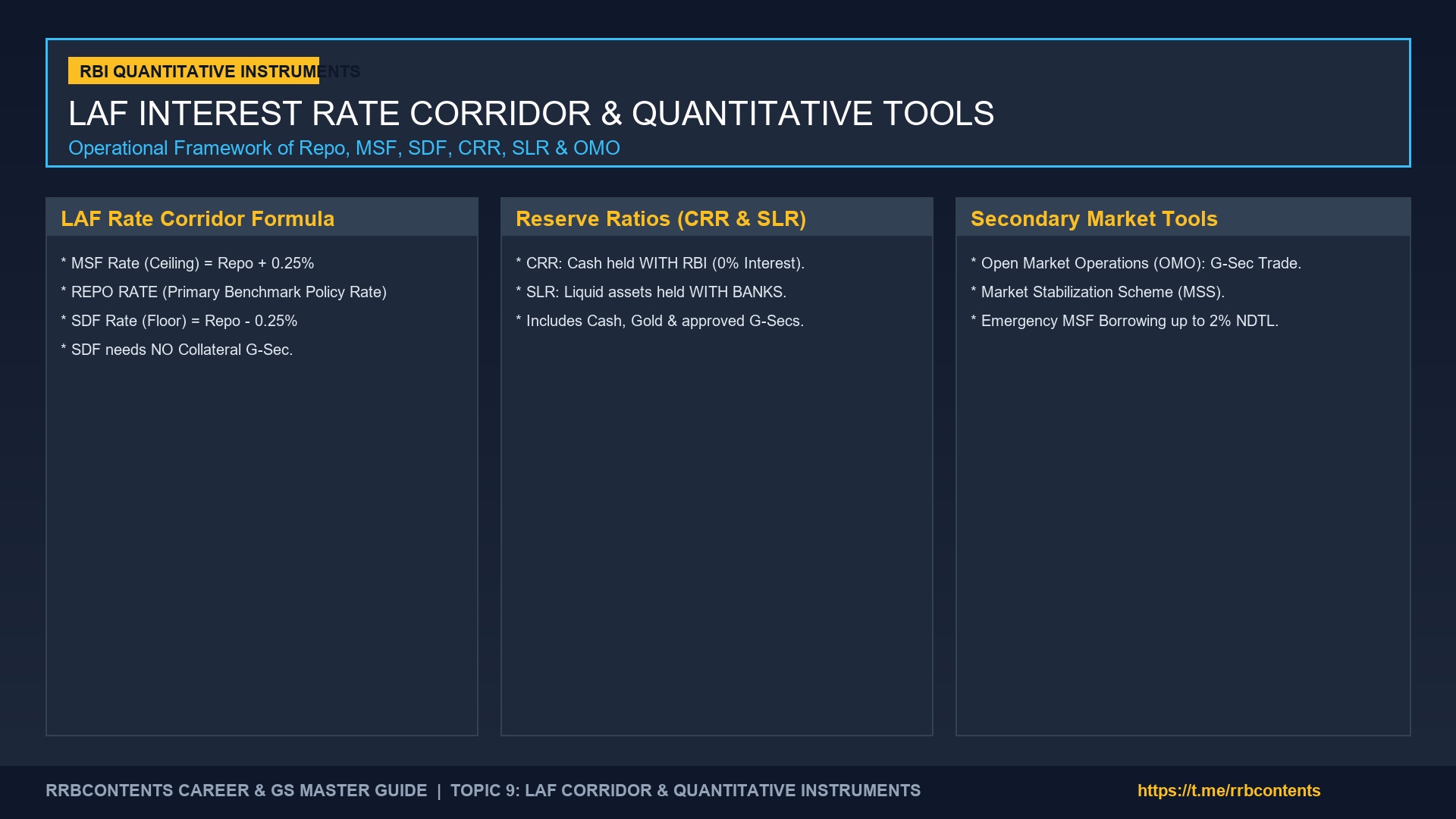
- Definition: Introduced by RBI in April 2022 under Section 17(1A) of RBI Act. SDF allows commercial banks to deposit excess overnight liquidity with the RBI at a lower interest rate WITHOUT requiring the RBI to provide Government Securities as collateral.
- Floor of LAF Corridor: SDF replaced the fixed Reverse Repo Rate as the floor of the Liquidity Adjustment Facility (LAF) corridor.
- Corridor Formula: $ ext{SDF Rate} = ext{Repo Rate} - 25 ext{ bps}$.
- Definition: Introduced in 2011, MSF is an emergency overnight borrowing facility under which scheduled commercial banks can borrow funds from the RBI over and above their LAF limit by dipping into their Statutory Liquidity Ratio (SLR) portfolio up to a specified percentage of Net Demand and Time Liabilities (NDTL).
- Ceiling of LAF Corridor: Acts as the ceiling (upper limit) of the LAF corridor.
- Corridor Formula: $ ext{MSF Rate} = ext{Repo Rate} + 25 ext{ bps}$.
$$ ext{MSF Rate (Ceiling: Repo + 0.25\%)} \quad > \quad ext{Repo Rate (Policy Rate)} \quad > \quad ext{SDF Rate (Floor: Repo - 0.25\%)}$$
    ▲ Marginal Standing Facility (MSF Rate) = Repo Rate + 0.25% (Ceiling Rate)
    │
    ┼── REPO RATE (Primary Policy Interest Rate)
    │
    ▼ Standing Deposit Facility (SDF Rate) = Repo Rate - 0.25% (Floor Rate)
Chapter 7
# 5. Bank Rate
- Definition: The rate at which RBI buys or re-discounts bills of exchange or other commercial papers for long-term periods without requiring collateral under Section 49 of RBI Act.
- Current Alignment: Bank Rate is penal in nature and is automatically aligned with the Marginal Standing Facility (MSF) Rate ($ ext{Bank Rate} = ext{MSF Rate}$).
- Definition: The percentage of Net Demand and Time Liabilities (NDTL) that scheduled commercial banks are mandated to maintain as cash balances WITH the Reserve Bank of India.
- Zero Interest: Banks earn 0% interest from RBI on CRR balances.
- Impact: Increasing CRR reduces the liquidity buffer of banks, contracting credit creation in the economy.
- Definition: The percentage of Net Demand and Time Liabilities (NDTL) that commercial banks are mandated to maintain WITH THEMSELVES in approved unencumbered liquid assets—specifically:
Chapter 8
1. Cash in hand.
Chapter 9
2. Gold holdings.
Chapter 10
3. Approved Government Securities (G-Secs & Treasury Bills).
- Purpose: Ensures solvency of banks and creates a captive market for government debt securities.
- Sterilization Operations: When heavy foreign portfolio investment (FPI) or FDI flows into India, RBI buys foreign currency (US Dollars) to prevent sharp appreciation of the Indian Rupee. This injects equivalent Rupee liquidity into the banking system.
- Market Stabilization Scheme (MSS): Introduced in 2004, MSS allows RBI to issue special Market Stabilization Treasury Bills and Dated Securities to absorb excess liquidity caused by large foreign capital inflows. The funds raised are kept in a separate MSS account with RBI and NOT used for government expenditure.
- Definition: The outright purchase or sale of Government Securities (G-Secs) in the open secondary market by the RBI.
- Injecting Liquidity: RBI buys G-Secs from banks $
- Absorbing Liquidity: RBI sells G-Secs to banks $
---
Chapter 11
QUALITATIVE / SELECTIVE MONETARY INSTRUMENTS
1. Margin Requirements (Loan-to-Value Ratio - LTV): The difference between the market value of a collateral security and the loan amount granted against it. Raising LTV margins for gold loans or real estate discourages speculative credit.
2. Moral Suasion: Informal persuasion, meetings, and advisory directives issued by the RBI Governor to bank CEOs urging them to align lending rates or curtail credit to speculative sectors.
3. Credit Rationing & Priority Sector Lending (PSL): Mandating banks to allocate a minimum of 40% of Adjusted Net Bank Credit (ANBC) to priority sectors such as Agriculture (18%), Micro Enterprises (7.5%), Weaker Sections (12%), and Renewable Energy.
---
Chapter 12
COMPARATIVE SUMMARY OF QUANTITATIVE MONETARY TOOLS
| Instrument | Full Name / Basis | Asset Location | Interest Earned by Banks | Primary Macroeconomic Function |
|---|---|---|---|---|
| Repo Rate | Re-Purchase Option Rate | RBI Collateral | N/A (Bank Borrows) | Primary benchmark policy rate governing short-term credit cost. |
| SDF Rate | Standing Deposit Facility | RBI Deposits | Repo - 0.25% | Floor of LAF corridor; absorbs overnight excess liquidity without G-Sec. |
| MSF Rate | Marginal Standing Facility | RBI Borrowing | N/A (Bank Borrows) | Ceiling of LAF corridor; emergency overnight borrowing against SLR. |
| CRR | Cash Reserve Ratio | Held WITH RBI | 0.0% (Zero) | Controls total cash reserves in banking system; affects credit multiplier. |
| SLR | Statutory Liquidity Ratio | Held WITH BANKS | Commercial Return | Ensures bank solvency and funds government G-Sec debt borrowing. |
| OMO | Open Market Operations | Open Secondary Mkt | G-Sec Yields | Outright purchase/sale of G-Secs to permanently adjust system liquidity. |
---
1. Targeted Long-Term Repo Operations (TLTRO): RBI provides 1-year to 3-year term repo liquidity to commercial banks at the Repo Rate, mandating that funds be invested directly in corporate bonds, commercial paper, and non-convertible debentures of specific stressed sectors (such as MSMEs and NBFCs).
2. Operation Twist (Simultaneous OMO Sale & Purchase): Modeled on the US Federal Reserve, RBI simultaneously buys long-term G-Secs (10-year bonds) and sells short-term Treasury Bills (1-year) in the open secondary market. This flattens the yield curve by lowering long-term interest rates without expanding the overall money supply.
3. Variable Rate Repo (VRR) & Variable Rate Reverse Repo (VRRR): Fine-tuning liquidity management auctions conducted for varying maturities (14 days, 28 days) to manage short-term interbank money market rates within the LAF corridor.
Chapter 13
# Digital Rupee (CBDC - Central Bank Digital Currency) & Monetary Policy:
- Sovereign Legal Tender: Digital token representing legal tender issued directly by RBI, operating as a digital alternative to physical cash.
- Monetary Policy Efficiency: Facilitates real-time cross-border settlements, reduces cash printing/handling costs, and enhances direct monetary policy transmission by lowering velocity frictions in digital payments.
Chapter 14
TRANSMISSION MECHANISM OF MONETARY POLICY & CHALLENGES
Monetary transmission refers to the process through which changes in RBI policy rate (Repo Rate) translate into changes in commercial bank lending/deposit rates and real economic activity.
RBI Repo Rate Change
       │
       ▼ (Commercial Banks Adjust Benchmark Lending Rates)
EBLR (External Benchmark Lending Rate - Repo Linked) / MCLR Adjustments
       │
       ▼ (Impact on Borrowers & Consumers)
Changes in Home Loan EMIs, Business Investment Costs & Consumer Demand
       │
       ▼ (Final Macroeconomic Impact)
Real GDP Growth Adjustment & CPI Inflation Control
Chapter 15
# Evolution of Benchmark Lending Rates in India: Prime Lending Rate to EBLR:
1. Benchmark Prime Lending Rate (BPLR Era - Pre-2010): Banks fixed lending rates arbitrarily. Non-transparent and favoured large corporates over retail borrowers.
2. Base Rate System (2010 - 2016): Minimum interest rate below which banks could not lend. However, banks resisted lowering Base Rates despite sharp Repo cuts by RBI.
3. Marginal Cost of Funds Based Lending Rate (MCLR Era - 2016 to 2019): Linked lending rates to banks' marginal cost of deposits, tenor premium, and operating costs. While an improvement, transmission remained sluggish (took 6-9 months for Repo cuts to reflect in borrower EMIs).
4. External Benchmark Lending Rate (EBLR Mandate - October 2019): RBI mandated all scheduled commercial banks to link all new floating-rate personal, housing, auto, and MSME loans directly to external benchmarks (such as the RBI Repo Rate or 3-Month Treasury Bill yield). EBLR reset periods (every 3 months) ensured instant monetary policy transmission!
1. Rigid Deposit Structures: Banks rely heavily on long-term fixed deposits with fixed interest rates, making it difficult to lower lending rates immediately after a Repo cut.
2. Small Savings Scheme Rates: High fixed interest rates on Post Office schemes (PPF, Sukanya Samriddhi) limit banks' ability to cut deposit rates without losing retail deposits.
3. NPAs and Bad Loans: High Non-Performing Assets (NPAs) make banks risk-averse, preventing credit transmission to small businesses.
4. Transition to EBLR: RBI mandated all floating-rate retail and MSME loans to be linked to External Benchmarks (like Repo Rate) from October 2019, significantly improving rate transmission.
---
- Countercyclical Capital Buffers (CCCB): Mandates banks to build up additional capital buffers (0% to 2.5% of risk-weighted assets) during credit boom periods, which can be released during economic recessions.
- Risk-Weight Adjustments: RBI increases risk weights on unsecured consumer loans and credit card receivables, requiring banks to set aside higher regulatory capital against risky lending.
Chapter 16
IMPORTANCE FOR COMPETITIVE EXAMS & QUICK REVISION
1. Section to Remember: Section 45ZB of RBI Act 1934 (MPC Constitution); Section 45ZA (Inflation Target).
2. Inflation Target: 4% CPI Combined (+/- 2% tolerance band: 2% to 6%).
3. MPC Composition: 6 Members (3 RBI + 3 External). Governor has Casting Vote in case of tie. Meets at least 4 times a year (bimonthly).
4. LAF Corridor: MSF Rate (Ceiling: Repo + 0.25%) > Repo Rate > SDF Rate (Floor: Repo - 0.25%).
---
Chapter 17
FREQUENTLY ASKED QUESTIONS (FAQS)
Chapter 18
# Q1: What is the primary objective of RBI's monetary policy under the RBI Act, 1934?
Answer: The primary objective is to maintain price stability while keeping in mind the objective of economic growth.
Chapter 19
# Q2: What is the current inflation target mandated for the RBI?
Answer: The target is 4% CPI Combined inflation, with a tolerance band of +/- 2% (Lower limit = 2%, Upper limit = 6%).
Answer: The MPC consists of 6 members (3 ex-officio members from RBI including the Governor, and 3 external experts appointed by the Central Government).
Chapter 20
# Q4: Who acts as the Chairperson of the Monetary Policy Committee?
Answer: The Governor of the Reserve Bank of India acts as the ex-officio Chairperson of the MPC.
Chapter 21
# Q5: What happens in case of a tied vote in the MPC?
Answer: Each member has one vote, and in the case of an equality of votes (a tie), the RBI Governor has a second or Casting Vote.
Chapter 22
# Q6: What is the Standing Deposit Facility (SDF) introduced in 2022?
Answer: SDF is an overnight liquidity absorption tool that allows banks to deposit surplus cash with the RBI without requiring the RBI to provide collateral G-Secs. It forms the floor of the LAF corridor.
Answer: CRR (Cash Reserve Ratio) is cash held by banks WITH the RBI (earning 0% interest). SLR (Statutory Liquidity Ratio) is liquid assets (cash, gold, G-Secs) maintained by banks WITH THEMSELVES.
Chapter 23
# Q8: What index is used as the benchmark for inflation targeting in India?
Answer: The Consumer Price Index (CPI Combined) published monthly by the National Statistical Office (NSO).
Chapter 24
# Q9: On whose committee recommendation was the Monetary Policy Committee (MPC) established?
Answer: Recommended by the Dr. Urjit Patel Committee report of 2014.
Chapter 25
# Q10: What constitutes a failure of the inflation targeting mandate under the RBI Act?
Answer: If CPI inflation remains above 6% or below 2% for three consecutive quarters, the RBI is deemed to have failed the mandate and must submit an explanatory report to the Central Government.
Answer: MSF is an emergency overnight borrowing facility where banks can borrow funds from the RBI at a higher rate by dipping into their Statutory Liquidity Ratio (SLR) securities.
Answer: External Benchmark Lending Rate (EBLR) mandates commercial banks to link all new floating-rate personal, home, and MSME loans directly to external benchmarks like the RBI Repo Rate to ensure fast monetary policy transmission.
---
Answer: Operation Twist is a simultaneous open market operation where RBI buys long-term G-Secs (to lower long-term yields) and sells short-term Treasury Bills (to absorb short-term liquidity).
Answer: Introduced in 2004, MSS is an instrument used by RBI to absorb excess domestic Rupee liquidity created by large foreign capital inflows by issuing special Treasury bills.
Chapter 26
# Q15: What is the difference between Fixed Repo and Variable Rate Repo (VRR)?
Answer: Fixed Repo operates at a fixed policy rate under daily LAF. Variable Rate Repo (VRR) conducts competitive yield auctions for varying maturities (e.g., 14-day VRR) to fine-tune money market liquidity.
Chapter 27
# Q16: What is the Marginal Cost of Funds Based Lending Rate (MCLR)?
Answer: Introduced in 2016, MCLR is an internal benchmark rate calculated based on a bank's marginal cost of funds, operating costs, and tenor premium.
Answer: PSLCs are tradable digital certificates on RBI's e-Kuber platform that enable banks with PSL deficits to buy compliance targets from surplus banks.
- Monetary Policy Department (MPD): Provides technical data modeling, core inflation estimates (excluding volatile food and fuel components), and household inflation expectation surveys to the MPC members prior to bi-monthly meetings.
- Financial Markets Operations Department (FMOD): Executes daily liquidity management operations (daily LAF repo/reverse repo auctions and OMO trades) to align the Weighted Average Call Rate (WACR) with the target Repo Rate.
- Financial Stability Department (FSD): Publishes the bi-annual Financial Stability Report (FSR), analyzing systemic risk indicators and bank capital adequacy ratios (CRAR under Basel III norms).
Chapter 28
QUANTITATIVE VS QUALITATIVE MONETARY INSTRUMENTS
The RBI utilizes a dual toolkit to manage money supply and credit delivery in the Indian economy:
| Instrument Category | Tools | Target / Purpose |
|---|---|---|
| Quantitative Tools | CRR, SLR, Repo Rate, Reverse Repo Rate, MSF, Bank Rate, OMO | Controls overall volume of credit and money supply across the entire banking system. |
| Qualitative Tools | Margin Requirements, Moral Suasion, Credit Rationing, Direct Action | Regulates direction and flow of credit to specific priority sectors or restricts speculative credit. |
---
Chapter 29
# Standing Deposit Facility (SDF):
- Introduced by RBI in April 2022 as the new floor of the Liquidity Adjustment Facility (LAF) corridor.
- Allows RBI to absorb liquidity from commercial banks without providing government securities as collateral.
- Replaced the Fixed Reverse Repo Rate as the primary tool for liquidity absorption.
---
Chapter 30
# Marginal Standing Facility (MSF) Mechanism:
- Introduced in 2011-12 to handle acute inter-bank liquidity shocks.
- Allows scheduled commercial banks to borrow overnight funds from RBI by dipping into their Statutory Liquidity Ratio (SLR) portfolio up to a specified limit.
- MSF interest rate is pegged at 25 basis points (0.25%) above the Repo Rate.
---
Chapter 31
# Variable Rate Repo (VRR) & Variable Rate Reverse Repo (VRRR):
- Fine-tuning liquidity management operations conducted by the RBI via variable rate auctions.
- VRR injects short-term liquidity into the banking system for periods ranging from 1 to 14 days.
- VRRR absorbs excess system liquidity when overnight call money rates fall below the SDF rate.
---
Chapter 32
CONCLUSION
The Monetary Policy of RBI is the macroeconomic cornerstone of financial stability, price control, and sustainable economic growth in India. By operating the Flexible Inflation Targeting framework, enforcing the 4% CPI mandate through the 6-member Monetary Policy Committee, and managing liquidity via Repo, SDF, MSF, CRR, and OMO, the RBI maintains the purchasing power of the Rupee while fostering economic expansion.
For competitive exam aspirants, mastering MPC voting rules, LAF corridor formulas, quantitative instruments, and inflation targeting parameters guarantees complete preparation for scoring top marks in Indian Economy and Banking Awareness.
👉 Official Career Portal: [https://rrbcontents.com](https://rrbcontents.com)
👉 Official Telegram Channel: [Join RRBCONTENTS Telegram (@rrbcontents)](https://t.me/rrbcontents)
---
Chapter 33
ADDITIONAL EXAM INSIGHTS & CASE STUDIES
---
Chapter 34
# A. Monetary Policy Committee (MPC) - Detailed Structure & Legal Basis
The MPC was a landmark structural reform in India's monetary policy framework, shifting rate-setting from the sole discretion of the RBI Governor to a rule-based committee system.
- Legal Basis: Section 45ZB of the RBI Act, 1934 (inserted by the Finance Act, 2016)
- Constitutional Hook: The inflation-targeting framework is backed by a formal agreement between Government of India and RBI under Section 45ZA
- Composition: 6 members total:
- RBI side (3 members): RBI Governor (Chairperson), Deputy Governor in charge of monetary policy, one RBI Executive Director
- Government side (3 external members): Appointed by the Central Government for 4 years; not eligible for reappointment; must have expertise in economics/banking/finance
- Quorum: Minimum 4 members must be present for a valid meeting
- Voting: Each of the 6 members has one vote. In case of a tie, the RBI Governor has a casting vote
- Meeting Frequency: Minimum 4 times per year (bi-monthly in practice - 6 meetings per year typically)
- Inflation Target: CPI (Combined) = 4% plus or minus 2% (lower bound: 2%; upper bound: 6%)
- Breach Trigger: If CPI inflation remains above 6% OR below 2% for three consecutive quarters, the RBI must submit a written report to the Central Government explaining: (a) reasons for failure, (b) remedial actions proposed, (c) estimated time to return to target
- Transparency: MPC meeting minutes (including individual voting records) are published within 14 days of each meeting - ensuring public accountability
Mnemonic - MPC "3+3+4": 3 RBI insiders + 3 Government outsiders = 6 members; Quorum = 4
---
Chapter 35
# B. Key RBI Monetary Instruments - Comparative Table
| Instrument | Full Form / Description | Direction of Action | Current Rate / Status |
|---|---|---|---|
| Repo Rate | Repurchase Agreement - RBI lends to banks overnight against G-Secs | Injects liquidity into banking system | 6.5% (as of 2024) |
| Reverse Repo Rate | Banks park surplus funds with RBI overnight | Absorbs excess liquidity from system | 3.35% (Fixed Rate Reverse Repo) |
| MSF | Marginal Standing Facility - banks borrow above repo at penal rate | Emergency overnight borrowing window | Repo + 0.25% = 6.75% |
| Bank Rate | Rate at which RBI lends without collateral; also penalty for SLR default | Signals long-term policy stance | Equal to MSF Rate (6.75%) |
| CRR | Cash Reserve Ratio - % of NDTL kept as cash with RBI | Mandatory reserve; earns no interest | 4% (of Net Demand and Time Liabilities) |
| SLR | Statutory Liquidity Ratio - % of NDTL in approved securities | Mandatory reserve in liquid assets | 18% (of NDTL) |
| OMO | Open Market Operations - RBI buys/sells G-Secs in open market | Manages long-term systemic liquidity | Variable (as needed) |
| LAF Corridor | Liquidity Adjustment Facility - Repo to Reverse Repo corridor | Daily liquidity management window | Repo-Reverse Repo spread |
Key Concept - LAF Corridor: The interest rate corridor is: Reverse Repo (floor), then Repo (policy rate), then MSF (ceiling). This corridor guides overnight interbank call money rates (MIBOR).
---
Chapter 36
# C. Inflation Targeting Framework in India - Exam-Critical Details
- Origin: Recommended by the Urjit Patel Committee (2014) - Report of the Expert Committee to Revise and Strengthen the Monetary Policy Framework
- Formal Adoption: The RBI-Government Monetary Policy Framework Agreement was signed in February 2015
- Legal Backing: RBI Act amended via Finance Act 2016 - gave the framework statutory force
- Target: CPI (Combined) = 4% as the medium-term target, with plus or minus 2% tolerance band (2%-6%)
- CPI vs WPI: India now uses CPI (not WPI) for inflation targeting. CPI captures consumer prices; WPI tracks producer/wholesale prices. WPI is used for business contracts and indexation
- CPI Basket Composition (as per MoSPI):
- Food and Beverages: 45.86% (largest component - explains why food inflation disproportionately affects overall CPI)
- Housing: 10.07%
- Fuel and Light: 6.84%
- Miscellaneous: 28.32% (includes health, education, transport)
- Clothing and Footwear: 6.53%
- Pan, Tobacco, Intoxicants: 2.38%
- CPI Release: Published by Ministry of Statistics and Programme Implementation (MoSPI) - released every second week of the following month
- Core Inflation: Excludes volatile food and fuel prices; used to assess underlying demand-driven inflation
- Breach Consequence: If CPI is outside 2-6% for 3 straight quarters, RBI sends a report to Parliament via Finance Ministry explaining failure and roadmap for correction
Exam Trap: The inflation target of 4% is set by the Central Government (not RBI) in consultation with RBI - this is a key separation of powers.
---
Chapter 37
IMAGE GENERATION PROMPTS
`A high-resolution, realistic digital photograph of the Reserve Bank of India (RBI) Main Building facade in Mumbai under bright daylight, showing the official RBI seal and lush landscaping. Professional architecture photography, 8k resolution, photorealistic quality.`
`A detailed realistic photo illustration of the Monetary Policy Committee (MPC) meeting room inside RBI headquarters, showing the RBI Governor and committee members reviewing macroeconomic charts and inflation data. High detail, warm interior lighting, photorealistic.`
Prepare with RRBCONTENTS
Free mock tests, previous year papers, and daily current affairs for UPSC, SSC & Railway exams.
Start Free Mock Tests →Continue Reading
Explore More Articles
Knowledge Hub
More Blog Articles
In-depth articles on Polity, Economy, Environment and Current Affairs.
Study Material
Exam Study Notes
Subject-wise notes and digests for Railway, SSC, Banking and State PSC exams.
Current Affairs
Daily Current Affairs & GK
Daily updates and static GK bank with active-recall quizzes.