Home › Jobs & Policy › Cooperative Sector › National Cooperative Policy 2025
National Cooperative Policy 2025: Key Features & Updates for Exams
Many students open the newspaper or current affairs PDF and see “National Cooperative Policy 2025” and immediately feel lost. Is this just another scheme? How is it different from the old 2002 policy? What are these six pillars everyone keeps talking about? And why does the government suddenly want 50 crore people inside cooperatives?
I have sat with hundreds of aspirants who score well in history and polity but lose easy marks on cooperative sector questions. The truth is simple. Cooperatives are no longer a side topic. With the creation of a full-fledged Ministry of Cooperation in 2021 and this new policy launched in 2025, the examiner has started treating it as core GS material. If you still treat it as “current affairs only”, you are making the same mistake many students made with UPS last year. This article will give you the complete picture — static background plus the latest July 2026 implementation status — in the same language a teacher uses in class.
Table of Contents
- 1. Why Cooperatives Suddenly Matter in Competitive Exams
- 2. Brief History of Cooperative Movement in India
- 3. Why a New Policy Was Needed After 23 Years
- 4. National Cooperative Policy 2025 – Vision, Mission & Launch
- 5. The Six Strategic Pillars Explained Simply
- 6. Key Targets and Numbers You Must Remember
- 7. Progress Report – What Has Happened Till July 2026
- 8. White Revolution 2.0 and Focus on Women, Dalits & Adivasis
- 9. Comparison Table – Old Policy vs New Policy
- 10. Must Remember Points for Quick Revision
- 11. Conclusion & Action Steps for Aspirants
Key Takeaways & Exam Highlights
- Launch & Vision: Launched on July 24, 2025, by Union Minister Amit Shah. Replaces the 2002 policy after 23 years with a 10-year roadmap to support 'Viksit Bharat 2047'.
- Drafting Committee: Formulated by a 48-member National Committee headed by former Union Minister Suresh Prabhu.
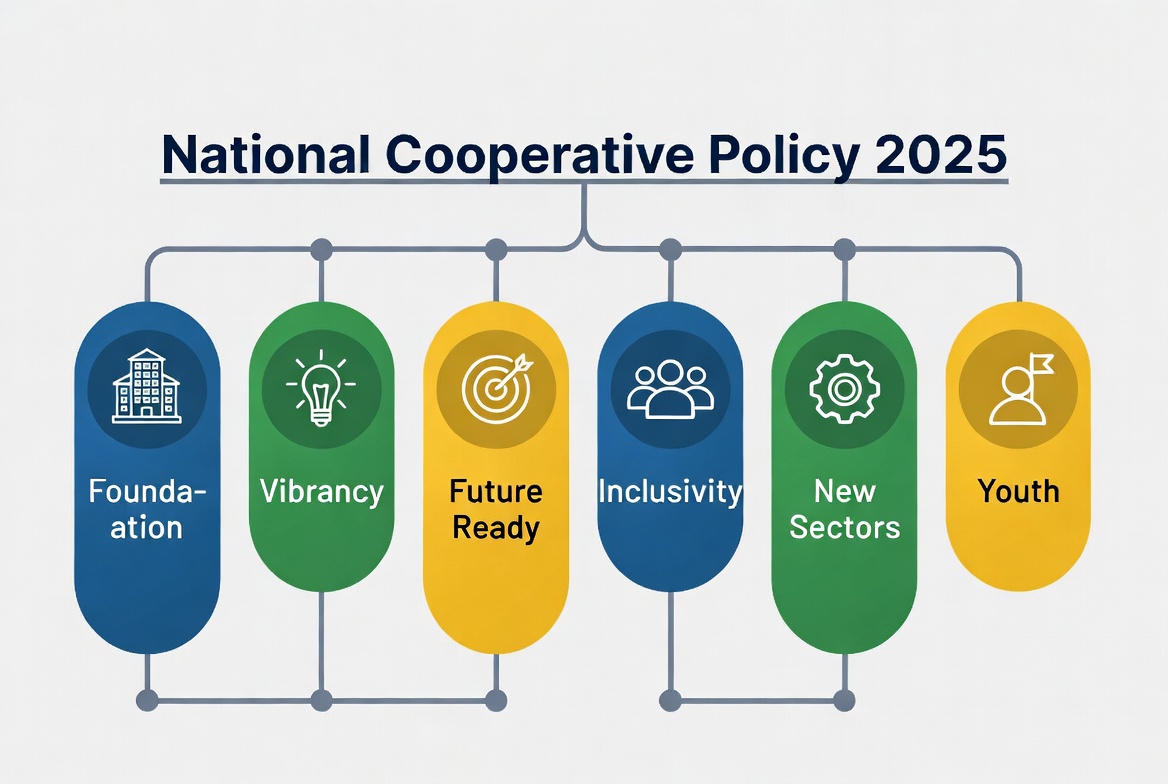
- The 6 Pillars: Foundation, Vibrancy, Future-Ready (Cooperative Stack/Digitalisation), Inclusivity (Women/SC/ST/Adivasis), New Sectors (Sahkar Taxi, Solar, Biofuel), and Youth Development.
- Core Numerical Targets: Expand membership from 30 crore to 50 crore, triple economic contribution, register 30% more societies, establish at least one active cooperative per village.
1. Why Cooperatives Suddenly Matter in Competitive Exams
In SSC CGL, RRB NTPC, Bank exams and even UPSC Prelims & Mains, questions on cooperatives have increased rapidly. Why? Because the sector already touches more than 30 crore people and the government has declared it the “second engine” of growth for Viksit Bharat 2047.
When a full ministry is created and a 10-year policy with 16 objectives and 83 recommendations is launched, examiners know students will be tested on both the underlying legal structure and the numerical targets. If you can explain the difference between the 2002 policy and the 2025 policy in three clear points, you already stand ahead of most candidates.
2. Brief History of Cooperative Movement in India
Cooperatives are not a new idea in India. The Cooperative Credit Societies Act came in 1904 during Lord Curzon's tenure. The famous success stories — Amul in dairy, IFFCO and KRIBHCO in fertilisers, and state cooperative banks — showed that when people pool small resources, big economic transformation is possible.
The Constitution originally put cooperative societies in the State List (Item 32 of List II). The 97th Constitutional Amendment Act of 2011 tried to give them constitutional status by inserting Article 19(1)(c) (right to form co-operatives), Article 43B in DPSPs (promotion of co-operative societies), and Part IXB (Articles 243ZH to 243ZT). The Supreme Court later in the Union of India v. Rajendra N. Shah (2021) case struck down Part IXB for multi-state cooperatives where state ratification was missing, but preserved the spirit of democratic member control.
The first National Policy on Cooperatives was announced in 2002. It focused mainly on basic organisation of economic activities. After that, for 23 years, the world changed — digitisation, globalisation, new technological sectors, and rising expectations of youth and women. The old policy simply could not keep pace.
3. Why a New Policy Was Needed After 23 Years
By 2021, the government felt the cooperative sector needed a complete reboot. That is why a separate Ministry of Cooperation was created on 6 July 2021 with the slogan “Sahkar-se-Samriddhi”. A 48-member national committee headed by former Union Minister Suresh Prabhu was set up in September 2022. They held regional workshops, collected 648 inputs, and drafted the new policy.
The old policy was good for its time. The new one had to answer modern questions: How do we bring technology? How do we get youth interested? How do we expand into green energy, tourism and taxi services? How do we make every village have at least one active cooperative?
4. National Cooperative Policy 2025 – Vision, Mission & Launch
The National Cooperative Policy 2025 was formally launched on 24 July 2025 by Union Home and Cooperation Minister Amit Shah in New Delhi.
- Vision: Contribute to India’s goal of becoming Viksit Bharat by 2047 through sustainable cooperative development, following the principle of Sahkar-se-Samriddhi.
- Mission: Create a strong legal, economic and institutional framework so that cooperative enterprises become professionally managed, transparent, technology-enabled and responsive economic entities that support production by the masses.
The policy is designed as a 10-year roadmap (2025–2035). It has no separate large budgetary allocation of its own; instead, it asks all ministries and state governments to align their existing budget schemes with these goals.
5. The Six Strategic Pillars Explained Simply
The entire policy rests on six pillars containing 16 specific objectives and 83 concrete recommendations. Remember them like this:
Detailed Breakdown of the 6 Pillars:
- 1. Strengthening the Foundation: Legal reforms, model bye-laws for PACS, better governance, easier access to institutional credit, and full digitalisation of cooperative offices.
- 2. Promoting Vibrancy: Creating proper business ecosystems, helping cooperatives export through National Cooperative Exports Limited (NCEL), and developing rural clusters so that farmer members earn higher profit margins.
- 3. Making Cooperatives Future-Ready: Technology adoption, professional management, and building a national “Cooperative Stack” for data-driven decisions and real-time auditing.
- 4. Promoting Inclusivity and Deepening Reach: Special focus on women, youth, small and marginal farmers, SC/ST, Dalits and Adivasis so that the movement becomes a true mass economic movement.
- 5. Entering New and Emerging Sectors: Encouraging cooperatives in tourism, ride-hailing taxi services (Sahkar Taxi / Bharat Taxi), insurance, green energy, bio-fuel, waste management, healthcare, warehousing and food processing.
- 6. Shaping the Young Generation for Cooperative Growth: New courses, training programmes, and the newly established Tribhuvan Sahkari University (declared an Institution of National Importance) to create the next generation of professional cooperative managers.
6. Key Targets and Numbers You Must Remember
For objective competitive exams (SSC CGL, RRB NTPC, Banking), memorize these exact figures:
| Target Area | Specific Policy Benchmark |
|---|---|
| Total Active Members | Expand from 30 Crore to 50 Crore Members |
| Economic Contribution | Triple the cooperative sector's GDP contribution in 10 years |
| Society Growth | Increase total registered societies by 30% (from 8.44 Lakh) |
| Village Coverage | At least one active cooperative society in every panchayat within 5 years |
| Model Villages | Develop 5 Model Cooperative Villages in every tehsil |
| PACS Computerisation | Complete migration of 63,000+ functional PACS onto unified IT software |
7. White Revolution 2.0 and Focus on Women, Dalits & Adivasis
A major push under the new policy is Cooperative-led White Revolution 2.0. The target is to increase milk procurement by dairy cooperatives by 50% in five years — from 660 lakh kg per day (2023-24) to 1,007 lakh kg per day by 2028-29.
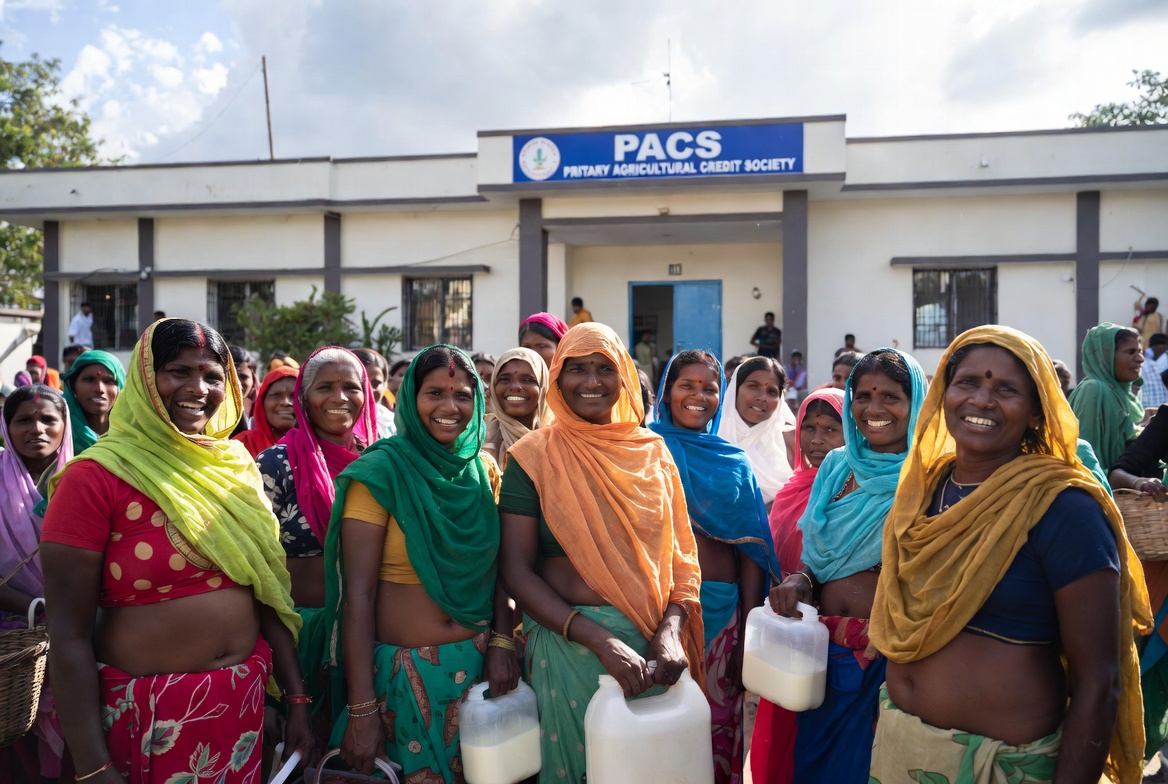
As of mid-2026, over 25,282 new Dairy Cooperative Societies have already been registered across 31 states and UTs. The policy specifically mandates that women, SC/ST, Dalits, and Adivasis should get priority in membership and board leadership so that cooperative prosperity reaches the last mile.
8. Progress Report – What Has Happened Till July 2026
One year after launch, the Ministry of Cooperation gave an official update in Parliament on 21 July 2026:
- 38,138 New Societies Registered: Since the February 2023 expansion plan, 38,138 new PACS, LAMPS, dairy, and fishery cooperative societies have been registered.
- Strengthened Societies: 21,292 dairy and fisheries primary cooperative societies have been upgraded (data as of June 2026).
- National Database: The National Cooperative Database now covers more than 8.44 lakh societies and nearly 32 crore members.
- New National Institutions: Successfully operationalized National Cooperative Exports Limited (NCEL), Bharatiya Beej Sahakari Samiti Limited (BBSSL), National Cooperative Organics Limited (NCOL), National Urban Cooperative Finance and Development Corporation (NUCFDC), and Bharat Taxi platform.
- Tribhuvan Sahkari University: Commenced courses as the apex national institution for cooperative management.
- State Alignment: States have started passing local policies; for example, Arunachal Pradesh approved its State Cooperation Policy 2026 aligned with the national framework in July 2026.
9. Comparison Table – Old Policy vs New Policy
| Aspect | National Policy 2002 | National Cooperative Policy 2025 |
|---|---|---|
| Nodal Ministry | Dept of Agriculture & Cooperation | Dedicated Ministry of Cooperation (Est. 2021) |
| Focus Area | Basic organisation of economic activities | Full transformation into modern economic entities |
| Time Horizon | Open-ended / Limited framework | 10-Year Strategic Roadmap (till ~2035) |
| Policy Structure | General broad guidelines | 6 Strategic Pillars + 16 Objectives + 83 Recommendations |
| Technology & IT | Not emphasised / Manual books | Unified Cooperative Stack & Computerised PACS software |
| Sectoral Reach | Traditional Agriculture & Credit only | Green Energy, Tourism, Sahkar Taxi, Insurance, Bio-fuel |
| Inclusivity Mandate | General statements | Specific quotas & focus on Women, Youth, SC/ST, Adivasis |
| Membership Target | Not quantified | 50 Crore Active Members |
| Education & Training | State training centers | Tribhuvan Sahkari University (National Importance) |
10. Must Remember Points for Quick Revision
Quick Revision Summary:
- Launched: 24 July 2025 by Union Minister Amit Shah.
- Replaces: 2002 National Policy on Cooperatives.
- Drafting Committee: 48 members headed by former Union Minister Suresh Prabhu.
- Slogan: Sahkar-se-Samriddhi.
- Six Pillars: Foundation, Vibrancy, Future-Ready, Inclusivity, New Sectors, Youth Development.
- Key Targets: 50 crore members, triple economic contribution, 30% more societies, one cooperative per village.
- July 2026 Progress: 38,138 new societies registered, 25,282 new dairy coops under White Revolution 2.0.
- New Institutions: NCEL, BBSSL, NCOL, NUCFDC, Bharat Taxi, Tribhuvan Sahkari University.
11. Conclusion & Action Steps for Aspirants
The National Cooperative Policy 2025 is not just another document. It is the government’s clear signal that cooperatives will play a much bigger role in rural prosperity and inclusive growth for the next decade. For aspirants, it is a perfect mix of static knowledge (history, 97th Amendment, Dhebar/Prabhu committees) and current affairs (launch date, 6 pillars, 50 crore target, White Revolution 2.0 numbers).
Do not try to mug up all 83 recommendations. Focus on the six pillars, the four big numbers (50 crore, triple contribution, 30% increase, one per village), and the latest July 2026 progress figures. Make a one-page note and revise it every week. These are the exact points that appear in both Prelims and Mains-type questions.
Open your notebook right now and write down the six pillars once. That small action will lock the topic firmly in your mind!
Frequently Asked Questions (Exam FAQ)
When was the National Cooperative Policy 2025 launched and by whom?
It was launched on July 24, 2025, by Union Minister for Home & Cooperation Amit Shah in New Delhi, providing a 10-year roadmap to achieve 'Sahkar-se-Samriddhi'.
What are the six strategic pillars of the policy?
The 6 pillars are: 1. Strengthening Foundation, 2. Promoting Vibrancy, 3. Future-Ready Tech, 4. Inclusivity (Women/SC/ST), 5. New Sectors (Tourism/Taxi/Insurance), 6. Shaping Youth via Tribhuvan Sahkari University.
What is the membership target set under the policy?
The policy aims to expand total cooperative membership from 30 crore to 50 crore, ensuring at least one active cooperative society in every panchayat.
Sources: Ministry of Cooperation, Press Information Bureau (PIB) Releases, Parliamentary Updates.
NEEDS DOUBLE-CHECK: none
Master Economic Governance on RRBCONTENTS
Practice PYQs, read policy notes, and explore job exam guides.
Solve Polity & Economy PYQs → Explore Govt Jobs →Join our official Telegram channel: @rrbcontents