 RRB
RRB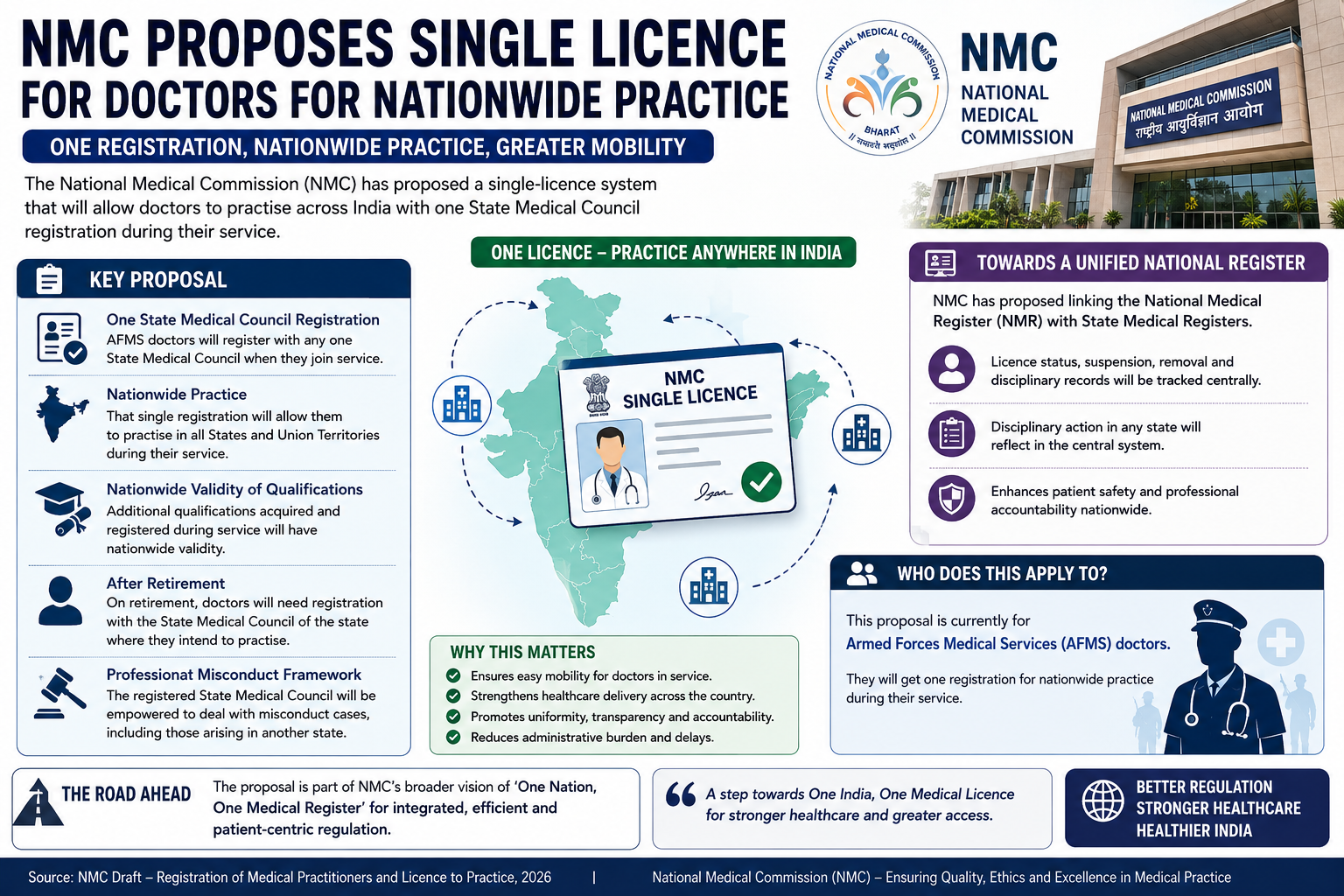
NMC single licence for doctors has been proposed by the National Medical Commission. The draft rules were notified on 11 August 2026. As a result, a doctor registered with any State Medical Council and allotted a Unique Identification number in the National Medical Register will be eligible to practise anywhere in India. Therefore, the need for fresh registration in every new state may soon end.
Under the current system, doctors often face repeated paperwork when they move from one state to another. In addition, tracking disciplinary action across states has remained incomplete. Consequently, the new proposal aims to create both greater mobility for doctors and better national oversight.
The draft is open for stakeholder comments. Once finalised, it could significantly change how medical practice is regulated across the country.
What the NMC Single Licence for Doctors Proposal Says
The proposal forms part of the Registration of Medical Practitioners and Licence to Practice Medicine (Amendment) Regulations, 2026. First, a doctor will continue to register with the concerned State Medical Council. Second, the Ethics and Medical Registration Board of the NMC will generate a Unique Identification number. Third, this UID will be entered in the National Medical Register.
Once the UID is allotted, the doctor becomes eligible to practise in any State or Union Territory. Fresh registration or a separate licence in another state will no longer be required. Moreover, the UID will incorporate the state code along with the state registration number. As a result, the system remains linked to the original state council while enabling nationwide practice.
The draft also provides for electronic synchronisation between the National Medical Register and the State Medical Registers. Therefore, any change made in one register will automatically reflect in the other.
How the New System Will Work in Practice
Doctors will apply through a unified registration portal of the Ethics and Medical Registration Board. The State Medical Council will process the application and grant registration. After that, the EMRB will allot the UID and update the National Medical Register. Consequently, the doctor will gain eligibility to practise across India.
Existing practitioners who are already registered but do not have a UID will be required to update their details through the portal. No fee is proposed for this one-time generation of the Unique Identification number. In addition, the licence is expected to remain valid for five years. Failure to renew within three months after expiry will mark the registration as inactive.
Disciplinary proceedings will also be tracked centrally. If a State Medical Council, the EMRB or the NMC takes action against a doctor, the record will appear in the National Medical Register. As a result, a doctor facing action in one state will not be able to simply move to another state and continue practice unnoticed.
Why the NMC Single Licence for Doctors Matters
India faces uneven distribution of doctors. Many rural and underserved areas struggle to attract medical professionals. At the same time, doctors who wish to move for better opportunities or family reasons often face administrative barriers. Therefore, a single national licence can improve mobility and help address shortages in some regions.
Patients also stand to gain. A centralised register with disciplinary history will make it harder for doctors with serious professional misconduct records to escape scrutiny. In addition, hospitals and regulators will find it easier to verify credentials. Consequently, the overall accountability of the medical profession can improve.
However, State Medical Councils will still retain an important role. They will continue to handle initial registration and many disciplinary matters. The national system is designed to support, not completely replace, the state-level framework.
Current Status and Next Steps
The draft regulations were notified on 11 August 2026. The NMC has invited objections and suggestions from stakeholders. After examining the feedback, the Commission may finalise the rules. Until then, the existing system of state-wise registration continues.
Several states have already experimented with easier interstate practice norms. The national proposal, however, seeks a uniform framework for the entire country. Therefore, its final shape will depend on the comments received and the decisions taken by the NMC.

For medical students, young doctors and health policy aspirants, this is an important reform to follow. It touches registration, professional mobility, patient safety and federal coordination in healthcare regulation.
You can follow more current affairs and healthcare policy updates on rrbcontents.com. Detailed reporting is available at The Hindu, Business Standard and National Herald.
Conclusion
The NMC single licence for doctors proposal is a significant step toward simplifying medical practice across India. By linking state registration with a national Unique Identification number, the system aims to reduce paperwork while strengthening oversight. As a result, both doctors and patients could benefit if the framework is implemented carefully.
The draft is still open for feedback. Therefore, the final regulations may see further refinements. In the coming months, the focus will remain on how effectively the National Medical Register, state councils and the Ethics and Medical Registration Board work together. For now, the proposal marks a clear move toward greater portability and accountability in India’s medical profession.
---