Pakistan Asks US for $10 Billion Financial Backstop
Finance Minister Muhammad Aurangzeb Meets US Treasury Secretary Scott Bessent in Washington
Home › Blog › Economy & Global Affairs › South Asia
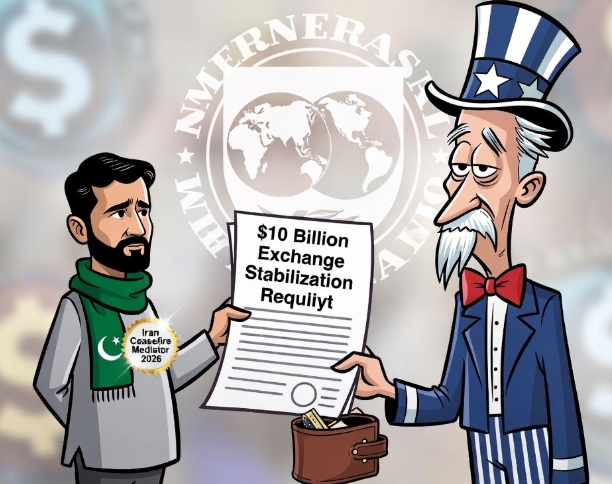
On 21 July 2026, Pakistan formally requested a $10 billion financial facility from the United States Government. Pakistan’s Finance Minister, Muhammad Aurangzeb, raised the matter directly during a high-level meeting in Washington with US Treasury Secretary Scott Bessent.
The specific vehicle requested is a Bilateral Exchange Stabilization Support Facility valued at $10 billion, structured with a maturity of up to five years. In practical financial terms, Pakistan is seeking a substantial dollar backstop to shore up its central bank reserves, insulate its foreign exchange market, and ease structural pressure on the Pakistani Rupee.
Pakistan’s macroeconomic fundamentals remain exceptionally fragile. Total liquid foreign exchange reserves currently hover around $22 billion. While this figure reflects an improvement compared to the severe default scare of previous years, the reserves remain thin and almost entirely dependent on external deposits and bilateral rollovers from China, Saudi Arabia, and the International Monetary Fund (IMF).
Pakistan is operating under a strict $7 billion IMF Extended Fund Facility (EFF) program. The IMF's mandatory reform conditions—enforcing higher taxation, electricity tariff hikes, spending cuts, and state-owned enterprise restructuring—have brought fiscal discipline but generated deep political discontent domestically. A dedicated $10 billion bilateral facility from Washington would afford Islamabad greater policy space, reducing its immediate vulnerability to rigid IMF tranche reviews.
Beyond fiscal necessity, the request carries a clear diplomatic dimension. Earlier in 2026, Pakistan played a visible role in mediating backchannel communications between Washington and Tehran during the heightened regional conflict. Pakistani diplomatic and military leadership facilitated quiet talks that eventually helped structure an April 2026 ceasefire.
“Islamabad appears to believe that its key diplomatic mediation during the 2026 Iran conflict should now translate into tangible economic support. The $10 billion request is being framed partly as strategic recognition for that role.”
Whether the US Department of the Treasury and Congress evaluate Pakistan's strategic mediation as grounds for a multi-billion-dollar financial package remains a complex political equation in Washington.
As of late July 2026, the US Treasury Department has not issued a formal public decision regarding the proposal. Approval of such a facility is far from guaranteed; exchange stabilization arrangements of this scale are exceptionally rare and subject to rigorous Congressional oversight, debt sustainability evaluations, and geopolitical scrutiny.
From an Indian policy perspective, this development follows a long-standing historical pattern. Whenever Pakistan faces acute balance-of-payments pressures, its administration seeks major external lifelines. While modern financial terminology like "exchange stabilization facility" replaces older bailout nomenclature, the underlying structural reliance on foreign capital persists. The situation highlights the ongoing divergence in South Asia, where neighboring economies operate under vastly different models of financial self-reliance and external debt management.
A) Special Drawing Rights (SDR) Allocation
B) Bilateral Exchange Stabilization Support Facility
C) Sovereign Debt Write-off Agreement
D) Stand-By Arrangement (SBA)
Correct Answer: B
Explanation: Pakistan requested a $10 billion Bilateral Exchange Stabilization Support Facility with a 5-year maturity.
A) Janet Yellen
B) Scott Bessent
C) Antony Blinken
D) Jerome Powell
Correct Answer: B
Explanation: US Treasury Secretary Scott Bessent hosted the bilateral meeting with Pakistan Finance Minister Muhammad Aurangzeb.
A) $3 Billion
B) $5 Billion
C) $7 Billion
D) $12 Billion
Correct Answer: C
Explanation: Pakistan is operating under a strict $7 billion IMF Extended Fund Facility program.
A) $8 Billion
B) $15 Billion
C) $22 Billion
D) $50 Billion
Correct Answer: C
Explanation: Pakistan's total liquid foreign exchange reserves stand at around $22 billion, supported by IMF and bilateral deposits.
A) US-Iran Conflict Ceasefire Mediation
B) Black Sea Grain Initiative
C) SCO Climate Accord
D) Afghan Reconstruction Treaty
Correct Answer: A
Explanation: Pakistan participated in backchannel efforts that helped structure an April 2026 ceasefire between the US and Iran.
Pakistan requested a $10 billion Bilateral Exchange Stabilization Support Facility with a maturity of up to five years to strengthen its foreign exchange reserves and stabilize the rupee.
Pakistan Finance Minister Muhammad Aurangzeb held discussions with US Treasury Secretary Scott Bessent in Washington.
Pakistan's total liquid foreign exchange reserves stand at approximately $22 billion, heavily supported by external assistance from the IMF, China, and Saudi Arabia.
Pakistan played a visible role in mediating backchannel efforts between the US and Iran during the early 2026 conflict, leading to an April ceasefire, and is framing the financial support partly as recognition for that effort.
Prepare for civil services and competitive exams by testing your knowledge on international financial bodies, foreign reserves, and global geopolitics.
Solve PYQs → Study Notes →Join our official Telegram community for daily study updates: @rrbcontents