73RD & 74TH CONSTITUTIONAL AMENDMENTS: PANCHAYATI RAJ, URBAN LOCAL BODIES & DEMOCRATIC DECENTRALIZATION (COMPLETE GUIDANCE FOR COMPETITIVE EXAMS)
Chapter 1
INTRODUCTION
The 73rd and 74th Constitutional Amendment Acts of 1992 represent a watershed moment in the constitutional history of Independent India. By conferring constitutional status and protection on Panchayati Raj Institutions (PRIs) and Urban Local Bodies (ULBs), these amendments institutionalized democratic decentralization and established a third tier of local self-governance below the Union and State levels.
Mahatma Gandhi famously remarked: "If the village perishes, India will perish too. India's survival depends on the revival of its village republics." To translate the Directive Principle of State Policy under Article 40 ("Organization of Village Panchayats") into concrete legal reality, Parliament enacted:
1. The 73rd Constitutional Amendment Act, 1992 (enacted on 24th April 1993, celebrated annually as National Panchayati Raj Day), which added Part IX ("The Panchayats") and the 11th Schedule containing 29 functional subjects to the Constitution.
2. The 74th Constitutional Amendment Act, 1992 (enacted on 1st June 1993), which added Part IX-A ("The Municipalities") and the 12th Schedule containing 18 functional subjects to the Constitution.
Together, these twin amendments revolutionized grassroots democracy by mandating regular 5-year elections, reserving at least 33% (and up to 50% in many States) of seats for women, guaranteeing political representation for Scheduled Castes (SCs) and Scheduled Tribes (STs), establishing independent State Election Commissions (SECs), and setting up State Finance Commissions (SFCs).
For aspirants preparing for competitive examinations such as UPSC Civil Services, State Public Service Commissions (BPSC, UPPSC, MPPSC, RAS), SSC CGL, and judicial services, mastering Articles 243 to 243-ZG, committee recommendations, functional schedules, and local governance challenges is essential.
This comprehensive master career guide provides an exhaustive breakdown of the 73rd and 74th Constitutional Amendments. We cover every legal detail—from historical committees (Balwant Rai Mehta to LM Singhvi) and article-by-article legal analyses to 11th and 12th Schedule subject tables, PESA Act 1996, 12 exam-focused FAQs, and essential revision tools.
---
Chapter 2
HISTORICAL EVOLUTION OF LOCAL SELF-GOVERNMENT IN INDIA
HISTORICAL EVOLUTION OF LOCAL SELF-GOVERNMENT IN INDIA - Illustrative Reference
Chola Dynasty Village Assemblies (Kudavolai System of Democratic Local Voting)
       │
       ▼ (Lord Ripon's Resolution 1882 - Father of Local Self-Government in India)
Establishment of Local Boards & District Councils in British Provinces
       │
       ▼ (Article 40 of DPSP - 1950 Indian Constitution)
"State shall take steps to organize village panchayats..."
       │
       ▼ (Balwant Rai Mehta Committee 1957)
Recommendation of 3-Tier Panchayati Raj System (Nagaur, Rajasthan 1st State on 2nd Oct 1959)
       │
       ▼ (73rd & 74th Constitutional Amendments 1992)
Constitutional Status Granted (Part IX & Part IX-A Inserted)
| Committee Name | Year | Key Recommendations & Constitutional Impact |
|---|---|---|
| Balwant Rai Mehta Committee | 1957 | Recommended a 3-tier Panchayati Raj system: Gram Panchayat (Village), Panchayat Samiti (Block), and Zilla Parishad (District). Coined "Democratic Decentralization". |
| Ashok Mehta Committee | 1977 | Recommended replacing 3-tier with a 2-tier system: Zilla Parishad (District) and Mandal Panchayat (Group of villages). Advocated official party participation. |
| G.V.K. Rao Committee | 1985 | Highlighted bureaucratic control, describing PRIs as "Grass without roots". Recommended making District the basic unit of planning. |
| L.M. Singhvi Committee | 1986 | First to recommend Constitutional Status for PRIs. Advocated constitutional recognition, Gram Sabha primacy, and Nyaya Panchayats. |
| P.K. Thungon Committee | 1988 | Re-emphasized constitutional backing for 3-tier PRIs, fixed 5-year tenure, and reservation for women/SCs/STs. |
---
Chapter 3
73RD CONSTITUTIONAL AMENDMENT ACT, 1992 (PANCHAYATI RAJ)
| Article | Subject Matter / Legal Provisions |
|---|---|
| Article 243 | Definitions of Panchayat, Gram Sabha, Village, District, etc. |
| Article 243-A | Gram Sabha: Body consisting of all persons registered in electoral rolls of village. |
| Article 243-B | Constitution of Panchayats: Mandatory 3-tier system (Village, Intermediate/Block, District). (States with population < 20 Lakhs need NOT form intermediate level). |
| Article 243-C | Composition of Panchayats: Direct elections for all members. Chairpersons at block/district level elected indirectly by elected members. |
| Article 243-D | Reservation of Seats: Mandatory seats for SCs and STs in proportion to population. Minimum 1/3rd (33.33%) reserved for WOMEN (including chairpersons). |
| Article 243-E | Duration of Panchayats: Fixed 5-Year tenure. If dissolved early, fresh elections MUST be held within 6 months. |
| Article 243-F | Disqualifications for Membership: Age 21+ Years required (unlike 25 yrs for Assembly). Disqualification rules governed by State law. |
| Article 243-G | Powers, Authority & Responsibilities: 29 Functional Subjects listed in 11th Schedule. |
| Article 243-H | Powers to Impose Taxes & Funds: State Legislature may authorize Panchayats to levy taxes, fees, and receive grants-in-aid. |
| Article 243-I | State Finance Commission (SFC): Constituted by Governor every 5 years to review financial position and recommend tax distribution. |
| Article 243-J | Audit of Accounts: Audit of accounts of Panchayats as prescribed by State Legislature. |
| Article 243-K | State Election Commission (SEC): Independent SEC appointed by Governor to conduct all Panchayat elections. |
| Article 243-L | Application of Part IX to Union Territories. |
| Article 243-M | Part IX NOT to Apply to Certain Areas: Nagaland, Meghalaya, Mizoram, 5th Schedule areas, and hill areas of Manipur/Darjeeling. |
| Article 243-N | Continuance of existing laws and Panchayats. |
| Article 243-O | Bar to Interference by Courts: Electoral boundaries and seat allocation cannot be questioned in court. |
---
SIRD institutes in every state capital conduct residential training workshops for newly elected Sarpanches, Ward Members, and Panchayat Secretaries on e-governance, financial management, and social audit procedures.
Chapter 4
THREE-TIER STRUCTURE OF PANCHAYATI RAJ INSTITUTIONS (PRIs)
Level 3 (Apex): Zilla Parishad (District Level)
└── Executive Officer: IAS / Senior State Civil Officer | Political Head: Zilla Parishad Chairperson
       │
       ▼
Level 2 (Intermediate): Panchayat Samiti / Block Development Office (Block Level)
└── Executive Officer: BDO (Block Development Officer) | Political Head: Block Pramukh / President
       │
       ▼
Level 1 (Grassroots): Gram Panchayat (Village Level)
└── Executive Officer: Panchayat Secretary / Gram Sevak | Political Head: Sarpanch / Mukhiya
       │
       ▼
FOUNDATION: GRAM SABHA (Body of ALL Registered Voters in the Village)
1. Gram Sabha (Article 243-A): The sovereign foundation of local democracy. Consists of all registered adult voters in a village. Exercises statutory oversight over Gram Panchayat development plans, social audits, and beneficiary lists (e.g., MGNREGA).
2. Gram Panchayat (Village Level): Directly elected body headed by the Sarpanch/Mukhiya. Responsible for basic civic amenities, village roads, street lighting, and sanitation.
3. Panchayat Samiti (Block Level): Intermediate tier acting as a link between Gram Panchayats and Zilla Parishad. Executed by the Block Development Officer (BDO).
4. Zilla Parishad (District Level): Apex district tier coordinating rural development plans across the district.
---
Chapter 5
11TH SCHEDULE: 29 FUNCTIONAL SUBJECTS FOR PANCHAYATS
Chapter 6
1. Agriculture, including agricultural extension.
Chapter 7
2. Land improvement, implementation of land reforms, land consolidation, and soil conservation.
Chapter 8
3. Minor irrigation, water management, and watershed development.
Chapter 9
4. Animal husbandry, dairying, and poultry.
---
- Civil & Minor Criminal Jurisdiction: Entrusted with resolving minor civil land disputes, petty thefts, and local trespass cases without complex legal technicalities.
- Exclusion of Legal Practitioners: Lawyers are excluded from appearing before Nyaya Panchayats to encourage amicable compromise and community mediation.
Chapter 10
PESA ACT 1996 (PROVISIONS OF THE PANCHAYATS EXTENSION TO SCHEDULED AREAS ACT)
Under Article 243-M, Part IX does NOT automatically apply to Scheduled Areas listed under the 5th Schedule. To extend local self-governance to tribal areas while protecting indigenous traditions, Parliament enacted the PESA Act, 1996 based on the recommendations of the Dileep Singh Bhuria Committee.
Chapter 11
1. Mandatory consultation before land acquisition for development projects in 5th Schedule areas.
Chapter 12
2. Ownership of Minor Forest Produce (MFP) vested directly in Gram Sabha.
Chapter 13
3. Mandatory approval for mining licenses/leases for minor minerals.
Chapter 14
4. Power to enforce prohibition or regulate/restrict sale and consumption of intoxicants.
---
Chapter 15
74TH CONSTITUTIONAL AMENDMENT ACT, 1992 (URBAN LOCAL BODIES)
| Article | Subject Matter / Legal Provisions |
|---|---|
| Article 243-P | Definitions of Municipality, Metropolitan area, Municipal area, Ward, etc. |
| Article 243-Q | Constitution of Municipalities: 3 Types (Nagar Panchayat, Municipal Council, Municipal Corporation). |
| Article 243-R | Composition of Municipalities: Direct election of ward councillors. Special representation for MPs/MLAs. |
| Article 243-S | Constitution & Composition of Wards Committees: Mandatory for urban areas having population of 3 Lakhs or more. |
| Article 243-T | Reservation of Seats: SCs & STs in proportion to population. Minimum 1/3rd (33.33%) reserved for WOMEN. |
| Article 243-U | Duration of Municipalities: Fixed 5-Year tenure. Elections within 6 months of dissolution. |
| Article 243-V | Disqualifications for Municipal Membership (Minimum age 21+ Years). |
| Article 243-W | Powers, Authority & Responsibilities: 18 Functional Subjects listed in 12th Schedule. |
| Article 243-X | Power to impose taxes, toll fees, and receive grants-in-aid. |
| Article 243-Y | State Finance Commission: Reviews financial position of Municipalities (same SFC under Art 243-I). |
| Article 243-Z | Audit of accounts of Municipalities. |
| Article 243-ZA | Elections to Municipalities: Conducted by the State Election Commission (SEC) (Art 243-K). |
| Article 243-ZB | Application of Part IX-A to Union Territories. |
| Article 243-ZC | Part IX-A NOT to apply to Scheduled Areas and Scheduled Tribes. |
| Article 243-ZD | District Planning Committee (DPC): Consolidated planning for district rural and urban areas. |
| Article 243-ZE | Metropolitan Planning Committee (MPC): Draft development plan for metropolitan areas (Pop 10 Lakhs+). |
| Article 243-ZF | Continuance of existing laws and Municipalities. |
| Article 243-ZG | Bar to interference by courts in electoral matters. |
---
Chapter 16
THREE TYPES OF URBAN LOCAL BODIES (ARTICLE 243-Q)
3-Tier Urban Architecture (Article 243-Q)
├── 1. Nagar Panchayat: For a transitional area (transitioning from rural to urban area)
├── 2. Municipal Council (Nagar Palika): For a smaller urban area
└── 3. Municipal Corporation (Nagar Nigam): For a larger urban area (Metropolitan cities)
| Urban Body Type | Area Category | Political Head | Executive Officer |
|---|---|---|---|
| Nagar Panchayat | Transitional Rural-to-Urban Area | Chairman / President | Executive Officer (EO) |
| Municipal Council (Nagar Palika) | Smaller Urban Town | President / Chairman | Chief Municipal Officer (CMO) |
| Municipal Corporation (Nagar Nigam) | Major Metro City (Population 5 Lakhs+) | Mayor | Municipal Commissioner (IAS Officer) |
---
- AMRUT (Atal Mission for Rejuvenation and Urban Transformation): Focuses on establishing universal tap water connections, sewage management networks, storm water drainage, and green urban parks across 500 target cities.
- Smart Cities Mission: Promotes 100 smart cities equipped with Integrated Command and Control Centres (ICCC), smart traffic management, intelligent waste collection sensors, and GIS property mapping.
- Municipal Bonds & Credit Rating: Encourages creditworthy Municipal Corporations (such as Pune, Ahmedabad, Lucknow, Indore, and Hyderabad) to issue Municipal Bonds on stock exchanges to raise non-grant capital for infrastructure development.
Urban Local Bodies are mandated under the Solid Waste Management Rules, 2016 to enforce doorstep segregated waste collection (biodegradable, dry recyclable, and hazardous waste), operating bio-methanation plants and sanitary landfills.
Chapter 17
12TH SCHEDULE: 18 FUNCTIONAL SUBJECTS FOR MUNICIPALITIES
Chapter 18
1. Urban planning including town planning.
Chapter 19
2. Regulation of land-use and construction of buildings.
Chapter 20
3. Planning for economic and social development.
Chapter 21
4. Roads and bridges.
---
Chapter 22
COMPARATIVE ANALYSIS: 73RD VS 74TH CONSTITUTIONAL AMENDMENTS
| Feature / Aspect | 73rd Amendment Act, 1992 | 74th Amendment Act, 1992 |
|---|---|---|
| Constitutional Part | Part IX ("The Panchayats") | Part IX-A ("The Municipalities") |
| Constitutional Articles | Articles 243 to 243-O | Articles 243-P to 243-ZG |
| Constitutional Schedule | 11th Schedule | 12th Schedule |
| Number of Subjects | 29 Functional Subjects | 18 Functional Subjects |
| Enactment Date | 24th April 1993 (Panchayati Raj Day) | 1st June 1993 |
| Grassroots Assembly | Gram Sabha (Art 243-A) | Wards Committee (Art 243-S - Pop 3L+) |
| Planning Bodies | District Planning Committee (Art 243-ZD) | Metropolitan Planning Committee (Art 243-ZE) |
| Women Reservation | Minimum 33.33% (Art 243-D) | Minimum 33.33% (Art 243-T) |
| Elections & Finance | SEC (Art 243-K) & SFC (Art 243-I) | SEC (Art 243-ZA) & SFC (Art 243-Y) |
---
- e-GramSWARAJ Portal: Integrated portal for planning, accounting, and online vendor payments for Gram Panchayats. All development projects funded under 15th Finance Commission grants are mapped online.
- SVAMITVA Scheme (Survey of Villages and Mapping with Improvised Technology in Village Areas): Uses drone technology to survey rural inhabited (Abadi) land, issuing property cards (Property Cards / Gharabari Khatian) to rural household owners, enabling bank loan leverage and reducing property disputes.
- AuditOnline Portal: Conducts 100% online audit of Panchayat accounts, making audit reports accessible to the public.
Chapter 23
CHALLENGES & ISSUES IN LOCAL SELF-GOVERNANCE
1. Inadequate Funds (Financial Dependence): Local bodies depend heavily on Central and State grants. Own-source tax revenue generation remains extremely low due to reluctance to levy property and civic taxes.
2. Lack of Functional Devolution: Many State Governments have failed to devolve all 29 subjects (11th Schedule) and 18 subjects (12th Schedule) to local bodies, retaining executive control through state departments.
3. Shortage of Functionaries (Staff Crunch): Acute shortage of technical staff, engineers, urban planners, and qualified accountants in Panchayats and Municipalities.
4. "Sarpanch Pati" Phenomenon: In many rural areas, elected female Sarpanches are sidelined by their husbands or male relatives ("Sarpanch Pati"), undermining genuine women empowerment.
---
Chapter 24
IMPORTANCE FOR COMPETITIVE EXAMS & QUICK REVISION
1. Articles: Art 243-A (Gram Sabha), Art 243-D (Reservation 33% Women), Art 243-E (5 Yr Duration), Art 243-I (SFC), Art 243-K (SEC), Art 243-Q (3 ULB Types), Art 243-ZD (DPC), Art 243-ZE (MPC).
2. Schedules: 11th Schedule (29 Subjects - Panchayats); 12th Schedule (18 Subjects - Municipalities).
3. Dates: 24th April 1993 (73rd Act - Panchayati Raj Day); 1st June 1993 (74th Act).
4. Committees: Balwant Rai Mehta (1957 - 3 Tier), Ashok Mehta (1977 - 2 Tier), LM Singhvi (1986 - Constitutional Status), PESA Act (1996 - Bhuria Committee).
---
Chapter 25
FREQUENTLY ASKED QUESTIONS (FAQS)
Answer: Article 40 under the Directive Principles of State Policy (DPSP) mandates that the State shall take steps to organize Village Panchayats.
Chapter 26
# Q2: When is National Panchayati Raj Day celebrated in India and why?
Answer: Celebrated annually on 24th April because the 73rd Constitutional Amendment Act, 1992 officially came into force on 24th April 1993.
Chapter 27
# Q3: What is the minimum age required to contest Panchayat or Municipal elections?
Answer: A candidate must have completed 21 years of age to contest local body elections (Article 243-F & 243-V).
Chapter 28
# Q4: How many functional subjects are contained in the 11th and 12th Schedules?
Answer: The 11th Schedule contains 29 functional subjects for Panchayats, while the 12th Schedule contains 18 functional subjects for Municipalities.
Chapter 29
# Q5: What is the mandatory minimum reservation for women in Panchayats under Article 243-D?
Answer: The Constitution mandates a minimum of one-third (33.33%) reservation for women in seats and chairperson posts. (Several States like Bihar, MP, Rajasthan, and Odisha have increased this to 50%).
Chapter 30
# Q6: What happens if a Panchayat or Municipality is dissolved before its 5-year tenure?
Answer: Fresh elections MUST be conducted within 6 months from the date of dissolution. The newly elected body serves ONLY for the remainder of the 5-year term.
Answer: Local body elections are conducted by the State Election Commission (SEC) under Articles 243-K and 243-ZA.
Chapter 31
# Q8: What is the primary purpose of the PESA Act, 1996?
Answer: The Provisions of the Panchayats (Extension to Scheduled Areas) Act, 1996 extends Panchayati Raj provisions to 5th Schedule tribal areas, empowering the Gram Sabha to protect tribal land, culture, and minor forest produce.
Chapter 32
# Q9: What is the District Planning Committee (DPC) under Article 243-ZD?
Answer: The DPC consolidates development plans prepared by Panchayats and Municipalities across the district into a unified District Development Draft Plan.
Chapter 33
# Q10: Which committee first recommended granting constitutional status to Panchayati Raj Institutions?
Answer: The L.M. Singhvi Committee in 1986 was the first to recommend constitutional status and recognition for Panchayati Raj Institutions.
Chapter 34
# Q11: Which state was the first to adopt the 3-tier Panchayati Raj system in India?
Answer: Rajasthan was the first state, inaugurating the 3-tier system in Nagaur district on 2nd October 1959 under PM Jawaharlal Nehru.
Answer: A Wards Committee is a statutory local committee constituted in urban areas having a population of 3 Lakhs or more, consisting of one or more electoral wards.
---
Answer: SVAMITVA uses drone survey technology to map rural inhabited land, issuing official property cards to rural owners to establish clear land ownership and unlock financial liquidity.
Answer: e-GramSWARAJ is a unified digital portal developed by the Ministry of Panchayati Raj for tracking Panchayat development plans, accounting records, and online vendor payments.
Chapter 35
# Q15: Which State was the first to provide 50% reservation for women in Panchayats?
Answer: Bihar was the first State in India to implement 50% reservation for women in Panchayati Raj Institutions in 2006.
Answer: A Municipal Bond is a debt instrument issued by creditworthy Municipal Corporations (such as Lucknow or Pune Municipal Corporation) to raise capital directly from financial markets for urban infrastructure projects.
Chapter 36
# Q17: What is the Metropolitan Planning Committee (MPC) under Article 243-ZE?
Answer: An MPC is a statutory planning body constituted in every Metropolitan area (having a population of 10 Lakhs or more) to draft a consolidated development plan for the entire metropolitan region.
- Panchayat Computer Operators & Account Clerks: Appointing computer-trained accounting assistants to manage e-GramSWARAJ ledgers, tax collection records, and digital birth/death certificate registration.
- Gram Sabha Meeting Frequency: State rules mandate at least four mandatory Gram Sabha meetings every year (typically on 26th January, 1st May, 15th August, and 2nd October) to approve village budget estimates and audit welfare spending.
- Social Audit Units: Independent Social Audit Societies conduct door-to-door physical verification of MGNREGA works, public school mid-day meals, and housing scheme construction, presenting findings directly in open Gram Sabha assemblies.
Chapter 37
PESA ACT 1996 (PROVISIONS OF THE PANCHAYATS EXTENSION TO SCHEDULED AREAS)
To extend Part IX of the Constitution to Scheduled V areas with suitable modifications preserving tribal traditions:
- Gram Sabha Supremacy: Mandates that every village shall have a Gram Sabha competent to safeguard and preserve traditions, customs, and community resources.
- Mandatory Consultation: Gram Sabha must be consulted prior to land acquisition in Scheduled Areas for development projects.
- Minor Forest Produce Ownership: Grants ownership rights over Minor Forest Produce (MFP) directly to Gram Sabhas.
- Control over Local Institutions: Empowers Gram Sabha to enforce prohibition, control money lending, and manage village markets.
---
Chapter 38
# Voluntary vs Compulsory Provisions of 73rd Amendment:
- Compulsory Provisions: Gram Sabha setup, 3-tier structure, direct elections, 21 years minimum age, 1/3rd reservation for women, 5-year tenure, State Election Commission, State Finance Commission.
- Voluntary Provisions: Voting rights to MPs/MLAs in PRIs, reservation for OBCs, financial powers to levy taxes, devolution of 29 subjects.
---
Chapter 39
# Article 243-O and Bar to Interference by Courts:
- Bar to interference by courts in electoral matters relating to Panchayats.
- Validity of any law relating to delimitation of constituencies or allotment of seats cannot be called into question in any court.
- No election to any Panchayat shall be called into question except by an election petition presented to such authority and in such manner as provided by State Legislature.
---
Chapter 40
# Ashok Mehta Committee 13 Recommendations (1977):
- Replaced 3-tier system with 2-tier system: Zila Parishad (district level) and Mandal Panchayat (group of villages with 15,000 to 20,000 population).
- Official participation of political parties at all levels of Panchayat elections.
- Compulsory powers of taxation to be given to Panchayati Raj institutions to mobilize their own financial resources.
- Regular social audit by an agency and by a committee of legislators.
---
Chapter 41
CONCLUSION
The 73rd and 74th Constitutional Amendments transformed the landscape of Indian democracy by decentralizing power directly to the people. By transforming local self-government from administrative discretion into an inviolable constitutional obligation, these twin amendments deepened democratic participation, empowered millions of women and marginalized communities, and created a robust framework for local planning and development.
For competitive exam aspirants, mastering Articles 243 to 243-ZG, committee milestones, functional schedules, and PESA provisions guarantees complete preparation for scoring top marks in Indian Polity.
👉 Official Career Portal: [https://rrbcontents.com](https://rrbcontents.com)
👉 Official Telegram Channel: [Join RRBCONTENTS Telegram (@rrbcontents)](https://t.me/rrbcontents)
---
Chapter 42
74th Amendment — Urban Local Bodies (Municipalities) in Detail
While the 73rd Amendment deals with rural Panchayati Raj Institutions, the 74th Constitutional Amendment Act, 1992 brought Urban Local Bodies (ULBs) under a constitutional framework for the first time. The provisions are contained in Articles 243P to 243ZG and the Twelfth Schedule.
Types of Urban Local Bodies:
- Nagar Panchayat: Established for a transitional area — a region in transition from rural to urban (smaller towns).
- Municipal Council: For smaller urban areas (towns).
- Municipal Corporation: For larger urban areas (cities with significant population and economic activity).
Key Constitutional Provisions:
- Article 243S: Mandates constitution of Ward Committees in municipalities having a population of 3 lakh or more. Ward Committees bring governance closer to citizens at the ward level.
- Article 243W read with Twelfth Schedule: Provides a list of 18 functions that the State Legislature may endow upon ULBs — these include urban planning, regulation of land use, public health, solid waste management, vital statistics (including registration of births and deaths), and slum improvement.
- Article 243ZD — District Planning Committee (DPC): Mandatory in every district to consolidate plans prepared by Panchayats and Municipalities for the district as a whole. The DPC prepares a draft development plan for the district integrating both rural and urban areas. Composition: 4/5th elected members (proportional to rural-urban population ratio), rest nominated.
- Article 243ZE — Metropolitan Planning Committee (MPC): Mandatory for every Metropolitan Area (population 10 lakh or more). Prepares a draft development plan for the metropolitan area as a whole. Composition: Not less than 2/3rd elected members. State governments have been slow in constituting MPCs — Mumbai, Delhi, Chennai, Kolkata still lack functional MPCs in many states.
---
Chapter 43
Eleventh Schedule — 29 Subjects for Panchayats (Complete List)
The Eleventh Schedule (inserted by 73rd Amendment, related to Article 243G) lists 29 subjects that State Legislatures may devolve to Panchayats. This is a frequently tested list in UPSC Prelims, State PSC exams, and RRB competitive exams:
Chapter 44
1. Agriculture including agricultural extension
Chapter 45
2. Land improvement, implementation of land reforms, land consolidation and soil conservation
Chapter 46
3. Minor irrigation, water management and watershed development
Chapter 47
4. Animal husbandry, dairying and poultry
Chapter 48
5. Fisheries
Chapter 49
6. Social forestry and farm forestry
Chapter 50
7. Minor forest produce
Chapter 51
8. Small scale industries, including food processing industries
Chapter 52
9. Khadi, village and cottage industries
Chapter 53
10. Rural housing
Chapter 54
11. Drinking water
Chapter 55
12. Fuel and fodder
Chapter 56
13. Roads, culverts, bridges, ferries, waterways and other means of communication
Chapter 57
14. Rural electrification, including distribution of electricity
Chapter 58
15. Non-conventional energy sources
Chapter 59
16. Poverty alleviation programme
Chapter 60
17. Education, including primary and secondary schools
Chapter 61
18. Technical training and vocational education
Chapter 62
19. Adult and non-formal education
Chapter 63
20. Libraries
Chapter 64
21. Cultural activities
Chapter 65
22. Markets and fairs
Chapter 66
23. Health and sanitation including hospitals, primary health centres and dispensaries
Chapter 67
24. Family welfare
Chapter 68
25. Women and child development
Chapter 69
26. Social welfare, including welfare of the handicapped and mentally retarded
Chapter 70
27. Welfare of the weaker sections, and in particular, of the Scheduled Castes and the Scheduled Tribes
Chapter 71
28. Public distribution system
Chapter 72
29. Maintenance of community assets
Important Note: These 29 subjects are not automatically transferred — each State Legislature decides which functions to actually devolve. In practice, many states have devolved only a fraction of these powers, leading to the criticism that PRIs remain paper tigers.
---
Chapter 73
Key Supreme Court & Committee Recommendations on PRIs
| Committee | Year | Key Recommendation |
|---|---|---|
| Balwant Rai Mehta Committee | 1957 | First to recommend a 3-tier Panchayat system — Gram Panchayat (village), Panchayat Samiti (block), Zila Parishad (district). Led to creation of Panchayati Raj in 1959 in Rajasthan. |
| Ashok Mehta Committee | 1977 | Recommended a 2-tier system — Mandal Panchayat (below block) and Zila Parishad (district). Also recommended political parties' participation at PRI level. |
| G.V.K. Rao Committee | 1985 | Recommended transferring all developmental functions to PRIs; called PRIs 'grass without roots' due to lack of power. |
| L.M. Singhvi Committee | 1986 | First to recommend constitutional status for PRIs; recommended Gram Sabha as the foundation of democracy; directly inspired the 73rd Amendment. |
| P.K. Thungon Committee | 1988 | Recommended constitutional status and functional autonomy for PRIs with clear devolution of funds, functions, and functionaries. |
---
Chapter 74
State Finance Commission (SFC) — Article 243I
The State Finance Commission (SFC) is a constitutionally mandated body under Article 243I for Panchayats (and Article 243Y for Municipalities). Every State Government is required to constitute an SFC within 1 year of the 73rd Amendment coming into force (i.e., by April 1994), and thereafter every 5 years.
Functions of SFC:
- Determine principles for distribution of tax revenues, duties, tolls between the State and PRIs
- Recommend grants-in-aid to Panchayats from the Consolidated Fund of the State
- Suggest measures needed to improve the financial position of PRIs
- Review any other financial matter referred by the Governor
Key distinction from Central Finance Commission: The Central Finance Commission (Article 280) deals with Centre-State financial relations. The SFC deals exclusively with State-PRI/ULB financial relations. Since the 73rd and 74th Amendments, the Central Finance Commission has also been mandated to recommend grants to supplement SFC recommendations — a unique two-tier fiscal federalism structure.
Challenge: Many states have been lax in constituting SFCs on time, and recommendations are often not implemented fully, leaving PRIs financially dependent on state discretion.
---
Chapter 75
IMAGE GENERATION PROMPTS
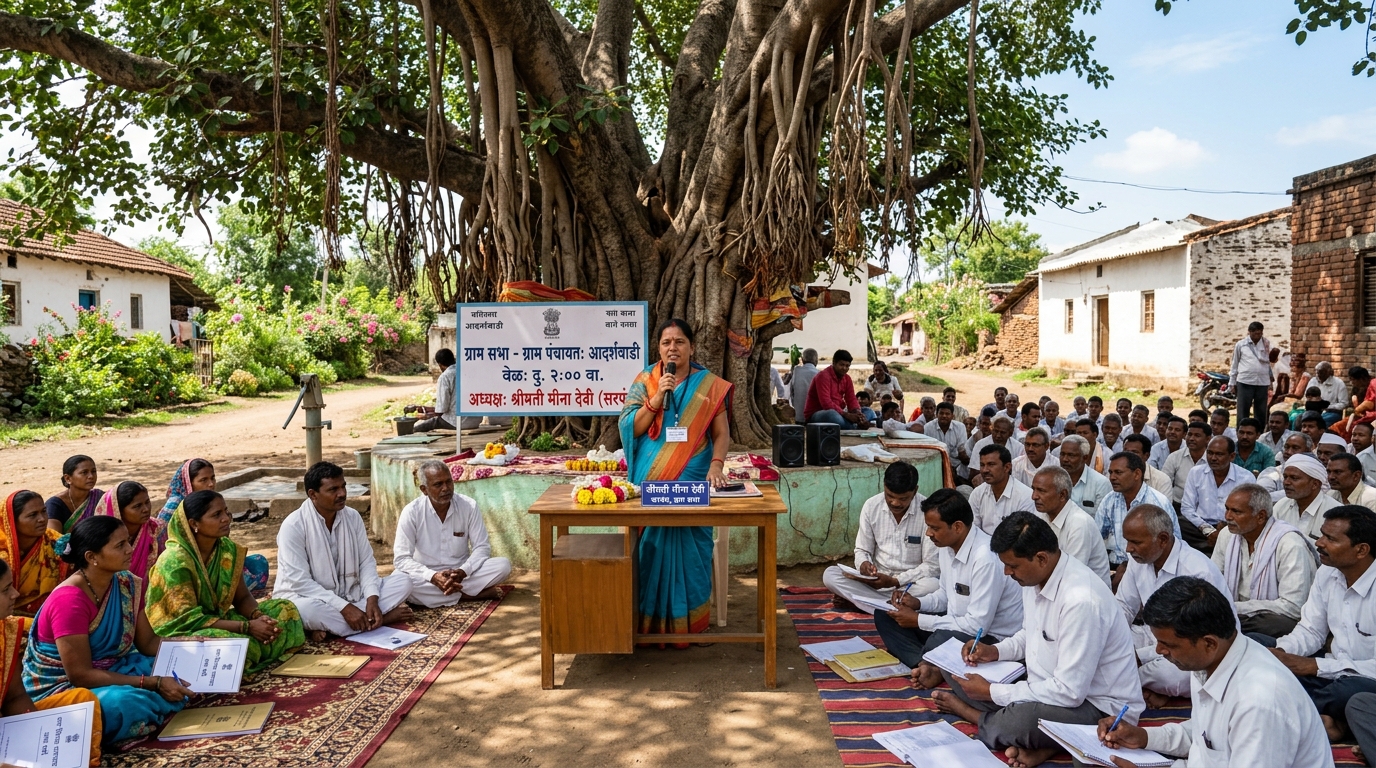
`A high-resolution, realistic digital photograph of a vibrant rural Gram Sabha meeting taking place under a large banyan tree in a clean Indian village, showing an elected female Sarpanch addressing villagers holding notebooks and documents. Warm sunlight, clear blue skies, professional photography, 8k resolution, photorealistic quality.`
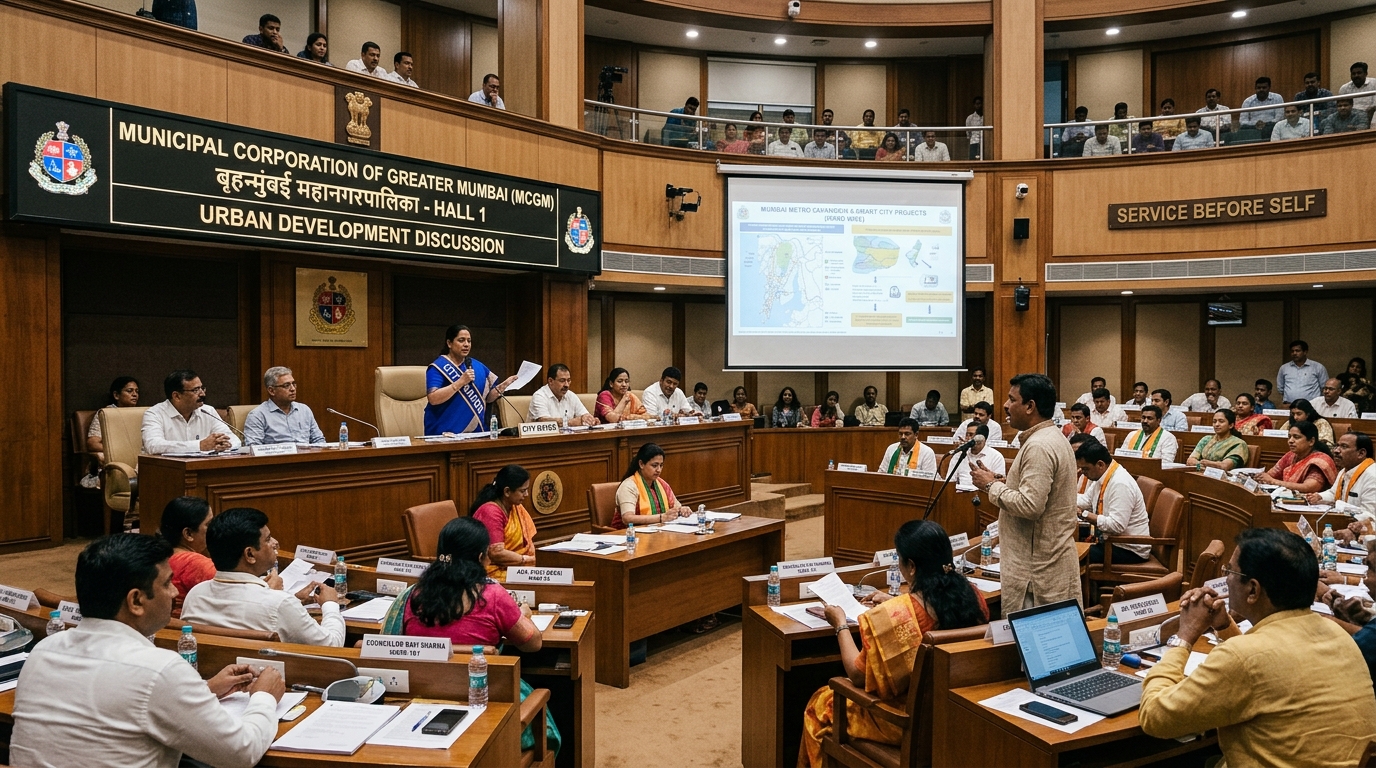
`A detailed realistic photo illustration of a modern Municipal Corporation hall in a major Indian city, with elected ward councillors and the City Mayor discussing urban development plans. Warm interior lighting, high detail, photorealistic quality.`
Prepare with RRBCONTENTS
Free mock tests, previous year papers, and daily current affairs for UPSC, SSC & Railway exams.
Start Free Mock Tests →Continue Reading
Explore More Articles
Knowledge Hub
More Blog Articles
In-depth articles on Polity, Economy, Environment and Current Affairs.
Study Material
Exam Study Notes
Subject-wise notes and digests for Railway, SSC, Banking and State PSC exams.
Current Affairs
Daily Current Affairs & GK
Daily updates and static GK bank with active-recall quizzes.