PARLIAMENTARY COMMITTEES OF INDIA: TYPES, FUNCTIONS, FINANCIAL COMMITTEES & IMPORTANCE (COMPLETE GUIDANCE FOR COMPETITIVE EXAMS)
Chapter 1
INTRODUCTION
Parliament is the supreme legislative and representative body of the Indian Republic. However, due to its massive size, constrained session timelines, and the immense complexity of modern governance, Parliament as a whole cannot thoroughly examine every bill, audit every rupee of public expenditure, or scrutinize every administrative policy on the floor of the House.
To overcome these operational limitations, Parliament works through a robust, specialized, and non-partisan system of Parliamentary Committees. Referred to as the "mini-parliament" or the "workhorses of Parliament," these committees conduct detailed, in-depth, and expert scrutiny of legislative proposals, government finances, executive policies, and public grievances in a calm, non-confrontational setting beyond the glare of television cameras.
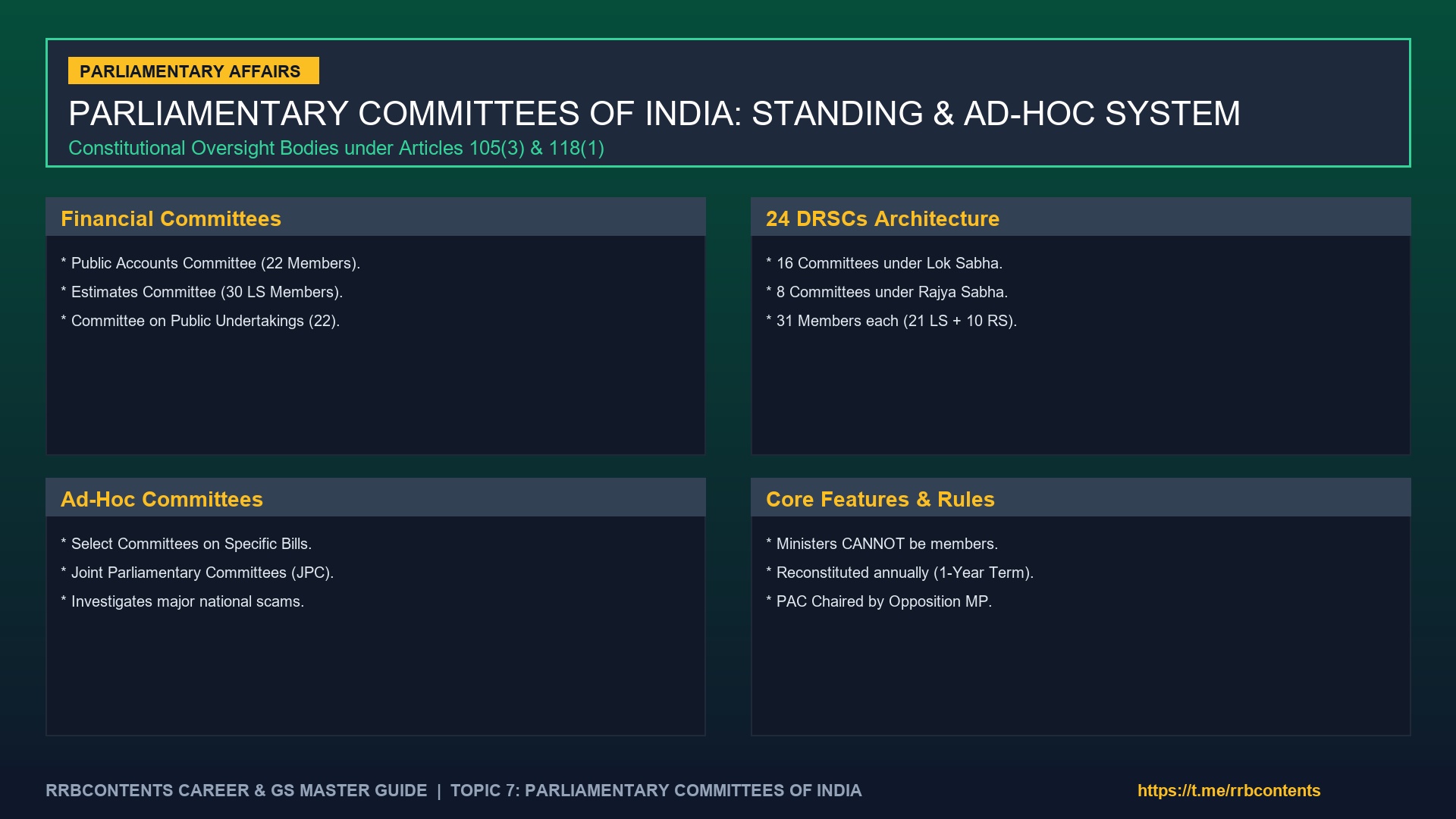
Rooted in the British Westminster system and formally sanctioned under Articles 105(3) and 118(1) of the Indian Constitution, as well as the Rules of Procedure and Conduct of Business in Lok Sabha and Rajya Sabha, the committee system enforces executive accountability to the legislature.
For aspirants preparing for competitive examinations such as UPSC Civil Services (GS Paper II), State Public Service Commissions (BPSC, UPPSC, MPPSC, RAS), SSC CGL, and Judicial Services, mastering the classification, membership composition, financial powers, DRSC structure, and limitations of Indian Parliamentary Committees is essential.
This comprehensive master career guide provides an exhaustive breakdown of Parliamentary Committees. We cover every legal detail—from Financial Committees (PAC, Estimates, COPU) and 24 DRSCs to Select Committees, JPCs, membership rules, 12 exam-focused FAQs, and essential revision tools.
---
Chapter 2
HISTORICAL ORIGIN & CONSTITUTIONAL BASIS
HISTORICAL ORIGIN & CONSTITUTIONAL BASIS - Illustrative Reference
Government of India Act 1919 (Montagu-Chelmsford Reforms)
└── First Standing Finance Committee & Public Accounts Committee (PAC) Created in 1921
       │
       ▼ (26th January 1950 - Enactment of Indian Constitution)
Articles 105(3) & 118(1) Empower Parliament to Create Committees & Rules
       │
       ▼ (1950 & 1964 Developments)
Estimates Committee (1950) & Committee on Public Undertakings (COPU 1964) Established
       │
       ▼ (1993 Watershed Reform)
Creation of 17 Departmentally Related Standing Committees (Expanded to 24 DRSCs in 2004)
- Article 118(1): Each House of Parliament may make rules for regulating its procedure and the conduct of its business.
- Article 105(3): Powers, privileges, and immunities of each House of Parliament and of the members and committees of each House shall be such as may from time to time be defined by Parliament by law.
Chapter 3
1. Is appointed or elected by the House or nominated by the Speaker / Chairman.
Chapter 4
2. Works under the direction of the Speaker of Lok Sabha / Chairman of Rajya Sabha.
Chapter 5
3. Presents its report to the House or to the Speaker / Chairman.
Chapter 6
4. Has a Secretariat provided by the Lok Sabha / Rajya Sabha Secretariat.
---
Chapter 7
BROAD CLASSIFICATION OF PARLIAMENTARY COMMITTEES
Parliamentary Committees of India
├── 1. Standing Committees (Permanent, reconstituted annually)
│      ├── Financial Committees (PAC, Estimates Committee, COPU)
│      ├── Departmentally Related Standing Committees (24 DRSCs)
│      ├── Committees to Inquire (Petitions, Privileges, Ethics)
│      ├── Committees to Scrutinize & Control (Subordinate Legislation, Government Assurances)
│      ├── Committees Relating to Day-to-Day Business (Business Advisory, Rules)
│      └── House Keeping Committees (House, Library, General Purposes)
└── 2. Ad-Hoc Committees (Temporary, created for specific task & dissolved after report)
       ├── Inquiry Committees (e.g. Joint Parliamentary Committee / JPC)
       └── Advisory Committees (Select or Joint Committees on specific Bills)
---
Chapter 8
THE THREE FINANCIAL COMMITTEES (MOST IMPORTANT FOR EXAMS)
Financial Committees Architecture
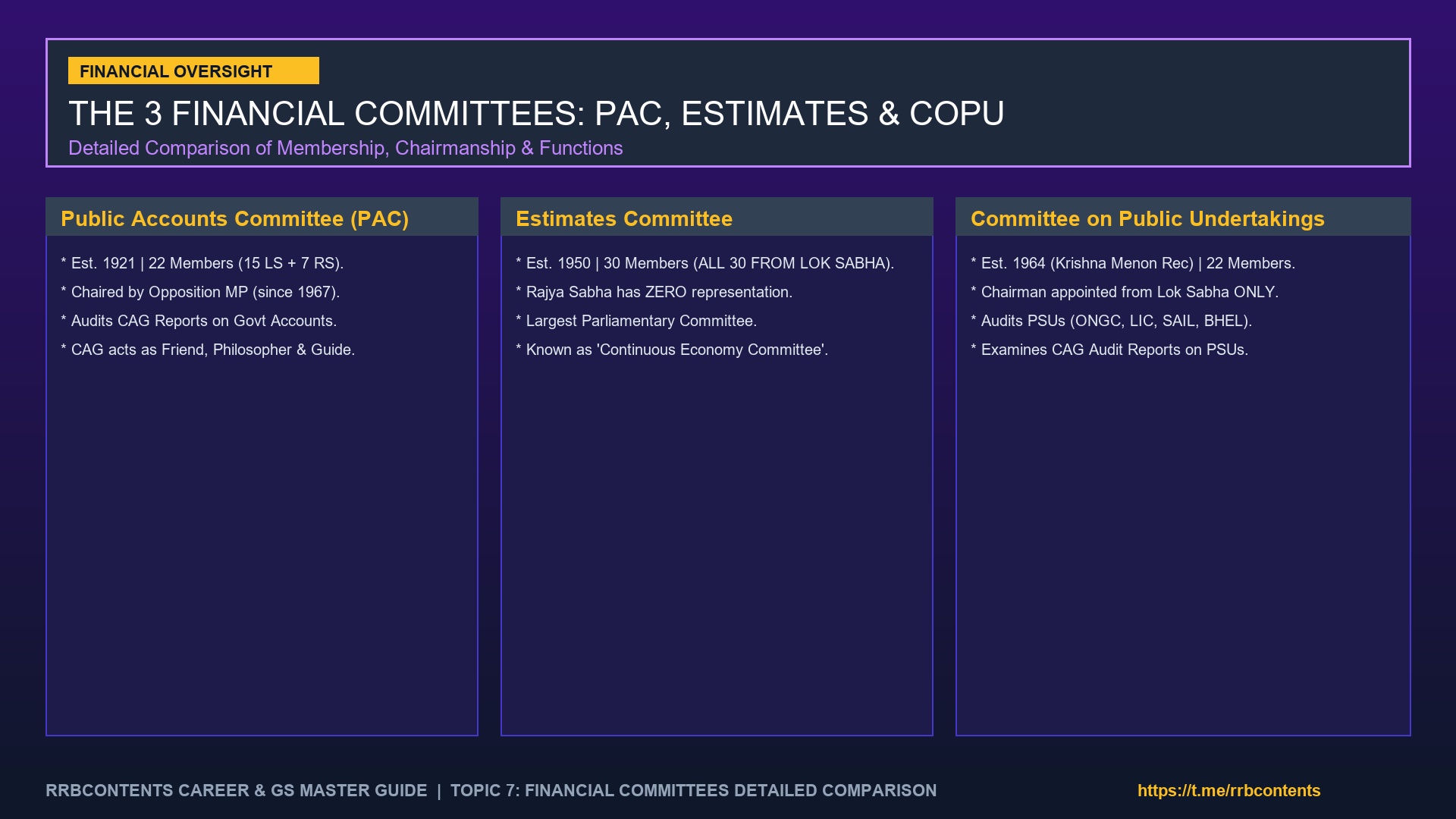
├── 1. Public Accounts Committee (PAC): 22 Members (15 LS + 7 RS) | Chaired by Opposition MP
├── 2. Estimates Committee: 30 Members (ALL 30 FROM LOK SABHA ONLY) | Largest Committee
└── 3. Committee on Public Undertakings (COPU): 22 Members (15 LS + 7 RS) | Audits PSUs
---
- Composition: 22 Members (15 from Lok Sabha and 7 from Rajya Sabha).
- Election Method: Members are elected annually by Parliament from amongst its members according to the principle of Proportional Representation by Single Transferable Vote (PR-STV).
- Term: 1 Year.
- Chairman Appointment & Opposition Convention: The Chairman of PAC is appointed by the Speaker of Lok Sabha from amongst its members. Since 1967, an unbroken parliamentary convention mandates that the Chairman of PAC is selected from the OPPOSITION party in Lok Sabha.
- Ministers Excluded: A Minister CANNOT be elected as a member of PAC. If a member is appointed a Minister, he/she ceases to be a member.
1. Scrutiny of CAG Reports: Examines the Audit Reports submitted by the Comptroller and Auditor General of India (CAG) relating to Appropriation Accounts and Finance Accounts of the Union Government.
2. Checking Financial Irregularities: Examines whether money granted by Parliament was spent legally, for the specified purpose, and without financial waste or corruption.
3. Friend, Philosopher & Guide: The CAG acts as the "Friend, Philosopher, and Guide" to the PAC during its meetings.
---
Chapter 9
# 2. ESTIMATES COMMITTEE
- Composition: 30 Members (ALL 30 MEMBERS ARE ELECTED FROM LOK SABHA ONLY).
- Crucial Exam Fact: Rajya Sabha has NO representation whatsoever in the Estimates Committee! It is the largest Parliamentary Committee.
- Election Method: Elected annually from Lok Sabha via Proportional Representation by Single Transferable Vote.
- Term: 1 Year.
- Chairman: Appointed by the Speaker from amongst Lok Sabha members. The Chairman invariably belongs to the ruling party.
- Ministers Excluded: Ministers cannot be members.
1. Continuous Economy Committee: Referred to as the "Continuous Economy Committee" because it suggests alternative policies and economies in public expenditure.
2. Scrutiny of Budget Estimates: Examines budget estimates to suggest form in which estimates shall be presented to Parliament and checks if money is well laid out within limits of policy.
---
- Composition: 22 Members (15 from Lok Sabha and 7 from Rajya Sabha).
- Election Method: Elected annually via PR-STV.
- Term: 1 Year.
- Chairman: Appointed by the Speaker from amongst Lok Sabha members ONLY. (Rajya Sabha members cannot be appointed Chairman of COPU).
- Ministers Excluded: Ministers cannot be members.
Chapter 10
1. Examines reports and accounts of Public Sector Undertakings (PSUs) like ONGC, LIC, SAIL, BHEL, NTPC, etc.
Chapter 11
2. Examines CAG audit reports on public undertakings.
Chapter 12
3. Checks whether PSUs are managed in accordance with sound business principles and prudent commercial practices.
---
Chapter 13
COMPARATIVE ANALYSIS OF FINANCIAL COMMITTEES
| Feature / Aspect | Public Accounts Committee (PAC) | Estimates Committee | Committee on Public Undertakings (COPU) |
|---|---|---|---|
| Year Established | 1921 (GOI Act 1919) | 1950 (John Mathai Rec) | 1964 (Krishna Menon Rec) |
| Total Membership | 22 Members | 30 Members (Largest) | 22 Members |
| Lok Sabha Members | 15 Members | 30 Members (All LS) | 15 Members |
| Rajya Sabha Members | 7 Members | NIL (0 Members) | 7 Members |
| Chairman Selection | Opposition MP (Convention since 1967) | Ruling Party MP | Lok Sabha MP Only |
| Primary Function | Audits past expenditure via CAG reports | Suggests expenditure economies | Audits PSU accounts & CAG reports |
| Minister Eligible? | NO (Ministers excluded) | NO (Ministers excluded) | NO (Ministers excluded) |
---
Chapter 14
DEPARTMENTALLY RELATED STANDING COMMITTEES (DRSCs)
Evolution & Structure of DRSCs
├── 1993: 17 DRSCs established
├── 2004: Expanded to 24 DRSCs (16 under Lok Sabha + 8 under Rajya Sabha)
└── Composition of Each DRSC: 31 Members (21 Lok Sabha + 10 Rajya Sabha)
1. Total Number: There are 24 DRSCs covering all Ministries and Departments of the Government of India (16 function under Lok Sabha Speaker; 8 function under Rajya Sabha Chairman).
2. Membership Composition: Each DRSC consists of 31 Members (21 from Lok Sabha nominated by Speaker; 10 from Rajya Sabha nominated by Chairman).
3. Term: 1 Year.
4. Ministers Excluded: A Minister is NOT eligible to be nominated as a member of any DRSC.
1. Demands for Grants Scrutiny: After the general discussion on Union Budget is over, Parliament is adjourned for 3-4 weeks. During this recess, the 24 DRSCs examine the Demands for Grants of concerned ministries and submit detailed reports to Parliament.
2. Legislative Bill Scrutiny: Examines bills referred to them by Speaker/Chairman and submits reports.
3. Annual Policy Reports: Considers annual reports of ministries and long-term national policy documents.
---
Chapter 15
OTHER STANDING COMMITTEES ANALYZED
1. Committee on Privileges:
- Scope: Examines cases of breach of parliamentary privileges and contempt of the House by MPs or outside citizens (e.g., publishing false reports of proceedings, obstructing MPs in performance of duties).
- Semi-Judicial Powers: Can summon witnesses, order production of documents, and recommend punishment (reprimand, admonition, or imprisonment) to the House.
2. Ethics Committee:
- Scope: Enforces the Code of Conduct for Members of Parliament, examining complaints of moral misconduct, corruption, or 'cash-for-query' allegations against sitting MPs.
- Landmark Enforcements: Examined the 2005 Cash-for-Query scandal leading to expulsion of 11 MPs, and the 2023 Ethics Committee inquiry recommending expulsion of a sitting MP for sharing digital login credentials with unauthorized commercial entities.
- Committee on Petitions: Examines petitions on bills and public importance. (15 LS members / 10 RS members).
- Committee on Privileges: Examines cases of breach of parliamentary privileges by MPs or outsiders. Semi-judicial in nature. (15 LS members / 10 RS members).
- Ethics Committee: Enforces Code of Conduct for MPs, examining complaints of misconduct. (15 LS members / 10 RS members).
In modern welfare states, Parliament passes framework statutes (parent acts) delegating powers to executive ministries to frame detailed rules, regulations, bylaws, and notifications (Delegated / Subordinate Legislation):
- Composition: 15 Members in Lok Sabha and 15 Members in Rajya Sabha. A Minister CANNOT be a member.
- Core Scrutiny Mandate: Examines whether executive rules and statutory notifications framed under delegated powers:
Chapter 16
1. Conform strictly to the parent Act passed by Parliament.
Chapter 17
2. Contain any unconstitutional provisions or exceed delegated authority (ultra vires).
Chapter 18
3. Impose unauthorized taxes or fees without express Parliamentary sanction.
Chapter 19
4. Exclude judicial review improperly.
- Impact: Acts as a vital constitutional check against bureaucratic overreach and executive law-making without parliamentary consent.
- Committee on Subordinate Legislation: Examines whether executive rules, regulations, and bylaws framed under statutory acts conform to original Parliamentary intent. (15 LS members / 10 RS members).
- Committee on Government Assurances: Tracks assurances, promises, and undertakings given by Ministers on the floor of the House. (15 LS members / 10 RS members).
- Committee on Welfare of SCs & STs: 30 Members (20 LS + 10 RS). Reviews SC/ST welfare schemes.
- Committee on Empowerment of Women: 30 Members (20 LS + 10 RS). Reviews women welfare programs.
- Composition: 15 Members (10 from Lok Sabha and 5 from Rajya Sabha).
- Core Function: Examines the composition and character of committees, boards, and statutory bodies set up by Central and State Governments to recommend whether holding an office in those bodies incurs disqualification for MPs.
- Composition: 15 Members elected from Lok Sabha ONLY.
- Core Function: Examines applications from Lok Sabha MPs for leave of absence from sittings of the House under Article 101(4). (Article 101(4) mandates that if an MP is absent for 60 days without permission, the seat may be declared vacant).
- Business Advisory Committee (BAC): Allocates time for discussion of legislative business. Chaired by Speaker in Lok Sabha (15 members) and Chairman in Rajya Sabha (11 members).
- Rules Committee: Recommends changes to House rules. Chaired ex-officio by Speaker in LS (15 members) and Chairman in RS (16 members).
---
- Consultative Committees: Attached to specific Ministries/Departments, chaired by the Cabinet Minister of that Ministry.
- Informal Discussion Forums: Created by the Ministry of Parliamentary Affairs to provide an informal forum for consultation between Ministers and MPs on policies.
- Not Parliamentary Committees: Consultative Committees do NOT possess formal parliamentary committee status because they are not appointed by the Speaker/Chairman, nor do they table reports in Parliament.
Chapter 20
AD-HOC COMMITTEES: SELECT COMMITTEES & JOINT PARLIAMENTARY COMMITTEES (JPC)
Ad-Hoc Committees
├── 1. Select / Joint Committees on Bills (Appointed to examine a specific legislative bill)
└── 2. Joint Parliamentary Committee (JPC) (Appointed to investigate major financial scams or scandals)
A Joint Parliamentary Committee (JPC) is an ad-hoc committee set up by Parliament for a specific purpose to investigate major financial scams, corruption, or policy failures.
- Composition: Members are drawn from both Houses of Parliament in a 2:1 ratio (twice as many Lok Sabha MPs as Rajya Sabha MPs).
- Powers: Has vast powers to summon witnesses, demand confidential government files, take oral evidence, and inspect records.
- Famous JPCs in Indian History:
Chapter 21
1. JPC on Bofors Contract Scam (1987 - Chaired by B. Shankaranand).
Chapter 22
2. JPC on Harshad Mehta Stock Market Scam (1992 - Chaired by Ram Niwas Mirdha).
Chapter 23
3. JPC on Ketan Parekh Stock Market Scam (2001 - Chaired by SPM Syed Khan).
Chapter 24
4. JPC on Soft Drink Pesticide Safety (2003 - Chaired by Sharad Pawar).
---
1. Submission of Action Taken Statements: Once a Parliamentary Committee submits its report to Parliament, concerned government ministries are mandated to submit Action Taken Statements within 6 months (or 3 months for PAC).
2. Scrutiny of Executive Compliance: The committee examines whether the ministry accepted the recommendations, implemented changes, or offered valid justifications for non-acceptance.
3. Action Taken Report (ATR): The committee drafts a secondary report called the Action Taken Report (ATR) and lays it before Parliament, highlighting unimplemented recommendations. This mechanism forces civil servants to take committee observations seriously.
Chapter 25
LIMITATIONS OF PARLIAMENTARY COMMITTEES
1. Advisory Nature of Reports: Committee recommendations are advisory in nature and NOT binding on the Government or Parliament.
2. Post-Mortem Analysis (PAC): The Public Accounts Committee conducts post-mortem examinations of expenditure after money has already been spent.
3. No Power of Executive Interdiction: Committees cannot interfere in day-to-day executive administration or issue direct orders to civil servants.
4. Short 1-Year Tenure: Annual reconstitution of DRSCs and financial committees affects continuity and domain expertise among members.
---
- Library Committee: 9 Members (6 from Lok Sabha nominated by Speaker + 3 from Rajya Sabha nominated by Chairman). Considers matters relating to Parliament Library services and research archives.
- Joint Committee on Salaries and Allowances of Members: 15 Members (10 from Lok Sabha + 5 from Rajya Sabha). Framed rules under the Salary, Allowances and Pension of Members of Parliament Act, 1954.
Chapter 26
IMPORTANCE FOR COMPETITIVE EXAMS & QUICK REVISION
1. PAC Secrets: 22 Members (15 LS + 7 RS). Established 1921. Chairman from Opposition since 1967. Audits CAG reports. Ministers excluded.
2. Estimates Committee Secrets: 30 Members (ALL 30 FROM LOK SABHA ONLY). Largest committee. Established 1950 (John Mathai). "Continuous Economy Committee".
3. COPU Secrets: 22 Members (15 LS + 7 RS). Established 1964 (Krishna Menon). Chairman from Lok Sabha ONLY. Audits PSUs.
4. DRSCs Secrets: 24 DRSCs (16 LS + 8 RS). 31 Members each (21 LS + 10 RS). Scrutinize Demands for Grants during budget recess.
---
Chapter 27
FREQUENTLY ASKED QUESTIONS (FAQS)
Answer: The Estimates Committee is the largest Parliamentary Committee, consisting of 30 members.
Answer: No. All 30 members of the Estimates Committee are elected exclusively from the Lok Sabha. Rajya Sabha has zero representation.
Chapter 28
# Q3: Who appoints the Chairman of the Public Accounts Committee (PAC)?
Answer: The Chairman of PAC is appointed by the Speaker of Lok Sabha. By convention established in 1967, the Chairman is selected from the Opposition party.
Chapter 29
# Q4: Can a Union Minister become a member of the Public Accounts Committee or DRSC?
Answer: No. Ministers are strictly excluded from becoming members of Financial Committees (PAC, Estimates, COPU) and Departmentally Related Standing Committees (DRSCs).
Chapter 30
# Q5: How many Departmentally Related Standing Committees (DRSCs) currently exist in Parliament?
Answer: There are 24 DRSCs (16 function under Lok Sabha and 8 function under Rajya Sabha). Each DRSC consists of 31 members (21 LS + 10 RS).
Chapter 31
# Q6: Which committee is known as the "Twin Sister" of the Public Accounts Committee?
Answer: The Estimates Committee is known as the twin sister of the Public Accounts Committee.
Chapter 32
# Q7: Who acts as the "Friend, Philosopher, and Guide" to the Public Accounts Committee?
Answer: The Comptroller and Auditor General of India (CAG) acts as the friend, philosopher, and guide to the PAC during its audits.
Chapter 33
# Q8: What is the membership ratio between Lok Sabha and Rajya Sabha in a Joint Parliamentary Committee (JPC)?
Answer: A JPC maintains a 2:1 ratio (twice as many members from Lok Sabha as from Rajya Sabha).
Chapter 34
# Q9: On whose recommendation was the Committee on Public Undertakings (COPU) established?
Answer: Established in 1964 on the recommendation of the Krishna Menon Committee.
Chapter 35
# Q10: Which Parliamentary Committees are chaired ex-officio by the Speaker of Lok Sabha?
Answer: The Speaker of Lok Sabha chairs the Business Advisory Committee, Rules Committee, and General Purposes Committee.
Chapter 36
# Q11: What is the main role of DRSCs during the Union Budget process?
Answer: During the 3-4 week Parliament recess after budget presentation, DRSCs examine the Demands for Grants of respective ministries and submit detailed reports before voting.
Answer: No. Recommendations of Parliamentary Committees are advisory in nature. However, the Government must submit Action Taken Reports (ATRs) explaining implementation.
---
Chapter 37
# Q13: What is an Action Taken Report (ATR) in Parliamentary procedure?
Answer: An Action Taken Report (ATR) is a follow-up report presented by a Parliamentary Committee detailing whether executive ministries have implemented the recommendations made in its original report.
Chapter 38
# Q14: What is the main function of the Committee on Subordinate Legislation?
Answer: The committee examines executive rules, regulations, and bylaws framed under delegated legislation to ensure they conform strictly to the parent Act passed by Parliament.
Chapter 39
# Q15: Which committee examines complaints of 'cash-for-query' or moral misconduct against MPs?
Answer: The Ethics Committee of the respective House examines complaints of unparliamentary conduct, moral corruption, or unethical practices against sitting MPs.
Chapter 40
# Q16: How are the 24 DRSCs divided between Lok Sabha and Rajya Sabha?
Answer: 16 DRSCs function under the Lok Sabha Speaker, and 8 DRSCs function under the Rajya Sabha Chairman.
Chapter 41
# Q17: What is the membership composition of the Joint Committee on Offices of Profit?
Answer: The committee consists of 15 members (10 from Lok Sabha and 5 from Rajya Sabha).
- Parliamentary Research and Training Institute for Democracies (PRIDE): Offers specialized briefing notes, statistical analysis, and comparative international legislative data to committee members prior to evidence hearings.
- Secretariat Verbatim Record Keepers: Verbatim reporters record every question asked to ministry secretaries and corporate witnesses during in-camera committee hearings, maintaining confidential verbatim transcripts.
- In-Camera Hearing Confidentiality: Committee proceedings are strictly confidential. No member or witness can leak committee evidence to the press prior to the official tabling of the report in Parliament.
Chapter 42
SUB-COMMITTEES AND AD-HOC STUDY GROUPS
Parliamentary Standing Committees frequently appoint specialized sub-committees or working study groups from among their members to conduct localized field investigations, examine specific technical provisions of bills, or scrutinize complex departmental audit paras before reporting back to the full committee.
---
Chapter 43
CONSULTATIVE COMMITTEES ATTACHED TO MINISTRIES
Unlike Parliamentary Standing Committees, Consultative Committees are informal bodies:
- Composition: Attached to various Central Ministries, consisting of members from both Houses of Parliament.
- Chaired by: The Cabinet Minister or Minister of State in charge of the respective Ministry.
- Function: Provide a forum for informal discussions between Ministers and MPs on policies, programs, and administrative working of the Ministry.
- Status: Not statutory committees of Parliament; constituted by the Ministry of Parliamentary Affairs after each general election.
---
Chapter 44
# Business Advisory Committee (BAC):
- Regulates the program and timetable of the House.
- Allocates time for transaction of legislative and other business brought before the House by Government.
- Lok Sabha committee has 15 members (chaired by Speaker); Rajya Sabha committee has 11 members (chaired by Chairman).
---
Chapter 45
# Committee on Subordinate Legislation — Key Functions:
- Examines whether powers to make rules, regulations, bylaws, and schemes delegated by Parliament are being properly exercised by the Executive.
- Ensures delegated legislation does not exceed the scope of the parent Act passed by Parliament.
- Consists of 15 members in Lok Sabha and 15 members in Rajya Sabha; a Minister CANNOT be nominated to this committee.
---
Chapter 46
# Committee on Government Assurances:
- Constituted in 1953 in Lok Sabha (15 members) and Rajya Sabha (10 members).
- Scrutinizes assurances, promises, undertakings, and commitments given by Ministers from time to time on the floor of the House.
- Reports on the extent to which such assurances have been implemented within the stipulated standard time frame of 3 months.
---
Chapter 47
# Standing Committee on Finance — Additional Oversight:
- Regularly audits non-performing assets (NPAs) of public sector banks, capital adequacy ratios under Basel III norms, and cryptocurrency regulation frameworks in consultation with RBI and SEBI officials.
---
Chapter 48
# Departmentally Related Standing Committee (DRSC) Subscriptions:
- Each DRSC consists of 31 members (21 nominated by Speaker from Lok Sabha, 10 nominated by Chairman from Rajya Sabha).
- A Minister is NOT eligible to be nominated as a member of any Standing Committee or Parliamentary Committee.
---
Chapter 49
CONCLUSION
The Parliamentary Committee system is the constitutional engine of executive accountability in Indian democracy. By enabling detailed scrutiny of legislation, auditing public expenditure through PAC, recommending budget economies through Estimates Committee, and conducting cross-party examination of national policies through 24 DRSCs, committees ensure that Parliamentary democracy remains informed, effective, and accountable.
👉 Official Career Portal: [https://rrbcontents.com](https://rrbcontents.com)
👉 Official Telegram Channel: [Join RRBCONTENTS Telegram (@rrbcontents)](https://t.me/rrbcontents)
---
Chapter 50
ADDITIONAL EXAM INSIGHTS & CASE STUDIES
---
| Feature | Public Accounts Committee (PAC) | Estimates Committee | Committee on Public Undertakings (COPU) |
|---|---|---|---|
| Purpose | Post-expenditure audit of government accounts | Pre-expenditure scrutiny of budget demands | Examine working of DPSUs and government companies |
| Basis | CAG Reports | Annual Demands for Grants | Annual Reports of Public Undertakings |
| Members | 22 (15 LS + 7 RS) | 30 (Lok Sabha only) | 22 (15 LS + 7 RS) |
| Chair | Traditionally from Opposition | Ruling party member | Ruling party member |
| Period Covered | Scrutinizes past (post-facto) spending | Scrutinizes future estimates | Scrutinizes ongoing enterprises |
| Origin | 1921 (oldest financial committee) | 1950 | 1964 |
| Joint or Single House | Joint Committee | Single House (LS only) | Joint Committee |
Mnemonic - PAC, EC, COPU: "Past Accounts Check; Estimates Come Before; Companies Observed Periodically Under COPU"
---
DRSCs are the backbone of India's parliamentary scrutiny architecture. Introduced in 1993 (initially 17; expanded to 24 in 2004), they provide subject-matter expertise across ministries.
- Total DRSCs: 24 (16 under Lok Sabha Speaker; 8 under Rajya Sabha Chairman)
- Composition: Each DRSC has 31 members - 21 from Lok Sabha + 10 from Rajya Sabha
- Tenure: 1 year (annually reconstituted each autumn session)
- Ministers CANNOT be members of DRSCs - ensures executive-independence of scrutiny
- Scope: Can examine Bills referred to them, Demand for Grants, and policies/working of ministries
- Budget Coverage: DRSCs examine approximately 60-70% of all Union Budget demands for grants
- Non-binding nature: Reports are recommendatory; ministries must submit Action Taken Reports (ATRs)
- Examples of DRSCs: DRSC on Finance; DRSC on Home Affairs; DRSC on External Affairs; DRSC on Defence; DRSC on Agriculture
Note: Unlike the three financial committees (PAC, EC, COPU) which are permanent, DRSCs are reconstituted annually and are not mentioned in the Constitution - they derive authority from Rules of Procedure.
---
Chapter 51
# C. Key Landmark Cases of Parliamentary Committee Effectiveness
1. 2G Spectrum Scam (2008): PAC examined CAG's report that estimated a notional loss of Rs 1.76 lakh crore to the exchequer due to arbitrary allocation of spectrum. The PAC report (2012) led to the Supreme Court cancelling 122 telecom licences in Centre for Public Interest Litigation vs Union of India (2012) - a watershed moment for parliamentary oversight triggering executive accountability.
2. Air India Restructuring: The Estimates Committee's sustained recommendations over multiple years for rationalising loss-making Air India - with cumulative losses exceeding Rs 70,000 crore by 2020 - directly contributed to the eventual strategic disinvestment of Air India to Tata Sons in January 2022. This is cited as one of the most impactful EC interventions in independent India.
3. JPC on Securities Scam (Harshad Mehta, 1992): The Joint Parliamentary Committee constituted in 1992 examined the Rs 5,000 crore bank receipt fraud. Its recommendations directly strengthened SEBI's statutory powers, leading to SEBI Act 1992 and transformed India's capital market regulation framework.
4. JPC on Bofors Scandal (1987): India's first major JPC on defence procurement. Investigated alleged kickbacks in the Rs 1,437 crore howitzer gun deal between India and AB Bofors (Sweden). Although inconclusive legally, it set the template for parliamentary oversight of defence contracts.
5. DRSC on Home Affairs and Demonetization (2016): The DRSC on Home Affairs examined the operational impact of the November 2016 demonetization. Its deliberations brought out ground-level implementation failures, ATM recalibration delays, and rural cash crisis - feeding into the broader policy discourse.
---
Chapter 52
# D. Privileges and Procedural Limitations of Parliamentary Committees
- Privileged Proceedings: All committee sittings are covered under parliamentary privilege. Leaking committee proceedings before the report is presented to Parliament constitutes a breach of privilege - punishable by the respective House.
- Ministers vs Civil Servants: No minister can be compelled to appear before a committee. However, civil servants and bureaucrats CAN be summoned to give evidence - making committees an indirect check on the executive.
- Non-binding Reports: Committee reports are purely recommendatory - the government is not legally bound to implement them. However, non-compliance invites political scrutiny.
- Action Taken Report (ATR): Ministries must submit an ATR within 6 months of a committee report being presented to Parliament. This is a key accountability mechanism.
- Parliamentary Privilege Protection: All verbal and written submissions before committees are fully protected under parliamentary privilege - witnesses cannot be prosecuted for their depositions.
- No Sub-Judice Bar: Unlike in courts, committees CAN examine matters that are sub-judice, giving them broader investigative latitude.
---
Chapter 53
IMAGE GENERATION PROMPTS
`A high-resolution, realistic digital photograph of the Parliament House of India (Samvidhan Sadan / Sansad Bhavan) in New Delhi under clear blue skies, showing the grand circular colonnade and the national flag flying high. Professional architecture photography, 8k resolution, photorealistic quality.`
`A detailed realistic photo illustration of a formal Parliamentary Committee meeting room inside Sansad Bhavan, with Members of Parliament seated around a horseshoe wooden conference table reviewing audit reports and legal documents. Warm interior lighting, high detail, photorealistic.`
Prepare with RRBCONTENTS
Free mock tests, previous year papers, and daily current affairs for UPSC, SSC & Railway exams.
Start Free Mock Tests →Continue Reading
Explore More Articles
Knowledge Hub
More Blog Articles
In-depth articles on Polity, Economy, Environment and Current Affairs.
Study Material
Exam Study Notes
Subject-wise notes and digests for Railway, SSC, Banking and State PSC exams.
Current Affairs
Daily Current Affairs & GK
Daily updates and static GK bank with active-recall quizzes.