Home › Blog › Government Schemes › PM Fasal Bima Yojana
PM Fasal Bima Yojana: Full Analysis for Exam Aspirants
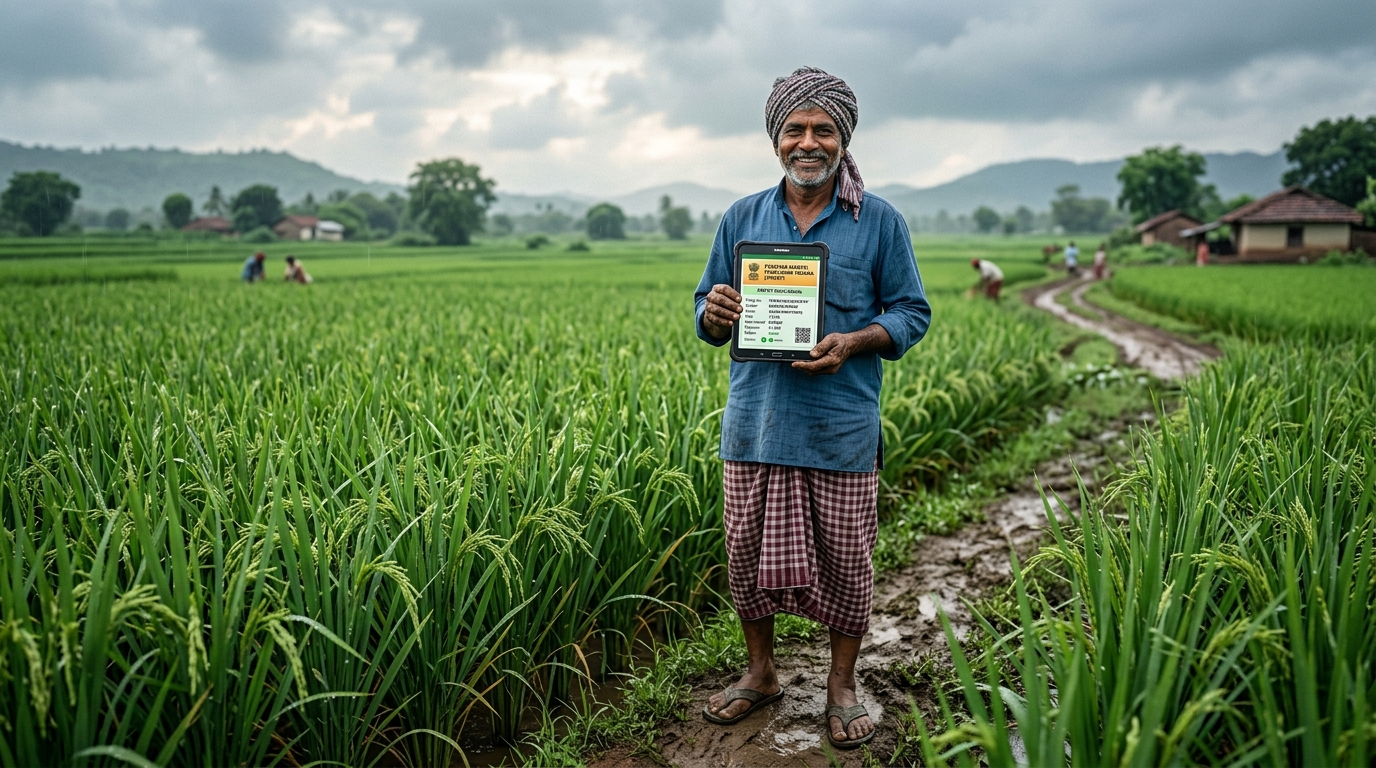
Aspirants, let’s start with something practical. When a farmer in Maharashtra loses his soybean crop to untimely rain or a cultivator in Odisha watches paddy drown after heavy flooding, the first question that comes up is whether any safety net exists. That safety net is the Pradhan Mantri Fasal Bima Yojana. For those of us who cleared exams by understanding schemes rather than just memorising names, this one is special. It sits at the heart of rural economy, disaster risk, and government delivery.
I have taught this scheme in classrooms for years. Students usually remember the premium rates and the launch year, then stop. That is incomplete. You need to know why the earlier crop insurance products failed, how the 2016 redesign tried to fix them, why some states still refuse to join, what the latest numbers from the Ministry of Agriculture actually show, and where the scheme is still falling short on the ground. According to official data shared by the Ministry and PIB in 2025, more than 78 crore farmer applications have been insured since 2016 and claims of around ₹1.83 lakh crore have been paid. Yet coverage remains patchy and trust is still a work in progress.
This is exactly the kind of topic that appears in RRB, SSC, Banking and UPSC papers — sometimes as a direct fact question, sometimes as a critical analysis in mains. So let’s go through it layer by layer, the way we do when a student asks “sir, is this scheme actually working?”
Table of Contents
- 1. Background & Historical Context
- 2. What Exactly Happened – Current Status of the Scheme
- 3. Why It Was Launched – Causes and Triggering Factors
- 4. Political Dimension
- 5. Economic Dimension
- 6. Social & Cultural Dimension
- 7. Legal & Constitutional Dimension
- 8. Environmental Dimension
- 9. Impact on India – Short-term and Long-term
- 10. Government Response & Official Stand
- 11. Criticism & Counter-arguments
- 12. Way Forward and Relevance for Competitive Exams
- 13. Comparison Table & Quick Revision Points
1. Background & Historical Context
Crop insurance did not begin in 2016. The first experimental scheme came in 1972. Then came the Comprehensive Crop Insurance Scheme in 1985, the National Agricultural Insurance Scheme in 1999, and the Modified NAIS a few years later. Every one of them ran into the same walls — high premium burden on farmers, slow claim settlement, limited risk cover, and almost no interest from non-loanee cultivators.
By the mid-2010s it was clear that the old model was not scaling. Drought years of 2014 and 2015 hit hard. Farmers were left with loans they could not repay and no meaningful compensation. The government decided to start afresh. Pradhan Mantri Fasal Bima Yojana was rolled out from the Kharif 2016 season under the Ministry of Agriculture and Farmers Welfare. The big shift was simple: keep the farmer’s share of premium extremely low and uniform across the country, and let insurance companies compete for the business through bidding.
That decision changed the numbers. Official Ministry data shows enrolment and claims both rose sharply compared with the pre-2016 period. Non-loanee farmers, who earlier stayed away, began joining in larger numbers. The scheme also brought in technology for yield estimation so that the old disputes over Crop Cutting Experiments could be reduced over time.
2. What Exactly Happened – Current Status of the Scheme
PMFBY is a yield-index based insurance product. States notify the crops and the areas. Food crops, oilseeds and annual commercial or horticultural crops are covered. The insurance runs from pre-sowing to post-harvest for a defined period. Risks include drought, flood, inundation, pests, diseases, landslides, natural fire, lightning, storm, hailstorm and cyclone.
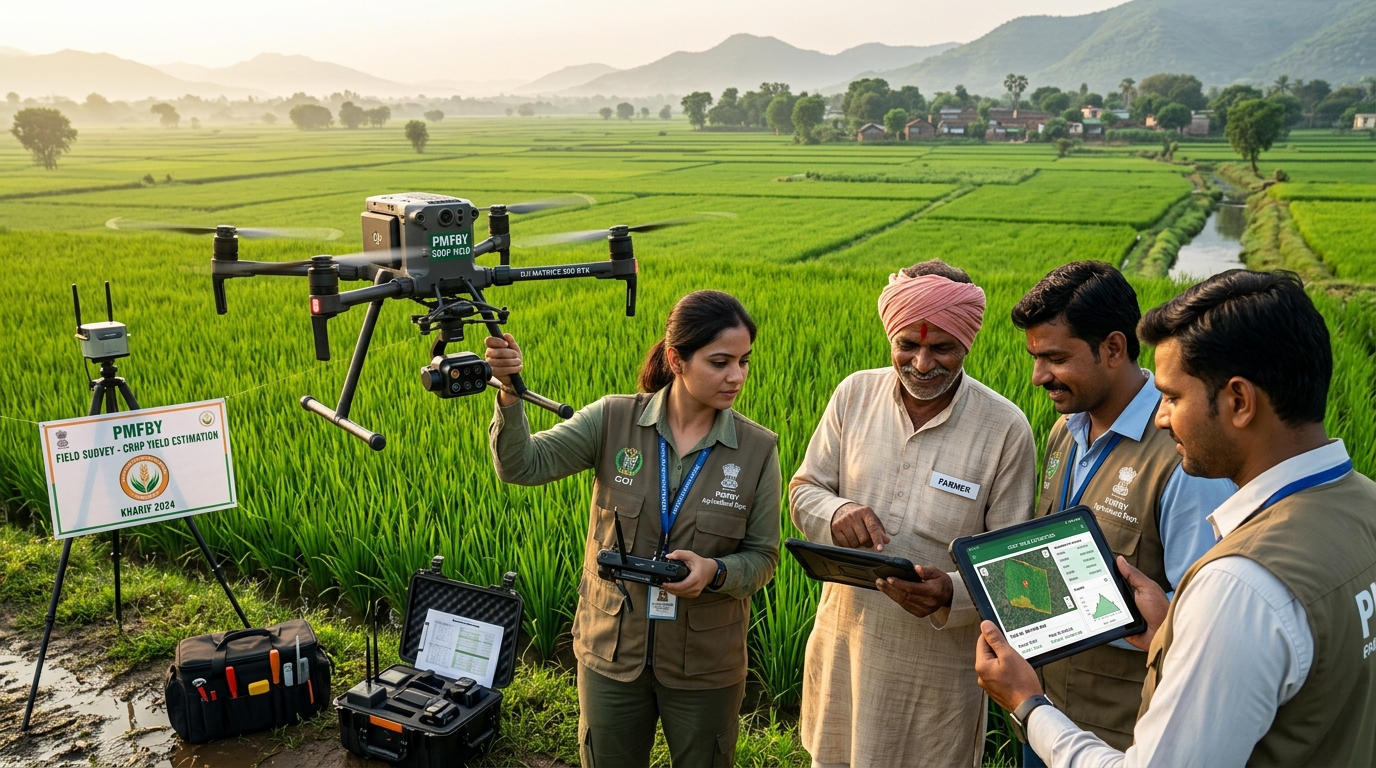
From Kharif 2026 the Ministry has formally included two additional localised risks — damage by wild animals and paddy inundation — after repeated requests from states. Farmers must report such losses within 72 hours through the official app with geo-tagged photographs.
Premium paid by the farmer remains fixed: 2 per cent of the sum insured for Kharif crops, 1.5 per cent for Rabi crops, and 5 per cent for commercial and horticultural crops. The rest is shared by the Centre and the concerned state. Enrolment is voluntary for both states and farmers. Banks still encourage loanee farmers to take the cover, but compulsion was removed in 2020.
As per Ministry figures shared in Parliament and PIB updates up to 2025, total farmer applications insured crossed 78 crore and claims paid reached approximately ₹1.83 lakh crore. In the 2024-25 season around 4.19 crore farmers were covered. For Kharif 2025 the scheme covered roughly 2 crore farmers and 25 million hectares across 24 states and Union Territories. Enrolment for Kharif 2026 is currently open in implementing states, with 31 July commonly fixed as the last date for non-loanee farmers.
3. Why It Was Launched – Causes and Triggering Factors
Indian farming is still weather-dependent. More than half the cultivated area depends on monsoon. Climate patterns have become more erratic — delayed rains, sudden heavy downpours, longer dry spells. One bad season can wipe out the entire income of a small or marginal farmer and push the family into debt.
Earlier insurance schemes charged higher premiums in riskier areas. Farmers simply did not buy them. Banks faced rising non-performing assets after successive crop failures. The government needed a product that could protect production, stabilise rural incomes and keep the credit cycle moving. The severe drought years just before 2016 provided the final push. The redesign focused on three things: low and uniform farmer premium, wider risk cover, and competitive bidding so that the subsidy burden stayed manageable.
4. Political Dimension
Any scheme that touches farmers is political by nature. The 2016 launch was presented as a major step towards protecting the Annadata. Later, when the scheme was made voluntary for states, a new political layer appeared. Several states either stayed out or limited their participation, citing fiscal burden or preference for their own schemes. Bihar, West Bengal, Punjab and Gujarat have remained outside or only partially involved at different points.
When claims are paid quickly after a disaster, the ruling party claims credit. When payments are delayed, opposition parties highlight the failure. The scheme therefore becomes both a governance instrument and a political talking point. Recent additions such as wild animal attack cover and stricter timelines for surveyors are partly responses to sustained political pressure from farmer groups and state governments.
5. Economic Dimension
For the individual farmer the arithmetic looks attractive — pay a small premium and get protection against major losses. For the government the subsidy outgo is significant. The Union Budget for 2026-27 has kept the allocation near ₹12,400 crore. Actual spending depends on the actuarial rates quoted by insurance companies and the area that finally gets covered.
Competitive bidding and the cup-and-cap model have brought premium rates down in recent tender cycles. Gross premium collection was noticeably lower in Kharif 2025 than in earlier years. Private insurers have often retained higher surplus than public sector companies, according to data placed in the Lok Sabha.
At the macro level the scheme is meant to reduce distress sales of land, limit migration, and protect rural demand. When claims reach bank accounts on time, farmers can repay loans and prepare for the next season. When claims lag, the opposite happens — informal credit expands and the formal banking system suffers.
6. Social & Cultural Dimension
Most participants under PMFBY are small and marginal farmers. Ministry data consistently shows that around 85-86 per cent of applications belong to this category. For these households crop insurance is not an abstract financial product; it is the difference between staying on the land and being forced to migrate.
Yet awareness remains uneven. Many farmers still treat the policy as a bank formality rather than a protective cover. Digital literacy, language barriers and complicated claim procedures create distance. Tenant cultivators and women farmers often struggle with documentation. In many villages the traditional response to crop failure is still borrowing from local lenders or selling assets. Building the habit of formal insurance is a slow social process.
7. Legal & Constitutional Dimension
Agriculture is a State List subject. That is why states can choose to implement or stay out of the central scheme. The Centre provides the operational guidelines, shares the premium subsidy and runs the national portal. Actual notification of crops, areas and the release of the state share of premium rest with the state governments.
The relationship between the state and the insurance company is contractual. Delays in the state share of subsidy have repeatedly frozen claim payments. Farmers have approached courts in several states over delayed or rejected claims. There is no fundamental right to crop insurance; the protection exists only as long as the policy and the contracts remain in force.
8. Environmental Dimension
Climate change is increasing the frequency and intensity of extreme weather events. Longer dry spells, heavier rainfall events and rising temperatures all raise the risk profile of agriculture. PMFBY is essentially a risk-transfer tool, not a climate-adaptation tool. It can compensate for losses after they occur, but it does not by itself encourage climate-resilient practices such as drought-tolerant varieties, better water management or crop diversification.
The recent inclusion of wild animal attack cover also has an environmental angle. As forests shrink and human-wildlife conflict rises in several states, crop damage by animals has become a regular complaint. The scheme is slowly expanding to cover this new reality, but the larger environmental challenge of making farming more resilient remains outside its core design.
9. Impact on India – Short-term and Long-term
In the short term the scheme has moved substantial money into farmers’ accounts after major weather events. Enrolment of non-loanee farmers has risen compared with the earlier regime. Technology pilots such as YES-TECH and the crop insurance app have reduced some of the old disputes over yield data.
Long-term results are more mixed. Coverage is still far from universal. Several high-risk districts continue to show low penetration. Some states prefer their own schemes, which fragments the national risk pool and makes actuarial pricing harder. Climate change is likely to push both the subsidy bill and the claims ratio higher in the coming years. The scheme has protected many households from immediate distress, but it has not yet transformed the underlying vulnerability of Indian agriculture.
10. Government Response & Official Stand
The Ministry of Agriculture and Farmers Welfare presents PMFBY as the world’s largest crop insurance scheme by number of farmer applications. Official statements highlight the sharp rise in coverage of small and marginal farmers, the reduction in actuarial premium rates through competitive bidding, and the continuous addition of technology tools.
Recent steps include the formal addition of wild animal attack and paddy inundation covers from Kharif 2026, stricterening of surveyor timelines, and interest penalties for delayed claim settlement. The government also points to the National Crop Insurance Portal and the DigiClaim system as evidence that transparency is improving. Budget documents show that the Centre has been able to cover more farmers with a relatively stable subsidy outgo because premium rates have come down.
11. Criticism & Counter-arguments
The most frequent complaint from the ground is delayed claim settlement. Even though the guidelines speak of payment within two months of harvest, many farmers report much longer waits. State governments sometimes delay their share of the premium subsidy, which stops the entire process.
Another criticism is that insurance companies prefer safer clusters and under-serve difficult areas. Data placed in Parliament has shown higher surplus retention by some private insurers, leading to the charge that the scheme benefits companies more than cultivators. The voluntary nature of the scheme after 2020 has also reduced coverage in certain states. Assessment of yield through Crop Cutting Experiments is still seen as opaque and open to local influence in many places.
The official response is that no previous scheme reached this scale, farmer premium remains among the lowest in the world, and technology is steadily reducing disputes. Both sides can point to numbers that support their view. The truth, as usual, lies somewhere in the middle.
12. Way Forward and Relevance for Competitive Exams
Three practical improvements would make a real difference. First, make claim settlement timelines enforceable with automatic interest and public district-wise dashboards of pending cases. Second, expand technology so that individual farm-level assessment becomes possible in more areas and dependence on village averages reduces. Third, design flexible models that can bring currently non-participating states back into the fold without forcing a one-size-fits-all approach.
Awareness campaigns in local languages, simpler claim processes for tenant farmers, and better integration with climate-resilient agriculture practices would also help. Insurance alone cannot solve the deeper problems of Indian farming, but a better-designed safety net can reduce the human cost of weather shocks.
Relevance for Competitive Examinations:
For competitive exams this scheme is high-value. In RRB and SSC papers you will see direct questions on launch year, premium rates, implementing ministry and recent additions such as wild animal cover. Banking exams link it to rural credit, NPAs and financial inclusion. UPSC Prelims tests factual clarity; Mains expects critical analysis of performance, technology use, state participation and the link with climate change and farmer income goals. Keep the latest PIB figures ready and be prepared to discuss both achievements and gaps.
13. Comparison Table & Quick Revision Points

| Parameter | Earlier Schemes (pre-2016) | PMFBY (current) | Persistent Challenge |
|---|---|---|---|
| Farmer Premium | High and variable | Fixed 2% / 1.5% / 5% | Still seen as costly by some |
| Risk Coverage | Limited | Pre-sowing to post-harvest | Localised risks expanding |
| Non-loanee Participation | Very low | Significantly higher | Awareness gaps remain |
| Claim Speed | Often years | Target two months | Frequent delays continue |
| Technology | Almost none | YES-TECH, apps, satellites | Not uniform across states |
| State Participation | Mostly uniform | Voluntary | Several major states out |
Quick Revision / Must Remember Points
- Launch season: Kharif 2016
- Farmer share of premium: 2% Kharif, 1.5% Rabi, 5% commercial/horticulture
- Ministry: Agriculture and Farmers Welfare
- Total applications insured (till 2024-25): Over 78 crore
- Claims paid: Approximately ₹1.83 lakh crore
- New covers from Kharif 2026: Wild animal attack and paddy inundation
- Loss reporting window for localised risks: 72 hours
- Nature: Voluntary for states and farmers since 2020
- Key technology tools: YES-TECH, CROPIC, National Crop Insurance Portal
- Budget allocation 2026-27: Around ₹12,400 crore
Conclusion
PM Fasal Bima Yojana has taken crop insurance to a scale that earlier schemes never managed. Low and uniform farmer premium, wider risk cover and technology tools are real improvements. At the same time, delayed claims, uneven state participation and lingering trust deficit show that the design is still not perfect on the ground.
For aspirants the takeaway is clear. Do not treat this as just another scheme to be mugged up. Understand the problem it was trying to solve, the numbers it has achieved, and the gaps that remain. That balanced understanding is what examiners look for in both objective and descriptive papers. Agriculture continues to support the largest share of India’s workforce. Any serious attempt to protect that workforce will keep appearing in your question papers for years to come.
Study the scheme with the same seriousness you give to the economy or polity chapters. The details matter, but the larger picture of rural risk and resilience matters even more.
Master Government Schemes & Economy on RRBCONTENTS
Explore complete exam notes, PIB data breakdowns, and daily current affairs updates.
Daily Current Affairs → Government Schemes Notes →Join our official Telegram channel: @rrbcontents