 RRB
RRB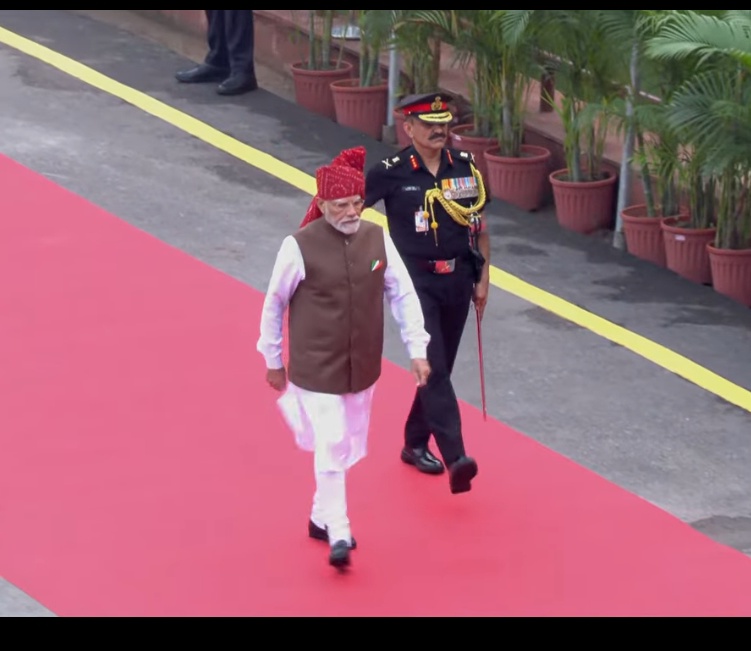
Prime Minister Narendra Modi spoke from the Red Fort for the 13th year in a row on 15 August 2026. The address lasted roughly 75 minutes. India was marking 80 years of independence. For the first time, Vande Mataram was sung from the ramparts during the official ceremony.
Modi opened by noting the moment. He said every heart was beating with the rhythm of the national song and that the tricolour was present in every home. He paid tribute to the freedom fighters and said their sacrifices still set the direction for the country.
The 2047 target
The main thread running through the speech was the goal of a developed India by 2047. Modi called it the shared ambition of more than 140 crore people. He argued that the progress of the past 12 years had made the target realistic.
He listed some numbers. Digital transactions had grown a hundred times. Internet users had increased fourfold. Piped gas, once available in about 70 cities, now reached more than 700 cities and over 1.45 crore homes. The entire railway network had been electrified in a decade. Defence production had risen four times, electronics manufacturing seven times, and mobile phone production 33 times.
These figures, he said, showed the country was no longer moving at the old pace.
Seven streams of strength
Modi introduced what he called Saptadhara — seven streams of strength. He said the next five to seven years must achieve what the previous five to seven decades could not.
The seven areas were manufacturing, agriculture and food processing, technology and innovation, Gati Shakti connectivity, defence, the green and blue economy, and soft power. Soft power, in his description, covered yoga, healthcare, tourism, films, animation and the creative industries.
He presented these as the practical levers that would decide whether India reached the 2047 goal on time.
Focus on the young
Youth received the most concrete announcements. Modi said one crore young people would receive training in artificial intelligence skills over the next year. The aim, he said, was to make sure Indian youth were not left behind as AI reshaped jobs and industries.
He also announced free online coaching for competitive examinations. An innovation fund of Rs 1 lakh crore was already in place to support startups and new ideas. More than 2.5 lakh startups had been registered under the Startup India programme, he noted.
Olympiad medal winners and My Bharat volunteers were present at the Red Fort. Modi pointed to them as examples of the talent the country needed to use better.
Women’s representation
On women’s political role, Modi made a direct appeal. He said the target of three crore Lakhpati Didis had already been crossed and the new target was six crore. Large numbers of women were already serving in panchayats and municipal bodies.
Standing under the flag, he asked all political parties to set aside differences and ensure 33 per cent reservation for women in state assemblies and the Lok Sabha without further delay. He said the constitutional amendment had been passed, but actual implementation had remained stuck in politics for decades.
Self-reliance and security
Self-reliance appeared several times. Modi said India must reduce dependence on others in critical areas, including semiconductors. Three major plants had already begun production, he said, and more were expected.
On internal security he claimed that armed Naxal groups had largely been neutralised, but warned that “intellectual Naxals” still needed to be watched. He also noted that modern threats were no longer limited to borders. Banking systems, infrastructure and energy assets were now part of the contest.
Sports and the 2036 Olympics
Looking ahead to the 2036 Olympics, Modi said India wanted to compete in many more disciplines than it does today. A talent hunt aimed at children aged five to 15 would be launched so that a stronger pipeline of athletes could be built over the next ten years.
Conclusion
Modi ended by returning to the idea of shared effort. Farmers, workers, entrepreneurs, teachers and young people all had a role, he said. The country had to keep discarding the old mindset of dependence.
The speech mixed celebration of past gains with a list of unfinished tasks. The first official singing of Vande Mataram at the Red Fort on Independence Day gave the occasion a different texture from previous years. The policy announcements, especially the AI training target and the free coaching promise, were the parts most likely to be remembered in the weeks ahead.