Home › Jobs & Education › Education Loans › PM Vidyalaxmi Complete Guide
PM Vidyalaxmi Scheme 2026: Features, Eligibility & Benefits
Many students clear their entrance exams or get admission in good colleges but then face the same old problem — how to arrange money for fees. Parents start looking for loans, banks ask for collateral or third-party guarantors, and the process becomes so complicated that some meritorious students simply drop out or take admission in average lower-ranked institutions.
I have seen this happen with several students in my own coaching batches. That is exactly why the government launched the PM Vidyalaxmi Scheme. If you are preparing for competitive exams, this scheme is not just a current affairs topic. It is a practical solution that can change the life of any student who gets admission in a quality institution. This article will explain everything — from the basic idea to the latest figures available in 2026 — in simple classroom language.
Table of Contents
- 1. Why Education Loan Schemes Keep Appearing in Exams
- 2. Background – Earlier Schemes and the Gap
- 3. What is PM Vidyalaxmi Scheme?
- 4. Key Features of the Scheme
- 5. Eligibility Criteria and Quality Higher Education Institutions
- 6. Interest Subvention and Credit Guarantee Explained
- 7. How to Apply and Latest Progress till 2026
- 8. Comparison with Earlier Education Loan Schemes
- 9. Must Remember Points for Quick Revision
- 10. Conclusion & Action Steps for Aspirants

Key Takeaways & Exam Highlights
- Cabinet Approval: Approved on 6 November 2024 by Union Cabinet under Department of Higher Education, Ministry of Education.
- Budget Outlay: ₹3,600 crore allocated for interest subvention from 2024–25 to 2030–31 (targeting ~7 lakh fresh students).
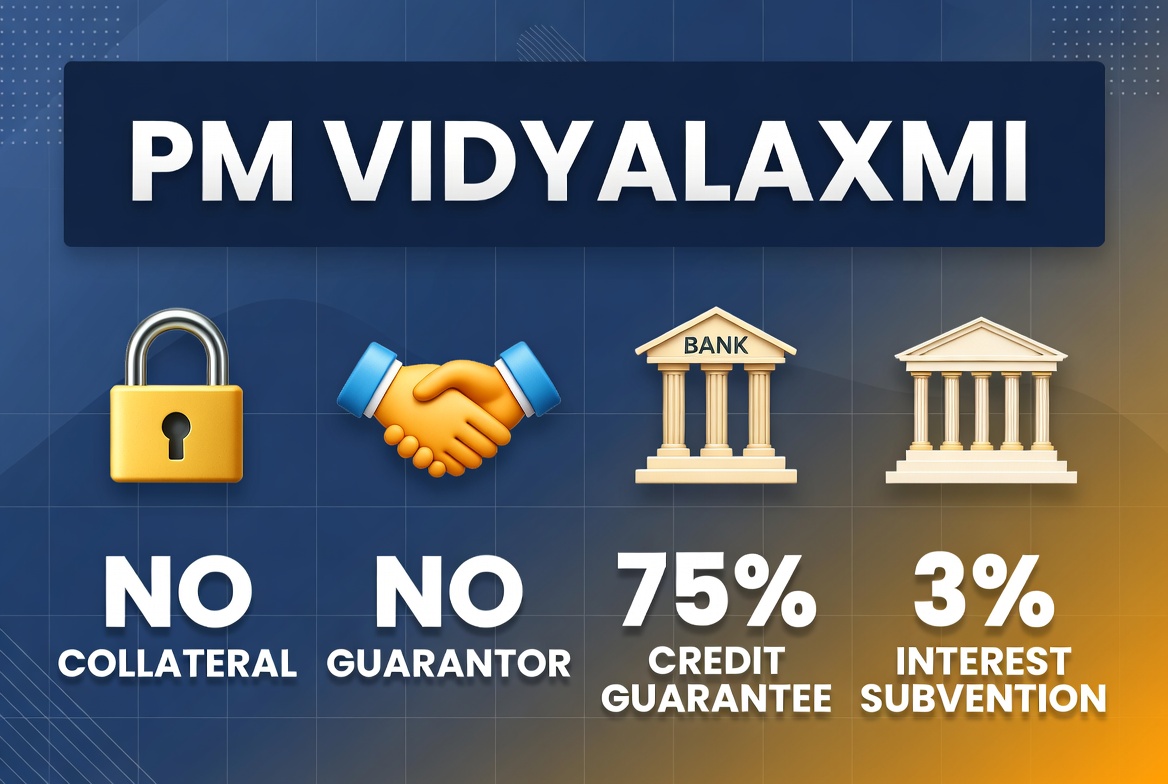
- Collateral-Free Loan: No collateral or third-party guarantor required for education loans.
- 75% Credit Guarantee: 75% credit guarantee provided by Central Government through NCGTC for loans up to ₹7.5 lakh.
- 3% Interest Subvention: Provided on loans up to ₹10 lakh during moratorium for students with family income up to ₹8 lakh/year.
- Full Interest Subsidy: 100% interest subsidy continues for family income up to ₹4.5 lakh under CSIS.
- Portal & Payout: Single portal
pmvidyalaxmi.co.inusing digital e-vouchers and CBDC Digital Rupee wallets.
1. Why Education Loan Schemes Keep Appearing in Exams
In SSC, RRB, Banking and UPSC papers, questions on education-related financial schemes have become regular features. The reason is simple. NEP 2020 gave high priority to access, equity, and inclusion in higher education.
When the central government creates a new Central Sector Scheme with credit guarantee and interest subvention, examiners test candidates on both the policy mechanics (collateral rules, NIRF ranking thresholds) and financial technology tools (CBDC, e-vouchers).
2. Background – Earlier Schemes and the Gap
Before PM Vidyalaxmi was launched, two main schemes existed:
- Central Sector Interest Subsidy (CSIS) Scheme (2009): Gave full interest subsidy during the moratorium period (course duration + 1 year) to students whose family annual income was up to ₹4.5 lakh.
- Credit Guarantee Fund Scheme for Education Loan (CGFSEL) (2015): Notified to provide central credit guarantee for loans up to ₹7.5 lakh without collateral.

Yet many students still faced severe problems. Banks were hesitant to disburse loans without property collateral or government-employed guarantors, the process was not fully digital, and meritorious students securing seats in top state or private institutions often remained uncovered.
3. What is PM Vidyalaxmi Scheme?
PM Vidyalaxmi is a Central Sector Scheme approved by the Union Cabinet on 6 November 2024. It is implemented by the Department of Higher Education, Ministry of Education. The core aim is simple: no meritorious student should be denied quality higher education simply due to financial constraints.
4. Key Features of the Scheme
| Feature | PM Vidyalaxmi Standard |
|---|---|
| Collateral Requirement | 100% Collateral-Free & Guarantor-Free |
| Credit Guarantee Cover | 75% Guarantee on loans up to ₹7.5 Lakh via NCGTC |
| Interest Subvention (Income ≤ ₹8 Lakh) | 3% Interest Subvention on loans up to ₹10 Lakh during Moratorium |
| Full Interest Subsidy (Income ≤ ₹4.5 Lakh) | 100% Interest Subsidy during Moratorium (via CSIS) |
| Application Portal | Unified Digital Portal pmvidyalaxmi.co.in |
| Subsidy Payment Mechanism | E-Vouchers & CBDC (Digital Rupee) Wallets |
| Financial Outlay | ₹3,600 Crore (2024–25 to 2030–31) |
| Target Beneficiaries | 7 Lakh Fresh Meritorious Students |
5. Eligibility Criteria and Quality Higher Education Institutions
Any Indian student who secures admission on merit in a designated Quality Higher Education Institution (QHEI) is eligible to apply for a loan under PM Vidyalaxmi.
Criteria for QHEI Inclusion:
- Top 100 overall NIRF ranked higher education institutions (public and private).
- NIRF category-wise and domain-specific top 100 institutions (Engineering, Management, Pharmacy, Law, Medical).
- All Central Government Institutions (IITs, NITs, IIMs, IISERs, AIIMS, Central Universities).
- State government higher education institutions ranked between 101 and 200 in the NIRF overall list.
6. Interest Subvention and Credit Guarantee Explained
Many students get confused between credit guarantee and interest subvention:
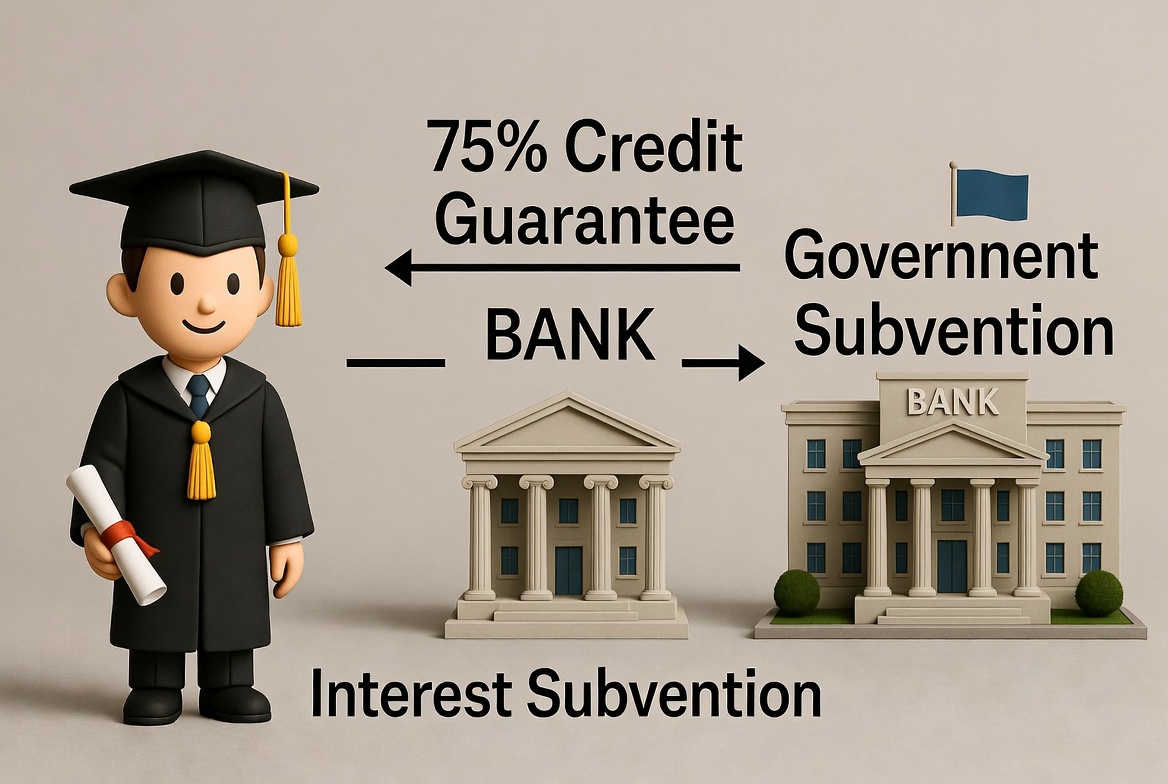
- Credit Guarantee (75% NCGTC): The National Credit Guarantee Trustee Company (NCGTC) promises to pay 75% of the defaulted principal amount to the bank if a student is unable to pay after completing the moratorium. This removes bank reluctance.
- Interest Subvention (3% / 100%): The government directly pays part of the loan interest during the course duration plus 1 year (moratorium). For family income up to ₹8 lakh, 3% interest is absorbed by the government. For income up to ₹4.5 lakh, 100% interest is absorbed.
7. How to Apply and Latest Progress till 2026
Students apply through the single portal pmvidyalaxmi.co.in. By filling out the Common Education Loan Application Form (CELAF), the application is routed automatically to participating commercial banks.
As per mid-2026 updates, over 5 lakh education loan applications have been digitally sanctioned, with interest subventions credited directly to students' Reserve Bank of India (RBI) CBDC Digital Rupee wallets.
8. Comparison with Earlier Education Loan Schemes
| Feature | CSIS (2009) | CGFSEL (2015) | PM Vidyalaxmi (2024-2026) |
|---|---|---|---|
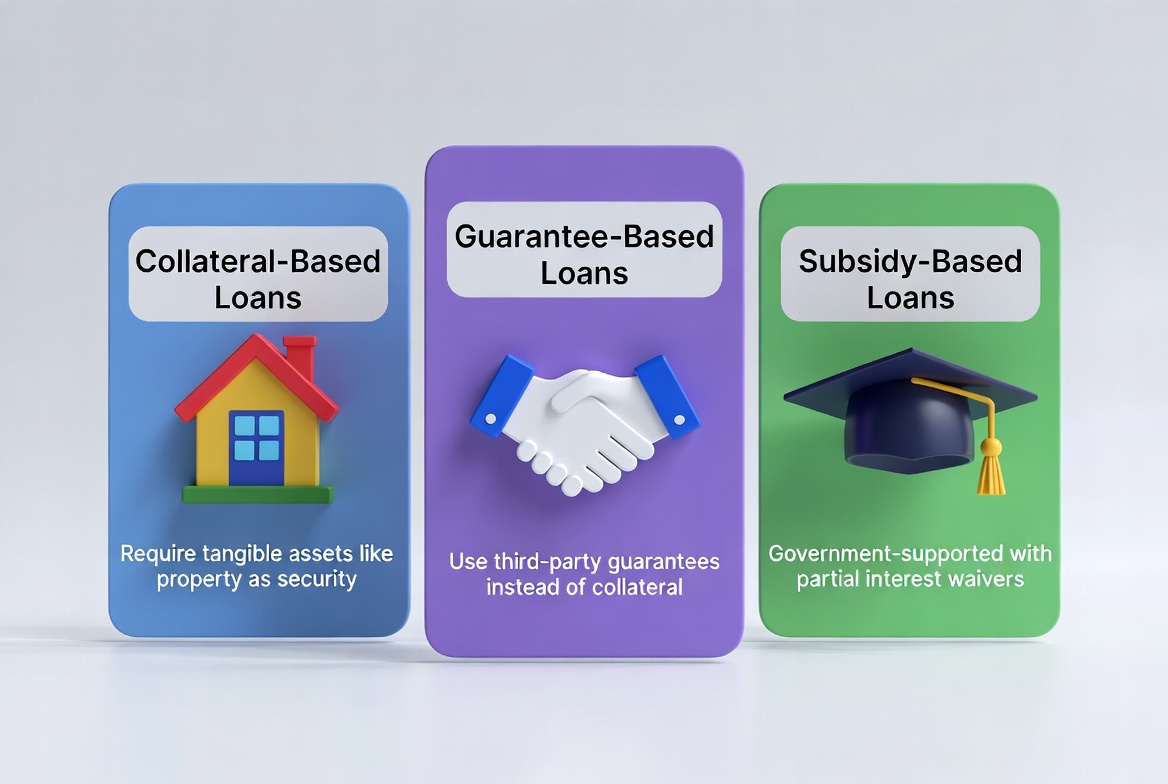
| Collateral / Guarantor | Required in many cases | Not required up to ₹7.5 Lakh | Strictly Collateral-Free & Guarantor-Free |
| Credit Guarantee | Limited / None | Available for banks | 75% Government Cover via NCGTC |
| Interest Subvention Income Cap | Full for Income ≤ ₹4.5 Lakh | Not primary focus | Full (≤ ₹4.5L) + 3% Subvention (≤ ₹8.0L) |
| Application Portal | Physical bank branches | Physical bank branches | Single Central Portal (pmvidyalaxmi.co.in) |
| Institution Scope | General institutes | General institutes | QHEIs (NIRF Top Ranked Institutes) |
| Disbursement Tech | Manual bank transfer | Manual bank transfer | Digital E-Voucher + CBDC Digital Rupee Wallets |
9. Must Remember Points for Quick Revision
Quick Revision Summary:
- Cabinet Approval: 6 November 2024.
- Portal:
pmvidyalaxmi.co.in. - Collateral & Guarantor: Zero / Not required.
- Credit Guarantee: 75% cover on loans up to ₹7.5 lakh via NCGTC.
- Interest Subvention: 3% for family income up to ₹8 lakh (loans up to ₹10 lakh).
- Full Interest Subsidy: 100% subsidy for family income up to ₹4.5 lakh.
- Outlay: ₹3,600 crore for interest subvention (2024–25 to 2030–31).
- Target Base: 7 lakh fresh students entering NIRF QHEIs.

10. Conclusion & Action Steps for Aspirants
PM Vidyalaxmi is a practical step that removes the biggest fear many meritorious students face — the fear of not being able to pay for quality higher education. For competitive exam aspirants, it connects NEP 2020, financial inclusion, and higher education policy.
Do not just remember the loan amount and the percentage of guarantee. Understand why the scheme was needed and how it is different from earlier schemes. Make a short note of the comparison table and the key numbers. These are the points that usually appear in the paper.
Frequently Asked Questions (Exam FAQ)
What is the collateral-free loan limit under PM Vidyalaxmi Scheme?
Education loans up to Rs 7.5 lakh are provided without any collateral or third-party guarantor, supported by a 75% credit guarantee from NCGTC.
Who is eligible for interest subvention under PM Vidyalaxmi?
Students with annual family income up to Rs 8 lakh get 3% interest subvention on loans up to Rs 10 lakh during the moratorium period. Full interest subvention applies for income up to Rs 4.5 lakh under CSIS.
Which institutions qualify as QHEIs under PM Vidyalaxmi?
Top 100 NIRF ranked higher education institutions, NIRF category-wise 101-200 institutions, and all Central Government institutions qualify.
Sources: Ministry of Education, NCGTC Portal, PIB Releases.
NEEDS DOUBLE-CHECK: none
Master Education Policy & Banking Schemes on RRBCONTENTS
Practice PYQs, read current affairs notes, and explore job exam guides.
Solve Banking & Policy PYQs → Explore Govt Jobs →Join our official Telegram channel: @rrbcontents