"Every Indian who desires freedom and strives for it must be his own guide..." — The historic call of August 1942 that transformed a nation's struggle against colonial rule.
Table of Contents
Chapter 1
August Revolution at a Glance
Year Launched
Passed by AICC at Gowalia Tank, Bombay on 8 August
Mantra Given
Mahatma Gandhi's stirring call to the nation
Parallel Governments
Ballia (UP), Satara (Prati Sarkar), Tamluk (Bengal)
Kranti
Also Known As
The final spontaneous mass uprising against British rule
Key Characteristic
A leaderless and spontaneous mass movement. Following the pre-emptive arrest of the top Congress leadership under Operation Zero Hour on 9 August 1942, youth, students, women, and rural masses led the resistance.
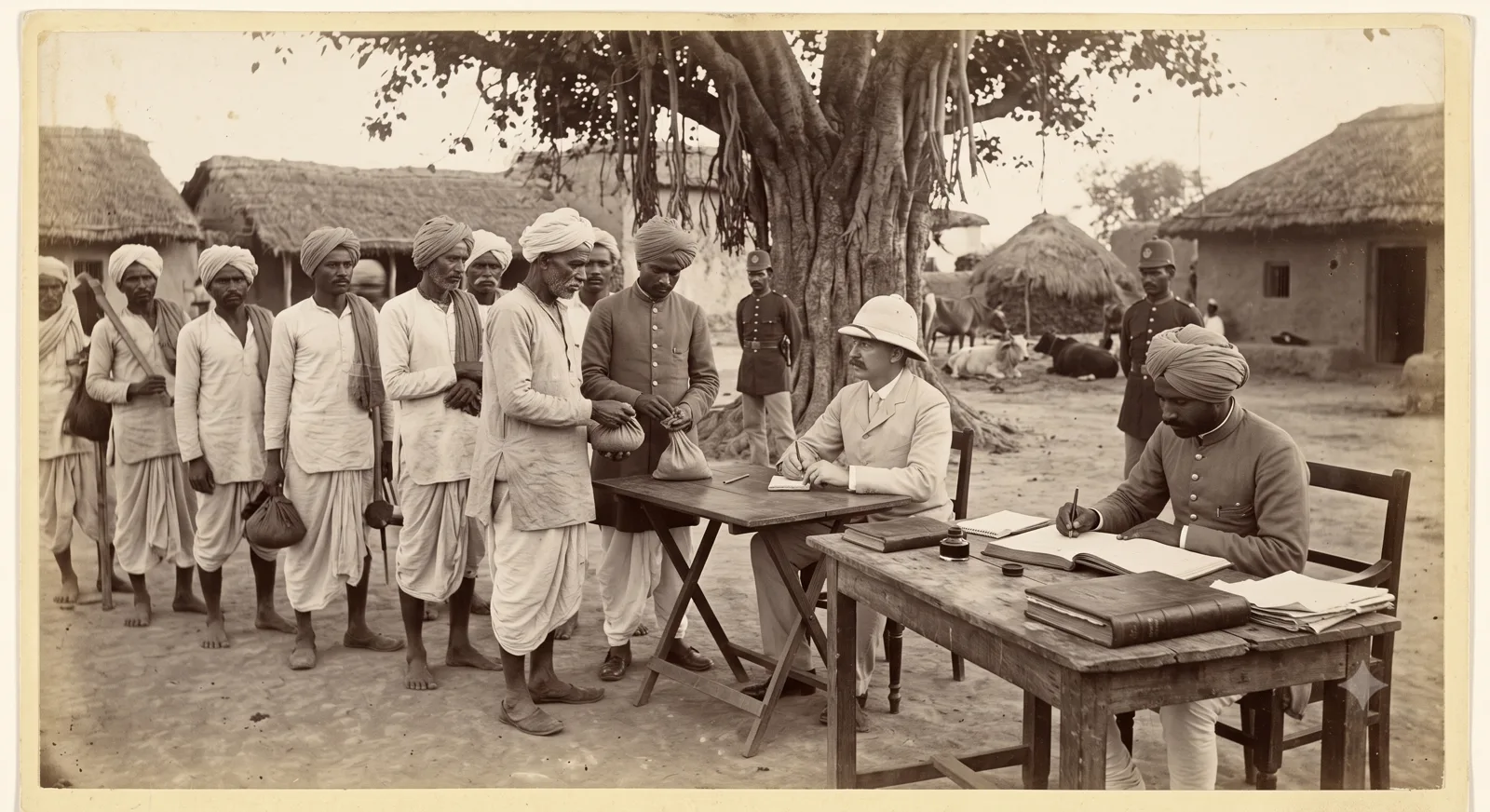
Historical record: Administration and rural policing during the late colonial period in British India.
August 1942 occupies a distinctive place in the history of the Indian national movement. It was not the first mass campaign against British rule, nor the last. Yet it differed in temper and in the speed with which it escaped the control of its own initiators. Within hours of the All India Congress Committee’s resolution in Bombay, the established leadership was behind bars. What followed was a scattered, often furious, uprising that the British suppressed with a severity not seen since 1857. The movement failed to expel the British in 1942. It succeeded, however, in demonstrating that the colonial state could no longer rely on the passive acquiescence of large sections of the population.
This article reconstructs the causes that produced the outbreak, traces the uneven course of the movement across different regions, examines the roles played by prominent and lesser-known figures, and assesses both the immediate and the longer-term consequences. The emphasis remains on understanding why the movement took the form it did and what it revealed about the late colonial relationship between state and society.
Chapter 2
The Road to August 1942
The Second World War created the immediate setting. When Britain declared war on Germany in 1939, the Government of India announced that India was also at war. The Congress ministries resigned in protest. Individual satyagraha followed in 1940–41, a limited campaign that kept the organisation in public view without inviting total confrontation. Meanwhile the war situation deteriorated. The fall of France, the retreat from Dunkirk, and then the rapid Japanese advance through Southeast Asia in early 1942 transformed the strategic picture. Rangoon fell in March. Indian territory itself seemed threatened.
In this atmosphere the British government sent Sir Stafford Cripps to India with a set of proposals. The Cripps Mission offered dominion status after the war and the right of provinces to secede from a future Indian union. It refused, however, any immediate transfer of real power. The Congress rejected the offer as a post-dated cheque on a crashing bank. The Muslim League found it inadequate for different reasons. The failure of the Cripps Mission left a bitter residue. Many nationalists concluded that Britain would never willingly relinquish authority while the war provided a convenient justification for delay.
Economic hardship intensified the political frustration. War-time inflation, shortages of food and cloth, and the heavy-handed methods of procurement created widespread discontent in both towns and countryside. The arrival of Allied troops and the construction of military installations disrupted local life in several provinces. By the middle of 1942 a mood of impatience had settled over large parts of the nationalist public.
Gandhi, who had earlier been cautious about a mass struggle during the war, now moved towards open confrontation. In his view the British presence itself invited Japanese attack; their withdrawal, he argued, would remove the bait. The phrase “Quit India” captured this demand with stark simplicity. The Congress Working Committee meeting at Wardha in July endorsed the idea of a mass struggle. The final decision was left to the All India Congress Committee session scheduled for Bombay in early August.
Key Causes Overview
WWII Impasse
Unilateral entry of India into WWII & resignation of Congress ministries (1939).
Cripps Mission Failure
March 1942 offer rejected as a "post-dated cheque on a crashing bank."
Economic Distress
Wartime inflation, acute food shortages, and harsh procurement policies.
Japanese Threat
Fall of Rangoon (March 1942); Gandhi argued British presence invited invasion.
Chapter 3
The Launch and the Leadership Vacuum
On 8 August 1942 the AICC passed the Quit India resolution. Gandhi’s speech that night contained the call “Do or Die.” The British response was pre-emptive and comprehensive. Before dawn on 9 August almost the entire top leadership of the Congress—Gandhi, Nehru, Patel, Azad, Rajendra Prasad and many others—was arrested. Provincial and district leaders followed in large numbers. The carefully prepared plans for a controlled movement collapsed at once. What remained was a leaderless, largely spontaneous upheaval.
The absence of the established high command shaped everything that followed. Younger activists, students, local Congress workers who had escaped arrest, and ordinary citizens stepped into the space. In many places the movement took a more militant turn than Gandhi had envisaged. Symbols of British authority—railway stations, post offices, telegraph lines, police stations—became the first targets. Parallel administrations appeared in a few districts. The geographical pattern was uneven. Bombay, Maharashtra, Gujarat, the United Provinces, Bihar, and parts of Bengal and Orissa saw intense activity. Large areas of Punjab, Madras and the princely states remained relatively quiet.
Chapter 4
Regional Patterns and Forms of Action
In Bihar and the eastern United Provinces the rebellion acquired a strong rural character. Peasants attacked symbols of government, disrupted communications, and in some cases forced the temporary withdrawal of British officials. Ballia district briefly came under a parallel government headed by local Congressmen. In Maharashtra, especially in Satara, a more sustained underground resistance developed; the “Prati Sarkar” there lasted longer than most other parallel structures and experimented with rudimentary forms of local justice and administration. In Bengal the movement was strong in Midnapore, where the Tamluk National Government functioned for several months despite brutal repression. Industrial centres such as Bombay and Ahmedabad witnessed strikes and urban demonstrations, though the working-class response was not uniform.
Key Parallel Governments (1942)
Students played a conspicuous role in the early days, keeping the agitation alive in towns after the older leadership had disappeared. Women participated both in open processions and in underground work; Aruna Asaf Ali’s hoisting of the flag at Gowalia Tank became an emblematic act. Socialist members of the Congress, among them Jayaprakash Narayan, Ram Manohar Lohia and Achyut Patwardhan, organised underground networks that attempted to give the scattered outbursts some coordination. Revolutionary groups and the Forward Bloc also joined in places, though their influence remained secondary.
The British authorities treated the movement as a rebellion. Troops were deployed, collective fines imposed, and villages burned in several districts. Official figures for casualties remain contested, but the repression was severe by any measure. By the end of 1942 the open phase of the movement had been crushed. Underground activity continued into 1943 and 1944, yet it no longer threatened the overall structure of colonial power.
Chapter 5
Key Personalities and Their Roles
Gandhi remained the moral centre even in prison. His earlier decision to launch the movement, and his refusal to condemn the violence that followed as strongly as some expected, shaped both contemporary and later assessments. Nehru and the other members of the Working Committee spent the war years in custody; their absence meant that the movement lacked the disciplined direction that had characterised the Civil Disobedience campaigns of the 1930s. Among those who remained free or went underground, Jayaprakash Narayan emerged as a prominent organiser of resistance. Aruna Asaf Ali, Sucheta Kripalani and other women activists kept the spirit of defiance visible in urban centres. Local figures—Chittu Pandey in Ballia, the leaders of the Satara Prati Sarkar, the organisers in Midnapore—gave the movement its concrete regional character. On the British side, Linlithgow’s determination to crush the outbreak quickly and the willingness of the wartime coalition government in London to endorse severe measures defined the official response.
Mahatma Gandhi
Gave the "Do or Die" call at Gowalia Tank; remained moral anchor during imprisonment.
Aruna Asaf Ali
Hoisted the Indian National Congress flag at Gowalia Tank ground on 9 August 1942.
Jayaprakash Narayan
Escaped Hazaribagh jail; organized Azad Dasta underground resistance networks.
It is equally important to note who stood apart. The Muslim League did not support the movement and in several areas its cadres opposed it. The Communist Party, after the Soviet Union entered the war, described the struggle as premature and collaborated with the British war effort. These divisions limited the movement’s social reach and allowed the colonial government to claim that it faced only a section of Indian opinion.
Chapter 6
Impact and Historical Significance
In the short term the Quit India Movement failed to achieve its stated objective. The British did not quit. The Congress organisation was shattered for the remainder of the war. Thousands of ordinary participants suffered imprisonment, injury or the destruction of property. Yet the political effects were profound. The movement demonstrated that the colonial state could maintain order only through large-scale coercion. It radicalised a generation of young Indians who would form the backbone of the postwar nationalist upsurge. It also internationalised the Indian question at a moment when American and international opinion was becoming more critical of old-style imperialism.
When the war ended, the British government faced a different India. The Labour ministry elected in 1945 concluded that the cost of holding the country by force had become prohibitive. The memory of 1942 weighed on both sides during the negotiations that followed. The movement also left an internal legacy within Indian nationalism: a heightened awareness of the possibilities and the dangers of spontaneous mass action, and a clearer understanding of the limits of purely urban or middle-class politics.
Historians continue to debate the precise character of the uprising. Some emphasise its spontaneous and popular nature; others stress the continuity with earlier Congress organisation at the local level. Both perspectives contain truth. The leadership vacuum created by the arrests allowed local energies to express phenomena with unusual force, yet those energies drew on the political education of the preceding two decades.
Chapter 7
Relevance for Competitive Examinations
The Quit India Movement is a staple of the modern India syllabus. Questions regularly ask for an analysis of its causes, a comparison with Non-Cooperation or Civil Disobedience, an assessment of its success or failure, or a discussion of the role of different social groups. Strong answers move beyond narrative. They explain why the movement erupted when it did, why it took violent forms in some regions, and why its long-term political consequences outweighed its short-term military failure. Attention to regional variation and to the attitudes of non-Congress forces adds depth that examiners reward.
The topic also links usefully with the broader endgame of empire—the INA trials, the Royal Indian Navy mutiny, the Cabinet Mission, and the final transfer of power. A secure understanding of 1942 therefore strengthens performance across the entire late-colonial portion of the paper.
Chapter 8
Concluding Assessment
The Quit India Movement was the last great mass confrontation between the Indian National Congress and the British Raj before the final negotiations for independence. It arose from the intersection of wartime crisis, political frustration and a calculated decision by Gandhi and the Congress leadership to force the issue. Once launched, it escaped the boundaries its authors had intended and revealed both the depth of popular alienation and the continuing organisational limits of the nationalist movement. The British suppressed it, yet they could not restore the old equilibrium. In that sense the events of August 1942 and the months that followed marked a point of no return in the history of colonial rule in India
Practice This Topic & Get Free Study Notes!
Join our official Telegram channel for high-yield notes, daily MCQs, PYQs, and exam notifications for UPSC, SSC, RRB & State PSCs.
Chapter 9
Frequently Asked Questions
What were the main causes of the Quit India Movement?
The immediate cause was the failure of the Cripps Mission. Longer-term factors included growing nationalist impatience during the war, economic hardships caused by inflation and shortages, the Japanese advance in Southeast Asia, and Gandhi’s conclusion that British withdrawal was necessary to meet the wartime crisis.
Why did the Quit India Movement turn violent in many places?
The sudden arrest of the entire top Congress leadership on 9 August created a vacuum. Local activists, students and ordinary citizens then acted without the restraining influence of the high command, attacking symbols of British authority in a more militant fashion than earlier Gandhian campaigns.
What was the significance of parallel governments during the movement?
Parallel governments in places such as Ballia, Satara and Tamluk demonstrated the ability of local nationalists to take over administrative functions temporarily. They remained limited in scale and duration but became powerful symbols of the erosion of British authority at the grassroots.
Did the Quit India Movement succeed?
It failed in its immediate objective of forcing the British to leave India in 1942. Its longer-term political impact was considerable: it radicalised a generation, demonstrated the depth of anti-colonial feeling, and convinced many British policymakers that continued rule by force was no longer sustainable after the war.