 RRB
RRB
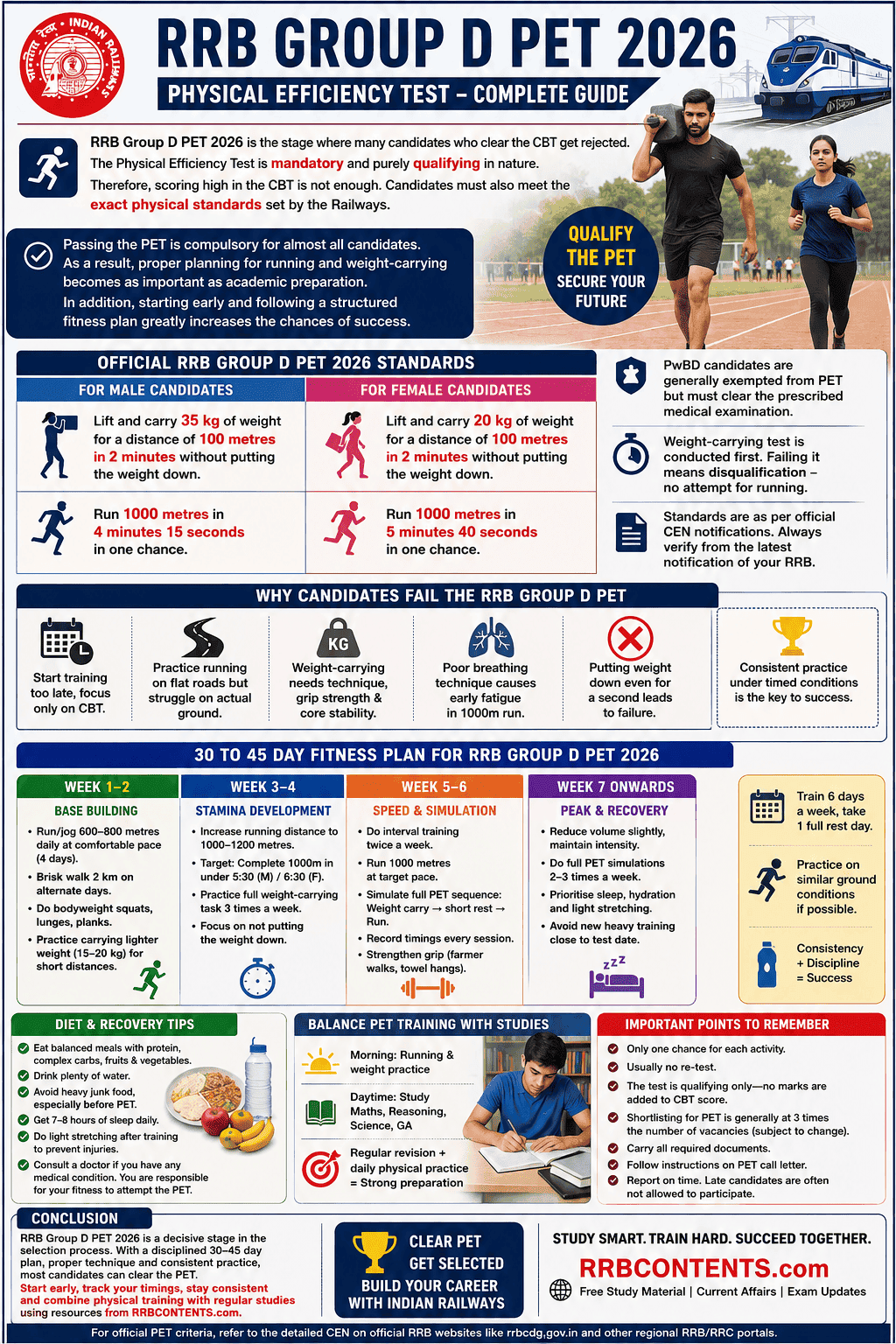
RRB Group D PET 2026 is the stage where many candidates who clear the CBT still get rejected. Therefore, scoring well in the written exam alone is not enough. As a result, candidates must also clear the Physical Efficiency Test to move forward in the selection process.
Moreover, the PET is purely qualifying in nature. Consequently, no extra marks are added to the CBT score. However, failing even one part of the test leads to immediate disqualification. In addition, only one attempt is usually allowed for each activity. Therefore, proper preparation becomes extremely important.
In this guide, we will first look at the official standards. After that, we will discuss common mistakes. Finally, we will share a practical fitness plan that most candidates can follow.
Official Standards for RRB Group D PET 2026
According to the official Centralised Employment Notifications, the Physical Efficiency Test has two compulsory parts. First, candidates must complete the weight-carrying task. Second, they must finish the running test within the given time.
For male candidates, the standards are as follows. They should be able to lift and carry 35 kg of weight for a distance of 100 metres in 2 minutes without putting the weight down. In addition, they must run 1000 metres in 4 minutes and 15 seconds in one chance.
For female candidates, the requirements are slightly different. They should be able to lift and carry 20 kg of weight for a distance of 100 metres in 2 minutes without putting the weight down. Moreover, they must run 1000 metres in 5 minutes and 40 seconds in one chance.
Furthermore, Persons with Benchmark Disabilities are generally exempted from the PET. However, they still need to clear the prescribed medical examination. As a result, most regular candidates have no choice but to prepare for both the weight-carrying and running tasks.
These criteria are clearly written in the detailed CEN documents issued by the Railway Recruitment Boards. Therefore, candidates should always cross-check the exact wording from the official notification of their recruitment cycle.
Why Many Candidates Fail the RRB Group D PET 2026
First, a large number of students start physical training very late. They focus only on the CBT and ignore running until the result is announced. As a result, they get very little time to build stamina.
Second, many candidates practise only on flat roads. However, the actual PET ground may have different conditions. Consequently, their timing becomes slower on the test day.
Third, the weight-carrying task looks simple but requires good grip strength and core stability. Moreover, some candidates put the weight down even for a second, which leads to immediate failure. In addition, poor breathing technique during the 1000-metre run causes early fatigue. Therefore, consistent timed practice is essential.
Week 1 and Week 2 – Base Building Plan
This plan is suitable for candidates who already have basic fitness. However, if you are starting from zero, you should begin slowly and increase intensity after the first week.
During these two weeks, run or jog 600 to 800 metres daily at a comfortable pace for four days. On alternate days, do brisk walking for about 2 km. In addition, include bodyweight squats, lunges and planks to build leg and core strength. Moreover, practise carrying a lighter weight of 15–20 kg for short distances so that your body gets used to the load.
Week 3 and Week 4 – Stamina Development
In this phase, increase the running distance to 1000–1200 metres. Meanwhile, aim to complete 1000 metres in under 5 minutes 30 seconds for males or under 6 minutes 30 seconds for females. Furthermore, practise the full weight-carrying task three times a week with the required weight. As a result, you will develop both endurance and confidence.
Week 5 and Week 6 – Speed and Full Simulation
During these weeks, do interval training twice a week. In addition, run 1000 metres at your target pace regularly. Moreover, simulate the complete PET sequence: first complete the weight carry, then take a short rest, and finally attempt the run. Consequently, your body will learn to perform both tasks one after another. Furthermore, strengthen your grip with farmer walks and towel hangs.
Week 7 Onwards – Peak Performance and Recovery
At this stage, reduce the total training volume slightly but maintain the intensity. Meanwhile, do full PET simulations two to three times a week. In addition, prioritise proper sleep, hydration and light stretching. Therefore, you will reach the test day in a fresh and confident state.
Overall, train six days a week and keep one full rest day. As a result, your body will recover properly and the risk of injury will remain low.
Diet and Recovery Tips for Better Performance
First, eat simple and balanced meals that contain enough protein and complex carbohydrates. In addition, drink sufficient water throughout the day. Moreover, avoid heavy junk food, especially in the final week before the PET. Consequently, your energy levels will stay stable during training.
Furthermore, try to get 7–8 hours of sleep regularly. Meanwhile, light stretching after every session helps prevent muscle tightness. However, candidates who have any existing medical condition should consult a doctor before starting intense training. Therefore, safety should always remain the top priority.
How to Balance PET Training with Studies
Morning is generally the best time for running and weight practice. After that, you can keep academic study for the later part of the day. First complete your physical session, and then focus on Mathematics, Reasoning, Science and Current Affairs. As a result, both mental and physical preparation move forward together.
Moreover, you can find free study material, current affairs updates and exam-related content on RRBCONTENTS.com. In addition, regular revision of CBT subjects along with daily physical practice creates a strong overall preparation strategy.
For the official PET criteria, always refer to the detailed Centralised Employment Notification available on the official websites of Railway Recruitment Boards such as rrbcdg.gov.in. Furthermore, other regional RRB and RRC portals also publish the same standards. Therefore, relying on official sources is the safest approach.
Important Points You Should Remember
First, only one chance is given for each activity in most cases. Second, there is usually no re-test if you fail. Third, the PET is only qualifying in nature and does not add any marks to your CBT score. Moreover, shortlisting for PET is generally done at three times the number of vacancies, although Railways can change this ratio. As a result, clearing the CBT with a safe score remains the first priority.
In addition, always carry all required documents and follow the instructions given on the PET call letter. Furthermore, report on time because late candidates are often not allowed to participate. Consequently, small mistakes on the test day can cost you the entire selection.
Conclusion
RRB Group D PET 2026 is a decisive stage in the selection process. Therefore, it must be treated with the same seriousness as the CBT. Male candidates must carry 35 kg for 100 metres in 2 minutes and run 1000 metres in 4 minutes 15 seconds. Meanwhile, female candidates must carry 20 kg and complete the same running distance in 5 minutes 40 seconds.
With a disciplined 30 to 45 day fitness plan, proper technique and consistent practice, most candidates can clear the PET successfully. Moreover, starting early and tracking your timings every week makes a big difference. In addition, combining physical training with regular studies using resources from RRBCONTENTS.com creates a balanced preparation approach.
As a result, you will be ready for both the written examination and the physical test. Stay consistent, follow the plan sincerely, and treat every training session seriously. Consequently, your chances of final selection in Indian Railways will improve significantly.
---