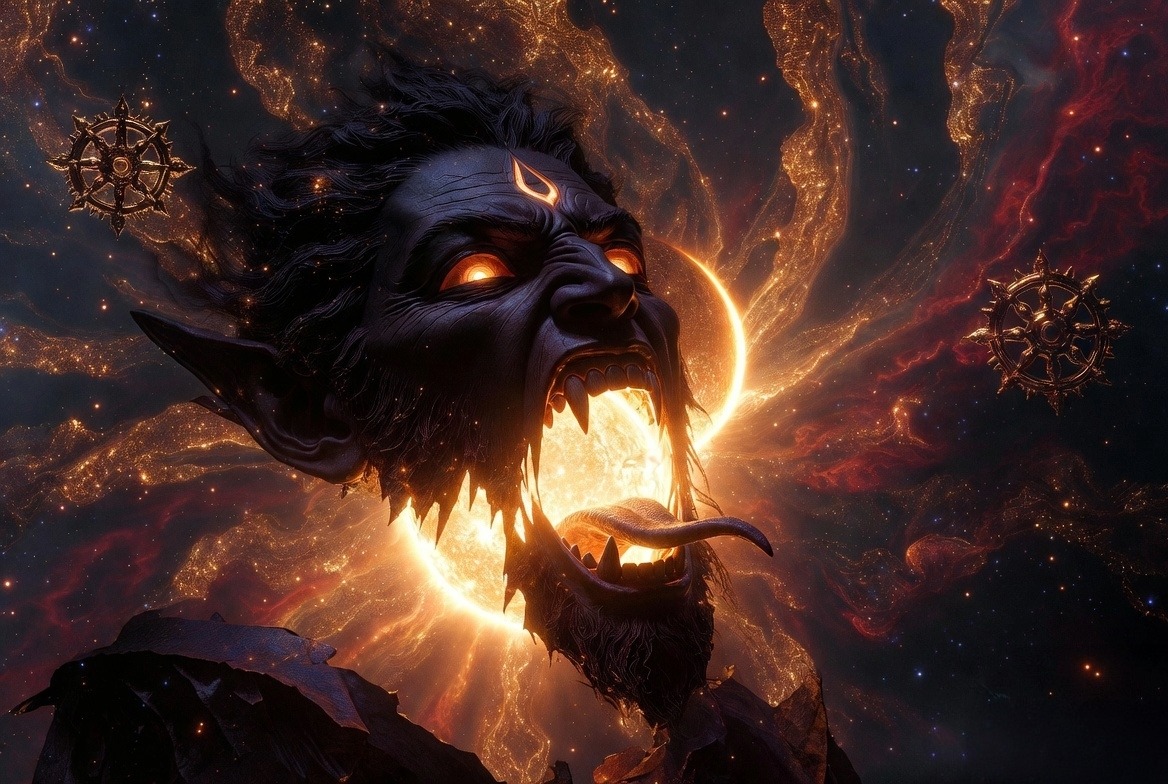
A solar eclipse is one of the most breathtaking visual spectacles the cosmos can offer. Throughout human history, the sudden darkening of the daytime sky has inspired awe, scientific curiosity, and deep spiritual reflection. While modern astronomy explains solar eclipses through celestial mechanics, traditional societies and world religions have viewed these alignments through symbolic, spiritual, and cautionary lenses.
Looking ahead, skywatchers, astronomers, and spiritual communities are preparing for the Total Solar Eclipse of August 12, 2026. Crossing Greenland, Iceland, Spain, Russia, and Portugal, this eclipse will turn daytime into dusk across parts of Europe, North America, and Africa.
| SOLAR ECLIPSE OVERVIEW AT A GLANCE | |
|---|---|
| Phenomenon Type | Total Solar Eclipse |
| Event Date | Wednesday, August 12, 2026 |
| Path of Totality | Russia, Greenland, Iceland, Spain, and northeastern Portugal |
| Partial Visibility | Most of Europe, North America, North Africa, Arctic, and Atlantic regions |
| Key Coinciding Event | Peak of the Perseid Meteor Shower |
This guide explores the scientific mechanics of a solar eclipse, examines why major world religions and cultures historically view eclipses as inauspicious, details the upcoming August 12, 2026 total solar eclipse, and outlines safe viewing practices.
Chapter 1
1. What Is a Solar Eclipse? The Science Behind the Celestial Alignment
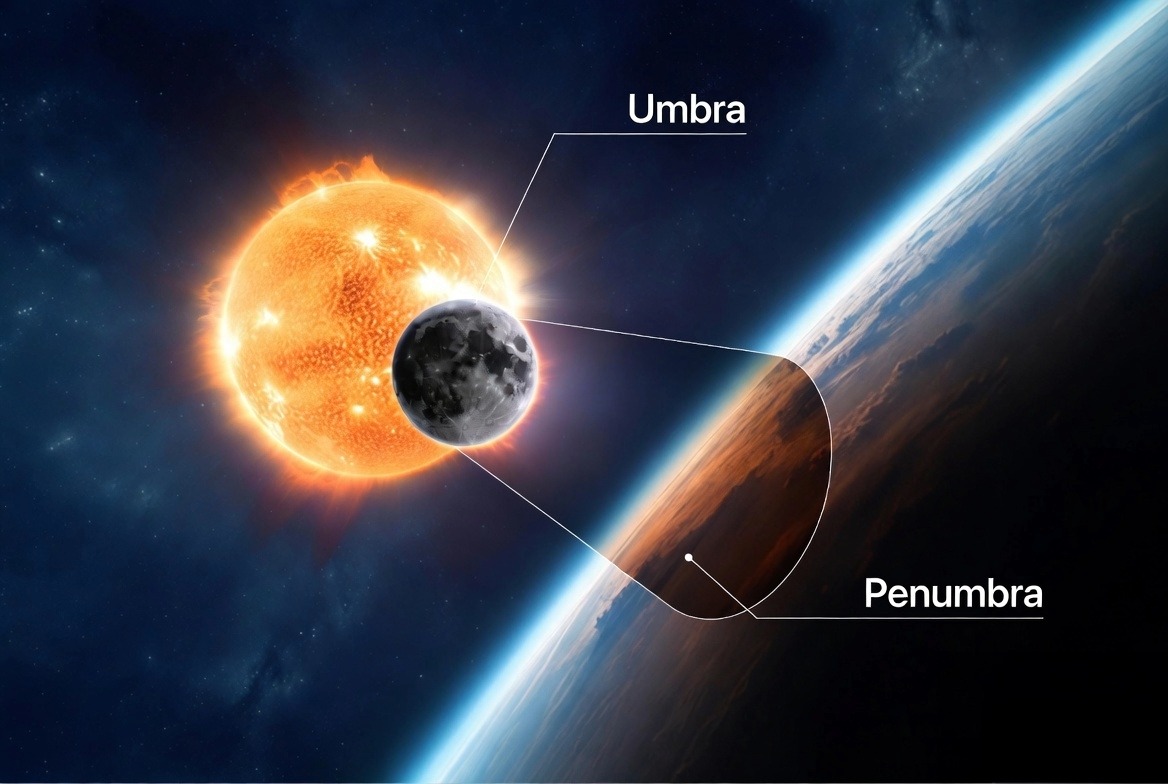
A solar eclipse occurs when the Moon passes directly between the Earth and the Sun, blocking all or part of the Sun’s light from reaching Earth's surface. This alignment is known in astronomy as syzygy—a straight-line configuration of three gravitational bodies in a solar system.
                  [ SUN ]
                     │
                     │  Solar Light Rays
                     ▼
                 ( MOON )
                ╱        ╲
     Penumbra  ╱          ╲  Penumbra
              ▼  [UMBRA]   ▼
           ═════════════════════
                 [ EARTH ]
A. Shadow Dynamics: Umbra vs. Penumbra
The Umbra: The dark, inner cone of the Moon's shadow. Anyone standing within the umbra experiences a total solar eclipse, where the Sun's disk is entirely obscured.
The Penumbra: The lighter, outer region of the shadow. Viewers located within the penumbra experience a partial solar eclipse, seeing the Moon cover only a portion of the Sun.
B. The Four Main Types of Solar Eclipses
Total Solar Eclipse: Occurs when the Moon is close enough to Earth in its elliptical orbit to completely block the solar disk, allowing observers to see the Sun’s faint outer atmosphere—the solar corona.
Partial Solar Eclipse: Occurs when the Sun, Moon, and Earth do not align perfectly in a straight line, creating a crescent-shaped solar disk.
Annular Solar Eclipse: Occurs when the Moon is farther from Earth (near apogee), leaving a bright "ring of fire" (annulus) around the edges.
Hybrid Solar Eclipse: A rare event where the eclipse transitions between an annular and a total solar eclipse along different points of its path.
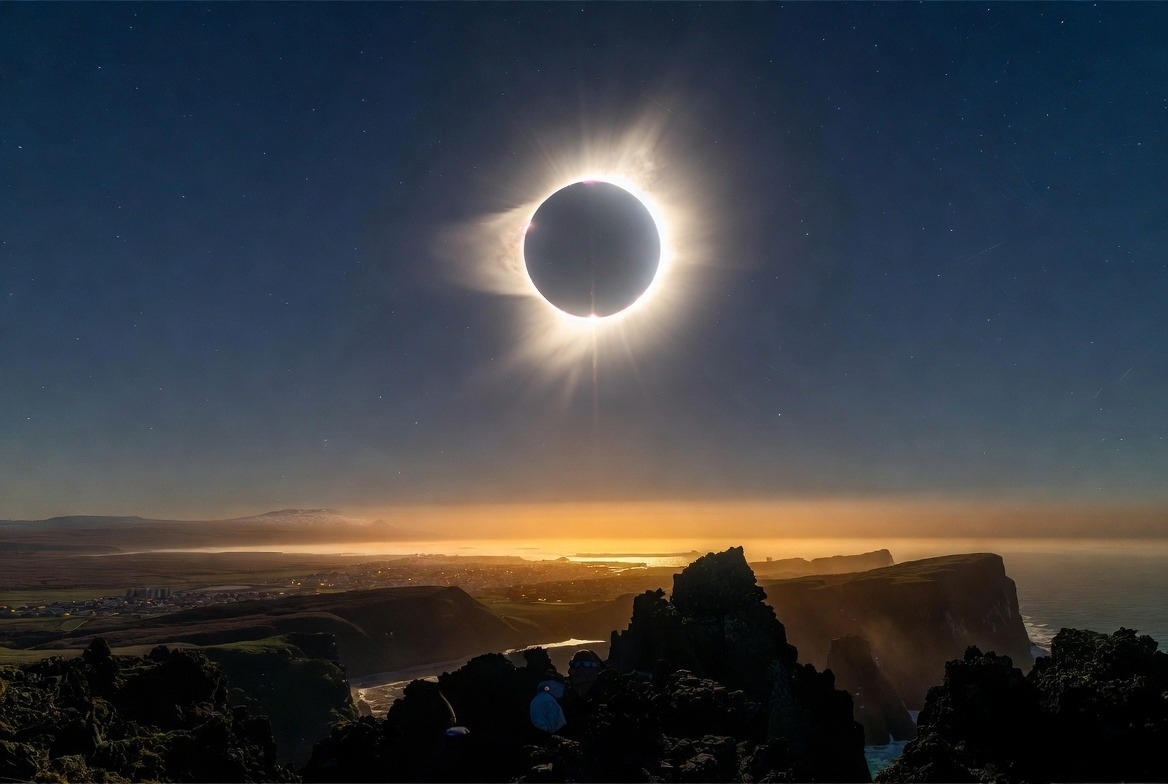
Solar Eclipse - Celestial Shadow Alignment & Corona
Chapter 2
2. Why Are Solar Eclipses Viewed as Inauspicious Across World Religions & Ancient Cultures?
While modern science views eclipses as predictable natural events, ancient human civilisations viewed the sudden disappearance of the Sun with anxiety. These early impressions laid the foundation for religious protocols, folklore, and cultural precautions that persist today.
| RELIGIOUS & CULTURAL PERSPECTIVES | |
|---|---|
| Tradition / Religion | Primary Belief or Observance |
| Hinduism | Symbolized by Rahu & Ketu swallowing the Sun; observance of Sutak rules. |
| Christianity / Judaism | Associated with divine warnings, cosmic darkness, and prophetic symbolism. |
| Islam | Sign of God’s majesty; marked by special eclipse prayers (Salat al-Kusuf). |
| Ancient Mythology | Interpreted as dragons, wolves, or monsters attempting to consume the Sun. |
A. Hinduism: The Myth of Rahu, Ketu, and the Concept of Sutak
In Hindu tradition, a solar eclipse (Surya Grahan) is considered a sensitive spiritual period. The cultural perspective stems from ancient Puranic literature, specifically the story of Samudra Manthan (the Churning of the Cosmic Ocean).
The Mythological Origin: According to Hindu texts, when the demon Swarbhanu disguised himself as a deity to drink Amrit, the Sun God (Surya) and Moon God (Chandra) alerted Lord Vishnu. Vishnu severed Swarbhanu’s head with his Sudarshana Chakra. The head became Rahu, and the tail became Ketu. Mythology holds that Rahu and Ketu periodically pursue and temporarily swallow the Sun and Moon in revenge.
The Sutak Period: Begins 12 hours before the actual eclipse starts. Traditional protocols include avoiding food/water preparation during the window, shielding pregnant women from exposure, closing temple doors, and taking purifying baths (Snan) after the eclipse ends.
B. Christianity and Judaism: Scriptural Symbolism
In Judeo-Christian traditions, sudden daytime darkness is often associated with divine intervention or cosmic signs. Passages in Joel (2:31), Amos (8:9), and the New Testament Crucifixion narrative (Luke 23:44-45) describe the darkening of the Sun as a sign of divine authority.
C. Islam: A Theological Shift from Omen to Divine Majesty
During the lifetime of Prophet Muhammad (PBUH), a solar eclipse coincided with the death of his infant son Ibrahim. The Prophet clarified: "The Sun and the Moon do not eclipse because of the death or life of any human being. They are two of the signs of Allah... So when you see an eclipse, remember Allah, call upon Him, pray, and give charity." (Sahih al-Bukhari). Muslims observe Salat al-Kusuf (eclipse prayer) and give charity during eclipses.
Solar Eclipse - Historical & Mythological Interpretations
Chapter 3
3. Deep Dive: The Total Solar Eclipse of August 12, 2026
The August 12, 2026 Total Solar Eclipse will be one of the premier astronomical events of the decade. Crossing the North Pole, Greenland, Iceland, Spain, and Portugal, it will mark the first total solar eclipse visible in mainland Europe since 1999.
       [ North Siberia / Russia ] (Eclipse Begins at Sunrise)
                  │
                  ▼
       [ Arctic Ocean / North Pole ] (Path of Totality)
                  │
                  ▼
       [ Eastern Greenland ] (Late Afternoon Eclipse)
                  │
                  ▼
       [ Western Iceland ] (Peak Duration off Coast)
                  │
                  ▼
       [ Northern & Central Spain ] (Sunset Eclipse)
                  │
                  ▼
       [ Balearic Islands / Mediterranean ] (Totality Concludes)
| AUGUST 12, 2026 ECLIPSE VISIBILITY MATRIX | ||
|---|---|---|
| Location / City | Eclipse Type | Local Timing Event |
| Reykjavík, Iceland | Total Eclipse | ~5:48 PM local |
| Látrabjarg, Iceland | Total Eclipse | Max land duration |
| A Coruña, Spain | Total Eclipse | ~7:30 PM CEST |
| Bilbao, Spain | Total Eclipse | Evening before sunset |
| Palma, Balearic Islands | Total Eclipse | Sunset totality |
| London, United Kingdom | Partial (90%+) | ~8:00 PM BST |
| Paris, France | Partial (92%+) | ~8:00 PM CEST |
| New York City, USA | Partial (10-20%) | Midday (~1:45 PM) |
| Casablanca, Morocco | Partial (80%+) | Evening before sunset |
Chapter 4
4. Eye Safety: How to Observe a Solar Eclipse
Viewing a solar eclipse requires appropriate eye protection. Looking directly at the Sun—even when 99% covered—can cause permanent retinal damage, a condition known as solar retinopathy.
| SOLAR ECLIPSE EYE SAFETY DIRECTIVES | |
|---|---|
| Safe Protection Method | Dangerous / Unsafe Methods |
| ISO 12312-2 Certified Glasses | Regular Sunglasses (even polarized) |
| Dedicated Front Solar Filters | Unfiltered Camera Lenses or Binoculars |
| Indirect Pinhole Projectors | Exposed Smoked Glass or X-Ray Film |
What You Need to Know (Key Takeaways)
- •What It Is: A total solar eclipse occurs when the Moon passes between Earth and the Sun, casting its shadow (umbra) on Earth.
- •Religious Views: Hinduism treats eclipses through Sutak rituals and Rahu/Ketu mythology; Christianity historically associates them with divine signs; Islam views eclipses as signs of God's power, marked by Salat al-Kusuf prayers.
- •August 12, 2026 Event: The total solar eclipse path crosses Russia, Greenland, Iceland, Spain, and Portugal, with a partial eclipse visible across North America, Europe, and Africa.
- •Safety First: Eye protection with ISO 12312-2 certified glasses is required during all partial phases.
Join RRBCONTENTS Official Telegram Channel
Get real-time updates, study notes, sports analysis, and exclusive content directly on Telegram.
Join @rrbcontents on Telegram